A covering for the foot—and several separate branches.
Recognize footwear, car language, forceful actions, computer startup, and the whole expressions that use boot.
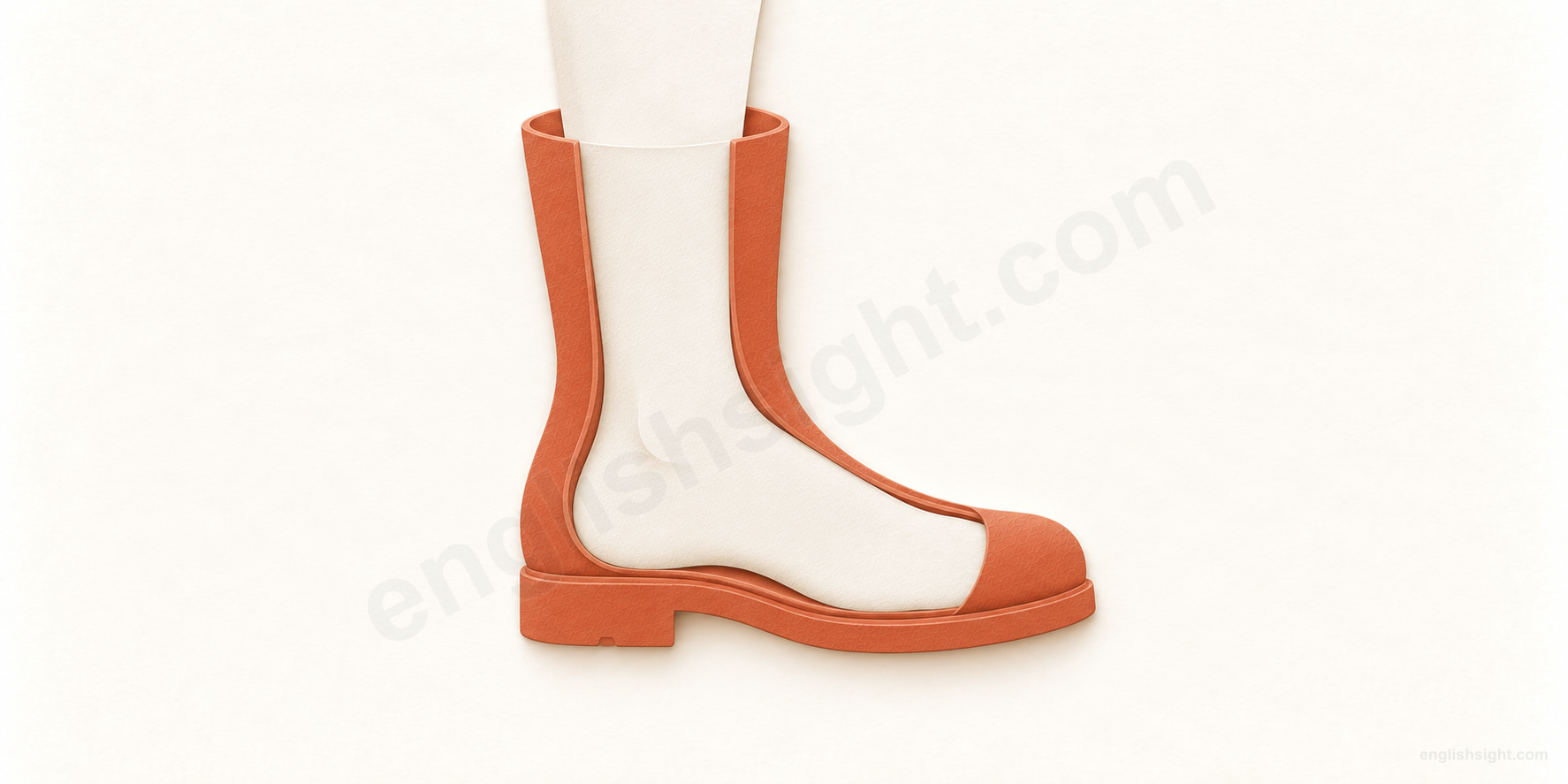
An outer covering around the foot and ankle
An outer covering around the foot and ankle
The foot and ankle are visible inside the cutaway.
boot
Its shaft extends above the ankle.
The boot's outer layer surrounds them.
A boot encloses the foot and reaches around the ankle or higher.
In its typical footwear sense, a boot encloses the foot and extends around the ankle or farther up the leg.
The picture explains a typical boot’s shape. It is a teaching reference for some extensions, not a rule that predicts every footwear design, car language, computer startup, or every idiom.
Start with a boot as a physical object: footwear shaped around the foot and extending around the ankle or up the leg. That object makes some comparisons memorable, but it cannot explain every modern use.
A car boot, booting a computer, and to boot need their own contexts. This lesson groups the uses by what people mean to do or describe, rather than treating every expression as a hidden picture of kicking.
01
Footwear and wearing it
Start with the physical object. A boot covers the foot and reaches around the ankle or farther up the leg; its design depends on its purpose.
01
a boot; boots; a pair of boots; purpose / material / height + boots
a boot / a pair of boots
footwear that encloses the foot and reaches around the ankle or higher
Situation / starting point
You need footwear for wet or rough conditions.
Meaning / result
You choose a suitable pair of boots.
The height and enclosing shape distinguish the basic object.
Boot is a countable noun: one boot, two boots, a pair of boots. Boots are a kind of footwear; unlike a typical low shoe, a boot has material extending around the ankle or up the leg. Not every boot is heavy, waterproof, or knee-high.
Use a modifier to identify purpose or shape: walking boots, hiking boots, riding boots, ankle boots, knee-high boots, or leather boots. Walking boots is a familiar British term; hiking boots is familiar in North America. Rubber boots are useful in wet conditions, but material alone does not guarantee every design is waterproof.
British football boots are the sports shoes worn for football (soccer), with studs on the sole for grip; the usual North American term is soccer cleats. This established name refers to the sporting design, so do not treat the tall shaft in the diagram as a requirement for every item called a boot.
A pair is singular when it is the grammatical head: This pair is too small. Boots is plural: These boots are too small. The word refers to wearable objects here, so the outline in the principle diagram applies directly.
In a sentence
These hiking boots support my ankles on rocky paths.
Watch the difference Say a pair of boots, not a boots. Choose the design for the task; boot alone does not promise protection from every hazard.
02
put on / wear / take off + boots; put them on; take them off
put your boots on / take them off
put boots on your feet, wear them, or remove them
Situation / starting point
Your boots are beside the door.
Meaning / result
They are on your feet, or you have removed them.
The action words supply the change; boot names the footwear.
Put on describes dressing; wear describes having the boots on; take off describes removing them. She is putting her boots on is an action now, whereas She is wearing boots describes what she has on.
You can say put on your boots or put your boots on. With a pronoun, use put them on and take them off, not put on them or take off them. Pull your boots on/off emphasizes the pulling movement; lace up your boots means fasten their laces.
These are combinations with put, take, pull, or lace, not phrasal verbs headed by boot. The rare verb meaning equip with boots is not the ordinary instruction for getting dressed.
In a sentence
Take your muddy boots off before you come inside.
Watch the difference Do not use wear for the act of removing or first putting on the boots.
02
Cars: storage and a locked wheel
British car storage and a North American wheel-locking device are separate uses. The surrounding words identify which one you mean.
03
the (car) boot; in / into / out of the boot
in the boot
in the luggage compartment of a car, in British English
Situation / starting point
You have bags to carry in the car.
Meaning / result
The bags are in the car’s storage compartment.
The car context selects storage rather than footwear.
In British English, the boot is the compartment used for luggage or shopping. In American English, trunk is the usual equivalent. Put the bags in the boot and Open the boot are ordinary travel requests.
In the boot means inside that compartment; on the boot can mean on its outside surface. Open the boot normally means open its lid. This is an established car sense, not an instruction to put bags inside a shoe.
The footwear diagram does not explain every feature of this meaning. Treat car boot as a separate everyday branch, selected by the vehicle context.
In a sentence
Could you put the suitcase in the boot?
Watch the difference For an American listener, use trunk when you mean this car compartment.
04
at / go to + a car boot sale
a car boot sale
a British outdoor sale of people’s unwanted possessions
Situation / starting point
People have used items they no longer need.
Meaning / result
They offer them for sale from cars or tables.
Car boot identifies the type of sale, not the goods being sold.
A car boot sale, also called a boot sale, is an outdoor event where people sell unwanted possessions, often displaying them at the back of cars or on tables. The items can be books, clothes, toys, and many other things.
The main noun is sale: one car boot sale, several car boot sales. At a car boot sale names the event where you buy or sell. It is not specifically a sale of boots, and it need not be a commercial shoe shop.
In a sentence
I found this old lamp at a car boot sale.
Watch the difference A boot sale is not simply a discount on footwear.
05
boot + car; a car is / gets booted; a wheel boot
a wheel boot / get booted
a wheel-locking device, or having one attached to a car
Situation / starting point
A parked car can move.
Meaning / result
A device on its wheel prevents it from being driven away.
The device immobilizes the wheel; it is not the luggage space.
In North American English, a boot or Denver boot can be a device fixed to a car wheel to prevent the car being driven away, often following illegal parking. The British equivalent is a wheel clamp.
Boot is also a transitive verb in this sense: They booted the car. My car was booted and My car got booted are passive patterns. A driver may say I got booted when their car received the device; context supplies the car.
The enclosing idea can help you remember the device, but a wheel boot locks a wheel rather than protecting a foot. Do not confuse got booted with got the boot, the dismissal idiom.
In a sentence
My car got booted while I was in the shop.
Watch the difference A booted car is immobilized; it has not necessarily been towed away.
03
A hard kick or an unwanted departure
Boot can describe a forceful kick. Informal expressions also describe making somebody leave, without implying physical kicking.
06
boot + object + direction / result; give + object + a boot
boot the ball / give it a boot
kick something hard
Situation / starting point
The ball is in front of a player.
Meaning / result
The player sends it away with a strong kick.
The verb expresses force; a following phrase can show direction.
Informal boot takes an object when it means kick hard: boot the ball across the field. Across the field describes the direction; down in boot the door down adds the result of knocking the door down.
A boot can also be a single hard kick: He gave the ball a boot. Compare neutral kick with the more forceful, informal boot. You do not have to mention the footwear for this verb to be understood.
The foot-to-object action provides a useful connection with footwear. It does not mean every use of boot is about actual kicking.
In a sentence
She booted the ball over the fence.
Watch the difference Boot the computer normally means start it, not kick it; the object and situation matter.
07
boot somebody out; boot somebody out of + place / organization; be booted out; boot somebody from + group / activity
boot somebody out (of something)
force somebody to leave a place, group, or position
Situation / starting point
Someone is inside a club or belongs to a team.
Meaning / result
They are made to leave against their wishes.
Out marks removal; no literal kick is required.
Boot somebody out is an informal phrasal verb. You can boot somebody out of a room, club, organization, or job. It describes forceful rejection or expulsion, which can be administrative rather than physical.
With a noun, both boot the troublemaker out and boot out the troublemaker are possible. Put a pronoun between the verb and particle: boot him out, not boot out him. Of introduces what the person must leave.
The passive is useful when the affected person matters most: She was booted out of the club. This is stronger and more informal than asked to leave.
Boot also occurs without out when it means eject or dismiss: The referee booted him from the game after a second warning. Here from names the activity he was removed from. The passive He was booted from the team likewise describes removal, not a wheel lock or computer startup.
In a sentence
They booted him out of the club for threatening other members.
Watch the difference Do not assume someone was physically kicked; an email ending membership could have the same result.
08
give + person + the boot; get / be given + the boot
give somebody the boot / get the boot
dismiss somebody or be rejected
Situation / starting point
Someone has a job or is in a relationship.
Meaning / result
That position or relationship is ended by the other party.
The fixed noun phrase the boot means an unwanted dismissal.
Give someone the boot presents the person doing the rejecting; get the boot presents the affected person. Be given the boot is another way to describe receiving that rejection. It can refer to losing a job or being rejected by a romantic partner.
This informal wording can sound blunt or unsympathetic. Lose your job or be dismissed may be more appropriate in a serious formal report. The expression itself does not explain the reason or whether the dismissal was fair.
Keep the in this idiom. She got a boot normally describes receiving one item of footwear, not losing her position.
In a sentence
The coach got the boot after a series of defeats.
Watch the difference Get the boot is a noun idiom; get booted can instead describe a wheel clamp in a parking context.
04
Starting a computer and intensive training
Computer booting is a technical meaning with its own grammar. Boot camp is an established compound for demanding training.
start a computer by loading the system it needs to operate
Situation / starting point
The computer has not finished starting.
Meaning / result
Its operating system loads so that it can be used.
Boot describes system startup, not movement or footwear.
Boot and boot up can be transitive: I booted the computer or I booted up the computer. They can also be intransitive: The computer booted up. The machine is the subject when you describe its own startup.
With a pronoun, say boot it up. Boot from a USB drive identifies the source used to start the system. A computer that will not boot fails to start its system; that does not necessarily mean it has no electrical power.
A boot is also the startup process: The update requires a fresh boot. In boot time or boot disk, boot modifies another noun. Reboot means start the system again. These technical meanings are learned as a separate branch; the boot outline is not a diagram of how a computer works.
In a sentence
The laptop powers on, but it won’t boot from the old drive.
Watch the difference Booting is system startup; it does not by itself mean logging into an account or opening a document.
10
go to boot camp; a fitness / coding boot camp
boot camp
demanding basic or intensive training
Situation / starting point
New recruits or learners need concentrated training.
Meaning / result
They enter a structured, demanding program.
The compound names a training setting, not a place to store boots.
Boot camp originally names demanding initial training for new military recruits. It also names short intensive programs such as fitness boot camps; a coding boot camp uses the training comparison for concentrated learning.
The camp is not necessarily a holiday campsite, and a civilian boot camp need not involve the armed forces. The point of the extension is intensive preparation. The noun can name a course as well as its setting.
Use go to boot camp for the military training institution, and a boot camp when identifying one particular course. The boot shape alone does not tell you the meaning of this established compound.
In a sentence
She joined a weekend fitness boot camp.
Watch the difference Boot camp does not mean an ordinary camping trip where everyone wears boots.
05
Read the whole expression
These expressions describe addition, attitudes, changed roles, fear, and other situations. Learn their complete wording rather than replacing boot with a single definition.
11
statement + and + extra point + to boot
to boot
add one more point for emphasis
Situation / starting point
You have already mentioned one quality or advantage.
Meaning / result
You add an extra one.
The whole phrase means in addition; to is not introducing an action.
To boot adds a further detail, often at the end of the clause or added description. In It is cheap and comfortable to boot, comfort is an extra benefit. The added point can also be negative.
Dictionaries differ in tone labels: Oxford calls it old-fashioned or humorous, while Collins COBUILD labels it formal and emphatic. Treat it as a marked, emphatic alternative to too or as well, rather than the default in every casual sentence.
This expression belongs to an older boot meaning advantage or benefit, not the footwear noun. It is different from an infinitive such as I need to boot the computer, where boot is a verb with an object.
In a sentence
The room was tiny and noisy to boot.
Watch the difference To boot can add an unwelcome detail; it does not always mean a bonus that makes things better.
12
be / get too big for + possessive + boots
too big for your boots
behave as if you are more important than you are
Situation / starting point
Someone receives praise or a promotion.
Meaning / result
They start treating other people as less important.
The idiom criticizes self-importance, not foot size.
Be too big for your boots describes an arrogant attitude. Get too big for your boots describes developing that attitude. The possessive follows the person: He is too big for his boots.
This British expression has the North American alternative too big for your britches. The clothing image is a memory aid, but the established judgment is about exaggerated importance, not ordinary confidence or literal tight footwear.
In a sentence
Since becoming captain, he has got too big for his boots.
Watch the difference Do not use this to mean that a child simply needs a larger shoe size. It is a criticism.
13
the boot is on the other foot
the boot is on the other foot
a situation has reversed, especially who holds power
Situation / starting point
One person used to make decisions for the other.
Meaning / result
The second person now holds the stronger position.
The idiom describes reversed roles rather than a misplaced item.
In British English, the boot is on the other foot says that the situation is reversed. It often concerns power or advantage: a former employee may become the manager of the person who once supervised them.
North American English commonly uses the shoe is on the other foot. Keep the singular boot and the fixed phrase on the other foot. The expression does not mean every small detail has become its exact opposite.
In a sentence
I used to train Mia; now she is my boss, so the boot is on the other foot.
Watch the difference The point is the reversal of roles or advantage, not that someone has put a left boot on a right foot.
14
shake / be shaking in + possessive + boots
shake in your boots
be very frightened or nervous
Situation / starting point
A person faces something threatening.
Meaning / result
They feel intense fear or nerves.
The shaking stands for fear; actual trembling is not required.
Shake in your boots is informal and vivid. The past is shook in my boots, not shaked. Change the possessive to match the subject: she was shaking in her boots.
Speakers can also use it ironically: I bet they’re shaking in their boots may mock the idea that someone is frightened. Tone and context decide whether the fear is sincere. Shake in your shoes is a related version.
In a sentence
I was shaking in my boots before the audition.
Watch the difference The idiom can describe fear even if you are not wearing boots.
15
(as) tough as old boots
as tough as old boots
very resilient and able to handle difficulty
Situation / starting point
Someone encounters demanding conditions.
Meaning / result
They cope with hardship without being easily defeated.
The durability of old boots provides the comparison.
This informal simile describes strength or resilience. She is as tough as old boots praises or emphasizes her ability to cope with difficult conditions; it does not mean she is unkind.
As tough as nails is another expression for toughness. Use the whole comparison; the opening as can be omitted in ordinary speech. The adjective tough supplies the quality, and old boots provides a familiar image of durability.
In a sentence
Our guide is as tough as old boots and never complains about the cold.
Watch the difference Tough here is resilient, not automatically aggressive or cruel.
16
fill + person’s / possessive + boots; have big boots to fill
fill somebody’s boots
take over somebody’s role and meet its demands
Situation / starting point
A capable person leaves a position.
Meaning / result
Someone else must perform that role well.
Another person’s boots stand for the role they occupied.
Fill somebody’s boots or fill somebody’s shoes means do their job acceptably when they are no longer there. This often draws attention to how difficult a good predecessor will be to replace.
The possessive identifies the person being replaced: fill her boots. Compare fill your boots in the next entry: when the boots belong to the person taking something, that different idiom means help yourself freely.
In a sentence
The new coach will find it hard to fill her predecessor’s boots.
Watch the difference This concerns doing the job well, not just being appointed to a vacant position.
17
Fill your boots!; fill + your / one’s own + boots
fill your boots
take or do as much as you want
Situation / starting point
Food or another opportunity is available.
Meaning / result
Someone is invited to enjoy plenty of it.
The phrase is an informal invitation to help yourself.
Fill your boots! is an informal British invitation to take as much as you like. At a table, it can offer plenty of food; more broadly, it can invite someone to make full use of an opportunity.
The speaker is not asking you to put food in footwear. Compare fill Anna’s boots: that normally means replace Anna in her role. The possessive and the situation change the interpretation.
In a sentence
There’s plenty of cake left, so fill your boots!
Watch the difference This very informal invitation may sound unfamiliar outside British English; help yourself is a clearer general alternative.
18
lick + person’s / possessive + boots
lick somebody’s boots
show excessive respect to gain favor from someone powerful
Situation / starting point
A person wants approval from someone in authority.
Meaning / result
They behave in an exaggeratedly submissive way.
The idiom disapproves of the person’s attempt to please.
Lick somebody’s boots criticizes exaggerated flattery or obedience toward someone with authority. The possessive identifies the person being pleased: lick the manager’s boots.
This is figurative and insulting. Being polite or showing deserved respect does not by itself amount to licking someone’s boots; the speaker is accusing the person of going too far for personal advantage.
In a sentence
You can disagree politely without licking the director’s boots.
Watch the difference Use this with care when describing people: it conveys a negative judgment, not neutral courtesy.
19
put / stick the boot in; put / stick the boot into + person
put / stick the boot in
kick someone hard, or attack them with cruel criticism
Situation / starting point
Someone is vulnerable or already in difficulty.
Meaning / result
Another person attacks them or makes the situation worse.
The expression can refer to physical violence or a verbal attack.
In British informal English, put the boot in or stick the boot in can literally describe kicking someone hard, especially when they are down. The figurative use describes harsh criticism, often directed at someone already struggling.
After an error at work, saying The papers put the boot in means they attacked the person in their reporting. It does not say that journalists kicked anyone. Keep the full idiom: put your boots on instead describes dressing.
In a sentence
After her first mistake, the critics really put the boot in.
Watch the difference Decide from the context whether the attack is physical or verbal; the two uses cannot be reduced to putting on footwear.
20
send / deploy / have + boots on the ground
boots on the ground
soldiers physically present in an area of operations
Situation / starting point
Military support could come from a distance.
Meaning / result
Soldiers are actually deployed on the ground.
The footwear stands for the personnel wearing it.
In news and political discussion, boots on the ground refers to soldiers deployed in a place, rather than only remote or air support. Boots stands for the people, not a delivery of footwear.
The expression can leave individual people in the background, so soldiers or troops may be clearer when you want to name them directly. The meaning is a conventional reference to military presence, not simply any shoes touching soil.
In a sentence
The proposal would put more boots on the ground in the region.
Watch the difference The phrase does not by itself state the troop numbers, mission, or outcome.
Use the noun, the object, and the full expression
Forms and pronunciation
Boot is pronounced /buːt/. The noun plural is boots. The regular verb forms are boot, boots, booted, booting; booted ends in an extra syllable /ɪd/. Booted the ball, was booted out, and the computer is booting are ordinary action patterns. The rare sense equip with boots is not the usual way to tell someone to get dressed.
Different grammar, different meaning
Boot it up and boot him out are separable particle constructions. Give him the boot is a fixed noun idiom. To boot meaning in addition is neither a command nor an infinitive. In a request such as I need to boot the laptop, however, to does introduce the verb.
Limits of the visual model
The boot outline anchors the footwear meaning. Computer booting is associated with bootstrap in its technical history; to boot comes from a different historical word for benefit. Do not invent a universal story in which every use means protection, kicking, or being inside something.
Scope and tone
Informal idioms may be blunt, critical, humorous, or regional. This is a selection of useful modern senses and recognizable expressions, not a frequency ranking. Specialized mechanical covers, historical meanings, and less central regional idioms are listed as boundaries in the coverage record.
Choose by context
Look at the object, the possessive, and any particle before choosing the interpretation.
1. You want two items of footwear sold together. Which phrase fits?
2. The computer is off. Replace the computer with it in Boot up the computer.
3. A manager is dismissed. Which sentence reports that informal meaning?
4. A talented coach retires, and the new coach must do her job well. Which phrase describes this?
5. The flat is expensive and cold to boot. What does to boot add?
6. A driver says My car got booted. In North American parking language, what happened?
Sources and teaching notes
The dictionaries below support the senses and usage distinctions. Explanations and examples are original; the footwear diagram is a teaching aid. The coverage record maps each unit to its sources.
The diagram anchors the footwear sense; speakers do not all share one fixed mental picture.