Use bottle for a familiar object, a packaging action, and several established expressions.
Contents held inside a container
Contents held inside a container
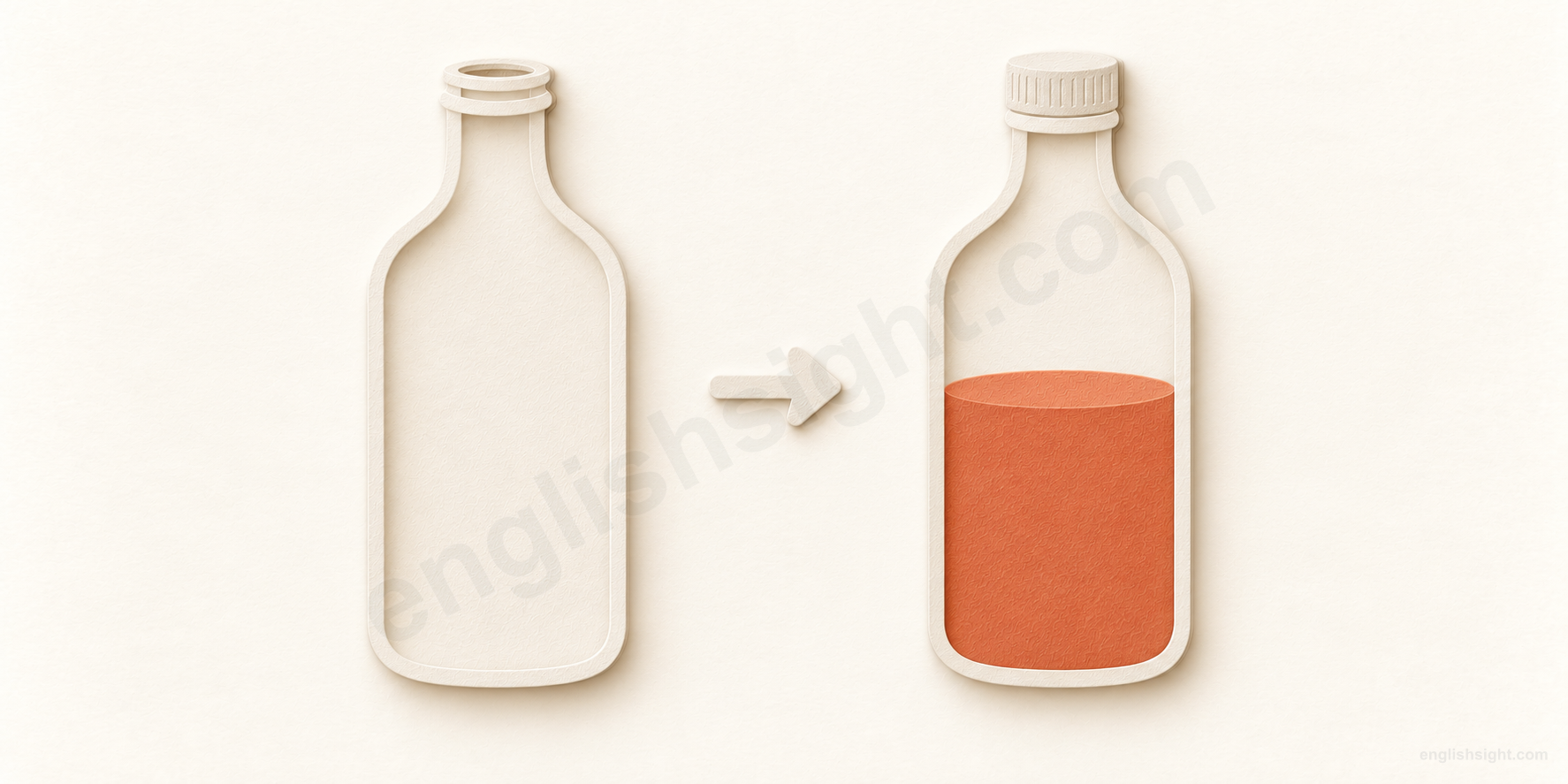
An open, empty bottle.
bottle
Liquid held inside the same bottle.
Fill the bottle through its narrow opening, then cap it.
The body holds the contents; the narrow neck provides access.
A bottle holds contents inside a body reached through a relatively narrow neck; bottling puts contents into such containers.
The two states illustrate an ordinary bottle before and after filling and closing. Bottles can also be empty or open. Preserving fruit, bottled gas, and established idioms have additional conventions explained below.
A bottle usually holds liquid in a body reached through a relatively narrow neck. English can use the same word for the container, its contents, or the action of putting something into bottles.
Keeping something inside offers a useful bridge to bottle up. Alcohol and British informal courage uses need their own explanations; a single picture cannot predict every expression.
01
The container and what it holds
Start with the physical object. Then distinguish its contents, its intended use, and the everyday actions performed on it.
01
a / the + bottle; number + bottles
a bottle / two bottles
a container with a relatively narrow neck or opening
Situation / starting point
You need something to carry a drink.
What is meant
You choose a bottle that can be closed.
Bottle names the container, whether full or empty.
A bottle typically has a body for holding liquid and a narrower neck leading to the opening. Glass and plastic are familiar materials, but the word is not restricted to glass: a reusable metal drinks bottle is still a bottle.
The noun is countable: a bottle, this bottle, three bottles. Empty and full describe its contents; an empty bottle has not stopped being a bottle. A glass bottle describes material, while a glass of water names a serving in a drinking glass.
A jar usually has a wider mouth, convenient for reaching in or taking food out. The distinction is useful for recognizing ordinary objects, rather than a rule that every product design must obey.
In a sentence
There are two empty bottles beside the sink.
Watch the difference Do not use bottle as an uncountable noun for an ordinary container: say I need a bottle.
02
a bottle of + contents; two bottles of + contents
a bottle of water
a container of something, or the amount it contains
Situation / starting point
The water is sold in separate containers.
What is meant
You ask for one container’s worth.
Of introduces what is inside; the bottle provides a countable unit.
A bottle of water can identify both the filled container and a quantity of water. If someone drinks a bottle of water, they drink the contents, not the container. The verb and the situation make the intended reading clear.
Use bottles to count portions of an uncountable liquid: two bottles of juice. The amount depends on the bottle; bottle is not a fixed measurement like litre. A half-full bottle and half a bottle describe related quantities from different viewpoints.
Once the drink is already known, We shared a bottle can leave its name unsaid. Context supplies the contents; the word bottle alone does not always mean wine.
In a sentence
We shared a bottle of apple juice during lunch.
Watch the difference Keep of when naming the actual contents: two bottles of water, not two bottles water.
03
contents / purpose noun + bottle; bottle of + actual contents
a water bottle / a bottle of water
distinguish a kind of container from its contents
Situation / starting point
Your reusable bottle is empty.
What is meant
You can still call it a water bottle.
The noun before bottle usually classifies its use or kind.
A water bottle is a bottle intended for water; a bottle of water is a bottle with water in it. The first expression can describe an empty object. A milk bottle or perfume bottle similarly identifies a familiar kind of container.
Compare a plastic bottle, which tells you the material, with a bottle of shampoo, which tells you the contents. A shampoo bottle names the type of container, so it may be empty.
The head noun is bottle: two water bottles, not two waters bottle. Size can also describe the container: a one-litre bottle; with plural containers, two one-litre bottles.
In a sentence
I filled my water bottle with orange juice today.
Watch the difference Water bottle does not guarantee that water is in it at this moment.
04
fill + bottle + with + liquid; pour + liquid + into + bottle; drink from + bottle
fill / open / empty a bottle
describe actions on a container and its contents
Situation / starting point
The bottle is empty and open.
What is meant
You fill it and put the top back on.
The action verb tells you what happens to the bottle.
Fill a bottle with water puts the water into the container. Pour water into a bottle describes the direction of the liquid. Empty the bottle removes its contents; it does not mean throw the container away.
Open a bottle and put the cap or top back on describe access through its opening. A cork is a particular kind of stopper; not every bottle has one. A bottle opener is a small tool for removing metal bottle tops, such as those on some beer bottles.
Bottle can modify another noun: the bottle cap is the cap belonging to a bottle. These are noun combinations, not phrasal verbs. In drink from a bottle, from identifies the source of the drink.
In a sentence
Please fill this bottle with water and put the cap back on.
Watch the difference Choose the preposition for the role: fill the bottle with water; pour water into the bottle.
05
give + baby + a bottle; finish + possessive + bottle
give a baby a bottle
use a feeding bottle, or refer to the milk it supplies
Situation / starting point
A baby is ready for a feed.
What is meant
A caregiver offers milk in a feeding bottle.
The feeding context selects a special bottle and often its contents.
A baby’s bottle has a soft part for sucking, called a teat in British English and a nipple in American English. Baby bottle and feeding bottle identify this kind of container.
Give the baby a bottle can mean offer a feed, not merely hand over an empty object. The baby finished her bottle means she drank its contents. On the bottle can refer to bottle feeding in a baby-care context, whereas the same words about an adult may refer to alcohol.
Bottle-feed names the act of feeding with a bottle. It is a related compound verb, not a particle combination such as bottle up. This lesson explains the expressions, not infant-feeding choices.
In a sentence
The baby finished her bottle and fell asleep.
Watch the difference Finish her bottle normally refers to drinking the contents, not completing or destroying the container.
02
Putting things into containers
As a verb, bottle names a packaging action. Context identifies the contents and explains a few uses that extend beyond an ordinary drinks bottle.
06
bottle + liquid; liquid + be bottled (+ place / time)
bottle the juice
put a liquid into bottles
Situation / starting point
The juice is ready in a large container.
What is meant
It is divided into bottles for storage or sale.
The liquid is the object of the verb bottle.
To bottle juice is to package it in bottles. The subject does the packaging and the object names what is packaged: The company bottles juice. This differs from fill a bottle, where the container is the object.
The action readily appears in the passive: The juice is bottled here. A label such as bottled at the farm says where packaging happened; it does not by itself say where the fruit grew.
The verb forms are bottle, bottles, bottled, bottling. Drop the final e in bottling. A production process can be ongoing: They are bottling the juice now. These are forms of the same action, not additional meanings.
In a sentence
They bottle the apple juice at a small farm nearby.
Watch the difference Bottle the juice and fill the bottle have different objects: the contents versus the container.
07
bottle + fruit / vegetables; bottled + fruit
bottle fruit
preserve fruit or vegetables in glass containers
Situation / starting point
Fruit is available in season.
What is meant
It is preserved in sealed glass containers for later use.
This established food-preserving use can involve jars.
In British usage, bottling fruit can mean preserving it in glass jars, rather than forcing it through a narrow drinks-bottle neck. Here bottle names the preserving process, so ordinary bottle shape is not a reliable guide.
American English generally calls this canning, including when glass jars are used. Bottled pears describes the preserved product. The wording names a food-preservation method, not simply putting fresh fruit into any closed container.
This is a vocabulary distinction, not a set of preservation instructions. It belongs beside liquid bottling because both involve preparing contents for keeping, but the food-processing sense needs to be learned in its own context.
In a sentence
My aunt bottles pears from her garden each autumn.
Watch the difference Bottled fruit may be in a wide-mouthed jar; do not infer the container’s shape from the verb.
Bottled water is water supplied in bottles. Compare a water bottle, the container, with bottled water, its packaged contents. The noun after bottled is the product being described.
Bottled gas is gas stored under pressure in a portable container, often called a cylinder. It does not mean an ordinary glass drinks bottle. The object being contained determines the appropriate container.
I wish we could bottle that excitement uses the packaging idea imaginatively: capture a feeling so it could be kept or used again. It is a creative extension, not evidence that all abstract nouns naturally follow bottle.
In a sentence
The shop sells bottled water near the checkout.
Watch the difference Bottled water names the packaged drink; a water bottle names the container.
03
Holding feelings, movement, or progress back
Bottle up extends containment to emotional expression, freedom of movement, and progress. These uses share an image but need different objects and situations.
09
bottle up + feelings; bottle + feelings / them + up; keep + feelings + bottled up
bottle up your feelings
keep strong feelings unexpressed
Situation / starting point
You feel upset but do not show or discuss it.
What is meant
The feeling remains hidden rather than being expressed.
Bottle up uses containment as a metaphor for suppressing expression.
Bottle up anger, grief, or your feelings means keep them inside instead of expressing them. The feeling still exists: the expression does not mean that you have stopped being angry or have solved the problem.
The phrasal verb is separable: bottle up your feelings or bottle your feelings up. With a personal pronoun, put it between the verb and up: bottle them up. Do not say bottle up them.
Keep everything bottled up describes a continuing state of unexpressed feelings. Up belongs to the established expression; it does not indicate upward movement or mean that the emotion is becoming happier. This is an extension of the container image, not literal bottling.
In a sentence
I bottled up my frustration instead of explaining what was wrong.
Watch the difference Bottle them up is the pronoun order. Bottled up describes hidden feelings, not feelings that have disappeared.
10
bottle up + traffic / a force; traffic / a force + be bottled up
be bottled up
be trapped or prevented from moving or progressing freely
Situation / starting point
A route is blocked.
What is meant
Vehicles cannot get through and accumulate in one area.
Here bottle up blocks movement or progress, rather than emotional expression.
Traffic can be bottled up when it cannot move out freely. An army or fleet can also be bottled up in a place. The image is of contents unable to get out; no real bottle is involved.
The passive often makes the trapped thing the subject: Traffic was bottled up by the road closure. In an active clause, something bottles up the traffic. This physical sense is distinct from hiding feelings, even though both use containment.
The expression can also describe obstructed progress: The proposal was bottled up in committee means it was kept from moving forward through the decision-making process. This is an institutional blockage, rather than an unexpressed feeling.
A bottleneck is a related noun for a narrow point or other restriction that slows progress. It names the restriction; bottled up describes what is being held back. Do not treat the two words as interchangeable parts of speech.
In a sentence
The road closure bottled up traffic near the station.
Watch the difference This use describes blocked movement, not simply a place where many vehicles happen to be parked.
04
Alcohol, courage, and changes that cannot be undone
These expressions have established meanings and particular tones. The container image helps with some of them; it does not explain every idiom.
11
hit / take to + the bottle; be on + the bottle
the bottle / hit the bottle
refer informally to alcohol or heavy drinking
Situation / starting point
An adult has started drinking heavily.
What is meant
Someone describes this as hitting the bottle.
The bottle can stand for alcohol and the habit of drinking it.
In adult drinking contexts, the bottle can mean alcohol rather than one particular container. Hit the bottle means drink heavily or start doing so. It does not mean strike a container, and it is not a neutral way to say have one drink.
Take to the bottle similarly suggests starting to drink heavily; be on the bottle can refer to heavy drinking. Context matters because on the bottle in a baby-care conversation may instead mean receiving bottle feeds.
These expressions are informal and can sound judgmental when applied to someone. For a neutral report, say exactly what you mean, such as He has been drinking heavily. The familiar link is container for contents, but the whole phrase supplies the heavy-drinking meaning.
In a sentence
After losing his job, he began to hit the bottle.
Watch the difference Keep the in the idiom. Hit a bottle normally has a different, literal reading.
12
have the bottle to + verb; lose + possessive + bottle; a lot of bottle
have the bottle / lose your bottle
have courage, or lose the nerve to act
Situation / starting point
Someone faces a difficult or frightening task.
What is meant
They either find the courage or lose their nerve.
This British informal noun names courage, not a container.
Have the bottle to do something means have enough courage to do it. Lose your bottle means lose your nerve. This use is British and informal; courage or nerve is more widely neutral.
Bottle is uncountable in this sense: a lot of bottle. The in have the bottle to ask belongs to a familiar pattern, not a count of one physical bottle. A statement about someone having no bottle can be critical or mocking.
Treat courage as a separate established branch. The lesson’s container sketch is not an explanation of its history, and it does not imply that courage comes from alcohol.
In a sentence
I wanted to complain, but I didn’t have the bottle to speak up.
Watch the difference For this meaning, avoid a bottle of courage; that would be a different, deliberately figurative phrase.
13
bottle out (of + noun / -ing); bottle it
bottle out / bottle it
abandon an intended action because of fear
Situation / starting point
You plan to do something that feels frightening.
What is meant
At the crucial moment, you do not go through with it.
Fear prevents the planned action; this is not a packaging instruction.
In British informal English, bottle out means withdraw from an intended action because you are frightened. Of can introduce what you abandon: bottle out of the jump; bottle out of asking a question. After of, use a noun or an -ing form.
Bottle it has a similar established meaning: lose your nerve and fail to do or finish the intended thing. Compare I bottled it at the last second with I bottled the juice. In the first, it is part of the idiom; in the second, the juice is a literal packaging object.
This use relates to the courage branch, not to liquid leaving a bottle. It can sound teasing or critical. Back out is a broader expression for withdrawing and does not always imply fear.
In a sentence
I planned to ask for a refund, but I bottled out at the counter.
Watch the difference Say bottled out of asking, not bottled out to ask. Do not confuse bottle it with bottle it up.
14
the genie is out of the bottle; let the genie out of the bottle; put the genie back in the bottle
the genie is out of the bottle
a major change has happened and is difficult to reverse
Situation / starting point
A development was previously contained or had not begun.
What is meant
Its effects are now spreading and cannot easily be undone.
The whole idiom invokes a released genie, not ordinary spilled liquid.
The genie is out of the bottle says that an important development has happened and returning to the earlier situation is very difficult or impossible. It often expresses concern about consequences, rather than simply announcing good news.
Let the genie out of the bottle focuses on causing that release. Put the genie back in the bottle describes trying to regain the earlier control, often in a negative sentence: We can’t put the genie back in the bottle.
The container image helps connect control and release, but the genie story supplies the idiom. The phrase is stronger than Something has changed; it emphasizes that the effects are difficult to reverse.
In a sentence
Once the software was freely available, the genie was out of the bottle.
Watch the difference Out here belongs to a larger idiom. Bottle out means lose your nerve, not release a genie.
Choose the branch and the construction
A typical shape, not a universal design rule
A narrow neck is a useful guide to the ordinary container. Specialized products and the fruit-preserving verb have their own conventions. Neither glass material nor a full or closed state is required for the noun.
Keep container, contents, and action apart
A water bottle is an object, a bottle of water identifies contents or quantity, and bottled water describes a packaged product. Bottle the water packages the liquid; fill the bottle acts on the container.
Particles and fixed wording matter
Bottle up feelings is a separable phrasal verb; bottle out is an informal British phrasal verb. Bottle it, hit the bottle, and the genie expressions are established idioms. A noun combination such as bottle cap is not a phrasal verb.
Scope and tone
This lesson selects practical modern noun and verb uses. The British courage expressions can sound critical. Specialized scientific containers, violence-related slang, dialect senses, and a full catalogue of compounds are outside the main lesson. The diagram is a teaching model, not a shared mental picture claimed for all English speakers.
Choose the meaning that fits
Use the surrounding words to decide whether bottle means a container, contents, an action, or an idiom.
1. Your reusable container is empty. Which description still names its intended use?
2. A farm puts juice into bottles for sale. Which sentence makes the juice the object of the packaging verb?
3. Someone keeps strong feelings hidden. Which sentence uses the ordinary pronoun position?
4. In British informal conversation, Maya says she bottled out of making a complaint. What happened?
5. Sam drank a bottle of juice. What did Sam normally drink?
6. A new technology is widely available, and people say the genie is out of the bottle. What are they stressing?
Sources and teaching notes
Definitions and usage were checked against the sources below. Explanations, example sentences, and the diagram were written for this lesson; the visual connection is a teaching interpretation.
The diagram is a teaching aid for containment; it does not explain every idiom.