From a container and its contents to marked spaces, packing, and familiar expressions.
An inside space set apart by a boundary
An inside space set apart by a boundary
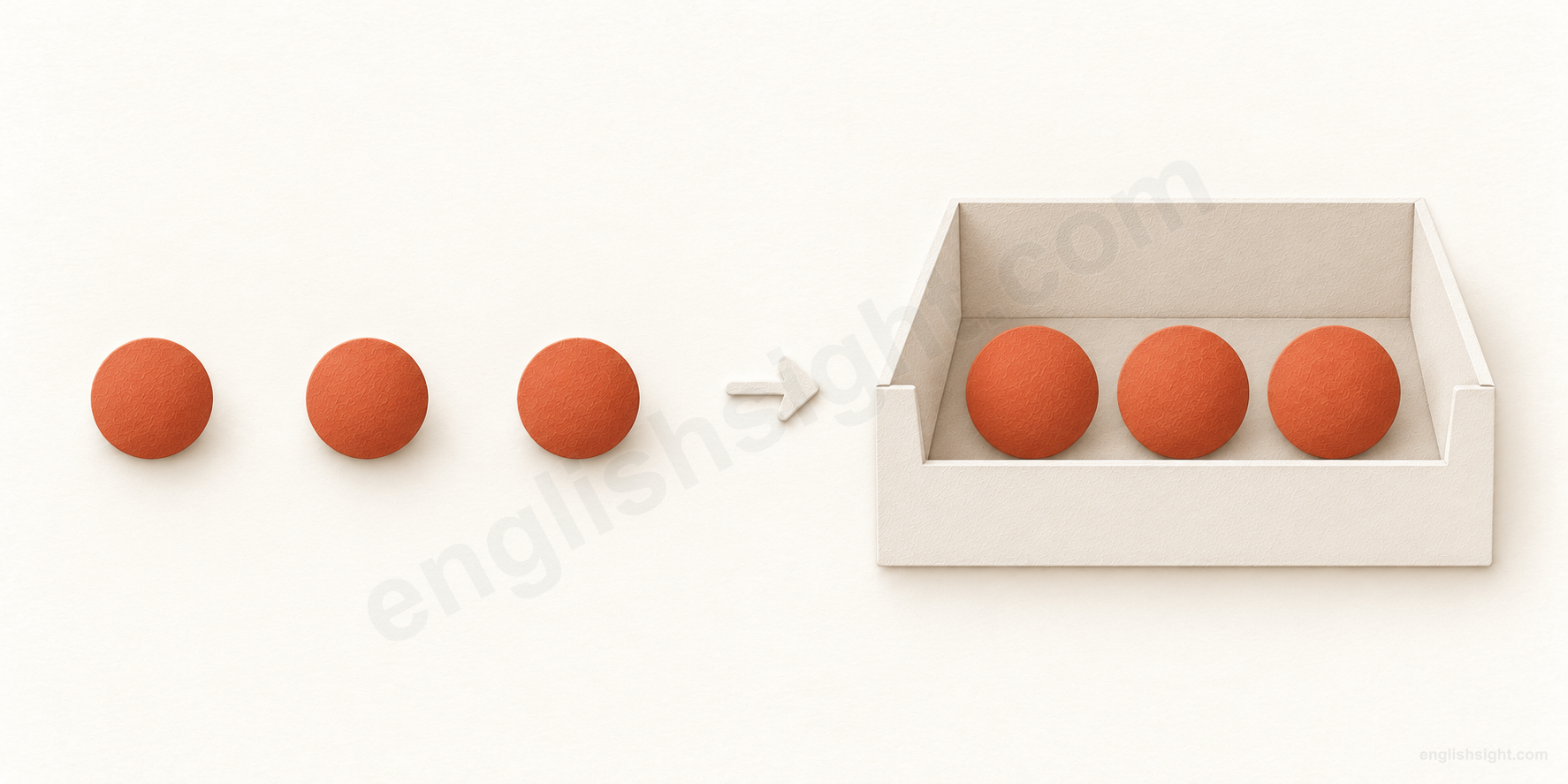
Three loose objects lie separately.
box
The three objects are together inside the box.
A base and firm sides provide an inside space to hold them together.
A box holds things within a bounded space; it need not have a lid.
A box provides a bounded inside space that holds things or sets an area apart for a purpose.
Physical containment helps explain containers, contents, marked spaces, and some restrictions. The exact meanings of compounds and idioms still need to be learned; the model does not explain the sport or plant name.
Put several loose things in a box: the sides and base give them a shared inside space. That relation is a useful starting point for learning this word. A box can also be an area set apart for people, information, or an activity.
This lesson connects meanings where the connection helps. Boxing as a sport and box as a plant name remain separate branches. The diagram is a teaching model, not a claim that all English speakers see one shared mental picture.
01
Containers, contents, and mail
Start with a real box. Then distinguish the thing itself, what it holds, its purpose, and a postal address.
01
a / the + box; adjective / material + box
a cardboard box
a container with firm sides
Situation
You need somewhere to keep loose cables.
Meaning in context
The cables are together inside one container.
The sides and base make an inside space for holding things.
Here box names the container, not an action. Picture loose cables lying around; a box gives them one place to stay. A lid can close that space, but an open box is still a box.
Ask for a box, this box, or two boxes. A material word can describe it: a cardboard box, a wooden box, or a plastic box. These are descriptions, not different grammatical senses.
In a box describes location: The cables are in the box. Into a box highlights movement to the inside: Put the cables into the box. Out of a box marks movement from inside to outside: Take the cables out of the box. The prepositions supply these relations; they are not extra meanings of the noun.
In a sentence
Keep the spare cables in this cardboard box.
Watch the difference Box is countable here: say I need a box, not I need box. A box need not be a cube.
02
a box of + contents; number + boxes of + contents
a box of chocolates
a container together with its contents, or that quantity
Situation
You choose chocolates sold in packages.
Meaning in context
You buy one package and the chocolates it contains.
Of names what fills the box; box supplies the package or quantity.
A box of chocolates can refer to the package as a gift or to the chocolates inside it. If someone says We ate the whole box, the food is understood; nobody needs to imagine eating cardboard.
Compare a chocolate box, which can name a box intended for chocolates, including an empty one. A box of chocolates normally includes the chocolates. Three boxes of chocolates counts the packages, not three individual chocolates.
In a sentence
We shared a box of chocolates after dinner.
Watch the difference A box is not a fixed unit like a kilogram. Two boxes may contain different amounts.
03
noun + box; compounds such as toolbox and matchbox
lunch box / toolbox / money box
a box named for what it carries or stores
Situation
You need a container for a particular job.
Meaning in context
Its name tells you the intended use.
The first part of the compound tells us what kind of box it is.
A lunch box carries your meal; a toolbox keeps tools together; a money box holds savings. You can use the container model, then ask what the first part contributes.
These are noun compounds, not phrasal verbs. Their spelling is conventional: lunch box is also written lunchbox, while toolbox and matchbox are commonly single words. Learn a familiar compound’s spelling with its meaning.
In a sentence
My lunch box is empty, but I have already packed my toolbox.
Watch the difference An empty lunch box is still a lunch box. Its name describes its purpose, not necessarily its current contents.
04
PO Box + number; a PO box; Box + number in an address
PO Box 84
a postal address for mail held for collection
Situation
A club receives letters through a post office.
Meaning in context
Senders use the club’s box number in its address.
The numbered mail space stands for a place to receive correspondence.
PO box means post office box. A person or organization uses its number as an address and collects the mail held there. In an address, Box can appear directly before a number.
For example, Please write to PO Box 84 directs a letter to that postal address. It does not ask the writer to send an empty package. Learn the whole address form rather than replacing a street name with the ordinary word box at random.
In a sentence
Please send your application to PO Box 84.
Watch the difference A PO box address and a parcel in a cardboard box are different uses of box.
02
Spaces set apart for a purpose
A box can be a bounded area on a form, on a screen, in a building, or on a field. The surrounding words identify its function.
05
tick / check / mark + a box
tick / check a box
mark a small square to record a choice
Situation
A form offers several options.
Meaning in context
Your mark identifies the option you select.
A visible boundary sets aside a place for one response.
On a form, a box may be a small square for a tick, check mark, or cross. Follow the instruction: Tick one box and Tick all that apply ask for different numbers of choices.
Tick a box is especially British; check a box is especially North American. Here check means mark the option, though in another context check the box could mean inspect a physical container.
In a sentence
Check the box beside your preferred delivery time.
Watch the difference Do not confuse checking a selection box with checking whether a parcel is damaged. Context decides the action.
06
type / enter something in(to) a box; a search / text / dialog box
type in the search box
put information into a bounded area on a page or screen
Situation
A website has a space for a search query.
Meaning in context
The words you enter tell it what to search for.
A box can hold information rather than physical objects.
A search box takes a query; a text box takes written input. A note box can instead contain information for you to read, and a dialog box presents a message or choices on screen.
The boundary groups the information. That connection helps you recognize the noun, but the specific interface tells you whether to type, choose, or read. Not every box is a checkbox.
In a sentence
Type the title in the search box.
Watch the difference Say type in the box for text entry; tick the box describes selecting an option.
07
in a box; a theatre / executive / jury / witness box
a theatre box / the jury box
a separate area for a person or group
Situation
A venue divides its seating into different areas.
Meaning in context
A particular small area is reserved for a group.
The box sets people apart spatially; it need not be a closed container.
A box at a theatre or stadium is a separate seating area. A jury box is the area for the jury in a courtroom; a witness box is the place where a witness gives evidence.
The words before box name the people or function. Compare We sat in a box at the theatre with We carried a box into the theatre: the first names seating, the second an object.
In a sentence
Our seats were in a small box above the main audience.
Watch the difference A theatre box is a seating area, not the box office where tickets are sold.
08
a phone / telephone / signal / sentry box
a phone box / signal box
a small enclosed place used for a particular activity
Situation
You notice a small structure with a particular function.
Meaning in context
Its compound name identifies the use of the structure.
A box may be large enough for a person to work or stand inside.
In British English, a phone box or telephone box is a public telephone booth. You may meet the expression in stories, street descriptions, or discussions of older telephone services.
A signal box is a small building or enclosure for controlling railway signals. These are established names. They share the idea of a separate space, not a requirement that every small building be called a box.
In a sentence
We waited beside the old phone box until the rain stopped.
Watch the difference Phone box is especially British, and Oxford marks the term old-fashioned. Booth is a useful alternative for a telephone enclosure.
09
in / inside / outside the box; the penalty box; a batter’s box
in the box
inside a designated area on a playing surface
Situation
A football field has a marked penalty area.
Meaning in context
A player receives the ball within that area.
The lines define a functional space even though there are no walls.
In football discussion, the box often means the penalty area. A batter’s box in baseball is a different marked space: the sport determines which area is meant.
The same broad boundary idea helps with British box junction, the yellow-marked area at a road junction. That is a road term, not a football term. Recognizing box as a marked area helps, but its exact function must come from context.
In a sentence
The striker received the pass just inside the box.
Watch the difference The box is not one identical area in every sport. Do not transfer football rules to other uses of the noun.
10
the box; on the box
on the box
on television, in informal British usage
Situation
Friends are talking about evening programmes.
Meaning in context
One asks what is being shown on television.
The box is a conventional nickname for television.
What’s on the box? asks about television programmes. The phrase is especially British and informal; Oxford also marks it old-fashioned. You can recognize it without choosing it as your usual way to say television.
On contributes the broadcasting relationship, as in on TV. The phrase does not normally locate a programme on top of a cardboard container.
In a sentence
Is there anything good on the box tonight?
Watch the difference Use the box for this nickname. On a box normally means physically supported by a container, unless the context supplies another meaning.
03
Packing things and limiting movement
As a verb, box can mean putting things in a container. Box in focuses on the loss of room to move or act.
The container noun becomes an action with the contents as its object.
Box the books and box the books up both describe packing them into boxes. Up often presents the packing as a completed task. It does not mean lifting the books upward.
You can say box up the books or box the books up. With a pronoun, say box them up. The passive is natural too: The books were boxed up yesterday.
In a sentence
We boxed the books up before the movers arrived.
Watch the difference Say box them up, not box up them. Boxing books is packing; boxing an opponent belongs to the sport branch.
12
box + someone/something + in; be boxed in by + obstruction
box a car in
surround something so that it cannot move freely
Situation
A driver returns to a parked car.
Meaning in context
Other vehicles block the route out.
Box in makes the surrounding boundary prevent movement.
The car need not be inside a literal box. Surrounding vehicles or other obstacles can form the effective boundary. Someone boxed us in explains what they did; We were boxed in describes our resulting situation.
This particle construction can separate: box the car in or box in the car. With a pronoun, use box it in. Do not confuse it with park the car in a box: in a box would be an ordinary prepositional phrase naming a place.
In a sentence
A delivery van parked behind us and boxed us in.
Watch the difference Say They boxed us in, not They boxed in us. No actual cardboard container is required.
13
be / feel boxed in (by + restriction)
feel boxed in
feel unable to choose or act freely
Situation
A worker faces many restrictive rules.
Meaning in context
There seems to be no room to make independent decisions.
Practical limits act like surrounding walls.
I feel boxed in can describe a loss of freedom caused by rules, obligations, or a situation. This use is often passive: be boxed in by something. It is about limited options, not necessarily a small physical room.
Compare I boxed up my papers, which describes packing objects, with I felt boxed in by the rules, which describes constraints on a person. In and up help distinguish these established constructions.
In a sentence
I felt boxed in by a job that left no time for study.
Watch the difference Boxed in does not automatically mean sad or shy; the central issue is restriction or lack of room to act.
04
Established expressions and compounds
Learn these combinations as expressions. The container model sometimes helps, but it does not supply every detail of their meanings.
14
think outside / out of the box
think outside the box
look beyond conventional assumptions for a solution
Situation
A team keeps trying versions of the same unsuccessful plan.
Meaning in context
Someone suggests a different way to approach the problem.
The imaginary box stands for familiar limits on thinking.
Think outside the box and think out of the box are established expressions for an imaginative approach. They ask you to reconsider assumptions, not to move your body away from a container.
The expression says something about the approach. It does not promise the new idea is good. You still need to test it; unusual and useful are different judgments.
In a sentence
To cut waste, we need to think outside the box about packaging.
Watch the difference Learn the whole expression. Outside by itself does not add the meaning creative to every noun.
15
something ticks / checks all the boxes; tick all someone’s boxes
tick all the boxes
meet all the important requirements
Situation
You want a quiet, affordable flat near work.
Meaning in context
One flat meets every item on your list.
The imagined checklist turns separate requirements into boxes to mark.
The flat ticks all the boxes means it has the features you want. It need not involve a real form. Tick all our boxes makes the people whose requirements matter explicit.
This informal expression is especially associated with British usage. You will also hear check all the boxes with the same checklist metaphor. Contrast either version with actually marking boxes on a form.
In a sentence
This flat ticks all our boxes: it is quiet, affordable, and close to work.
Watch the difference The flat is the subject meeting the requirements; it is not literally holding a pen.
16
work / run + (right) out of the box; out-of-the-box + noun
work out of the box
work immediately without extra setup or modification
Situation
A customer unpacks a new device.
Meaning in context
Its promised features are ready to use.
The package marks the starting point for using the product.
This use of out of the box focuses on immediate usability. In product descriptions, out-of-the-box features are supplied ready to use rather than requiring custom development.
Compare It works out of the box with We need to think outside the box. The first is about readiness; the second is about imagination. The similar words do not make the meanings identical.
In a sentence
The keyboard worked right out of the box; no software installation was needed.
Watch the difference An out-of-the-box solution in a product description may mean a ready-made solution, not a creative one. Read the context.
17
(right / straight) out of the box
right out of the box
from the very start
Situation
A new show has just opened.
Meaning in context
It succeeds from its first performances.
The expression can mark an immediate start rather than literal unpacking.
The show was popular right out of the box means it was popular from the beginning. This informal use is especially North American. There is no need for an actual packaged product.
This overlaps with the timing in ready-to-use product language, but it does not necessarily claim that equipment required no setup. Here the sentence reports the show’s early success.
In a sentence
The new show drew large audiences right out of the box.
Watch the difference Do not infer a physical package from every use. Australian and New Zealand out of the box can also mean exceptionally good; that regional sense is outside the main practice here.
18
at the box office; do well / badly at the box office; box-office + noun
at the box office
at the ticket-sales point; in terms of ticket sales
Situation
You want tickets for a performance.
Meaning in context
You buy them from the venue’s ticket-sales point.
Box office is a fixed compound connected with tickets and sales.
Buy tickets at the box office names the ticket-sales location. A theatre box is a place to sit; the box office is where tickets are sold. The word office changes the expression’s reference.
The film did well at the box office evaluates its commercial performance through ticket sales. Compare We met at the box office at six, which identifies a physical meeting place. A box-office success is a production with strong ticket sales.
In a sentence
We collected our tickets at the box office before the concert.
Watch the difference Box-office success concerns sales. It does not by itself mean critics liked the production.
19
a / the black box; something is a black box to someone
a black box
a flight recorder; equipment whose inner workings are not understood
Situation
Investigators need recorded information after a flight incident.
Meaning in context
They examine the aircraft’s flight recorder.
This fixed name refers to function, not merely the colour of a container.
In aviation news, a black box is a flight recorder. Investigators recovered the black box therefore identifies equipment with recorded flight information, not just any dark container.
A second use treats complicated equipment as a black box when someone knows its results without understanding how it works inside. For example, To me, that device is a black box describes a gap in understanding. Learn the two uses with their contexts.
In a sentence
Investigators recovered the black box from the aircraft.
Watch the difference A literal black storage box is not automatically a flight recorder. The compound has specialized meanings.
20
open a Pandora’s box (of + problems)
open a Pandora’s box
start something that leads to many problems
Situation
An apparently small change is proposed.
Meaning in context
It may set off a difficult chain of consequences.
The container-and-release image belongs to a conventional myth-based expression.
Open a Pandora’s box warns that taking a step may release many further problems. The name Pandora is part of the expression, not a description of the material of a box.
Opening that dispute again could open a Pandora’s box of legal problems means the action might start an expanding set of complications. The warning concerns consequences, not simply the fact that someone opened a lid.
In a sentence
Changing the ownership rules could open a Pandora’s box of disputes.
Watch the difference Keep the name and possessive form Pandora’s. Opening an ordinary box is not necessarily opening a Pandora’s box.
05
Boxing, strategy, and a plant name
The same spelling also belongs to the sport of boxing and to a shrub. Keep these branches distinct from putting things in containers.
21
box; box + opponent; go boxing
box an opponent
compete in the sport of boxing
Situation
Two athletes take part in a boxing match.
Meaning in context
They compete against each other under the sport’s rules.
This verb names the sport, not putting a person inside a container.
Box can be intransitive: She boxes at a local club. It can also take an opponent as its object: She boxed the champion. The object is the person she competes against, not something she packs.
Boxing is the name of the sport and the -ing form of the verb. The context distinguishes She is boxing tonight from She is boxing the books up tonight. This is a separate meaning branch; the container diagram does not explain it.
An older expression, box someone’s ears or give someone a box on the ears, means strike the side of someone’s head with a hand. It describes a blow or punishment, not necessarily a sporting contest.
In a sentence
Nina boxed a more experienced opponent in her first match.
Watch the difference Boxing someone is not a general synonym for arguing with them. Use the sporting or striking context to identify the meaning.
22
box clever
box clever
act strategically to get what you want
Situation
A negotiation requires care.
Meaning in context
Someone chooses a smart tactic instead of a direct confrontation.
This British informal idiom concerns tactics, not packing.
Box clever means handle a situation shrewdly to achieve your aim, sometimes by misleading another person. It can describe negotiations or dealings that have nothing to do with a boxing ring.
For example, We’ll have to box clever to get a fair price suggests a careful strategy. Clever is fixed in this idiom. In ordinary descriptions of how someone packs, say pack carefully rather than using box clever for neat packing.
In a sentence
We will have to box clever if we want a better deal.
Watch the difference This is a British informal expression. It does not simply mean to be intelligent in every context.
23
box as a plant/material noun; a box hedge; boxwood
a box hedge
a hedge made from a small evergreen shrub
Situation
A garden has a low, dense green hedge.
Meaning in context
A gardener identifies the plant used for it.
Box here names a plant, not a container or a sport.
Box can name the evergreen shrub used in hedges and shaped garden plants. In a box hedge, box identifies the plant material. This is useful recognition vocabulary in garden descriptions.
The word can also name the plant’s hard wood, called boxwood. That material use is uncountable. Compare a box hedge with a wooden box: one is a row of living plants; the other is a container made from wood.
In a sentence
A low box hedge borders the path.
Watch the difference A box hedge is not a row of storage boxes. The plant name needs its own branch in your understanding.
Keep the boundary idea and the limits of the model
A container is not a fixed shape or amount
A box usually has firm sides and a roughly rectangular shape; it need not be a cube or have a lid. A box of something counts a package, not a standard weight or number of pieces.
Forms and grammar
The ordinary plural is boxes /ˈbɒksɪz/ in British pronunciation. Verb forms are box, boxes, boxed, boxing; boxed ends in /kst/. In an ordinary sentence, the singular container noun needs a determiner, such as a, the, this, or my. Packing takes an object, while the sporting verb can stand alone or take an opponent. Both action meanings can be progressive; passive packing and be boxed in are natural. There is no general box someone to do pattern meaning make someone do something.
Compounds and idioms belong to the whole expression
A search box, a theatre box, and a box office perform different jobs. Think outside the box concerns ideas; work out of the box concerns immediate use. The boundary model helps organize these, but it is not a rule for inventing new meanings.
Recognition and scope
The television nickname, phone box, box clever, and box someone’s ears carry regional or older-language associations described in their entries. Specialist machinery, cricket protection, nautical commands, regional slang, and many additional compounds are not expanded here. This is a practical selection, not every dictionary use.
Choose what the whole expression means
Use the situation and the words around box to choose an interpretation.
1. A friend says, “We ate the whole box of chocolates.” What was eaten?
2. You have packed the books. Which instruction uses a pronoun naturally?
3. Rules leave Mira no freedom to make decisions. Which sentence fits?
4. A product description says, “It works right out of the box.” What does that promise?
5. You must collect theatre tickets before finding your seats. Where should you go?
6. “She boxed the champion last Saturday.” In a sports report, what happened?
Sources and teaching notes
The dictionary entries below were consulted for meanings, grammar, and usage labels. Explanations and examples are original. The visual connection is a teaching interpretation.
The diagram is a teaching aid for containment, not a mental picture shared by every speaker.