Connect the physical brain with mental ability, planning, and familiar expressions about thought.
From organ to function
An organ and the function it stands for
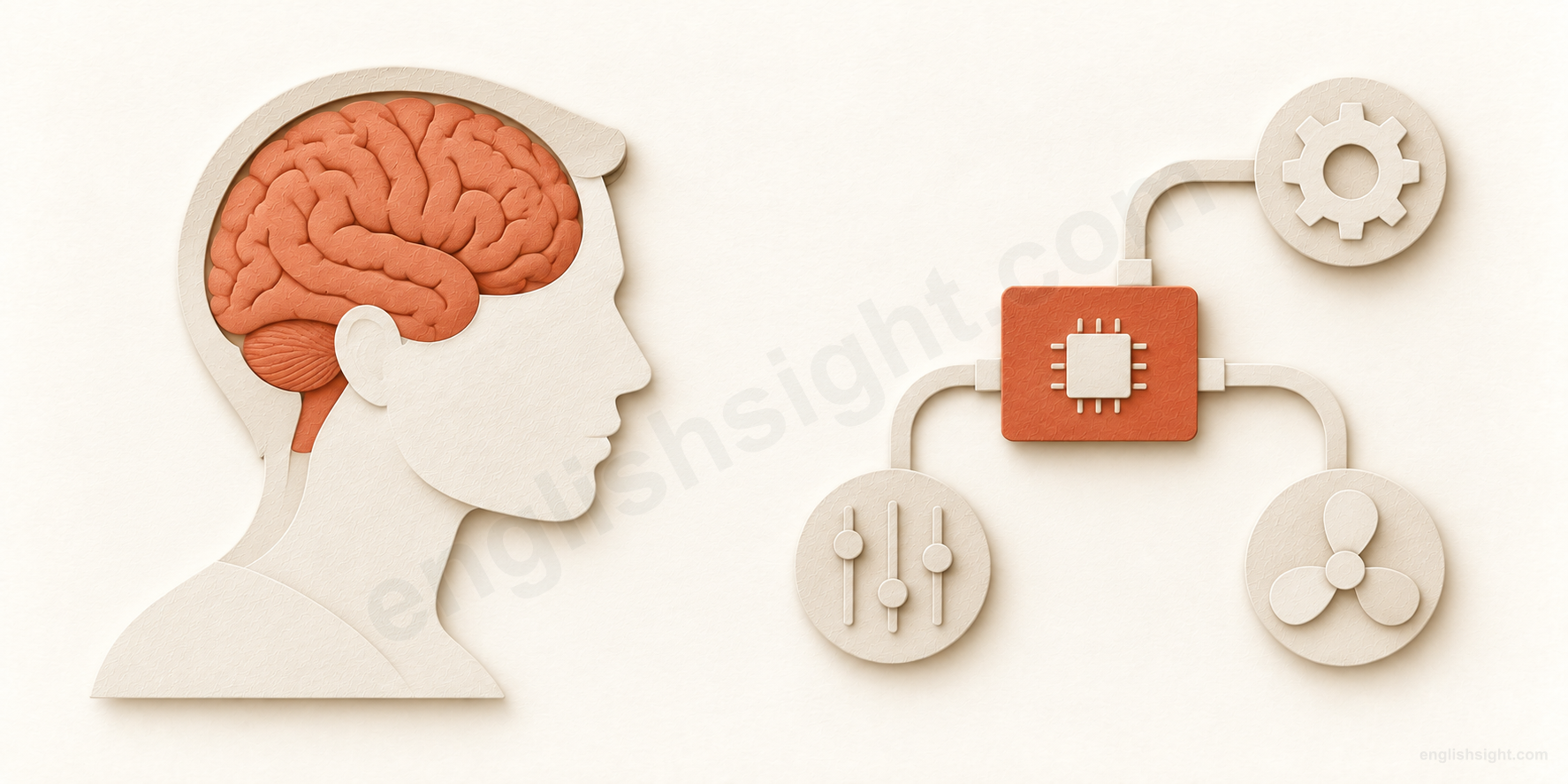
A folded brain is shown inside a human head.
brain
A central controller connects to three separate working parts.
The two views compare coordinating roles, not stages in time.
The organ’s coordinating role helps explain calling a machine’s controller its brain.
The brain is an organ in the head involved in thinking and coordinating the body; its name also stands for mental ability and for people or devices that supply ideas or control.
The two sides of the sketch compare functions. They are not before-and-after stages, and a biological brain does not turn into a machine. Fixed expressions still need their own explanations.
Brain /breɪn/ first names a physical organ inside the head. English also uses the name for thinking ability, a clever person, or the person or device supplying the plans and control.
This connection helps organize the meanings, but it cannot predict every idiom. The model is a teaching aid, not a claim that all English speakers share one mental picture.
01
The organ and the ability to think
Start with the physical brain, then notice when the same noun refers to thinking or intelligence. Singular and plural forms do different jobs.
01
a / the / possessive + brain; brain + noun
the human brain
the organ inside the head involved in thought and bodily control
Situation
You are naming a part of the body.
What the expression says
Brain identifies the organ, not the whole head.
The brain is inside the skull; the head includes more than the brain.
A brain is a physical organ. The human brain refers to the organ in humans generally; her brain refers to one person’s organ. Two dogs have two brains: here the plural counts organs.
Brain also modifies nouns: a brain scan, brain activity, a brain injury. In these combinations, brain normally stays singular. The sketch highlights its location, without attempting a detailed anatomy lesson.
In a sentence
The scan produced a clear image of her brain.
Watch the difference A headache is pain in the head; do not automatically rename it a brain ache.
02
use + possessive + brain
use your brain
think carefully rather than act without thought
Situation
A problem needs attention.
What the expression says
You think about how to solve it instead of guessing.
The organ’s name stands for the thinking it enables.
Use your brain asks someone to think. It does not describe physically handling an organ. In My brain isn’t working today, the speaker may be joking about tired or confused thinking.
A direct command such as Use your brain! can sound impatient or insulting. Let’s think this through is often kinder when working with someone.
In a sentence
I had to use my brain to work out which bus to take.
Watch the difference Use my brain, your brain, or her brain to match the thinker.
03
have brains; have a good brain; have the brains to + verb
have brains / a good brain
have intelligence or an ability to learn and solve problems
Situation
You describe someone’s mental ability.
What the expression says
The description concerns intelligence, not extra organs.
Brains can refer to intelligence even when only one person is involved.
She has brains praises her intelligence. She has a good brain is another way to describe mental ability. Brains in this use does not count anatomical organs.
Compare His brains are an asset with He has a good brain: the plural noun takes are, while the singular takes a. In Have you got the brains to solve it?, to solve it specifies the task.
In a sentence
She has the brains to solve the problem without our help.
Watch the difference Do not assume that brains always means several people or several organs.
02
A person or device that supplies the thinking
English can name a whole person or a controller after the brain’s function. Read the phrase to see whether it praises intelligence or identifies who plans things.
04
be + a + (adjective) + brain
a real brain
an unusually intelligent person, informally
Situation
You are talking about someone who learns very quickly.
What the expression says
You describe the person as a brain.
Here the whole person is named after mental ability.
Calling someone a brain informally describes that person as very clever. The article a and the reference to a person distinguish this use from brains meaning intelligence.
It may sound admiring or teasing, depending on tone. An intelligent person is a more neutral description.
In a sentence
Everyone in the class knows that Leo is a real brain.
Watch the difference This informal label does not mean that Leo is literally an organ.
05
person + be + the brains behind + project / idea; the brains of + group
the brains behind…
the person responsible for the ideas or planning
Situation
Several people help with a project.
What the expression says
You identify the person supplying the main ideas.
Behind marks responsibility for the idea, not physical position.
The brains behind a project is its main thinker or planner. A single person can be the brains: Mina is the brains behind it. The brains of the team similarly identifies its leading thinker.
Unlike a real brain, this phrase explains someone’s role in a particular undertaking. A person can be intelligent without being the brains behind that undertaking.
In a sentence
Mina is the brains behind our new booking system.
Watch the difference Keep the usual plural form brains even when the subject is one person.
06
the brain of + machine / system
the brain of a machine
a device or component that performs a central control function
Situation
A machine contains several working parts.
What the expression says
One controller coordinates what those parts do.
This is a functional comparison with the biological organ.
A computer or controller may be called a machine’s brain because it processes information and directs operations. The comparison concerns its role, not biological tissue.
The brain of the system means the component doing that work. A machine described this way is not thereby claimed to have feelings or human understanding.
In a sentence
This small computer is the brain of the robot.
Watch the difference Do not read the metaphor as a scientific claim that the machine has a human mind.
03
Advice, effort, attention, and memory
These established expressions describe everyday mental activity. Their exact meaning and tone belong to the whole expression, not to brain alone.
07
pick + someone’s + brain / brains + about + topic
pick someone’s brain / brains
ask someone for useful knowledge or advice
Situation
Someone has experience you need.
What the expression says
You ask that person questions and learn from the answers.
The person after pick is the source of advice.
Can I pick your brain about…? is an informal way to ask for someone’s expertise. Both brain and brains are accepted in this expression; the plural need not refer to more than one adviser.
About introduces the subject: pick your brain about hiring staff. This is an idiom, not physical picking and not a separable particle verb. Asking first respects the other person’s time.
In a sentence
Could I pick your brain about growing tomatoes on a balcony?
Watch the difference Pick your brain seeks advice; pick your nose names a different, literal action.
08
rack + possessive + brain / brains + to + verb
rack your brain / brains
think very hard to remember or find an answer
Situation
The answer will not come to you.
What the expression says
You make a strong mental effort; success is still uncertain.
The idiom describes effort, not a guaranteed result.
Rack your brain or rack your brains describes concentrated thinking, often when trying to recall a name or solve a problem. Both singular and plural forms occur; a following to-infinitive can give the purpose of the effort.
I racked my brains but couldn’t remember is perfectly consistent. The effort is the point. Rack here is the verb in an established figurative expression, not a command to damage your brain.
In a sentence
I racked my brains to remember where I had put the receipt.
Watch the difference For your own mental effort, match the possessive to the thinker: she racked her brains; I racked my brain.
09
have + topic + on the brain
have something on the brain
keep thinking about one subject
Situation
One topic repeatedly attracts your attention.
What the expression says
It keeps returning to your thoughts or conversation.
On the brain is stronger than merely having a thought.
Have something on the brain is informal and often teasing or critical. It suggests that the topic occupies someone excessively: a sport, a holiday, or a plan may dominate their thoughts.
The topic goes after have, followed by on the brain. Compare I have something on my mind, which can simply introduce a concern; on the brain more strongly suggests repeated preoccupation.
In a sentence
You’ve had that sailing trip on the brain all week.
Watch the difference Keep the fixed wording on the brain; on a brain does not express this idiom.
10
have a brain like a sieve; possessive + brain + be + like a sieve
have a brain like a sieve
often forget things
Situation
You forget another small but important detail.
What the expression says
You jokingly describe your memory as poor.
A sieve lets things through; the comparison is about not retaining information.
A brain like a sieve is a vivid informal way to describe forgetfulness. The speaker imagines information slipping away as material passes through a sieve.
It is often used about oneself: My brain is like a sieve today. This is a conversational comparison, not a diagnosis or a claim that an organ contains holes.
In a sentence
I forgot the door code again; I have a brain like a sieve today.
Watch the difference The comparison concerns memory, not necessarily a person’s general intelligence.
11
get + possessive + brain + into gear
get your brain into gear
start thinking clearly and effectively
Situation
You feel mentally slow at the start of a task.
What the expression says
You begin to concentrate and make progress.
The comparison is to engaging a mechanism, not to literal gears in a head.
Get your brain into gear is an informal expression for starting to think properly. It is useful when describing the move from sleepy or unfocused attention to active thought.
The possessive identifies the thinker: I need to get my brain into gear. A command directed at another person can sound impatient; it is not automatically friendly encouragement.
In a sentence
Give me a moment to get my brain into gear before we start.
Watch the difference Into belongs to this established phrase; it does not describe an actual destination.
12
beat + possessive + brains + out + trying to + verb
beat your brains out
make an intense mental effort to solve something
Situation
A difficult problem takes a great deal of effort.
What the expression says
You keep trying hard, perhaps with frustration.
With one’s own brains, this can be a figurative description of thinking.
I’ve been beating my brains out trying to fix this emphasizes the difficulty and effort involved. It is vivid informal language, close to rack my brains in a thinking context.
Read the participants carefully. A threat to beat someone else’s brains out refers to severe violence, not to helping that person think. The figurative reading is supported by the problem-solving context.
In a sentence
I’ve been beating my brains out trying to solve this puzzle.
Watch the difference This forceful idiom may sound exaggerated; try hard is a more neutral choice.
13
it + be + not + brain surgery
It’s not brain surgery.
say that a task should be easy to do or understand
Situation
A task is being treated as very difficult.
What the expression says
You say it does not require exceptional expertise.
The whole negative comparison conveys simplicity.
Brain surgery literally names an operation on the brain. In It’s not brain surgery, the demanding activity provides a humorous comparison: the task under discussion is much easier.
The phrase can reassure a friend, but it can also belittle someone who is struggling. That’s fairly straightforward is gentler. It’s not rocket science is a similar expression.
In a sentence
We only need to sort the cards by color; it’s not brain surgery.
Watch the difference Do not interpret this as information about whether a patient needs an operation.
04
Two useful compound nouns
In a compound, the second noun helps determine what the whole expression names. Learn these meanings as units.
14
a brain drain; a brain drain from + place / sector
brain drain
the loss of skilled or educated people who leave for other opportunities
Situation
An area or sector has trained specialists.
What the expression says
Many leave, taking their expertise elsewhere.
Brain stands for skilled human ability; drain suggests its loss.
A brain drain occurs when educated or professional people leave a country, region, or field, often for better conditions elsewhere. News and policy discussions use this compound for a loss of talent.
It does not mean that an individual is tired after thinking. The people leaving are the source of the ability that the place or sector loses.
In a sentence
The region faces a brain drain as young engineers move abroad.
Watch the difference For personal tiredness, say I’m mentally exhausted rather than I have a brain drain.
15
get / have + brain freeze
brain freeze
a sudden head pain after very cold food or drink
Situation
You eat or drink something very cold.
What the expression says
You experience a sudden sharp pain in your head.
The compound has a conventional meaning; the brain does not literally become ice.
Brain freeze is an everyday name for the sudden head pain associated with very cold food or drink. The example refers to that physical sensation, not to low intelligence.
Learn the compound as a unit. A literal reading of freeze would give the wrong picture. This lesson names the experience and does not explain its medical mechanism.
In a sentence
I got brain freeze after drinking the icy smoothie too quickly.
Watch the difference This unit teaches the cold-food sense; do not infer a medical diagnosis from the name.
05
Recognizing the informal verb
Brain is mainly a noun in this lesson. A separate informal verb refers to a blow to the head; it does not mean think.
16
brain + person; be brained by + thing
brain someone
hit someone hard on the head, informally
Situation
Something strikes or nearly strikes a person’s head.
What the expression says
The verb describes the blow, not mental activity.
Brain is a transitive verb here; the person hit is its object.
The informal verb brain takes a person as its object: nearly brained me. Its forms are brain, brains, brained, and braining. A passive is possible: he was nearly brained by a falling branch.
This verb can also have a severe, killing sense in dictionaries. It is useful to recognize in narratives, but think is the ordinary verb for mental activity: I’m thinking, not I’m braining.
In a sentence
The low branch nearly brained me as I stood up.
Watch the difference Do not use brain as an everyday substitute for think.
Keep the noun, the idiom, and the verb distinct
Brain, brains, and agreement
One physical organ is a brain; several are brains. Brains can also mean intelligence. In Mina is the brains behind it, is agrees with Mina even though the role description contains brains. The spelling alone does not tell you the meaning.
Brain, head, and mind
The head is the body part containing the brain. Brain can name the organ or emphasize mental ability. Mind usually concerns thoughts, awareness, or intentions. These words overlap in some expressions but are not freely interchangeable: change your mind is the normal expression for changing a decision.
Grammar belongs to the whole construction
Most uses here are nouns or noun phrases, not phrasal verbs. The informal verb brain can be progressive or passive when describing a blow. Noun phrases such as brain injury are not passive constructions. There is no general causative brain + person + to do pattern meaning make someone think.
Scope of the lesson
This selection covers the main noun meanings, everyday mental idioms, two useful compounds, and recognition of the informal verb. It does not teach detailed anatomy, clinical terminology, or every derived word and slang compound. It is not a frequency ranking.
Choose the meaning in context
Read the whole phrase, identify the participants, and notice whether brain is a noun or a verb.
1. Mina created the main idea for a project. Which sentence identifies that role?
2. You want an experienced gardener’s advice. Which question fits?
3. You tried very hard but still could not recall a name. Is the sentence below consistent with that situation?
4. Many trained engineers leave a region for better jobs abroad. What is the region experiencing?
5. A story says, “The branch nearly brained me.” What almost happened?
Sources and teaching notes
The sources below support the meanings and expressions. Explanations and examples are original; the visual connection is a teaching interpretation, not a dictionary claim about mental pictures.
The diagram explains a connection; it is not a picture shared by every native speaker.