From a vehicle’s brakes to a brake on progress, follow what is being held back.
Restraint checks motion
Restrain movement, rather than damage the object
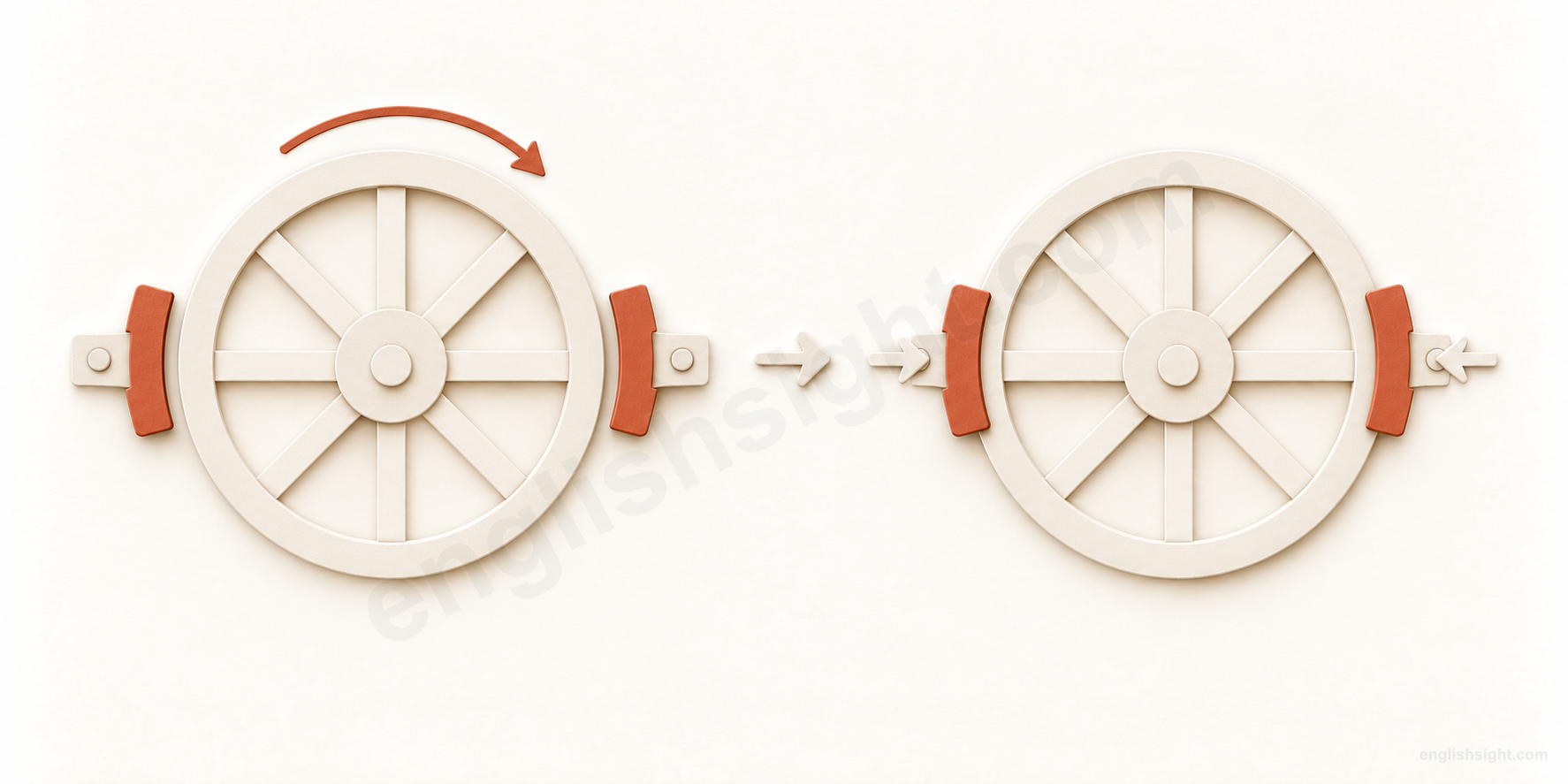
The wheel turns while the brake blocks stand clear of its rim.
brake
The wheel is shown at rest with the brake blocks applied.
The brake blocks press inward against the rim.
A brake restrains motion. Stopping is one possible result; braking can also reduce speed.
A brake applies a restraining effect to motion, reducing it, stopping it, or keeping the mechanism still.
The wheel illustrates one friction brake, not every brake design. Abstract uses transfer the restraint relationship to activity or progress.
A brake controls movement: it can reduce speed, bring movement to an end, or hold something still. As a verb, brake describes applying that control or slowing through it.
English also treats an activity as something that can move forward and be restrained. That connection helps with familiar expressions, but it does not explain unrelated plant names or every technical use of the spelling brake.
01
The device and its controls
Name the equipment, describe using or releasing it, and recognize familiar words at a repair shop.
01
a brake; the / my / your brakes; brakes + work / fail / squeal
the brakes
the equipment that checks a vehicle’s movement
Situation before
A bicycle is being checked at a repair shop.
What changes or follows
The mechanic identifies a problem with its brakes.
The plural commonly names the braking equipment as a whole.
A brake is a countable device: a front brake, a rear brake, two brakes. The brakes often refers collectively to the equipment used to reduce a vehicle’s speed or stop it.
The brakes work, the brakes fail, and the brakes squeal describe condition or sound. Fail means that the equipment does not perform its function; squeal describes a high-pitched noise and does not itself explain the cause.
A brake can also hold a mechanism still. The core relationship is restraint on movement, rather than damage to the moving object.
In a sentence
The mechanic said my bicycle’s brakes needed attention.
Watch the difference Treat brakes as plural: The brakes are noisy. Use a singular verb with The front brake is noisy.
02
press the brake / brake pedal; put your foot on / take your foot off the brake
put your foot on the brake
press the control used to operate the brakes
Situation before
A driving instructor points out the pedals.
What changes or follows
The learner identifies the brake pedal.
The singular brake can refer to the pedal, not to one wheel’s brake.
In a car, press the brake and put your foot on the brake commonly refer to the pedal. Brake pedal makes that control explicit.
The pedal is the control; the brakes are the equipment it operates. Taking your foot off the brake describes removing your foot from that control, not removing a mechanical part.
In a sentence
The instructor pointed to the brake pedal beside the accelerator.
Watch the difference Brake and break sound alike, /breɪk/. Take a break means rest; it does not mean use a pedal.
03
apply / use the brakes; put on the brakes; put the brakes on
apply / put on the brakes
operate the equipment to check movement
Situation before
A bus approaches a busy junction.
What changes or follows
The driver operates the brakes smoothly.
Apply and put on describe using the equipment; on does not mean installing it.
Apply the brakes is a neutral expression common in descriptions and instructions. Use the brakes and put on the brakes are ordinary alternatives. Put the brakes on is also possible.
With a pronoun referring to the brakes, say put them on. These are combinations with the noun brakes, not phrasal verbs formed from the verb brake.
Tap the brakes suggests a brief light application. Squeeze the brakes and touch the brakes can also describe gentle application. Pump the brakes describes repeated pressing and releasing. These describe different actions; they are not interchangeable names for any braking.
In a sentence
The bus driver applied the brakes smoothly as the junction came into view.
Watch the difference Apply the brakes describes an action. Replace the brakes describes fitting new equipment.
04
slam on / hit / jam on the brakes; jam / slam the brakes on
slam on / hit / jam on the brakes
apply the brakes suddenly, often with force
Situation before
A ball rolls into the road ahead of a car.
What changes or follows
The driver reacts with a sudden brake application.
The action verb adds abruptness or force to ordinary braking.
Slam on the brakes and jam on the brakes emphasize a forceful sudden action. Hit the brakes is another familiar expression for applying them suddenly; hit does not mean striking the equipment with a separate object.
Jam the brakes on and slam the brakes on are also possible orders. Compare tap the brakes, which suggests a much lighter, brief action. None of these phrases guarantees that the car stops in time.
In a sentence
When a ball rolled into the road, Maya slammed on the brakes.
Watch the difference The plural brakes remains a noun after slam on. Do not analyze this as brake + an on particle.
05
apply / release the parking brake; put the handbrake on / take the handbrake off
release the parking brake
stop a brake from holding a stationary vehicle
Situation before
A parked vehicle is held still by its parking brake.
What changes or follows
That brake is released.
Release removes the restraint; it does not itself make the vehicle move.
A parking brake is used to hold a parked vehicle in place. Handbrake is especially British and names a hand-operated brake; North American English also uses emergency brake for this equipment.
Put the handbrake on means engage it; take the handbrake off means release it. The brake is on or off describes its state, not whether it is physically attached to the vehicle.
This is the reverse side of the core relationship: removing a brake removes its restraint. The vehicle may still remain still for another reason.
In a sentence
“The parking brake is still on,” said the instructor.
Watch the difference Handbrake and brake pedal name different controls. Taking the handbrake off does not mean detaching it.
A repair bill lists several items related to the brakes.
What changes or follows
You distinguish a signal light, a friction part, and a liquid.
Brake modifies the following noun; that noun tells you what kind of thing it is.
Brake lights are red lights at the back of a vehicle that illuminate when the brakes are used. A brake pad is a friction block that presses against a brake disc. Brake fluid is liquid used in the braking system.
The final noun controls number: one brake light, two brake lights; one brake pad, several brake pads. Brake fluid is normally uncountable: some brake fluid.
Brake stays singular as the modifier in these compounds. The expressions are equipment names, not additional senses of the verb.
In a sentence
The repair bill listed new brake pads and a replacement brake light.
Watch the difference A brake light signals brake use; it is not the brake itself. Write brake lights, not brakes lights.
02
The action of slowing down
The verb can describe a driver or a vehicle. Extra words specify force, a stopping result, or the reason for braking.
07
person / vehicle + brake; brake + vehicle; be braked; be braking
the driver / the car braked
use the brakes, or slow through their use
Situation before
A car is moving along a road.
What changes or follows
Its driver uses the brakes and the car loses speed.
The subject can be the operator or the moving vehicle.
The driver braked focuses on the person’s action. The car braked describes the vehicle undergoing the braking action. No object is required in either sentence.
Brake the car is also possible: the car is then the object whose motion is controlled. A passive such as The vehicle was braked automatically is possible when the mechanism or operator matters less.
Forms are brake, brakes, braked, braking. Braked has one syllable, /breɪkt/. The progressive is ordinary for an action in progress: The driver was braking when the warning sounded. Gently, hard, and sharply describe how the action happens.
In a sentence
The car braked gently as it approached the bridge.
Watch the difference Braking need not end in a complete stop. Slow down is broader: a vehicle can lose speed without anyone applying its brakes.
08
brake (a vehicle) to a halt / stop
brake to a halt / stop
use the brakes until movement ends
Situation before
A tram is moving toward a platform.
What changes or follows
The tram is no longer moving.
To a halt names the achieved result.
Brake alone does not state that speed reaches zero. Brake to a halt and brake to a stop explicitly give that stopping result.
Here to is a preposition followed by a noun phrase, a halt or a stop. This differs from to avoid an obstacle, where to begins a verb phrase explaining purpose.
A driver can also brake a vehicle to a halt, with the vehicle as object. The result phrase adds the endpoint; it is not a separate meaning supplied by brake alone.
In a sentence
The tram braked to a halt beside the platform.
Watch the difference A stop is a noun in to a stop. To stop has a verb and can explain the purpose of braking.
09
brake for + noun; brake to + verb; brake to avoid + noun / -ing
brake for something / to avoid something
identify what prompts braking or what it is intended to prevent
Situation before
An obstacle or junction is ahead.
What changes or follows
The driver brakes in response to it.
For introduces the situation; to + verb can introduce the purpose.
Brake for a pedestrian or brake for a bend identifies the person or road feature that prompts the action. For does not turn brake into a new separable phrasal verb.
Brake to avoid something explains an intention: the driver wants to prevent a collision. Unlike braked to a halt, it does not say that the vehicle actually stopped or that the danger was avoided.
Compare The driver braked hard for the junction with The driver braked to avoid hitting a barrier. The first names a reason or situation; the second states the intended prevention.
In a sentence
The driver braked to avoid hitting the fallen branch.
Watch the difference For takes a noun here; use to avoid hitting it, not for avoid hitting it.
03
Slowing an activity or plan
English extends the braking relationship to progress, spending, and decisions. Learn the established combinations as whole expressions.
10
be / act as a brake on + activity; brake + growth / inflation
a brake on something
a factor that limits an activity or its development
Situation before
A small business wants to expand.
What changes or follows
A high cost limits how quickly it can grow.
The activity is metaphorically moving forward; a factor restrains it.
A brake on growth, spending, or progress names a restraining influence. Act as a brake on emphasizes the role something plays. The factor can slow the activity without ending it.
On introduces the activity being limited, not a physical surface. The brake can be an unintended obstacle or a deliberate control; the expression alone does not say whether it is helpful.
The verb can also extend beyond vehicles, especially in formal descriptions such as policies intended to brake inflation. In everyday discussion, slow or curb may be a clearer choice; brake does not mean damage or reverse.
In a sentence
The cost of new equipment is a brake on the workshop’s expansion.
Watch the difference A brake on expansion need not stop expansion completely. Avoid replacing on with of in this pattern.
11
put the brakes / a brake on + activity or plan
put the brakes on something
take action that checks or stops an activity
Situation before
A team plans to spend more on advertising.
What changes or follows
Its manager limits the spending plan.
The whole expression presents restraint as applying a vehicle’s brakes.
Put the brakes on spending or on a plan means check its continuation or pace. Put a brake on is also used. Unlike be a brake on, this construction highlights the introduction of restraint.
The brakes are figurative; on spending identifies the activity affected. The expression does not tell you whether the limit is temporary or permanent, or whether activity stops entirely.
Slam on the brakes can likewise describe a sudden halt or sharp cutback in an activity when the context clearly concerns a plan rather than a vehicle.
In a sentence
The manager put the brakes on the team’s advertising spending.
Watch the difference Do not translate the phrase as physically breaking the plan. Brakes suggests restraint, not destruction.
12
take the brakes off; take the brakes off + activity
take the brakes off
remove restrictions that have been holding an activity back
Situation before
A project is subject to tight spending restrictions.
What changes or follows
Those restrictions are relaxed or removed.
Removing restraint allows more activity without guaranteeing it.
Take the brakes off can be literal, as with a brake being released, or figurative. In a discussion of a budget, the brakes stand for restrictions on spending or development.
Context may supply the affected activity: The funding is approved; we can take the brakes off now. Take the brakes off recruitment makes the activity explicit.
Off reverses the on relationship in put the brakes on. This is an established extension of brake imagery; it does not mean that all problems have disappeared or that success is certain.
In a sentence
With more funding available, the charity took the brakes off recruitment.
Watch the difference Permission to expand is not the same as actual expansion. Removing a brake only removes that restraint.
Keep the form and the result separate
Brake is not break
Brake and break share the pronunciation /breɪk/. Modern brake has braked and braking; break has broke, broken, and breaking. The brakes are broken means the braking equipment is damaged. A coffee break is a rest, not a brake.
An action is not always a complete stop
Brake can mean reduce speed. Brake to a halt states a stopping result; brake to avoid a collision states a purpose. A brake on progress can slow progress without preventing all progress.
Read the whole construction
The verb has ordinary active, progressive, and passive forms. It does not need a collection of particle verbs to explain these uses. Put the brakes on and take the brakes off contain the noun brakes, and their surrounding verbs and particles contribute the operation or release.
Scope of this lesson
This lesson covers the modern movement-control noun and verb, familiar equipment names, and established figurative expressions. Botanical brake, thickets, old carriages, flax-processing tools, sheet-metal machines, and archaic brake as a past tense of break belong to separate or specialist branches.
What does the whole expression tell you?
Choose the meaning supported by the sentence, including its result or purpose words.
1. “The car braked gently but kept moving.” What happened?
2. “The driver braked to avoid hitting a barrier.” What does to avoid express?
3. Which sentence explicitly says that the vehicle stopped moving?
4. “The new budget put the brakes on expansion.” What did it do?
5. “The board took the brakes off recruitment.” What can you conclude?
Sources and teaching notes
The sources below support the meanings and constructions. Explanations and example sentences are original; the wheel is a teaching model of one braking mechanism.
The diagram explains a restraint relationship; it does not represent a mental picture shared by every English speaker.