Start with the copper-and-zinc alloy, then recognize objects, music, authority, and fixed expressions.
Two ingredients, one alloy
Two ingredients, one alloy
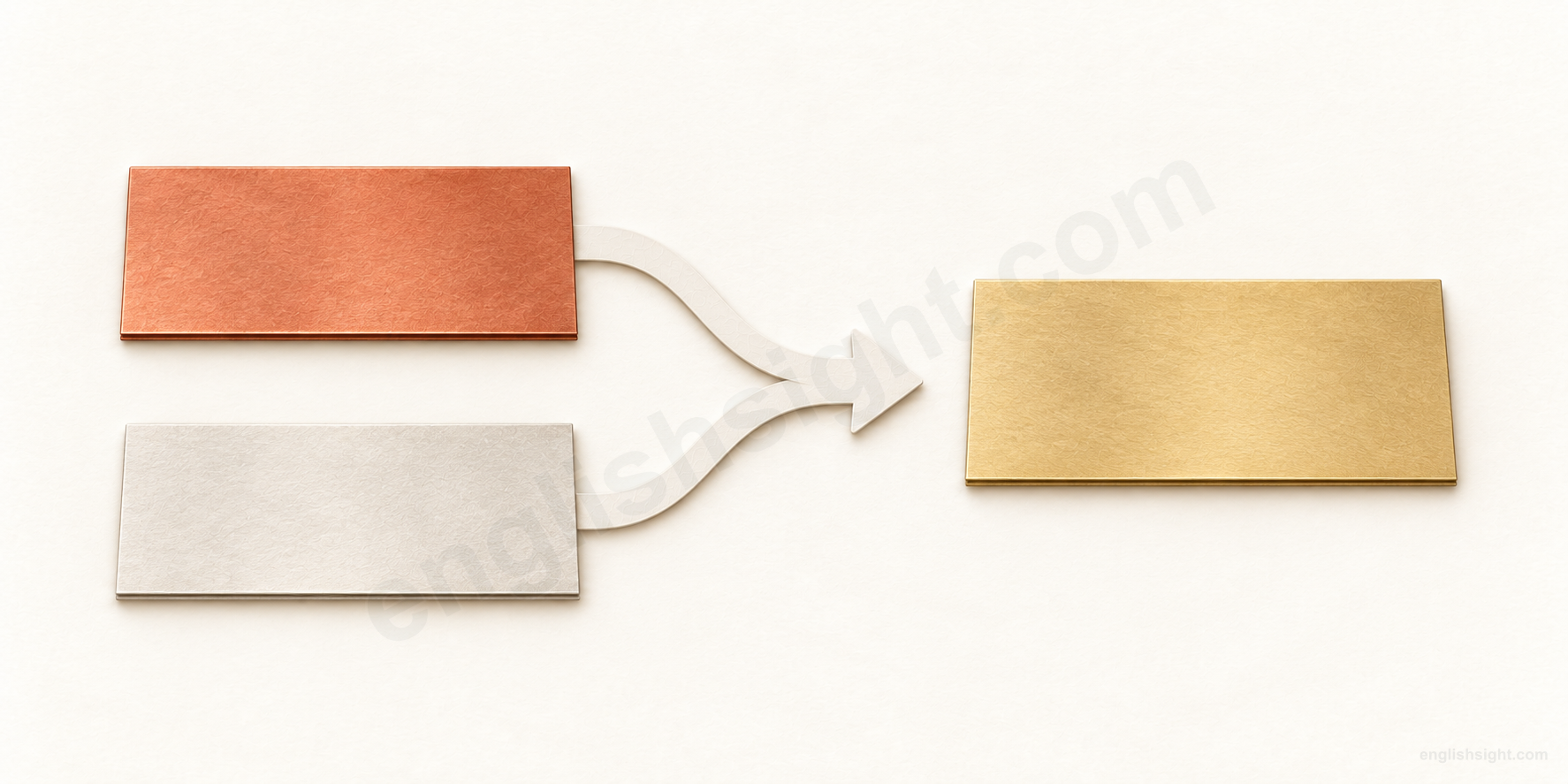
Copper and zinc are shown as two separate material swatches.
brass
One uniform yellowish swatch represents brass.
The two branches converge to represent combination into one alloy.
Copper and zinc combine into brass. The swatches show ingredients, not proportions or a manufacturing sequence.
Brass is a yellowish metal made mainly by combining copper and zinc into one alloy.
The material can take many shapes. Objects and instruments provide a useful connection; leadership, cheek, and fixed idioms must be learned in context rather than predicted from the ingredients.
Brass usually starts with a material: a yellowish alloy made mainly from copper and zinc. The word also names things made from it, a musical family, and—in a different context—senior officials.
Some expressions have meanings of their own. Learning their grammar and situation is more useful than trying to turn every idiom back into a metal. This lesson organizes useful uses, with regional expressions marked for recognition.
01
The metal and things made from it
Identify a material, describe a fitting, and recognize the special countable use for a decorated plate.
01
be made of / from brass; a piece / sheet of brass
made of brass
made from a copper-and-zinc alloy
Situation
You want to know what a candlestick is made of.
What the expression tells you
The answer identifies its material.
Brass names the alloy, not its shape or its price.
Brass is a yellowish metal made mainly from copper and zinc. In This is brass, brass is a material noun; in It is made of brass, of introduces the material. Neither sentence means that the object is gold.
Treat the material as uncountable: some brass, a piece of brass, or a sheet of brass. A piece is countable; brass itself is not being counted. The material stays brass whether it is a sheet, a handle, or an instrument.
Copper names one of the ingredients. Bronze is another copper alloy, traditionally made with tin, so brass and bronze are not interchangeable material labels. The diagram shows composition schematically, not a recipe or a manufacturing process.
In a sentence
The candlestick is made of brass, not gold.
Watch the difference For the material, say some brass or a piece of brass, not a brass. Special countable objects are explained separately.
describe brass objects or refer to them collectively
Situation
A shop offers handles made from different materials.
What the expression tells you
You choose brass handles and later clean their surfaces.
Before a noun, brass specifies material; the brass can stand for the relevant objects.
In a brass handle, handle is the countable object and brass tells you the material. Brass fittings, brass buttons, and a brass lamp follow the same pattern. Dictionaries may list this use as a modifier or as an adjective.
Solid brass contrasts with brass-plated: the first describes an object made of brass rather than merely having a brass coating over another material. The compound brass-plated describes the coating; plated does not mean polished.
Polish the brass can mean polish the brass fittings or ornaments understood in the situation. The material name stands for the objects. A brass plate can also be a sign outside a professional’s premises, giving a name and profession.
In a sentence
We chose solid brass handles for the doors.
Watch the difference Brass does not take a plural ending before handles. Brass handles, not brasses handles, names several handles.
03
a memorial / horse brass; brasses; brass rubbing; a brass rubbing
a memorial brass / a brass rubbing
a decorated metal plate, or a paper copy of its design
Situation
A church has a flat engraved plate commemorating someone.
What the expression tells you
A visitor recognizes a memorial brass and a copy of its design.
Here a brass is a particular object, so the plural brasses is possible.
A memorial brass is an engraved plate commemorating a person, especially in a British church. This is a special countable use: a brass, two brasses. It is more specific than a piece of the raw metal.
Brass rubbing names the activity of making a copy by rubbing a pencil, chalk, or wax over paper laid on the plate. A brass rubbing also names the resulting paper image; it is not the metal plate itself.
Another British countable use is a horse brass: a decorative piece attached to a horse’s harness. These established object names do not mean that every brass object is normally called a brass.
In a sentence
The guide showed us two memorial brasses in the church.
Watch the difference Keep the plate, the activity, and the copy distinct: a brass is the plate; brass rubbing is the activity; a brass rubbing is a paper reproduction.
02
Instruments and musicians
Brass can name an instrument family or the instruments and people playing together. Read the following noun and the concert context.
04
a brass instrument / player; a brass band
a brass instrument / a brass band
an instrument of the trumpet family, or a group playing such instruments
Situation
You want to learn the trumpet and join a local music group.
What the expression tells you
You choose a brass instrument and hear a brass band.
In musical compounds, brass identifies a family of instruments.
Trumpets, trombones, French horns, and tubas are brass instruments. The player’s vibrating lips at the mouthpiece start the sound; blowing into any metal instrument does not automatically make it part of this family.
A brass band is a group of musicians playing brass instruments. In a brass band, band names the group, whereas brass tells you its musical type. A brass player is a musician who plays an instrument in this family.
The material gives a useful connection to the core picture, but musical classification is not simply a test for yellow metal. Learn the family name along with the instruments.
In a sentence
A brass band played outside the station.
Watch the difference Say She plays a brass instrument, not She plays a brass when introducing her instrument to a beginner.
05
the brass (section); music for brass; the brass was / were playing
the brass / the brass section
the brass instruments or their players together
Situation
An orchestra’s different instrumental groups enter at different moments.
What the expression tells you
The trumpet and horn players begin their part.
The brass can name a section collectively rather than a quantity of metal.
The brass section is the brass-instrument part of an orchestra or band. The brass can mean that section’s instruments or their players: the concert context tells you which interpretation matters.
Singular or plural agreement is possible with collective brass: The brass was playing and The brass were playing. You may also meet the brasses in musical writing. This does not make raw brass a countable material.
Compare brass music, which is music for these instruments, with a brass band, which is a group of performers. A whole band and one section of a larger orchestra need not be the same thing.
In a sentence
The brass section enters after the strings.
Watch the difference At a concert, The brass was loud concerns instruments or players, not noisy metal waiting in a workshop.
03
Authority and shameless confidence
These informal uses refer to people or behavior. They are established extensions, not facts you can deduce from the alloy’s ingredients.
06
the (top) brass; the military brass; the top brass has / have + past participle
the top brass
the people holding the highest positions
Situation
A company’s most senior leaders will make a decision.
What the expression tells you
You refer informally to that leadership group.
Brass refers to rank and authority, not to the people’s material possessions.
The top brass means the highest-ranking people in an organization, including military leaders or company executives. The brass alone has this use especially in North American English. Top helps make the leadership meaning explicit.
This is informal collective wording. The top brass has approved it and The top brass have approved it are both possible. To name one individual clearly, say a senior officer or a senior executive.
The metal picture is an anchor for the word, not a rule that turns any brass object into a boss. In a sentence about an orchestra, the brass will usually have the musical meaning instead.
In a sentence
We need approval from the top brass before hiring anyone.
Watch the difference This expression is less suitable than senior management in a formal report. It does not ordinarily mean every employee.
07
(as) bold as brass; do something, bold as brass
(as) bold as brass
openly confident despite a reason for shame or hesitation
Situation
Someone has taken your seat without asking.
What the expression tells you
They calmly ask you to move your bag as well.
The idiom evaluates an unembarrassed manner, often with criticism or surprise.
Bold as brass describes someone acting with striking confidence, often where others would expect embarrassment or restraint. It can sound disapproving, amused, or impressed; it is not automatically a compliment.
You can say He was as bold as brass or describe an action with bold as brass. The first as is optional in the familiar expression. Brass is fixed in this comparison; replacing it with bronze does not preserve the idiom.
In a sentence
He took my seat and, bold as brass, asked me to move my bag.
Watch the difference Bold can describe admirable courage. Bold as brass often adds the feeling that the confidence ignores normal shame or restraint.
08
have the brass neck / brass to + verb
have the brass neck to…
dare to do something cheeky or disrespectful
Situation
A customer has already received a refund.
What the expression tells you
They demand another refund for the same purchase.
Brass neck names shameless nerve; the following infinitive states the act.
Have the brass neck to do something is informal British wording for daring to act with a remarkable lack of shame or respect. The infinitive names what the person dares to do; it is not an instruction to move a neck.
Brass alone also has a sense of cheek or nerve: He had the brass to ask again. In contrast, bold as brass describes a manner of behaving; have the brass neck to highlights the audacity needed for a particular act.
These are established evaluative expressions. The lesson does not claim that metal composition explains the personality judgment or that their history follows from this picture.
In a sentence
She had the brass neck to demand a second refund.
Watch the difference This is stronger and more critical than simply saying She felt confident. Use neutral wording when criticism is not intended.
04
Practical details and a goal worth pursuing
Learn these expressions as whole units. Neither discussion details nor a major success must involve actual metal.
09
get down to brass tacks
get down to brass tacks
start dealing with the essential practical details
Situation
A meeting has spent time on broad ideas.
What the expression tells you
The group begins discussing costs and deadlines.
The whole expression shifts attention to what must actually be settled.
Get down to brass tacks is an informal way to begin discussing the facts and practical details that matter. It can introduce the serious part of a conversation after introductions or general discussion.
Get down to contributes the idea of starting to deal seriously with something. Brass tacks supplies the established idiomatic image for essential details; the discussion need not involve any physical tacks.
The words stay together in this idiom. Let’s get down to brass tacks is a useful meeting invitation; it is not a command to lower yourself toward metal objects.
In a sentence
Let’s get down to brass tacks: how much will it cost, and who will pay?
Watch the difference Keep tacks plural and use to. Get down brass tacks or get down to brass tracks does not reproduce the idiom.
10
go for / grab the brass ring
go for / grab the brass ring
pursue or obtain an important success or opportunity
Situation
A performer has a chance at a career-changing role.
What the expression tells you
They decide to pursue that major opportunity.
The brass ring is a sought-after success, not necessarily a physical ring.
The brass ring is an informal North American expression for a major success, reward, or opportunity to succeed. The specific goal comes from context: a role, a promotion, or another valued achievement.
Go for the brass ring emphasizes trying for it; grab the brass ring presents seizing the opportunity or achieving the success. The verb changes whether the sentence concerns pursuit or attainment.
A brass ring can also literally be a ring made of the metal. A sentence about ambition, opportunity, or a career supports the idiomatic reading; the material diagram alone cannot choose between them.
In a sentence
When the lead role became available, Maya decided to go for the brass ring.
Watch the difference Going for the brass ring does not itself mean the person succeeded. Keep the distinction between trying and obtaining.
05
British expressions to recognize
The following money, weather, and annoyance expressions have regional or informal limits. Neutral alternatives work more widely.
11
brass = money; where there’s muck there’s brass
where there’s muck there’s brass
unpleasant or dirty work can be profitable
Situation
A dirty job turns out to be a successful business.
What the expression tells you
Someone comments on the money it can bring.
In the saying, brass means money and muck means dirt or unpleasant work.
Brass has an old-fashioned informal British money sense, associated especially with northern England. It is useful for recognizing regional speech, but money is the ordinary neutral choice for a learner.
Where there’s muck there’s brass is a British saying that dirty or unpleasant business can produce money. It comments on an opportunity for profit; it does not guarantee that any dirty job pays well.
Here there’s means there is, and where introduces the sort of situation in which the observation applies. Neither muck nor brass has to be a literal substance in the speaker’s immediate surroundings.
In a sentence
When the waste business began making a profit, Dan said, “Where there’s muck there’s brass.”
Watch the difference Do not use brass as the default international word for money. The saying and the regional sense have limits.
12
brass monkey weather; it’s brass monkeys
brass monkey weather
extremely cold weather
Situation
You step outside into bitter cold.
What the expression tells you
A British speaker uses a slang description of the weather.
This fixed weather expression means very cold; it does not report an animal’s material.
Brass monkey weather and It’s brass monkeys are British slang ways of saying that it is very cold. They are recognition expressions for informal conversation, not a scientific description of the temperature.
Keep the established forms: monkey is singular before weather, while monkeys is plural in It’s brass monkeys. Freezing or very cold gives the meaning more neutrally.
This weather meaning belongs to the phrase. It does not make brass a general adjective meaning cold, so a brass day will not normally express a cold day.
In a sentence
I’m taking my thickest coat—it’s brass monkey weather today.
Watch the difference Use this only with an informal audience familiar with British slang. It does not mean a statue of a monkey is present.
13
be / get brassed off; be brassed off with + person / thing
be brassed off
feel annoyed or fed up
Situation
You have waited a long time and the train is cancelled again.
What the expression tells you
You express your irritation informally.
Brassed off is a fixed adjective describing a feeling.
Brassed off means annoyed or fed up in British slang. Be brassed off describes the feeling; get brassed off describes coming to feel that way. With can introduce what is annoying you.
Although brassed looks like a past participle, this lesson treats brassed off as an established adjective, not a productive brass + off movement pattern. Off does not mean that metal has been removed.
Compare the top brass, which refers to senior people, and bold as brass, which describes confidence. Neither of those expressions means annoyed.
In a sentence
I’m brassed off with these repeated cancellations.
Watch the difference Say brassed off, not brass off, for the feeling. Annoyed or fed up is a more widely useful alternative.
Let the context choose the sense
Material and countable object
The alloy is uncountable. Count a piece, sheet, or handle. A brass and brasses have special object uses, notably decorated plates; musical writing can also use the brasses.
Noun, modifier, and related adjective
Brass is chiefly a noun and is used before other nouns for material or music. Some dictionaries label these modifier uses adjective. Brassed off is a separate established adjective; this is not a lesson in a productive family of brass phrasal verbs.
Recognize one additional compound
Brass knuckles is a plural North American name for a metal weapon worn over the fingers, also called a knuckleduster. It is a fixed object name, not the meaning of bare brass.
Scope and pronunciation
Common dictionary pronunciations are British /brɑːs/ and American /bræs/. This lesson covers everyday material and music uses and selected established expressions. Regional, old-fashioned, and slang items are marked; technical bearing parts, cartridge-case usage, and rare verb senses are outside the main lesson.
Choose by situation and grammar
Decide what brass refers to before interpreting the full expression.
1. Which sentence describes the material of a door handle?
2. In a concert report, what does “The brass entered after the strings” mean?
3. A company needs permission from its most senior leaders. Which expression fits?
4. A meeting must now decide costs and deadlines. Which invitation fits?
5. Which expression says that someone is fed up, in British slang?
6. Maya decided to go for the brass ring. What does this sentence establish?
Sources and teaching notes
The dictionary pages below support the usage and regional labels. Explanations and example sentences are original; the alloy diagram is a teaching aid.
The diagram illustrates composition; it does not claim that every speaker pictures the word in the same way.