Understand bread as food, then follow its uses in cooking, livelihood, and familiar expressions.
The food and its portions
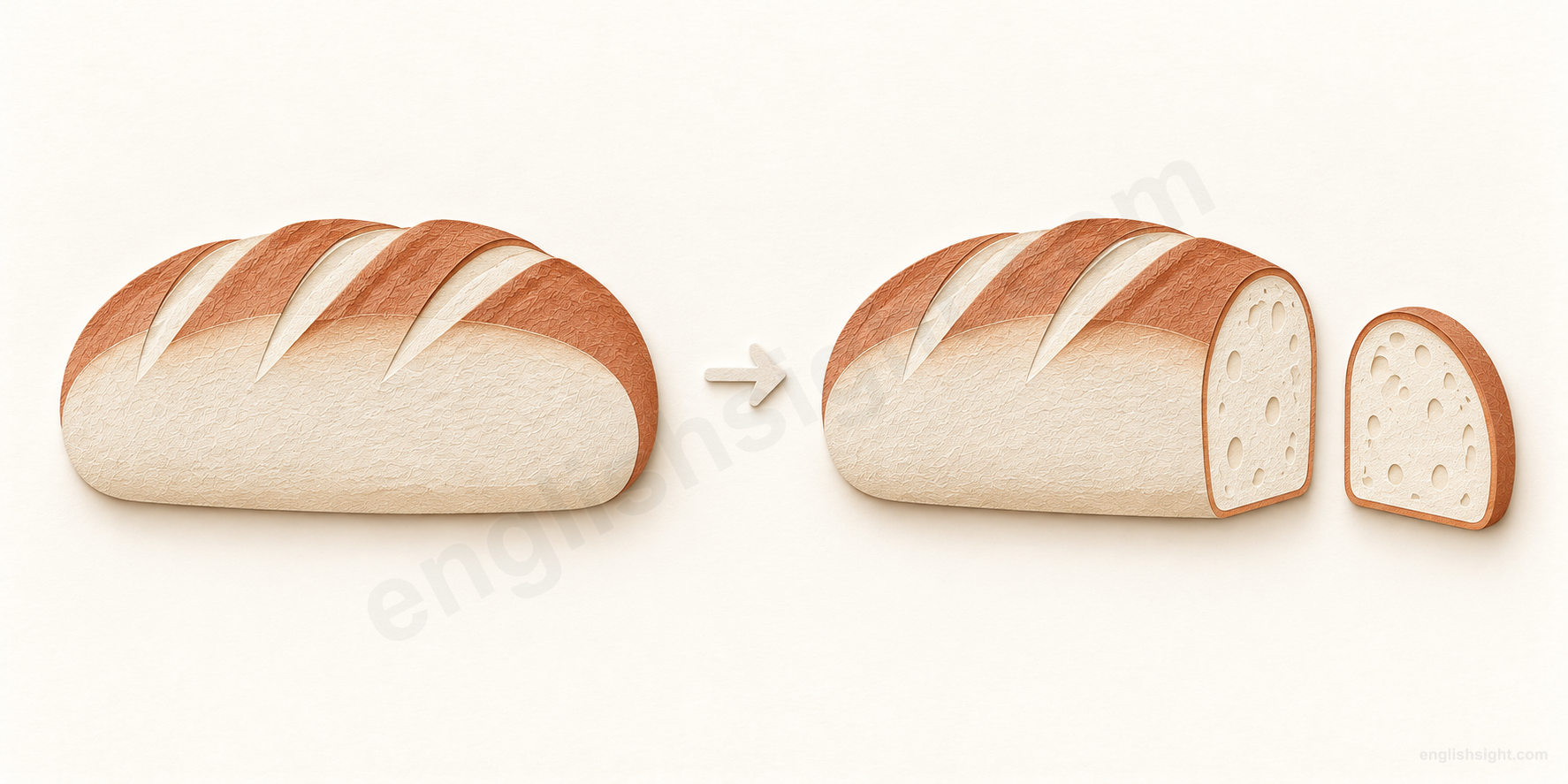
The food stays bread; the portion changes
Bread forms one whole loaf.
bread
The remaining loaf and its slice are still bread.
One thin slice is cut from the loaf.
Bread names the food; loaf and slice name its units and portions.
Bread names a flour-based food; a loaf or slice gives a whole unit or portion of that food.
The sketch uses one familiar loaf to show the food–portion distinction. Bread also includes flat and differently shaped kinds. The verb and idioms are explained separately; the picture is not a formula for predicting them.
Think of bread first as a food rather than a countable shape. A whole loaf and a cut slice can both be bread; words such as loaf and slice tell us what unit we mean.
Because bread is a basic food, it can also stand for nourishment or the means of living. Fixed expressions add meanings that must be learned in context. This is a teaching connection, not a shared mental picture claimed for every English speaker.
01
Food, quantities, and choices
Ask for the food, count its portions, and describe what kind or condition you want.
01
some / any / a little + bread; buy / bake / eat + bread
some bread
the flour-based food, without counting individual items
Situation
You are preparing soup for lunch.
What you express
You ask for bread to eat with it.
Bread names the food; it does not specify one loaf.
Bread is made from flour or meal mixed with liquid and usually baked. Many kinds rise; flat, unleavened kinds are bread too.
For an unspecified amount, say some bread or a little bread. Buy bread, bake bread, and eat bread describe different actions involving the same food. Bread is not the name for every food made with flour.
Example in context
Could you bring some bread to go with the soup?
Watch the difference For an ordinary quantity, avoid a bread or two breads; name the unit instead.
02
a loaf / slice / piece of bread; two loaves / slices / pieces of bread
a loaf / slice / piece of bread
count a whole baked unit or a smaller portion
Situation
You need enough bread for several sandwiches.
What you express
You request a definite number of portions.
The unit word, not bread, carries the ordinary count.
A loaf is a whole shaped mass of bread; a slice is a thin, flat portion cut from it. A piece is less specific about shape. Ask for two slices of bread or two loaves of bread.
Bread is normally uncountable when you mean the food. The plural of loaf is loaves. The diagram separates the amount of food from the unit used to count it.
Example in context
Please cut four slices of bread for the sandwiches.
Watch the difference Four breads does not normally mean four slices. Also say How much bread?, but How many slices?
03
type word + bread; different / several + breads
white / wholemeal / whole-wheat bread
identify a type of bread
Situation
A shop offers several varieties.
What you express
You choose bread by its ingredients or style.
A modifier identifies the kind; breads can count varieties.
White bread and brown bread name familiar categories. Wholemeal bread is the usual British term corresponding to whole-wheat bread in American English. Rye bread and sourdough bread describe other choices.
The bakery sells several breads means several kinds, rather than several unnamed slices. Compare We bought three loaves, which clearly counts whole units. Not all bread contains yeast.
Example in context
The bakery sells several breads, but I usually choose whole-wheat bread.
Watch the difference Do not assume brown automatically guarantees wholemeal ingredients; use the specific name when that distinction matters.
The describing word changes the condition, not the identity of the food.
Fresh bread is recently made or still in good condition; stale bread has lost its freshness. Crusty bread has a firm outer crust. Sliced bread is already cut into slices.
Toast is bread browned by heat. You can toast bread, but bake bread usually means make the bread itself. Bread and butter can also be literal: bread served with butter, rather than an income idiom.
Example in context
The bread is a little stale, so I’ll toast it for breakfast.
Watch the difference Stale describes lost freshness, not necessarily visible mould. Do not confuse stale with sliced.
02
A cooking verb
As a verb, bread describes adding a crumb coating to another food.
05
bread + food; be breaded; breaded + food noun
bread the fish; breaded fish
coat food with small dry bread pieces
Situation
The fish has no crumb coating.
What you express
Its surface is covered with breadcrumbs before cooking.
The object is the food receiving a coating, not a loaf being baked.
Bread as a transitive verb takes a food object: bread the fish. The noun becomes a verb meaning to apply a bread-crumb coating. It does not mean make bread.
You will often meet the passive or adjective: The fish is breaded; breaded chicken. The forms are breads, breaded, breading. Breadcrumbs are small bread particles; they are not the same as slices.
Example in context
Bread the fish before you put it in the pan.
Watch the difference Breaded fish is fish with a coating, not fish placed between bread slices.
03
Food becomes a way of talking about support
Bread can stand for basic nourishment, earning a living, or money. Context and register matter.
06
earn + possessive + bread; daily bread
earn your bread; daily bread
basic food or the means of supporting yourself
Situation
Someone needs food and other necessities.
What you express
Their work provides a way to live.
A staple food can stand for basic sustenance.
Earn your bread means earn a living. The noun refers to support rather than a particular bakery product. Earn a living is a neutral alternative in ordinary conversation.
Daily bread can mean the food and necessities people depend on, especially in religious or elevated language. It can also be literal in a context about buying bread each day; the surrounding sentence decides.
Example in context
She earns her bread by repairing musical instruments.
Watch the difference The expression does not imply that she is paid in actual loaves.
07
bread as an uncountable slang noun
bread (slang for money)
recognize an informal money meaning
Situation
Friends discuss the price of a used car.
What you express
Bread refers to the money needed to buy it.
This is a slang extension, not the default reading in a food shop.
In slang, bread can mean money: I need more bread. The meaning is established, not a rule allowing every food word to replace money.
Use money or cash when you want broadly neutral wording. No bread left can describe an empty bread bin or a lack of money; context is essential.
Example in context
I’d buy that car, but I haven’t got the bread.
Watch the difference In a formal payment request, write money, payment, or the amount rather than bread.
04
Established expressions
These whole expressions have conventional meanings. A picture of a loaf alone cannot explain all of them.
08
something + be + someone’s bread and butter
your bread and butter
the work or activity you mainly depend on for income
Situation
A designer has occasional large projects and steady small jobs.
What you express
The steady jobs pay the regular bills.
Basic food stands for the source of regular support.
Your bread and butter is the activity that provides your main income. It need not be your most exciting work. In literal food use, the same words simply refer to bread with butter.
A possessive often identifies the person or business supported: her bread and butter, our bread and butter. When the whole phrase is the subject and names one source of income, it takes a singular verb: Our bread and butter is repair work. In Repairs are our bread and butter, the subject is the plural noun Repairs, so the verb is are.
Example in context
Small repair jobs are the workshop’s bread and butter.
Watch the difference Do not interpret the phrase as a free choice of two foods; replacing butter with jam loses the established income meaning.
09
bread-and-butter + issues / concerns / work
bread-and-butter issues / work
basic practical concerns or dependable routine work
Situation
Voters are concerned about rent and wages.
What you express
A discussion focuses on everyday material needs.
The adjective highlights practical basics rather than literal food.
Bread-and-butter issues are concerns such as living costs and jobs that directly affect ordinary life. The phrase can describe matters beyond food.
Bread-and-butter work can be routine, dependable work that supports a business. Before a noun, hyphens help show the words form one modifier. The exact emphasis—basic needs, reliable work, or income—comes from the noun and context.
Example in context
The meeting focused on bread-and-butter issues such as rent and wages.
Watch the difference Do not treat the adjective as meaning edible or especially luxurious.
10
break bread with + person
break bread with someone
share a meal, often emphasizing company
Situation
Two families meet after a long separation.
What you express
They sit down to eat together.
The whole expression foregrounds eating together, not damaging food.
Break bread with someone can mean share a meal. It often has a warm or somewhat formal tone; have dinner with is an everyday alternative.
Literal breaking may be part of a meal, but the expression does not require a loaf to be physically broken. In Christian contexts it may refer to Communion, so check the setting.
Example in context
We broke bread with our new neighbours on Sunday.
Watch the difference Break has the past form broke and participle broken; this is a verb–noun expression, not a phrasal verb.
11
be / think something is + the best / greatest thing since sliced bread
the best / greatest thing since sliced bread
enthusiastic or exaggerated praise
Situation
Someone discovers a tool that makes work easier.
What you express
They describe it as a wonderful invention.
The fixed comparison expresses an opinion, not a historical test.
Calling something the best thing since sliced bread praises it as unusually useful or impressive. The greatest thing since sliced bread is a familiar variant.
The praise can be playful or exaggerated. It can also be reported skeptically: He thinks it’s the best thing since sliced bread may suggest the speaker is less convinced. Read the tone.
Example in context
Maya thinks her new kitchen timer is the best thing since sliced bread.
Watch the difference Since belongs to the fixed comparison; it is not giving the date when this timer was invented.
12
know which side + possessive + bread + is buttered on
know which side your bread is buttered on
know where your advantage or support comes from
Situation
A consultant relies on one client for most of her work.
What you express
She takes care to keep that client happy.
The idiom concerns self-interest and useful relationships.
The expression means recognize what benefits you and whom it is useful to please. The possessive changes with the person: I know which side my bread is buttered on.
It may sound knowingly practical or mildly critical of someone’s self-interest. The passive is buttered is part of the established wording; the phrase is not an instruction about spreading butter.
Example in context
He always makes time for his biggest client; he knows which side his bread is buttered on.
Watch the difference Do not replace which side with where and expect the same familiar wording.
13
take the bread out of + someone’s + mouth
take the bread out of someone’s mouth
deprive someone of a way to earn a living
Situation
A small shop depends on a few regular contracts.
What you express
Losing them threatens the owner’s income.
Removing bread figuratively removes the means of support.
This vivid expression describes taking away someone’s livelihood. The loss may result from competition or a decision affecting work; no literal food theft is required.
It is emotionally stronger than reduce someone’s income. Use the whole expression deliberately, rather than as a neutral description of any small financial change.
Example in context
The owner said the cancelled contracts would take the bread out of her mouth.
Watch the difference The possessive identifies the person whose support is threatened, not the person taking it away.
Keep the unit, meaning, and register clear
Pronunciation and countability
Bread is pronounced /bred/, rhyming with red; its ea does not sound like the ea in bead. Use bread for the food, loaves for whole units, and slices or pieces for portions. Breads can identify varieties.
Noun and verb do different jobs
Bake bread makes the food. Bread the fish gives the fish a crumb coating; breaded is also used as an adjective. This cooking verb permits ordinary active and passive forms. There is no everyday particle-verb family to learn here.
Recognize the limits of the selection
Bread and circuses concerns distractions offered to keep people content or draw attention from problems, especially in political commentary. Cast your bread upon the waters is literary wording about doing good or taking a risk with little expected return. These are recognition notes, not beginner production targets. Detailed religious uses, specialist bread names, and compounds such as breadwinner are outside the main units.
Choose the meaning in context
Use the situation and the complete expression, not just the picture of a loaf.
1. You want two thin portions cut from a loaf. Which request is clearest?
2. A recipe says “Bread the fish.” What should happen?
3. “Repairs are our bread and butter.” What does the workshop mean?
4. A bakery says “We offer six different breads.” What is the natural interpretation?
5. “We broke bread with the neighbours.” What does this expression usually mean in a social setting?
Sources and teaching notes
The dictionary pages below support the meanings and usage notes. Explanations, example sentences, and the compatibility sketch are original teaching material. The sketch is not a completed AI illustration.
The diagram illustrates a food–portion distinction. It is a teaching aid, not a picture shared by every native speaker.