From one intake of air to pauses, suspense, and refreshing change.
Air in, air out
Air in, air out
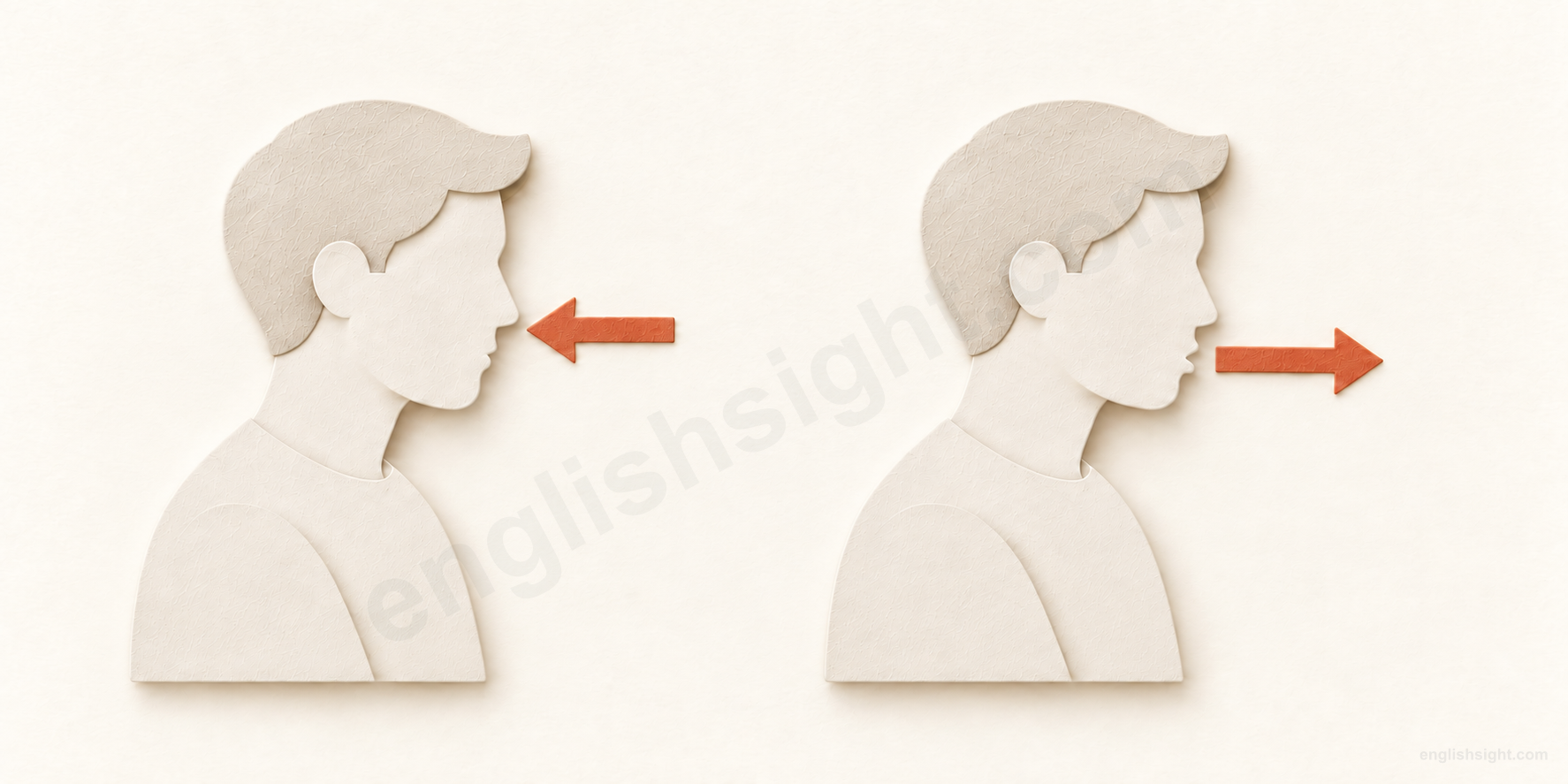
Air moves toward the nose.
breath
Air moves away from the mouth.
The same person breathes in, then breathes out.
Breath is the air taken in and sent out during breathing.
Breath is the air taken into and sent out of the lungs, or one intake of that air considered as a unit.
The picture shows the physical starting point. A breeze, a faint trace, and idioms about talking or expectations require their own explanations; the picture does not predict every phrase.
Breath names the air involved in breathing and, when counted, one intake or breathing event. Breathe is the related verb: take a breath, but breathe slowly.
Many expressions connect breathing with effort, speech, and emotion. Others are fixed comparisons. The diagram offers a starting point for learning these connections, not a claim about one image shared by all English speakers.
01
Air and individual breaths
Breath is a noun. It can name the air involved in breathing, or one intake or release considered as a unit.
01
possessive + breath; bad breath; a smell on someone’s breath
your breath; bad breath
the air you breathe, especially as it leaves your mouth
Situation
You breathe near a cold window.
Meaning in context
A small patch of mist forms on the glass.
Breath names the air or a noticeable effect of breathing, rather than the action verb.
Your breath can be warm, visible in cold conditions, or noticeable by its smell. Bad breath means unpleasant-smelling breath; a smell can also be on someone’s breath.
Here breath is normally uncountable: Her breath smelled of coffee. The plural breaths instead counts individual breathing events. The same noun shifts its grammar with the meaning.
In a sentence
I could smell coffee on his breath.
Watch the difference Say He has bad breath, without a before bad breath. Use breathe for the verb.
02
take / draw in + a breath; let out + a breath; adjective + breaths
take a deep breath
take air into your lungs once
Situation
You are about to begin a difficult conversation.
Meaning in context
You take air in before speaking.
A breath is one countable intake; take supplies the action.
Take a breath treats one intake of air as a unit. Deep and shallow describe its depth; taking a few slow breaths involves several such events. Draw in a breath also describes taking air in.
Let out a breath describes releasing air. She let out a long breath of relief connects that release with feeling less worried. A deep breath may help someone pause before acting, but calmness is supplied by context, not guaranteed by breath.
In a sentence
Mara took a deep breath before asking her question.
Watch the difference Use the noun after take: take a breath. Breathe deeply uses a verb plus an adverb.
03
hold + possessive + breath
hold your breath
temporarily stop breathing
Situation
Air has entered the lungs.
Meaning in context
For a short time, no air is taken in or released.
Hold describes a temporary interruption of the breathing cycle.
In the literal use, the person stops breathing briefly. Hold your breath does not mean stop talking while breathing normally.
The possessive follows the person: I held my breath; she held her breath. Tense or surprised situations can instead give this phrase a figurative reading, discussed below.
In a sentence
She held her breath for a moment when the strong smell reached her.
Watch the difference Keep breath singular in the usual expression: hold your breath, not hold your breaths.
02
Effort, difficulty, and recovery
These expressions describe how breathing feels and whether it has returned to normal. Read the whole phrase to identify the state.
04
be / get + out of breath; leave someone out of breath
be out of breath
breathe hard after physical effort
Situation
You hurry up several flights of stairs.
Meaning in context
You need a moment before you can speak comfortably.
The phrase describes difficulty after effort, not a complete absence of air.
Out of breath is a state, often after running, climbing, or other exertion. The activity can leave someone out of breath.
The breathing cycle in the sketch is still happening. Out of is an established way to describe this difficulty; it does not mean that the person has stopped breathing.
In a sentence
The steep steps left us out of breath.
Watch the difference Say out of breath, without a or the. Out of air can describe an empty air supply and is not always interchangeable.
05
be / feel + short of breath; shortness of breath
be short of breath
have difficulty breathing comfortably
Situation
A person describes how their breathing feels.
Meaning in context
They report that getting enough air feels difficult.
The phrase reports a breathing difficulty without identifying its cause.
Short of breath overlaps with out of breath, but is also used when describing illness or other breathing problems. It is not restricted to being tired after exercise.
Shortness of breath is the related noun phrase. Short breaths, by contrast, counts brief individual breaths. These descriptions do not by themselves explain why the difficulty occurs.
In a sentence
He told the nurse that he felt short of breath.
Watch the difference Short of breath is not the same construction as a short breath. Do not infer a diagnosis from the expression.
06
gasp / struggle / fight + for breath
gasp for breath
struggle to take in air
Situation
Someone has been running hard.
Meaning in context
They take sudden, difficult breaths.
For points to the air the person is trying to obtain.
Gasp for breath presents an urgent or labored attempt to breathe. Fight for breath and struggle for breath make the difficulty explicit too.
A gasp can also be caused by surprise. With for breath, attention is on getting air, whereas a gasp of surprise identifies an emotional reaction.
In a sentence
After the final sprint, I leaned on the fence, gasping for breath.
Watch the difference Keep for in gasp for breath. Gasp is the verb; breath remains a noun.
07
catch + possessive + breath; get + possessive + breath + back
catch your breath; get your breath back
return to comfortable breathing after effort
Situation
You finish carrying boxes upstairs.
Meaning in context
After a pause, your breathing becomes easier.
Catch and get back present recovery, rather than taking one particular breath.
Catch your breath commonly means pause until breathing becomes normal again. Get your breath back is another familiar form, especially in British English; regain your breath is possible too.
Let me catch my breath can also request a brief rest before the next task. This is an established extension from physical recovery, not an instruction to catch an object.
In a sentence
Give me a minute to catch my breath before we move the sofa.
Watch the difference Catch your breath can also describe a sudden reaction to shock. Use the context to choose between recovery and surprise.
03
Breathing, pauses, and speaking
Speech uses outgoing air. Several established expressions connect breath with a pause, a low voice, or the effort of talking.
A breathing pause can stand for a brief break in an activity.
Pause or stop for breath highlights a break needed during speech or exertion. Hardly pause for breath emphasizes how continuously someone talks.
Draw breath can likewise mean take a short break, especially in British English; American English also uses draw a breath. It need not report an obvious breathing problem: After a week of meetings, we finally had time to draw breath.
In a sentence
She explained the whole problem, hardly pausing for breath.
Watch the difference Draw a deep breath can simply mean inhale. The pause or rest reading depends on the surrounding activity.
09
say / read / recite something + in one breath
in one breath
without pausing, or with almost no gap
Situation
A long announcement must be spoken.
Meaning in context
The speaker delivers it in one continuous stretch.
One breath measures continuity, not how quietly someone speaks.
For speech, in one breath can be literal: the words fit into one outgoing breath. It also describes a very rapid, uninterrupted stretch of speaking.
In one breath and in the same breath can overlap in the broader meaning almost at the same time. In the same breath often draws attention to inconsistent claims, explained separately.
In a sentence
She read the long station name in one breath.
Watch the difference In one breath concerns continuity; under your breath concerns a quiet voice.
10
say / mutter / swear + something + under + possessive + breath
mutter under your breath
say something very quietly
Situation
You are annoyed but do not want to start an argument.
Meaning in context
You make a remark in a low voice.
Under your breath describes the volume and often the wish not to be overheard.
Say, mutter, or swear under your breath means speak very quietly. A listener may still catch the words; the expression does not promise complete silence.
Under is part of a fixed phrase, not a physical position beneath the air. The possessive identifies the speaker: He muttered under his breath.
In a sentence
“Another delay,” she muttered under her breath.
Watch the difference Do not confuse this with out of breath: someone can speak under their breath while breathing normally.
Breath stands for the effort of speaking when speaking achieves nothing.
You are wasting your breath judges the attempt as ineffective, especially because the listener will not listen or change. It does not mean that the speech is too long or grammatically poor.
Save your breath tells someone not to make that ineffective effort. It can sound blunt or dismissive. Do not waste your breath arguing with him gives the activity with an -ing form.
In a sentence
You’re wasting your breath trying to persuade him; he has already decided.
Watch the difference The judgment is about the usefulness of talking. It does not literally tell someone to stop breathing.
12
say one thing + and / but + in the same / next breath + say another
in the same breath; in the next breath
say things close together, often with conflicting meanings
Situation
Someone says they support your decision.
Meaning in context
Almost immediately, they criticize you for making it.
The phrase often highlights an inconsistency between closely connected statements.
In the same breath can simply connect things said almost together, but a familiar use criticizes a contradiction or striking contrast. In the next breath makes the immediate switch explicit.
The words need not literally share one exhalation. Compare in one breath for speaking without a pause; its emphasis may be continuity rather than inconsistency.
In a sentence
He called the rules essential and in the same breath said nobody should follow them.
Watch the difference Do not require an actual measured breath. The point is how the two statements relate.
04
Surprise, suspense, and expectations
Breathing can change when people are startled or tense. The expressions here also have conventional figurative meanings.
13
catch + possessive + breath + (in surprise / when-clause)
catch your breath in surprise
suddenly interrupt your breathing because you are startled
Situation
You open a box and find something unexpected.
Meaning in context
For a moment, your breathing catches.
The emotional event triggers a brief reaction, rather than recovery after exertion.
Catch your breath also describes the sudden effect of shock, fear, or surprise. Here the situation interrupts normal breathing; it is not a rest after exercise.
The surrounding words do the disambiguating: She stopped to catch her breath after the climb describes recovery; She caught her breath when the door slammed describes a startled reaction.
A sharp intake of breath is a sudden drawing-in of air, often in reaction to surprise. The noun intake names the inward movement; it is different from pausing to recover after effort.
In a sentence
I caught my breath in surprise when I saw my name on the winner’s card.
Watch the difference Do not give catch your breath one fixed translation for every context.
14
hold + possessive + breath + while / as + clause
hold your breath while waiting
wait in a tense, expectant way
Situation
The final result is about to appear.
Meaning in context
Everyone waits anxiously for it.
A temporary pause in breathing becomes an image of suspense.
People may actually hold their breath briefly when tense, but this expression can describe anxious or excited waiting without a literal breathing report.
The group can be figurative too: The whole town held its breath. The wording emphasizes shared suspense, not a simultaneous physical action by every resident.
In a sentence
We held our breath as the final score appeared on the screen.
Watch the difference This expectant use differs from the skeptical negative expression don’t hold your breath.
15
don’t hold your breath; not be holding your breath; wouldn’t hold your breath
don’t hold your breath
do not expect something soon, or perhaps at all
Situation
Someone promises a reply today.
Meaning in context
You doubt the reply will actually arrive.
Negation creates a conventional warning against confident expectation.
Don’t hold your breath is an informal response to a doubtful promise or forecast. It says that waiting eagerly is unlikely to be rewarded soon.
I’m not holding my breath and I wouldn’t hold my breath express the speaker’s skepticism. They do not necessarily rule the event out completely; tone can be humorous or cynical.
In a sentence
They say the lift will be fixed tomorrow, but I’m not holding my breath.
Watch the difference In this context the phrase comments on expectations, not a breathing technique.
16
wait / watch / listen + with bated breath
with bated breath
with intense anticipation or suspense
Situation
A performance is reaching its most uncertain moment.
Meaning in context
The audience watches, eager and tense.
The fixed phrase describes the manner of waiting, watching, or listening.
Wait, watch, or listen with bated breath presents anxious or excited attention to what comes next. The phrase has a formal or dramatic tone.
Learn bated as part of this expression. It suggests breath held back, but the whole phrase need not describe a literal interruption in breathing.
In a sentence
We watched with bated breath as the final performer stepped onto the stage.
Watch the difference The spelling is bated, not baited. Do not replace the fixed adjective with an unrelated word.
17
something + take + someone’s breath + away
take someone’s breath away
overwhelm someone with beauty or surprise
Situation
You see a spectacular view for the first time.
Meaning in context
You feel an immediate, powerful reaction.
The thing causing the reaction is the subject; the affected person appears in the possessive.
The view took my breath away says that the view was extraordinarily beautiful or surprising. It usually expresses an impression rather than actual inability to breathe.
Surprise can be positive or negative: The price took my breath away can express shock at the cost. In take my breath away, my modifies breath; breath is the object of take.
In a sentence
The view of the snowy valley took my breath away.
Watch the difference Use the affected person’s possessive: took her breath away, not took she breath away.
05
Freshness, faint traces, and life
Some extensions compare a change or a small amount with moving air; others use a final breath to refer to the end of life. Register matters.
18
go / step outside + for a breath of (fresh) air
go out for a breath of fresh air
spend a short time outside breathing fresher air
Situation
You have spent hours in a warm, stuffy room.
Meaning in context
You step outside for a change of air.
Here the expression keeps a literal connection to breathing.
A breath of fresh air can mean some clean or refreshing air after being indoors. For a breath of air is also possible in this situation.
You usually mean a short outside break, not exactly one measured inhalation. Compare a person who is a breath of fresh air: that is an approving metaphor, not an outdoor activity.
In a sentence
I stepped outside for a breath of fresh air during the break.
Watch the difference For introduces the purpose of going outside. Be a breath of fresh air has a different use.
19
person / thing + be + a breath of fresh air
be a breath of fresh air
be a welcome, refreshing change
Situation
Meetings have become repetitive and unhelpful.
Meaning in context
A new approach makes them lively and useful.
Fresh air becomes a comparison for something pleasantly different.
A person, approach, or other change can be a breath of fresh air when it makes a stale situation feel interesting or refreshing. The expression normally shows approval.
The subject is what makes the difference: Her direct style is a breath of fresh air. It does not mean that every new person or idea deserves this description; the positive response matters.
In a sentence
The new teacher’s practical lessons are a breath of fresh air.
Watch the difference Keep a in the metaphor: She is a breath of fresh air. This does not describe her breathing.
20
a breath of wind / air; not / without a breath of wind
a breath of wind
a very slight movement of air
Situation
The water is smooth and the leaves do not move.
Meaning in context
You notice how still the air is.
A small puff of breath provides a comparison for a tiny breeze.
A breath of wind or air describes a slight breeze, especially in literary description. It often appears in negative expressions emphasizing stillness.
Not a breath of wind means there is no detectable breeze. This is a conventional use outside the body; it does not suggest that wind has lungs.
In a sentence
There was not a breath of wind on the lake that evening.
Watch the difference This wording is descriptive and literary. A slight breeze is a plainer alternative.
21
a breath of + abstract noun
a breath of suspicion
a slight trace or suggestion
Situation
A decision appears honest to most people.
Meaning in context
Even a tiny suggestion of dishonesty would damage trust.
Breath of can describe a small amount, but it is not a general counting rule.
In formal or literary writing, a breath of suspicion or scandal means a faint suggestion of it. Breath of common sense can similarly suggest a small welcome amount.
This resembles the slightness of moving air, but the combinations are conventional. Do not freely replace a little with a breath of before any noun.
In a sentence
The report must be clear enough to avoid even a breath of suspicion.
Watch the difference This sense is mainly useful for recognition in writing; a hint of suspicion is a more ordinary alternative.
22
take / draw + possessive + last breath; with + possessive + dying breath; until + possessive + last breath
someone’s last breath
the final moment of life
Situation
A story describes the end of a person’s life.
Meaning in context
The person takes their final breath.
Breathing stands for continued life; the last breath marks its end.
Take or draw one’s last breath is a literary way to say die. With her dying breath can introduce words spoken at the end of her life.
Until my last breath or to my last breath can make a solemn promise to continue for the rest of one’s life. These phrases are much stronger than saying until I am tired.
In a sentence
“I will defend this place until my last breath,” the character declares.
Watch the difference Last breath normally refers to death or a solemn lifetime commitment; it is not a casual synonym for the end of a conversation.
Keep the noun and the whole phrase clear
Breath and breathe sound different
Breath /breθ/ is a noun, with a short vowel and a voiceless ending as in thin. Breathe /briːð/ is a verb, with a longer vowel and a voiced ending as in this. Use a deep breath or breathe deeply. Countable plural: breaths.
Count the events, not the substance
Bad breath and short of breath use uncountable breath. A breath and three breaths count individual events. The possessive in hold her breath or catch my breath normally refers to the person breathing.
Idioms are complete expressions
Under, out of, in the same, and with bated contribute established phrase meanings. These noun expressions are not a family of phrasal verbs built from a verb breath. Learn their wording, context, and tone together.
What this lesson leaves for later
The breath of life meaning an essential source of vitality, literary draw breath meaning be alive, archaic vapor or spirit senses, and technical phonetics uses are outside the main practice. The verb breathe and derivatives such as breathless, breathtaking, and breather need their own grammar.
Choose the meaning in context
Check whether the sentence concerns air, recovery, speaking, or an established figurative meaning.
1. Which sentence uses the noun and verb correctly?
2. After carrying the boxes upstairs, Lee stopped to catch his breath. What does this mean?
3. The repair company promises to call today. “Don’t hold your breath,” says your friend. What is the friend suggesting?
4. Nora said the complaint under her breath. How did she say it?
5. “Your clear explanations are a breath of fresh air.” What is being praised?
6. He demanded complete freedom and in the same breath asked for strict control. What does the phrase highlight?
Sources and teaching notes
Noun senses and established phrases were checked against the publisher pages below. The explanations, examples, exercises, and visual teaching model were created for this lesson.
The diagram is a teaching aid for the physical starting point of breath.