From building blocks and materials to barriers, devices, and fixed expressions.
From one block to a wall
One solid block, part of a larger structure
One brick is a separate building unit.
brick
One unit forms part of a larger wall.
Individual bricks are placed together.
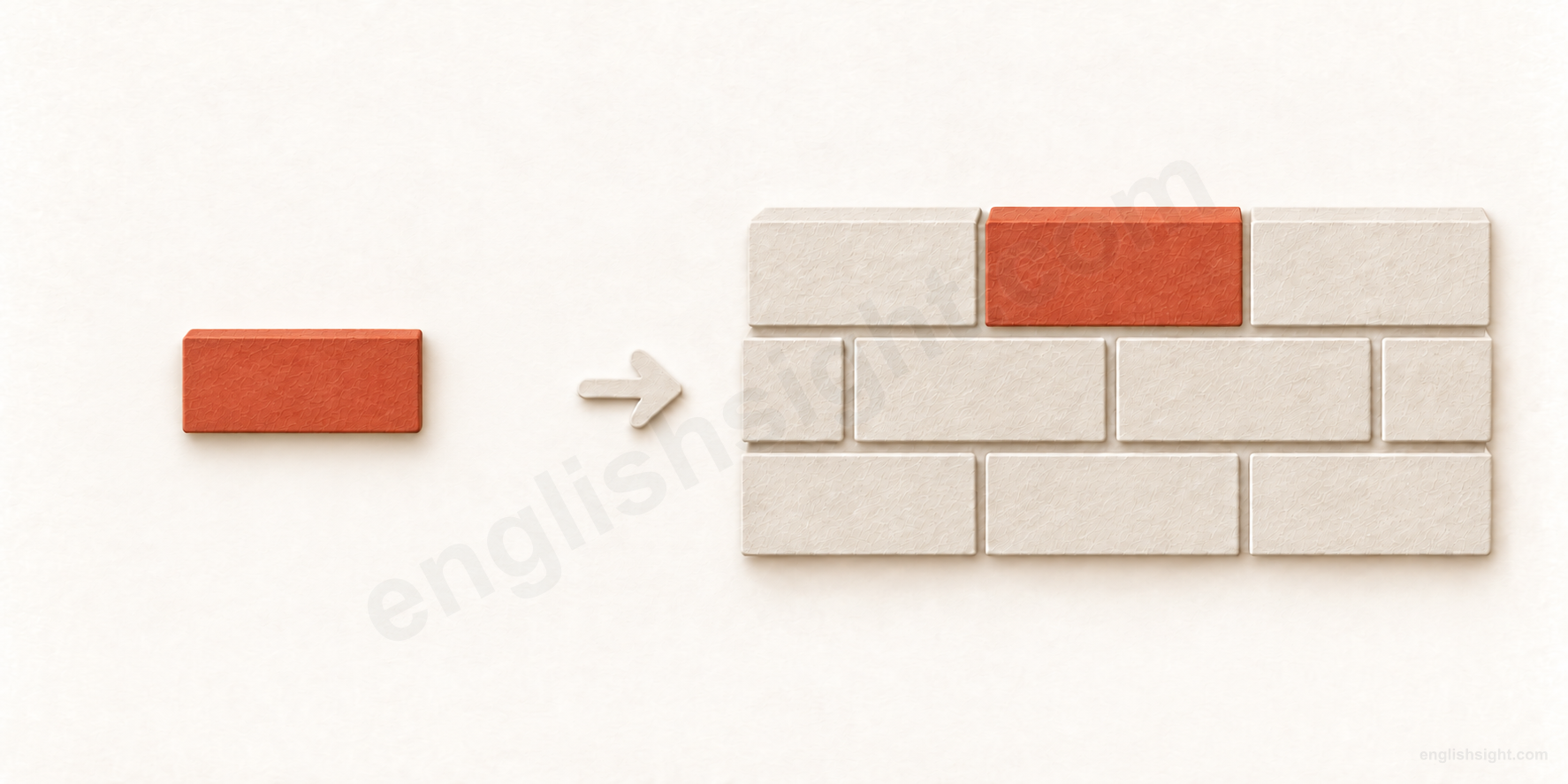
One brick is a building unit; many bricks together form a wall.
A brick is a small, usually rectangular building unit; placing such units together forms a larger structure such as a wall.
The diagram connects the individual unit with a wall made of units. Shape, solidity, and weight can support useful comparisons, but fixed expressions and specialist uses must be learned separately.
Start with a small solid block used in building. Many bricks placed together form a wall. English can count the individual units, treat brick as a material, or use the familiar block shape in a new setting.
The wall also helps explain some comparisons about resistance and weight. It cannot predict every idiom: a helpful person, a ruined phone, and a tactless remark need their own context. This is a teaching connection, not a claim that every English speaker sees the same picture.
01
One block, a material, and building work
Count separate bricks, describe a surface made of brick, and use the verbs for putting bricks in place or filling an opening.
01
a / one + brick; number + bricks; brick + noun
a brick / bricks
an individual block used in building
Situation / starting point
A wall has a damaged section.
Meaning in context
You count the replacement pieces.
One brick is a unit; bricks are separate units.
A brick is a building block, typically rectangular and made from hardened clay. Use a countable noun when the individual pieces matter: one brick, two bricks, a pile of bricks.
In a brick wall or a brick house, brick comes before another noun to identify the building material. It normally stays singular there: brick walls. Red brick describes color and material; bricks are not necessarily red.
In a sentence
We need twelve bricks to repair this corner.
Watch the difference Say two bricks, but two brick walls. The walls, not the material modifier, take the plural ending.
02
be made / built of + brick; red / exposed + brick
made of brick
brick considered as a building material
Situation / starting point
Someone asks what the wall is made of.
Meaning in context
You identify its material rather than count pieces.
Uncountable brick names the material as a whole.
The wall is made of brick treats brick as material. The wall is made of bricks is also possible and draws attention to the separate units. The contrast is viewpoint, not two different substances.
Compare brick with clay, stone, and concrete. Clay is a substance from which many bricks are made; brick is the building product. A stone wall and a brick wall describe different materials, though both can consist of many pieces.
In a sentence
The extension is built of brick rather than wood.
Watch the difference Do not add a to the material use: built of brick. Built with a brick would single out one piece.
put bricks in place; build or dismantle one unit at a time
Situation / starting point
The wall is not yet complete.
Meaning in context
Each added unit contributes to the structure.
Lay names placement; brick by brick names the unit-by-unit process.
Builders lay bricks: they put them in their positions to form a wall or another structure. Lay is transitive: lay bricks, laying bricks, laid bricks. A bricklayer is a person whose work involves this skill.
Brick by brick can describe building, taking down, or moving a structure in separate pieces. It can also be used figuratively for gradual progress: We rebuilt their trust brick by brick. By contributes the repeated-unit pattern, as in step by step; brick alone does not mean gradually.
In a sentence
The team rebuilt the garden wall brick by brick.
Watch the difference Lay bricks describes placing the pieces. Make bricks describes producing them; these are different activities.
04
brick + opening + up / in; brick up + opening; be bricked up
brick something up / in
fill an opening with bricks
Situation / starting point
An old doorway still has an opening.
Meaning in context
A wall of bricks closes the opening.
Brick supplies the material; up or in forms the established closing construction.
You can brick up a doorway, brick a doorway up, or brick it up. The object is the opening being filled, not the bricks themselves. With a pronoun, put it between the verb and the particle.
Brick in is also used for filling an opening. A passive is natural when the result matters: The doorway was bricked up years ago. Bricking up is the ongoing work; bricked up describes the completed closure.
Related literal construction uses include brick over a surface, meaning cover it with brick. These are material-specific actions: board up uses boards instead, and block up need not specify the material.
In a sentence
They bricked up the unused doorway to create a solid wall.
Watch the difference Do not say brick up it. Say brick it up. An ordinary locked door has not necessarily been bricked up.
02
Other things shaped like bricks
Toys, compact blocks of other substances, and a computer’s power supply use the shape connection. Their material and purpose come from context.
05
building / toy / plastic / wooden + bricks
building bricks
small toy blocks for making models
Situation / starting point
Children have a box of pieces.
Meaning in context
They fit or stack the pieces to make a model.
The building function remains, while the material and scale change.
In British English especially, bricks can be plastic or wooden toy blocks. Building bricks or toy bricks makes the play context clear. Building blocks is a useful broader alternative.
Here building tells you what the pieces are used for; it does not say they are real masonry. A model castle made from plastic bricks is not a castle made of baked clay.
In a sentence
The children made a small bridge from wooden bricks.
Watch the difference Check the context before assuming bricks are heavy clay objects; toy bricks can be light and colorful.
06
a brick of + substance; a gold brick
a brick of ice cream
a compact rectangular block of another substance
Situation / starting point
Ice cream has been packed into a rectangular shape.
Meaning in context
You describe the block’s form.
The shape is brick-like; the material is named after of.
A brick of ice cream is a block resembling a building brick in shape. A brick of gold similarly describes a solid block; gold bar is another familiar expression.
The structure a brick of + substance lets you count blocks of something that is otherwise often uncountable. It does not mean that the substance is clay or that you would use it to build a wall.
In a sentence
We sliced a brick of ice cream into six portions.
Watch the difference Use brick for a block-like form, not for every container or quantity: a scoop of ice cream describes a different shape.
07
a / the + power brick
a power brick
the block-shaped part of a computer’s power supply
Situation / starting point
You pack a laptop and its charging equipment.
Meaning in context
You include the bulky power-supply block.
Brick refers to the rectangular shape of a working component.
A power brick is the rectangular block in a computer’s external power supply. In a laptop bag, the cable and the power brick are related items, but the brick names the block rather than just the wire.
This compound does not imply a fault. A power brick can work normally. Compare the informal description My phone is a brick, where the whole device may be useless.
In a sentence
I packed the laptop but left its power brick at home.
Watch the difference Power brick and power bank are not interchangeable names: this use concerns power-supply equipment, not specifically a portable battery.
03
Devices and basketball
These informal uses need a specific setting. A useless phone and a badly missed shot are not additional kinds of building material.
08
something + bricks + device; be bricked; a device is a brick
brick a phone / a bricked phone
make a device unusable; describe a device as useless or bulky and outdated
Situation / starting point
An electronic device works before a failed change.
Meaning in context
It no longer functions as a usable device.
The verb describes loss of function; the noun can also make a joke about an old device.
In informal technology talk, to brick a phone or router is to render it nonfunctional, for example through a failed software change. The cause is the subject and the affected device is the object. A bricked phone or My phone was bricked presents the resulting condition.
This is stronger than saying an app crashed or a battery needs charging. The brick image suggests a device that is about as useful as an inert block; it does not promise that recovery is impossible in every technical case.
As a noun, an old brick can also mean an old, bulky device even if it still works: My father still uses that old brick. Read the context to distinguish outdated shape from loss of function.
In a sentence
The failed update bricked my router, and it no longer starts.
Watch the difference A power brick is a component, not automatically a broken device. This technology verb does not need up.
09
a brick; brick + a shot / free throw
a brick / brick a shot
a badly missed basketball shot; miss a shot very badly
Situation / starting point
A player attempts a shot.
Meaning in context
The attempt is a very poor miss.
In basketball slang, brick evaluates the shot, not the ball’s material.
Basketball speakers can call a badly missed shot a brick. Brick can also be a transitive verb: brick a shot or brick a free throw. It expresses a notably poor miss rather than any successful attempt.
This sports use is separate from construction and technology. Do not infer from the noun that the player threw an actual brick, and do not use it as the neutral general verb for playing basketball.
In a sentence
He bricked the final free throw.
Watch the difference Use this informal meaning when basketball provides the context; miss is the broader neutral verb.
04
Buildings, barriers, and established expressions
Some phrases use the solidity, weight, or physical presence of bricks. Others must be learned as whole expressions, with their tone and regional limits.
10
invest in / put money into + bricks and mortar
bricks and mortar
buildings or property, often considered as an investment
Situation / starting point
Someone compares different kinds of assets.
Meaning in context
They talk about money put into property.
The building materials stand for the buildings themselves.
Bricks and mortar can refer to houses and other buildings, especially as property. Mortar is the material between bricks; together the words can stand for a whole building rather than a shopping list of raw materials.
The investment meaning depends on context. Someone discussing repairs may mean literal bricks and literal mortar. The expression itself does not say that property is profitable or a good purchase.
In a sentence
Her savings are tied up in bricks and mortar.
Watch the difference This expression names property, not a guarantee about its value. Keep the plural bricks in this noun phrase.
11
brick-and-mortar / bricks-and-mortar + store / business
a brick-and-mortar store
a business with physical premises where customers can go
Situation / starting point
You compare shopping online with visiting a shop.
Meaning in context
You identify a business’s physical retail presence.
Physical premises, rather than wall material, are the contrast.
A brick-and-mortar store serves customers in a physical building. The business can also sell online; the expression distinguishes its physical presence, not an absolute ban on internet sales.
Bricks-and-mortar is also an accepted form. These multiword modifiers are normally hyphenated before a noun: brick-and-mortar shops. A shop can have glass walls and still be a brick-and-mortar business.
In a sentence
The website lists products, but the company also has two brick-and-mortar stores.
Watch the difference Do not read the expression as a statement that the building must literally be made of bricks.
12
hit / come up against / be up against + a brick wall
hit / come up against a brick wall
reach a difficulty that stops progress
Situation / starting point
A project is moving forward.
Meaning in context
A barrier prevents further progress.
A solid wall is a metaphor for an obstacle.
In informal English, hit a brick wall and come up against a brick wall mean encounter something that prevents progress. The obstacle may be a rule, lack of information, or refusal to cooperate; there need not be a physical collision.
Be up against a brick wall describes the blocked situation rather than the moment you encounter it. The speaker presents the obstacle as serious; the phrase does not establish that no solution could ever exist.
In a sentence
The investigation hit a brick wall when the records turned out to be missing.
Watch the difference Do not confuse hit a brick wall with hit the wall in sports or fatigue contexts. Learn the complete phrase for this obstacle meaning.
13
be banging + possessive + head against a brick wall; like banging one’s head against a brick wall
bang your head against a brick wall
keep trying without getting a useful response or result
Situation / starting point
You repeat an argument or attempt.
Meaning in context
Nothing changes despite your continued effort.
The expression emphasizes repeated ineffective effort, not merely an obstacle.
This informal idiom often describes trying to persuade someone who will not listen. The head-against-wall image conveys frustration and futility; it does not normally report physical injury.
Compare We hit a brick wall, which can simply report reaching a barrier. I’m banging my head against a brick wall adds the sense of repeatedly trying without effect. The possessive matches the person: she is banging her head, not my head.
In a sentence
Explaining the same rule to them again felt like banging my head against a brick wall.
Watch the difference In this idiom, the person’s own head is the grammatical object. It is not advice to strike anything.
14
come down on + person + like a ton of bricks; something hits + person + like a ton of bricks
like a ton of bricks
with overwhelming force or severity
Situation / starting point
An event or criticism reaches someone.
Meaning in context
Its effect feels very strong.
The heavy load provides a comparison; the whole construction selects the effect.
In informal English, come down on someone like a ton of bricks means criticize or reprimand them very severely. The person or authority doing the criticizing is the subject; on introduces the person criticized.
With hit, the comparison can describe the force of news or an emotion: The loss hit me like a ton of bricks. That is emotional impact, not necessarily criticism. Ton intensifies the weight image; no actual measurement is intended.
In a sentence
The supervisor came down on us like a ton of bricks for ignoring the safety rule.
Watch the difference Keep on in come down on someone. The meaning comes from the full expression, not from brick meaning angry.
15
person + be + a (real) brick
You’re a brick.
you are a dependable, helpful person
Situation / starting point
Someone helps you when you need support.
Meaning in context
You praise that person warmly.
This is an established compliment, not a literal classification.
In old-fashioned informal British English, calling someone a brick praises their helpfulness or reliability. A real brick strengthens the compliment. The subject is a person, and a brick is a description of that person.
The idea of solidity may help you remember dependable support, but the accepted expression must be learned. It does not mean that all brick comparisons are compliments. You’re a star or You’ve been a great help will often be easier contemporary choices.
In a sentence
Thanks for collecting me from the station—you’re a real brick.
Watch the difference This is marked old-fashioned and informal. Do not treat it as a neutral description for every situation or region.
16
drop a brick; realize that + person + has dropped a brick
drop a brick
make a tactless remark that causes embarrassment or offence
Situation / starting point
You speak without realizing a subject is sensitive.
Meaning in context
Your comment upsets or embarrasses someone.
The social mistake is the established idiomatic meaning.
Drop a brick is an informal expression especially associated with British English. It often describes an unintended tactless or indiscreet remark, such as mentioning a private matter in front of other people.
The literal sentence I dropped a brick can describe an accident during building work. In conversation about an awkward remark, the same words form an idiom. Brick itself does not generally mean every sort of mistake.
In a sentence
I dropped a brick by asking about a party she hadn’t been invited to.
Watch the difference For a neutral international alternative, say I made a tactless remark or I said the wrong thing.
17
be bricking it; brick it
be bricking it
be very frightened
Situation / starting point
A frightening event is about to happen.
Meaning in context
You describe intense fear in slang.
The whole fixed expression conveys fear; it is not a literal object.
Brick it is mainly British slang for being very frightened. The continuous form is familiar in a scene such as waiting for a difficult test: I was bricking it. It is a fixed part of this expression, not a pronoun whose referent you must identify.
Compare I bricked it after updating the phone: there it can be a real pronoun referring to the phone, and brick is the technology verb. The surrounding event and grammar decide which meaning is intended. For neutral speech, say I was terrified or I was very nervous.
In a sentence
Before the interview, I was bricking it.
Watch the difference This is slang, not a neutral expression for formal writing. Do not infer its meaning from brick up an opening.
Keep material, metaphor, and register distinct
Pronunciation and forms
Brick is pronounced /brɪk/. The ordinary count plural is bricks. The verb forms are brick, bricks, bricked, bricking; bricked ends with /kt/. Building and technology uses can take an object and a passive. The noun’s material use is uncountable.
A picture is a guide, not a word-building rule
Solidity may help you remember an obstacle and weight may help with a strong impact. It does not license invented meanings for new brick phrases. This lesson distinguishes transparent combinations, specialist meanings, and established idioms.
Recognition and scope
The lesson prioritizes building, everyday objects, technology, physical businesses, and familiar figurative expressions. Basketball is included for its setting; the helpful-person use is old-fashioned British English, drop a brick is especially British informal, and brick it is mainly British slang. Other literary, regional, offensive, and technical expressions are outside this selection.
Read the whole expression
Choose the sentence that fits the context, including its grammar and register.
1. You need three separate pieces to repair a wall. Which wording counts the pieces?
2. An old opening has been filled with a wall of bricks. Which sentence describes that result?
3. A failed software change leaves a router unable to start. Which informal description fits?
4. A shop serves customers in a building with glass walls and also sells online. Which description can still be correct?
5. You keep explaining a problem, but nobody listens and nothing changes. Which idiom emphasizes the repeated ineffective effort?
6. At dinner you mention a private matter and embarrass your host. Which British informal idiom describes your social mistake?
Sources and teaching notes
Dictionary entries were consulted for meanings, constructions, and usage labels. The explanations, examples, and diagram are original teaching material; the visual connections are teaching interpretations.
The diagram offers a teaching connection, not a picture shared by every native speaker.