From a route over a river to links between people, ideas, and stages.
Separated sides, then a connection
Separated sides, then a connection
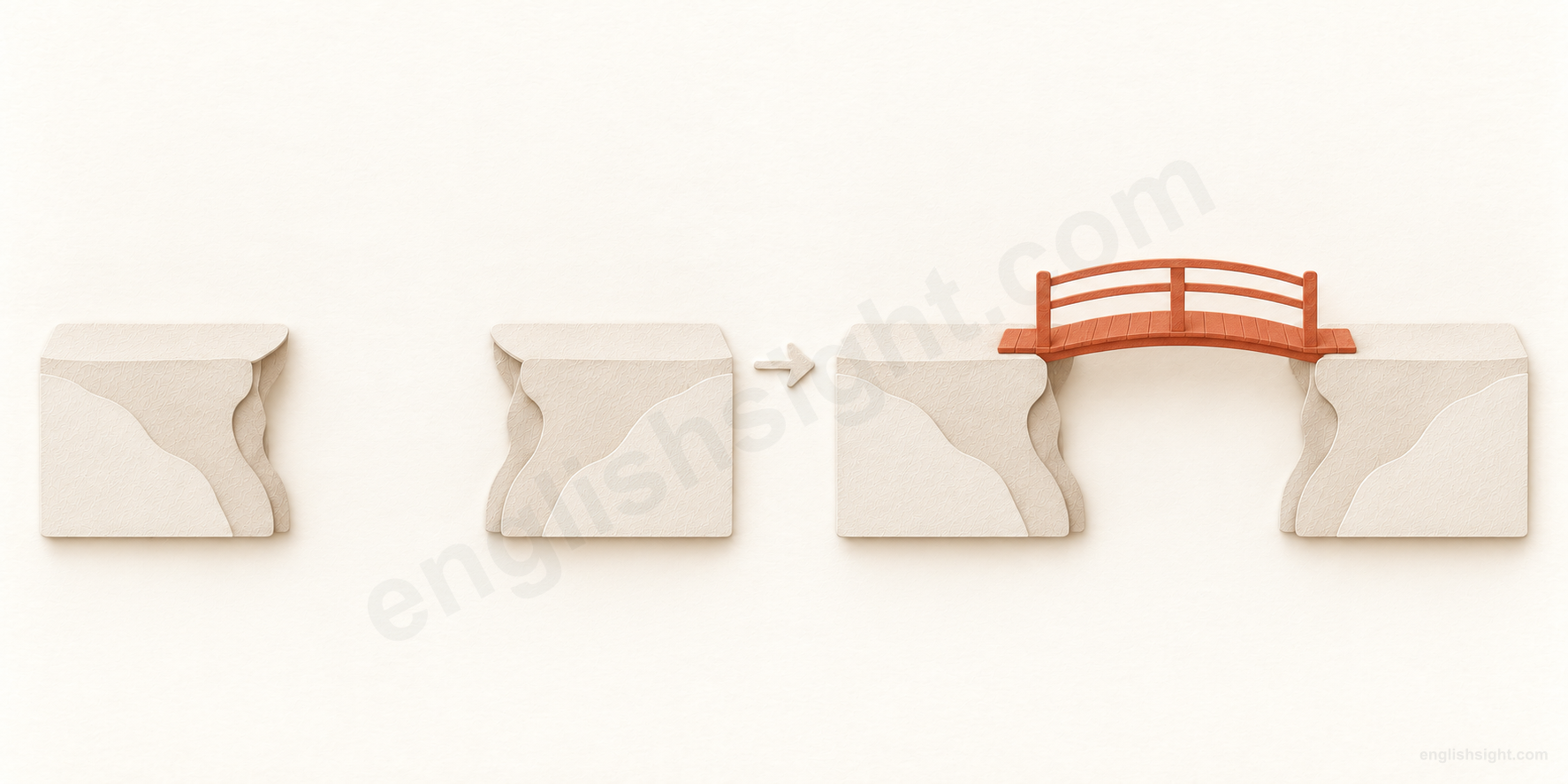
Two banks are separated by an open gap.
bridge
The bridge connects the banks; the space below remains open.
A bridge is added across the gap.
A span connects the two sides while the gap stays open underneath.
A bridge provides a connection across a gap or obstacle, making passage or contact possible.
A gap can remain underneath a physical bridge. In figurative uses, bridging can reduce a difference or make contact possible; it does not always erase every difference or guarantee agreement.
A bridge gives separated sides a connection. This is a useful starting point for the physical structure, the verb bridge, and several figurative expressions. It is not a formula for predicting every meaning.
Some named parts resemble a bridge in shape or function. The ship’s control area and the card game need their own explanations. The picture is a teaching aid, not a claim about an image shared by all native speakers.
01
A way across a physical gap
Start with the structure, the route across it, and the verb for spanning an obstacle.
01
a bridge over / across + obstacle; cross / walk across / drive over / go under + the bridge
a bridge over the river
a structure providing a route across an obstacle
Situation / starting point
A river separates two roads.
Result / interpretation
A bridge provides a route between them.
The bridge is the structure; crossing is the movement.
Use a bridge for one structure and bridges for more than one. A road bridge carries road traffic; a railway bridge carries trains; a footbridge or pedestrian bridge is for people walking. A suspension bridge names a design, not a different basic meaning.
A bridge over the river describes where the structure is. Walk across or over the bridge describes a route along it to the other side. Go under the bridge describes a different route below it. These prepositions change the spatial relation, not the noun’s meaning.
Compare cross the bridge with cross the river: the first names the structure you traverse, while the second names the obstacle you get across. Cross does not itself say whether you used a bridge, a boat, or another method.
In a sentence
Walk across the bridge, then take the path on your left.
Watch the difference Say cross the bridge without across, or walk across the bridge; avoid cross across the bridge.
02
a land bridge between + places; a land bridge linking + places
a land bridge
land joining two larger areas
Situation / starting point
Two larger land areas would otherwise be separated by water.
Result / interpretation
A strip of land connects them.
A bridge can be a natural connection, not a built structure.
A land bridge is connecting land. It is useful in geography and accounts of animal or human movement. It is not necessarily a road or a constructed bridge.
Land tells you what provides the connection. The shared idea is a link across a separation; do not assume every expression containing bridge describes an engineered object.
In a sentence
The animals reached what is now the island via a land bridge.
Watch the difference Do not picture an ordinary bridge deck when a geographical account says land bridge.
extend across or provide a bridge over an obstacle
Situation / starting point
There is a stream between the banks.
Result / interpretation
A board reaches across it.
The object of bridge is the gap or obstacle being spanned.
As a transitive verb, bridge takes a direct object: bridge a stream, a river, or a gap. The subject may be builders who provide the structure or the structure that spans the space.
A wide board bridged the stream describes the board’s position and function. We crossed the stream describes our movement. In the passive, The stream was bridged describes what was done to the stream; it does not mean the water crossed something.
In a sentence
A wide board bridged the narrow stream.
Watch the difference Use bridge the stream, not bridge across the stream as a required verb pattern. Across is unnecessary in this direct-object construction.
02
Connections between people, ideas, and stages
A gap can be social or conceptual. Read the whole expression to see what kind of connection is intended.
04
act as / serve as / provide + a bridge between A and B; a bridge to + goal
a bridge between two communities
a person or thing enabling connection or transition
Situation / starting point
Two communities have little contact.
Result / interpretation
A shared project gives them a connection.
The bridge is the means of connecting, not either endpoint.
A person, activity, or resource can act as a bridge between A and B. It enables contact or understanding; it need not make the two sides identical.
Between names both endpoints. A bridge to something emphasizes a destination or next stage: an introductory course can be a bridge to further study. This is a teaching extension of the physical connection, not a promise that a transition will succeed.
In a sentence
The community garden serves as a bridge between longtime residents and new arrivals.
Watch the difference Use a bridge between A and B with and linking the endpoints; do not confuse a bridge to a goal with arrival at that goal.
05
bridge the gap / gulf / divide between A and B; bridge differences
bridge the gap / divide
reduce a separation or difference
Situation / starting point
Two teams have different expectations.
Result / interpretation
Discussion brings their positions closer.
The gap is an abstract difference; bridging reduces its separating effect.
Bridge the gap, gulf, or divide between A and B can concern understanding, access, skills, or opposing positions. The difference is the direct object; between identifies the sides.
You can also bridge differences without the noun gap. This is often used in reports, education, and public discussion. It can describe an aim or an attempt, so We hope to bridge the gap does not say it has already disappeared.
In a sentence
Regular meetings helped bridge the gap between the design team and the builders.
Watch the difference Bridging a divide does not require making the groups the same; read the context for how far the difference is reduced.
06
something + bridges the gap between + category A and category B
bridge the gap between two styles
connect categories by having features of both
Situation / starting point
Listeners think of folk and electronic music as separate styles.
Result / interpretation
One album draws on both traditions.
Here the connection comes from shared qualities, not settling a disagreement.
Bridge the gap can describe a work or activity that belongs partly to each of two areas. It brings categories into contact by combining their features.
The surface pattern is the same as bridging a social divide, but the context changes the interpretation. An album does not negotiate a dispute; it can connect audiences or styles through its music.
In a sentence
Her new album bridges the gap between folk and electronic music.
Watch the difference Do not assume every gap is a problem or every use means ending a conflict.
03
Relationships, decisions, and the past
These established expressions use bridge imagery, but their practical meanings belong to the complete phrase.
07
build bridges (between A and B)
build bridges
develop better relationships
Situation / starting point
Two groups have become distant.
Result / interpretation
Shared activities encourage contact and trust.
The plural bridges represents improved relationships.
Build bridges, often followed by between A and B, means making relationships better. It can describe reconciliation after conflict or creating contact where little existed.
The context tells you whether construction is literal. In a story about community relations, building bridges usually concerns people rather than concrete or steel. It is a verb–noun idiom, not a phrasal verb.
In a sentence
The joint workshop helped build bridges between the two departments.
Watch the difference Building bridges describes relationship work; it does not guarantee complete agreement.
08
burn + possessive + bridges; burn your boats (also British English)
burn your bridges
make returning to a previous situation impossible
Situation / starting point
You could leave a job while keeping good relations.
Result / interpretation
A hostile public attack closes off the possibility of returning.
The imagined route back is destroyed.
Burn your bridges warns about actions that remove a way back. A departure, decision, or damaged relationship may leave someone without a previous option.
The possessive changes with the person: my bridges, your bridges, her bridges. British English also uses burn your boats. Neither expression normally describes an actual fire in a discussion about a job or relationship.
In a sentence
I want to leave on good terms; I don’t want to burn my bridges.
Watch the difference Leaving alone need not burn bridges; the phrase emphasizes losing the way back.
09
we’ll / I’ll cross that bridge when we / I come to it
cross that bridge when you come to it
deal with a possible problem when it becomes relevant
Situation / starting point
Someone raises a difficulty that may arise later.
Result / interpretation
You choose to deal with the current task first.
The future bridge stands for a future problem.
We’ll cross that bridge when we come to it postpones dealing with a possible future difficulty. The full expression supplies the practical meaning; it is not advice about a real bridge.
You can change the pronoun to fit the speaker. In this future-time when-clause, ordinary English uses come rather than will come: we’ll cross … when we come ….
In a sentence
“What if the hall is too small?” “We’ll cross that bridge when we come to it.”
Watch the difference This reply can sound dismissive when the other person thinks planning is needed now.
10
it / that + is + (all) water under the bridge
water under the bridge
a past matter treated as no longer important
Situation / starting point
An old disagreement is mentioned.
Result / interpretation
You indicate that you have moved on.
Water has passed; the speaker chooses not to keep revisiting the matter.
It’s water under the bridge, or It’s all water under the bridge, treats an event or disagreement as finished and no longer worth worrying about.
This is an idiom about the past, not a claim that nobody remembers the event. The speaker may remember it clearly but choose not to let it affect the present relationship.
In a sentence
We argued about the schedule last year, but that’s water under the bridge now.
Watch the difference It can sound insensitive if the other person still feels hurt; it expresses a viewpoint, not automatic forgiveness.
04
Parts, places, music, and a game
Several things are called a bridge because of their shape or function. The card game is a separate word history; learn it separately.
11
the bridge of + possessive / the + nose
the bridge of your nose
the upper hard part of the nose between the eyes
Situation / starting point
Your glasses press near the top of your nose.
Result / interpretation
You identify that precise part.
This names a body part, not a way for someone to cross.
The bridge of the nose is the raised, hard area between the eyes. Use of to identify the whole that the part belongs to: the bridge of her nose.
Its shape offers a memory connection with a raised structure, but anatomy determines the location. Do not extend the word to every part of the nose.
In a sentence
The glasses left a red mark on the bridge of my nose.
Watch the difference The tip of the nose is farther forward and lower; it is not the bridge.
12
the bridge of + glasses; a frame with a + adjective + bridge
the bridge of the glasses
the central part joining the two sides and fitting over the nose
Situation / starting point
The middle of a pair of glasses breaks.
Result / interpretation
The two lens sections are no longer connected properly.
The glasses have a bridge; the nose beneath has its own bridge.
On glasses, the bridge is the central connecting part over your nose. The object following of tells you which bridge is meant.
Compare The bridge of my glasses broke with The bridge of my nose hurts. One refers to the frame; the other refers to your body.
In a sentence
The bridge of my glasses broke when I dropped them.
Watch the difference A pair of glasses has one central bridge. Say the bridge of my glasses when you mean that single part, even though glasses is plural in form.
13
the bridge of a ship; on the bridge
on the bridge
in the ship’s control area
Situation / starting point
A ship is approaching the harbour.
Result / interpretation
Its officers direct the approach from the bridge.
This is a named place on a ship, not a route to the shore.
The bridge is the area from which a ship is navigated and controlled. In a shipboard context, the bridge often identifies that particular area without further explanation.
On the bridge is the conventional location phrase. Read the setting: officers on the bridge at sea are not necessarily standing on a river crossing.
In a sentence
The officer on the bridge called for a change of course.
Watch the difference Do not confuse the bridge with a gangway used to board a ship.
14
the bridge of a guitar / violin; the strings pass over the bridge
the bridge of a guitar / violin
the part supporting an instrument’s strings
Situation / starting point
Strings are stretched across an instrument.
Result / interpretation
A small bridge holds them above the instrument’s body.
The bridge supports the strings rather than being something a player walks across.
A guitar or violin has a bridge under its strings. This is the name of a particular component; its exact shape depends on the instrument.
The support function helps explain the name for learning purposes. Keep this physical part separate from a bridge in the music being played.
In a sentence
The violin repairer checked the bridge beneath the strings.
Watch the difference An instrument’s bridge is not its neck, and not the connecting section of a song.
15
the bridge of a song; during / in the bridge
the bridge of a song
a passage connecting sections of music
Situation / starting point
A song has established its main musical material.
Result / interpretation
A connecting passage leads toward another section.
The connection unfolds in musical time.
A bridge in a song or composition links sections. In popular music it often provides contrast before familiar material returns, but the term does not require one fixed length or position in every song.
The music is the bridge here, not the hardware of the instrument. The connection model is useful, while the actual musical structure must be heard or explained in context.
In a sentence
During the bridge, the melody changes before the final chorus.
Watch the difference Not every instrumental break is automatically a bridge; the term concerns the passage’s role in the composition.
16
a dental bridge; have a bridge fitted
a dental bridge
a replacement for missing teeth supported by nearby teeth
Situation / starting point
One or more teeth are missing.
Result / interpretation
A bridge replaces them using support from neighbouring teeth.
The connecting support offers a useful link with the main model.
A dental bridge replaces a missing tooth or missing teeth and is attached to natural teeth beside the space. You can say a bridge once the dental context is clear.
The word names the restoration, not every kind of false tooth. This lesson teaches how to understand the term in conversation; choosing dental treatment requires more information.
In a sentence
My dentist explained how a bridge could replace the missing tooth.
Watch the difference A bridge and a dental implant are different terms; do not use bridge as a general name for all tooth replacements.
17
play / learn bridge; a game of bridge; bridge + partner / player / tournament
play bridge
play the partnership card game
Situation / starting point
Four friends form two partnerships.
Result / interpretation
They bid and play a game of bridge.
This game name is a separate branch; the crossing model does not explain its rules.
Bridge is normally uncountable as the game name: play bridge, learn bridge, a game of bridge. Two partnerships bid and try to win tricks, each trick being a round in which players contribute cards.
A bridge partner is your teammate in the game; a bridge tournament is a competition. Here bridge is a noun modifying another noun. You do not need to imagine a physical connection to understand these phrases.
In a sentence
We play bridge with our neighbours on Friday evenings.
Watch the difference Say play bridge, not play a bridge, when naming the game. Use a game of bridge for one occasion.
Use the connection model with its limits
Forms and grammar
Pronunciation is /brɪdʒ/. The countable noun has plural bridges. Verb forms are bridge, bridges, bridged, bridging: drop the final e before -ing. The ordinary verb is transitive; active and passive forms are possible. It does not have a productive everyday family of particle verbs or a special causative construction.
Bridge, cross, and connect
People cross a bridge; a structure bridges a gap. Connect is broader and need not suggest separated sides or an intervening gap. Build bridges, burn your bridges, and bridge the gap are verb–noun expressions; across and under in travel directions are prepositions, not particles in a phrasal verb.
Count the right thing
Use a bridge for a structure, component, or dental restoration, and the bridge when that particular one is identifiable. The card game is uncountable: play bridge. A game of bridge counts the playing occasion.
Scope of this lesson
This is a selection of useful modern senses and expressions, not a frequency ranking. Engineering bridge designs, electronic circuits, computer networking, billiards supports, specialist anatomy, bridge loans, and the regional expression like painting the Forth Bridge are not developed into specialist lessons here.
Choose the intended meaning
Use the setting and the whole pattern, not just the picture.
1. A board stretches between two banks. Which sentence describes its spanning function?
2. You walk below an elevated road without using its deck. Which phrase describes your route?
3. A possible problem may arise next year. You decide to deal with it only when it becomes relevant. What fits?
4. You want to leave a team while keeping the possibility of working with them again. Which concern fits?
5. Which sentence names the card game naturally?
6. A composer bridges the gap between classical music and jazz. What can that mean?
Sources and teaching notes
The sources below support the meanings and constructions. The explanations and examples are original; the diagram’s connection model is a teaching interpretation.
This diagram is a teaching model, not an image shared by every native speaker.