Read what bright describes, then learn the expressions that carry their own meaning.
Compare light levels
Strong light, with separate figurative branches
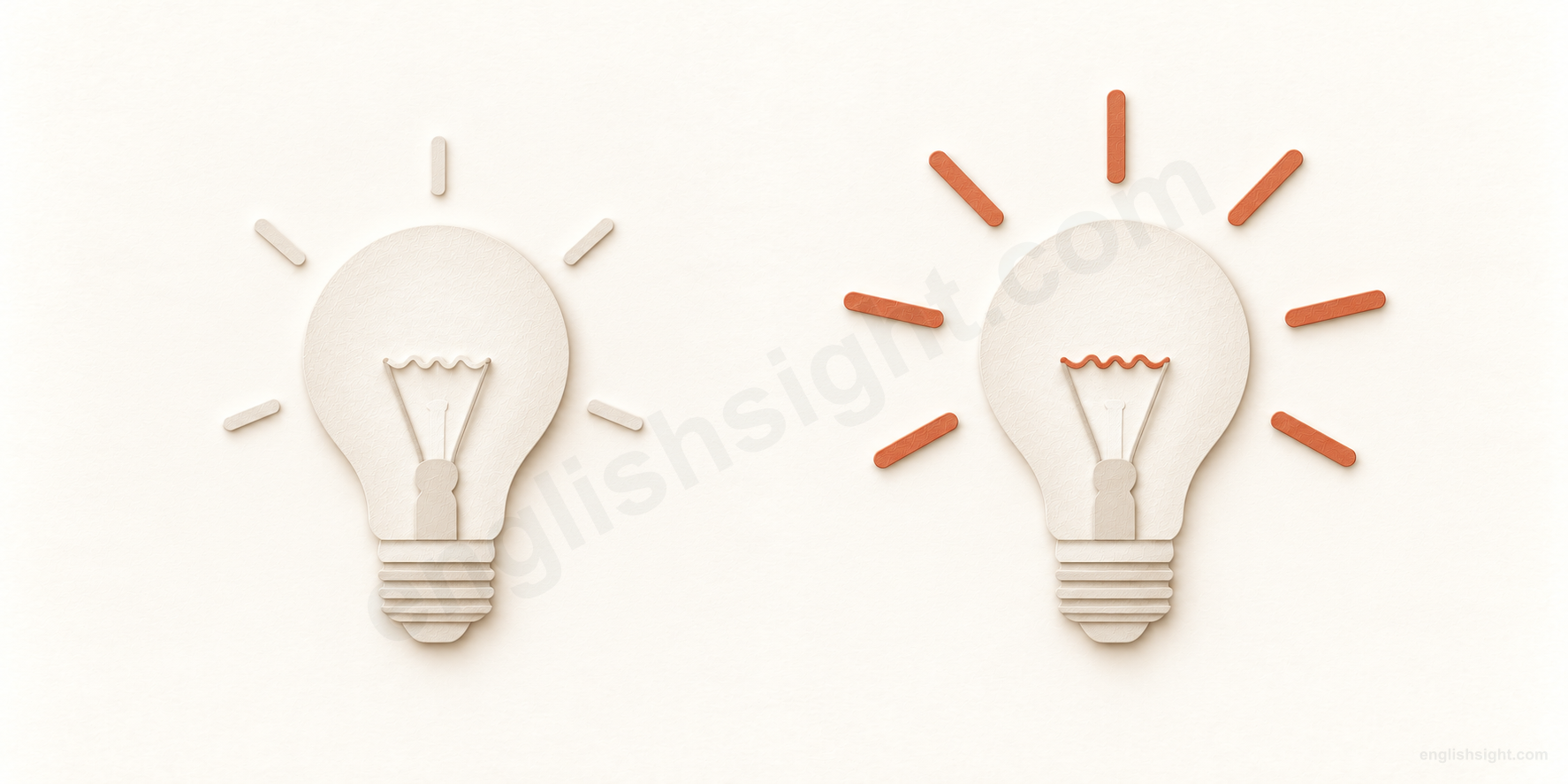
Left: a bulb giving little light.
bright
Right: a bulb giving strong light.
Compare light levels, not a change over time.
Bright describes strong light here. The comparison does not explain intelligence, mood or future success.
Bright describes strong light or vivid colour; established figurative uses describe quick intelligence, lively cheerfulness, or encouraging prospects.
The sketch compares light levels. Bright is an adjective describing a quality, not an action that must change a dim object. Intelligence, mood, promise, and fixed expressions need their own contexts.
A bright lamp, a bright colour, and a bright student do different jobs. Start with strong light and vivid visual presence, then recognize the established descriptions of intelligence, cheerfulness, and promise.
The light comparison is a memory aid for one part of this family. It does not prove that every meaning is literal light or that every English speaker imagines the same picture.
01
Light and colour
A source can give off strong light, a surface can reflect it, and a place can be full of it. Vivid colour is a related visual use, with a different contrast.
01
a bright + light source / reflecting object; be + bright
a bright light
giving off or reflecting a lot of light
Situation / context
You compare two lamps.
What is being described?
One gives a much stronger light.
Bright describes the amount of visible light, not necessarily heat.
A bright lamp emits strong light. A bright coin reflects light from somewhere else; it need not produce its own. The same adjective works before a noun or after be: The lamp is bright.
Choose the opposite for the contrast: dim light is weak; a dull surface lacks shine. A bright light may be uncomfortable, so bright is not always praise.
In a sentence
That little lamp is surprisingly bright.
Watch the difference A shiny surface reflects light; bright can also describe the source itself.
02
bright + room / day / screen; too bright; brighter than
a bright room / day
full of light or sunshine
Situation / context
You open the curtains in the morning.
What is being described?
The room receives plenty of daylight.
A place is bright because of its light; it does not have to shine by itself.
A bright room has plenty of light. A bright day usually has sunshine. Neither expression guarantees warmth: a winter afternoon can be bright and cold.
The screen is too bright judges its light level as excessive. Too adds the idea of a problem; very bright simply states a high degree. A brighter setting increases the light level.
In a sentence
The kitchen is bright even on winter mornings.
Watch the difference Bright weather concerns light or sunshine, not automatically temperature.
03
bright + colour word; bright + colours / clothes
bright red / bright colours
strong, vivid colour that attracts attention
Situation / context
You choose paint for a sign.
What is being described?
A vivid red stands out against the wall.
Colour brightness and strong illumination are different judgments.
In bright red, bright qualifies the colour word red: it is a vivid red rather than a dull one. In bright colours, it directly describes the plural noun.
Light blue describes a pale shade. Bright blue emphasizes a strong, noticeable colour; it need not mean pale blue. A bright red coat does not need to glow or give off light.
In a sentence
She marked the exit with a bright red arrow.
Watch the difference Do not treat bright blue and light blue as interchangeable colour descriptions.
02
Minds, moods, and possibilities
Read what bright describes. A bright student learns quickly; a bright smile shows cheerfulness; a bright future offers hope. These are established uses, not physical light.
04
a bright + person; someone is bright / not very bright
a bright student
quick to learn and understand
Situation / context
A student encounters a new problem.
What is being described?
She understands the principle quickly.
With a person, bright can describe intellectual ability.
A bright child or student grasps things quickly. Here bright is close to intelligent or clever; it says nothing about how much light falls on the person.
Not very bright is a softened way to say someone is not intelligent, but it can still insult them. Being bright also does not by itself mean being well informed about every subject.
In a sentence
Our new student is bright and asks thoughtful questions.
Watch the difference A person can be bright but inexperienced; intelligence and experience are different.
05
have a bright idea; the bright idea of + -ing
a bright idea
a clever or inventive suggestion
Situation / context
You need to keep several cables apart.
What is being described?
Someone proposes using coloured clips.
An idea is bright because it offers an intelligent solution.
Have a bright idea introduces a clever suggestion. Had the bright idea of using clips uses of + an -ing form to state the idea; bright itself does not require that preposition.
Tone can reverse the praise. After a plan fails, Whose bright idea was this? can criticize the suggestion. Read the situation before assuming that bright expresses approval.
In a sentence
Maya had the bright idea of labelling each cable.
Watch the difference A bright idea may be genuinely clever or sarcastically described as clever.
The noun and context distinguish cheerfulness from intelligence.
A bright smile or a bright voice conveys cheerfulness. You sound bright today comments on your lively manner; You are a bright student evaluates learning ability.
Eyes bright with excitement connects a shining appearance with an emotion. With names what fills or animates the eyes. It is not a rule that bright with can attach freely to every noun.
In a sentence
She greeted us with a bright smile.
Watch the difference A bright voice can describe a cheerful manner; specialized sound descriptions depend on context.
07
a bright future; bright prospects; the future looks bright
a bright future
likely to bring success or good things
Situation / context
A young musician wins a scholarship.
What is being described?
Her prospects seem encouraging.
Bright evaluates what may happen, rather than guaranteeing it.
A bright future and bright prospects express promise. Things look bright means the situation seems hopeful. Look links the subject to an adjective; it is not an instruction to direct your eyes somewhere.
A brighter future compares expectations with an earlier or worse situation. This hope may be based on evidence, but bright does not promise that the outcome is certain.
In a sentence
With this training, her future looks bright.
Watch the difference A bright future is promising; it has not already happened.
03
Familiar expressions and their tone
Learn these combinations as units. Some encourage optimism, some describe energy, and some can express criticism through irony.
08
look on the bright side; on the bright side, + clause
look on the bright side
focus on an advantage within a difficult situation
Situation / context
Your train is cancelled.
What is being described?
You notice that the delay gives you time to eat.
The bright side is the favourable aspect of the same situation.
Look on the bright side invites an optimistic viewpoint, often after bad news. On the bright side, … can introduce the advantage directly. The side is figurative, not a location in sunlight.
This wording does not deny the problem. Use it with care when someone is seriously upset: immediately pointing out an advantage can sound dismissive.
In a sentence
On the bright side, the delay gives us time for lunch.
Watch the difference Keep on in the fixed expression look on the bright side.
09
a bright spot in + situation / period
a bright spot
one good thing amid difficulties
Situation / context
Most of your week has been difficult.
What is being described?
A visit from a friend provides some happiness.
The spot is one positive part, not necessarily the whole experience.
In informal English, a bright spot in a difficult week is something welcome within it. A report may similarly call one successful part of a struggling business a bright spot.
Compare a bright future: that looks ahead. A bright spot can be something good that has already happened. A spot on a wall may also be literally bright; context decides.
In a sentence
Your visit was the one bright spot in a difficult week.
Watch the difference Use a noun phrase after in; the whole expression names the positive element.
10
be up / arrive / leave + bright and early
bright and early
very early in the morning
Situation / context
You plan an early departure.
What is being described?
Everyone is ready at six in the morning.
The whole phrase emphasizes an early morning time.
Leave bright and early or be up bright and early places an activity at the start of the day. The phrase often has an energetic tone, but it does not report the actual weather.
Bright and early can describe a departure on a dark, rainy morning. It does not mean merely before a deadline; for an afternoon appointment, say arrive early instead.
In a sentence
We will leave bright and early to avoid the traffic.
Watch the difference Do not replace bright with brightly inside this fixed expression.
11
a bright spark; some bright spark + verb
a bright spark
a clever person, sometimes mentioned ironically
Situation / context
Someone suggests a plan.
What is being described?
You praise their cleverness, or mock an unwise decision.
A label that sounds complimentary may carry criticism.
In informal British English, a bright spark is someone with a clever idea. Some bright spark… often introduces an action that the speaker actually considers foolish.
Some bright spark locked the cupboard with the keys inside criticizes the decision. The sarcasm comes from the mismatch between the supposed cleverness and the result, not from a special negative form of bright.
In a sentence
Some bright spark locked the cupboard with its only key inside.
Watch the difference This informal British expression can sound mocking when used about a person.
12
(as) bright as a button
as bright as a button
very alert, intelligent, energetic, or cheerful
Situation / context
A child wakes ready to talk and play.
What is being described?
You describe the child as lively and alert.
The comparison is a conventional expression about a person.
As bright as a button can emphasize intelligence or lively alertness; the situation tells you which. The first as is sometimes left out: bright as a button.
Collins marks this mainly British and old-fashioned. It is useful to recognize, but bright, alert, or cheerful is often a more neutral choice. It is not a literal comparison of someone’s skin with a shiny button.
In a sentence
After her nap, Ella was as bright as a button.
Watch the difference Do not reduce the idiom to intelligence alone; cheerfulness or energy may be central.
13
be / arrive + bright-eyed and bushy-tailed
bright-eyed and bushy-tailed
cheerful, alert, and full of energy
Situation / context
A new colleague arrives keen to begin.
What is being described?
You describe their lively readiness.
The informal phrase describes a person’s attitude and energy.
Bright-eyed and bushy-tailed is a playful description of someone who seems fresh and enthusiastic. No literal tail is involved.
It can be affectionate or gently ironic when one person is energetic and everyone else is tired. It is more colourful and informal than alert and ready.
In a sentence
Our new colleague arrived bright-eyed and bushy-tailed on Monday.
Watch the difference Learn the two linked parts together; bright-eyed alone is also possible.
14
the bright lights (of + city / entertainment centre)
the bright lights
the excitement and attractions of big-city life
Situation / context
Someone wants a more exciting life.
What is being described?
They imagine the city’s entertainment and opportunities.
The lights stand for the life associated with a lively city.
The bright lights of a city can mean its glamorous or exciting life rather than simply its lamps. The phrase often appears when people discuss moving away to seek entertainment or success.
The bright lights hurt my eyes is normally literal. The bright lights drew her to the city is more likely figurative. Use the surrounding action to choose the reading.
In a sentence
He left the village for the bright lights of the capital.
Watch the difference This expression is different from the noun brights for car headlights.
04
Nouns and useful forms
Bright is mainly an adjective. The plural noun brights has particular meanings, and brightly is the usual adverb in ordinary descriptions of manner.
15
turn / put the brights on; turn the brights off
the brights
a vehicle’s headlights on their high-beam setting
Situation / context
A driver is using high beams.
What is being described?
Another vehicle comes towards them.
Here brights is a plural noun naming a headlight setting.
In informal American usage, put your brights on means switch to high beams. Turn your brights off means stop using that setting; it need not mean switching off all your headlights.
Use plural agreement: The brights are on. The adjective in bright headlights simply describes the lights; the plural noun brights names the high-beam setting.
In a sentence
Please turn your brights off while that car passes.
Watch the difference In this sense, brights is plural; a bright is not the ordinary name for one headlight.
16
wear / wash brights; brights and neutrals
brights
bright colours or clothes in those colours
Situation / context
You sort a load of laundry.
What is being described?
You separate vivid clothes from whites.
A plural noun can name a colour category or the clothes themselves.
In clothing and colour contexts, brights can mean vivid colours or brightly coloured clothes. A rack of brights describes the colourful items on it.
The noun depends on context. Wash the brights separately refers to clothes; switch off the brights refers to vehicle lights. The plural ending does not turn every use of the adjective into a noun.
In a sentence
Wash the brights separately from the white towels.
Watch the difference Bright clothes is the ordinary adjective + noun phrase; brights is a context-specific noun.
compare brightness or describe how something shines
Situation / context
You compare the light in two rooms.
What is being described?
You describe the sunnier room and how it is lit.
Choose adjective or adverb according to its job in the sentence.
The usual comparison forms are brighter and brightest: This room is brighter than the hall. Use bright after a linking verb: The room looks bright.
Use brightly to modify an action or participle: The lamp shines brightly; a brightly lit room. Bright also occurs as an adverb in expressions such as stars burning bright, especially in literary wording. It is not a general substitute for brightly: say brightly coloured clothes.
In a sentence
This room is brighter because it has two windows.
Watch the difference Brighten is the related verb: brighten the room. Do not use bright as a verb in ordinary modern English.
Let the noun and context guide you
An adjective, not one universal translation
Bright can modify light, colour, intelligence, mood, or prospects. A room can be bright but cold; a student can be bright but inexperienced. Choose the relevant comparison rather than transferring every quality to every noun.
Grammar belongs to the whole pattern
Bright normally describes a noun before it or follows be, look, or sound. Brighter and brightest compare degrees. Brightly modifies verbs and participles. Bright has no ordinary passive, causative, or phrasal-verb family; brighten is a separate related verb.
Scope and register
The lesson covers the principal modern adjective uses, useful noun uses, and selected familiar expressions. The paintbrush noun, poetic splendour, specialized sound or liquid descriptions, proper names, and historical uses are not developed. Recognition items are marked for tone and region, not presented as equally useful in every conversation.
Read bright in context
Use the noun, the situation, and the whole expression to choose a meaning.
1. A sign is bright red. What does bright describe here?
2. A teacher says, “Leo is bright, but he is new to the subject.” Which reading fits?
3. The future looks bright. What is being claimed?
4. We left bright and early, although it was still dark and raining. Is this consistent?
5. A cable was cut by mistake. Someone asks, “Whose bright idea was that?” What is the likely tone?
6. Which is the ordinary description of a room with strong lighting?
Sources and teaching notes
Usage and register were checked against the dictionary pages below. Explanations, examples, and the light comparison are original teaching material; the diagram is a memory aid.
The comparison illustrates strong light; other meanings depend on context.