Connect damaged objects, interrupted patterns, and familiar human meanings—then read the grammar.
Wholeness, function, and continuity
A whole or continuous connection no longer holds
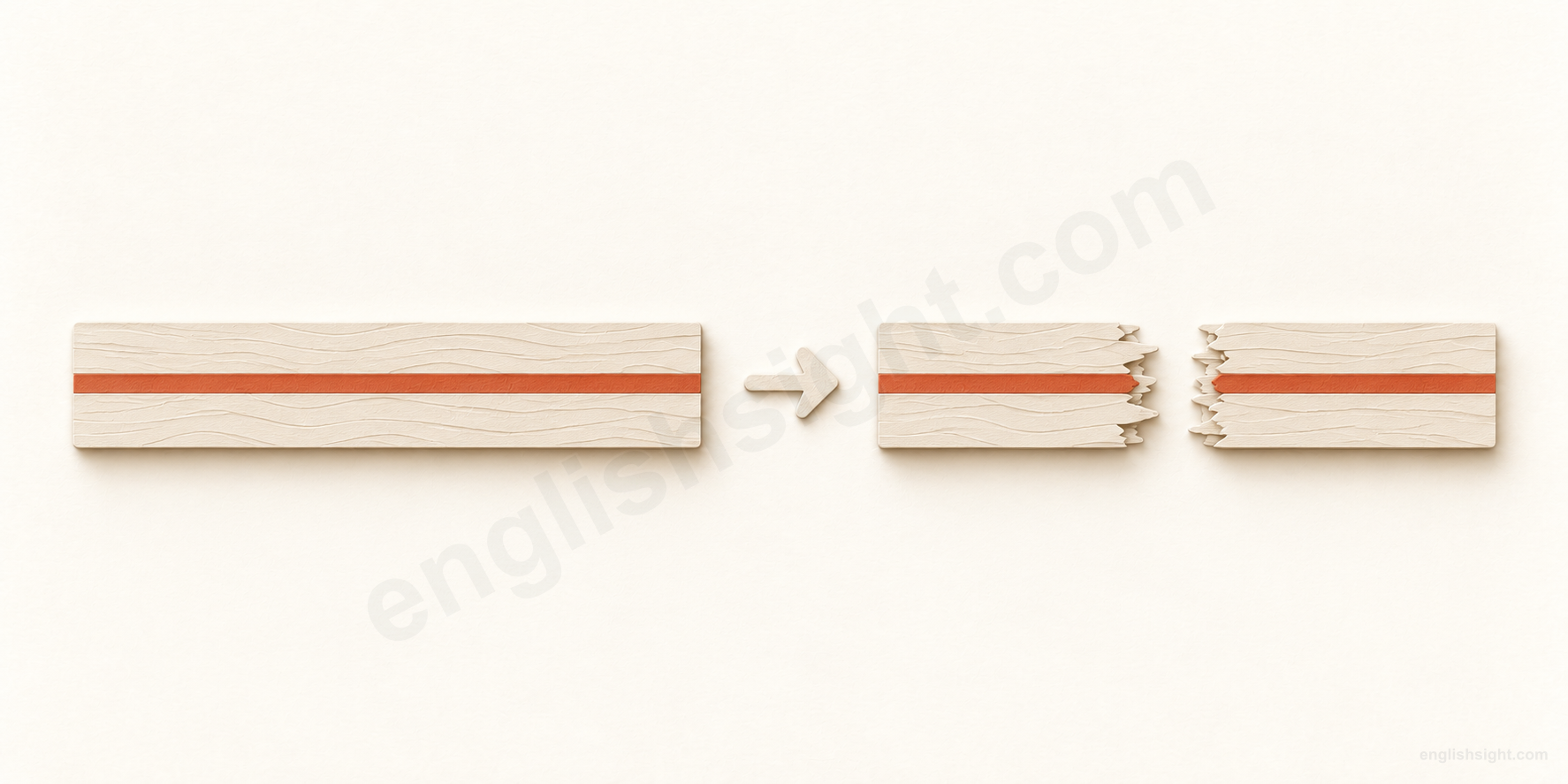
A single wooden slat is whole.
broken
Two pieces remain, with a gap between their jagged ends.
A break separates the slat.
The split slat shows a loss of wholeness. Other uses concern function or continuity; their meaning depends on context.
Broken can mark a failure of wholeness, working order, or continuity. Ask what is damaged or interrupted in this particular expression.
The split strip illustrates a loss of physical wholeness. A broken line may be drawn with gaps from the start; a broken promise, a broken heart, and verb expressions need their own explanations.
Broken can describe something that is no longer whole, does not work properly, or is not continuous. With promises, relationships, and feelings, the noun directs us toward a more specific kind of failure or hurt.
This lesson covers the adjective and the essential past-participle patterns of break. The connections are teaching aids, not a claim that every speaker sees the same picture or that every expression can be guessed from one image.
01
Damage and things that do not work
Describe the condition of an object or bone, or explain that equipment or a system is failing.
01
a broken + singular noun; broken + material noun; be broken (in half / into pieces)
a broken plate / broken glass
physically damaged or no longer whole
Situation
A plate falls onto the floor.
Result or interpretation
The plate has a crack and a piece has come away.
Broken describes the damaged condition, not the action that caused it.
A broken plate, window, or handle has suffered physical damage. It may have split into several pieces, but broken does not always mean completely shattered: one snapped part or a serious crack can be enough.
Use broken before a noun or after be: a broken plate; the plate is broken. Broken glass often means glass fragments, so glass is uncountable here. A broken glass can instead mean one damaged drinking glass.
Broken in half specifies two parts; broken into pieces describes smaller separate parts. In and into add the resulting arrangement. The adjective broken alone does not tell you how many pieces there are.
In a sentence
There was broken glass beside the empty window frame.
Watch the difference Damaged is broader: a scratched plate is damaged but would not normally be called broken just because of a scratch.
02
have a broken + body part; a broken bone
a broken arm / leg / bone
a bone has fractured
Situation
A person falls and injures an arm.
Result or interpretation
A bone in the arm is fractured.
The everyday body-part expression refers to a bone injury.
A broken arm or leg usually means that a bone in it is fractured, not that the whole limb has separated from the body. Fractured is the more technical alternative for the bone injury.
Compare She has a broken arm, which describes her condition, with She broke her arm, which reports the injury event. A sore or bruised arm is not automatically a broken arm.
In a sentence
Nora has a broken wrist and cannot carry the box.
Watch the difference Broken is not a general word for every injury; a sprain or bruise is a different injury.
03
be broken; a broken + device / system; broken beyond repair
the printer is broken
not working properly
Situation
You send a page to the printer.
Result or interpretation
A fault prevents it from printing.
Working order can be lost without visible pieces coming apart.
A broken printer, watch, or switch has a fault that prevents normal operation. It can still look whole. Be broken describes its condition; stop working reports the change.
The same idea extends to a broken system: its processes fail to do what they should. This is a judgment about how the system works, not a claim about literal fragments.
Broken beyond repair adds that repair is no longer possible or practical. Broken alone leaves repair open. A device that is simply switched off or needs charging is not necessarily broken.
In a sentence
The printer is broken, so please use the one upstairs.
Watch the difference In neutral standard writing use The printer is broken. Informal broke occurs in this sense, especially in the saying If it ain’t broke, don’t fix it: do not change something that already works. I’m broke usually means I have no money.
02
Gaps, interruptions, and unevenness
Broken can describe a pattern that is not continuous or smooth. It need not mean that something has smashed.
04
a broken + line; a broken white line
a broken line
a line made of separated stretches
Situation
A map needs to show a path differently from a boundary.
Result or interpretation
Short line segments have spaces between them.
The gaps are part of the pattern; they need not be accidental damage.
A broken line is not continuous. On a diagram it may consist of separate dashes. Contrast a solid or continuous line, which has no gaps.
This use describes the visible arrangement. No one needs to have drawn a continuous line and then damaged it. That is a limit of the before-and-after teaching sketch.
Road markings can also be called broken lines, but their legal meaning depends on the local rules. The word describes their pattern, not permission to cross in every situation.
In a sentence
Follow the broken line from the gate to the lake on the map.
Watch the difference In the map or diagram use taught here, a crooked line bends and a broken line has gaps. A line can be both crooked and broken. Broader dictionaries also record broken for an abruptly changing direction; context determines the reading.
05
have broken sleep; a night of broken sleep
broken sleep
sleep interrupted by waking
Situation
You try to sleep through the night.
Result or interpretation
Noise wakes you several times.
The period of sleep is interrupted rather than continuous.
Broken sleep consists of stretches of sleep separated by waking. A night of broken sleep emphasizes interruptions, not just a short total duration.
Compare I had only four hours of sleep, which says how much you slept but does not say whether you woke during that time. Unbroken sleep means sleep without interruption.
In a sentence
After a night of broken sleep, I kept yawning at breakfast.
Watch the difference Use broken sleep or a night of broken sleep as the usual learner patterns. Sleep can also be countable for a period of sleeping, so a broken sleep is possible in that use; do not treat it as a grammatical error.
06
in broken words; in a broken voice
broken words / a broken voice
speech that comes in interrupted or unsteady stretches
Situation
A speaker is trying to explain something upsetting.
Result or interpretation
The words come out with pauses and changes in the voice.
The interruption concerns the flow of speaking, not necessarily language knowledge.
Broken words or a broken voice can describe someone speaking unevenly because of tears or strong emotion. The speaker may know the language perfectly well.
The noun matters: broken English conventionally points to limited command of English, whereas a broken voice in an emotional scene points to an unsteady delivery. Neither phrase means the voice has physically snapped.
In a sentence
In a broken voice, he explained why the old house mattered to him.
Watch the difference Do not infer poor grammar from broken words alone; the context may be grief or distress.
07
speak (in) broken + language name
in broken English
using English with limited fluency and frequent errors
Situation
A traveler knows some English but cannot yet form fluent sentences.
Result or interpretation
They communicate using short, hesitant phrases.
This established use describes limited fluency in a language.
Speak in broken English, or speak broken English, describes non-fluent English with errors and hesitation. Broken modifies the language noun; it is not an adverb meaning badly.
The expression does not mean that the message is impossible to understand. Someone may communicate an important point successfully with limited English.
Calling another person’s English broken can sound dismissive. When you want a neutral description, say that the person speaks some English or is still learning English. This is advice about considerate wording, not a separate dictionary meaning.
In a sentence
I explained the address in broken Italian, and the driver understood.
Watch the difference Do not say speak brokenly English. To name the language pattern, put broken before English, Italian, or another language name.
08
broken + ground / terrain / country
broken ground / terrain
rough, uneven land
Situation
A walking route leaves a smooth path.
Result or interpretation
The surface has rocks, dips, and irregular stretches.
Broken describes an uneven surface rather than a damaged machine.
Broken ground or broken terrain is rough and irregular, often making travel difficult. This is useful recognition vocabulary in descriptions of walks, landscapes, and journeys.
The land need not have recently cracked or collapsed. The adjective describes its surface. Ground here means land, not the floor inside a room.
In a sentence
We moved slowly across the broken ground above the valley.
Watch the difference Broken ground here differs from They have broken new ground, a verb expression about making a new advance.
03
Promises, relationships, and feelings
These uses describe a failure of commitment or a damaging human experience. Learn the noun and the context together.
09
a broken promise / agreement; have broken a promise; a rule has been broken
a broken promise / agreement
a commitment has not been kept
Situation
Someone agrees to send the payment by Friday.
Result or interpretation
They do not do what they promised.
The failure concerns an obligation, not a physical object.
A broken promise is a promise that has not been kept. Broken agreements or contracts similarly involve failure to honor what was agreed. The noun tells you what obligation was involved.
A promise can be broken even if nothing physically changes. The connection with damage is a teaching comparison: something that another person relied on no longer holds.
With rules and laws, break means violate: No rules have been broken. That sentence uses the passive verb form. Broken does not itself mean that the rule is badly designed.
In a sentence
After two broken promises, Mia asked for a written agreement.
Watch the difference An unfulfilled promise describes the failure; a broken promise can also carry criticism. A broken rule in this context means a rule someone violated.
10
a broken marriage / engagement; come from a broken home
a broken marriage / a broken home
a relationship or family arrangement disrupted by separation
Situation
Two parents used to live together as a couple.
Result or interpretation
They separate and no longer share that arrangement.
In these expressions, broken concerns a human relationship.
A broken marriage or engagement has ended or been destroyed. A broken home traditionally means a family in which the parents are divorced or separated, not a house with structural damage.
Broken home can suggest that this family arrangement is defective or necessarily unhappy. To describe people without that judgment, say Her parents are separated or name the particular family situation.
This is an established social expression. A picture of a split object can suggest disruption but cannot explain a family’s quality or circumstances.
In a sentence
The memoir describes a broken marriage and the years that followed.
Watch the difference Do not assume that every separated family is unhappy, or use broken home simply to mean a damaged building.
11
have / recover from a broken heart
a broken heart
deep sadness, especially after a loss in love
Situation
A person loses someone they love.
Result or interpretation
They experience intense sadness.
Heart names the emotional experience in this established metaphor.
A broken heart describes deep emotional pain, especially after someone loved has left or died. It does not ordinarily describe a literal fracture in the heart.
You can have a broken heart, suffer from a broken heart, or recover from a broken heart. The related adjective broken-hearted, also written brokenhearted, describes the person.
The link with physical breakage is metaphorical: a person feels deeply hurt. It does not mean that sadness is permanent or that everyone experiences loss in the same way.
In a sentence
It took her a long time to recover from a broken heart.
Watch the difference For ordinary sadness, upset or sad may fit better; a broken heart suggests a much deeper emotional hurt.
12
a broken spirit; a broken man / woman; feel broken
a broken spirit / a broken man
seriously weakened in confidence, hope, or strength
Situation
Someone endures repeated losses and hardship.
Result or interpretation
Their confidence and energy are badly weakened.
The metaphor concerns a person’s strength or morale.
A broken spirit refers to confidence or hope that has been severely damaged. A broken man or woman can describe a person worn down by suffering, illness, or defeat.
These are strong descriptions, often found in storytelling. They are not neutral labels for being tired after an ordinary day. In conversation, I feel broken can express intense distress rather than physical injury.
Read the context: a broken bone concerns an injury, while a broken spirit concerns morale. Neither expression supplies a medical diagnosis.
In a sentence
After years of setbacks, he returned a broken man.
Watch the difference Do not confuse broken with broke meaning without money: financial loss may cause distress, but the two adjectives do not make the same claim.
04
Broken as a verb form
Broken is also the past participle of break. The auxiliaries and the rest of the expression determine the event being described.
13
subject + have / has / had + broken (+ object)
has / have broken
the past participle used to report a break event
Situation
A cup was intact earlier.
Result or interpretation
Someone has caused it to break.
Have supplies the perfect construction; broken supplies the verb form.
The verb forms are break, broke, broken, breaking. Say I broke the cup yesterday for a finished past event, but I have broken the cup for a perfect construction. Broken cannot normally stand alone as the past-tense verb.
Both The handle has broken and I have broken the handle are possible. In the first, the handle is the thing affected; in the second, the subject caused the damage. Have does not mean possession in these perfect constructions.
The meaning still comes from the whole verb expression: She has broken the record means she has surpassed a previous best, not damaged a recording. A bare adjective lesson cannot predict all the meanings of break or its particle combinations.
In a sentence
I have broken the handle, but the rest of the drawer is fine.
Watch the difference Use broke after a subject in the simple past, and broken after have: not I broken it or I have broke it in standard English.
14
be + broken; be broken by + cause; get broken; have + object + broken
is broken / was broken by… / got broken
state, passive event, or change into a damaged state
Situation
A ball hits a window.
Result or interpretation
The window ends up damaged.
Auxiliaries and context distinguish the condition from the event.
The window is broken normally describes a state. The window was broken by a ball reports a passive event: the window receives the action, and by identifies its cause. A sentence with was broken can describe either a past state or an event, depending on context.
The window got broken highlights becoming damaged, often in an informal account of an accident. It does not say that the window repaired itself or acted intentionally.
I had my window broken during the storm describes an unwanted experience affecting my property. Have + object + broken is not automatically an instruction or an arrangement; the context determines that reading.
In a sentence
The window was broken by a falling branch during the storm.
Watch the difference The by-phrase belongs to the passive event. In The window has broken, has forms the perfect and the subject is still the affected thing.
05
A familiar comparison in conversation
An established expression uses a faulty record as an image for unwanted repetition.
15
sound like a broken record; like a stuck record (also British)
like a broken record
repeating the same point in an annoying way
Situation
You have already reminded someone several times.
Result or interpretation
You repeat the reminder yet again.
The comparison is to a faulty record that keeps repeating a passage.
Sound like a broken record means keep saying the same thing, usually in a way that annoys people. The expression refers to an old sound recording that repeats a short section because of a fault.
I know I sound like a broken record, but… acknowledges your repetition before another reminder. British English also uses like a stuck record.
Compare The record has been broken, which can refer to a sports achievement being surpassed. In the idiom, like introduces a comparison with a faulty recording; record is not an achievement.
In a sentence
I know I sound like a broken record, but please lock the door when you leave.
Watch the difference Keep like in the conversational comparison. By contrast, In that race the record was broken uses record for an achievement that someone surpassed.
Check the noun, the form, and the tone
A useful connection has limits
A broken device need not be in pieces, and a broken line need never have been continuous. Learn established human expressions with their nouns. The sketch is a memory aid, not a rule for inventing new combinations.
Pronunciation and forms
Broken has two syllables, with stress on the first: British /ˈbrəʊkən/, American /ˈbroʊkən/. The verb forms are break, broke, broken, breaking; the adjective has the same spoken form as the participle.
Damage, condition, and event
A broken cup names a condition; someone has broken the cup reports an event; the cup was broken by someone is passive. Broken is not normally a simple past form, and it does not take a verb ending such as brokens.
Do not turn every break expression into a new adjective sense
Have broken a record, have broken the news, and have broken down are verb constructions. This lesson explains the participle and selected contrasts; it does not attempt a complete course on break, its phrasal verbs, or compounds such as broken-down.
Human descriptions carry judgments
Broken home and broken English are established expressions but can sound dismissive. Broken spirit and broken heart are strong descriptions of suffering. Choose wording that fits what you know about the person.
Choose what broken contributes
Use the noun and the sentence pattern to distinguish damage, interruption, and an event.
1. A printer looks intact, but a damaged part prevents it from printing. Which statement fits?
2. You damaged a handle a moment ago. Complete the standard perfect construction: I have ___ the handle.
3. A designer deliberately draws separated dashes. What does a broken line tell you here?
4. A fluent speaker pauses and struggles to speak through tears. Which interpretation fits a broken voice?
5. I sound like a broken record, but please send the form. What is the speaker acknowledging?
Sources and teaching notes
The sources below support the uses and forms. Explanations and examples are original; the visual connection and usage comparisons are teaching analysis.
The diagram is a teaching aid, not a picture shared by every native speaker.