Use brown to describe colour, recognize food names, and follow a change in appearance.
From a colour to a change of surface
The colour stays connected to the change
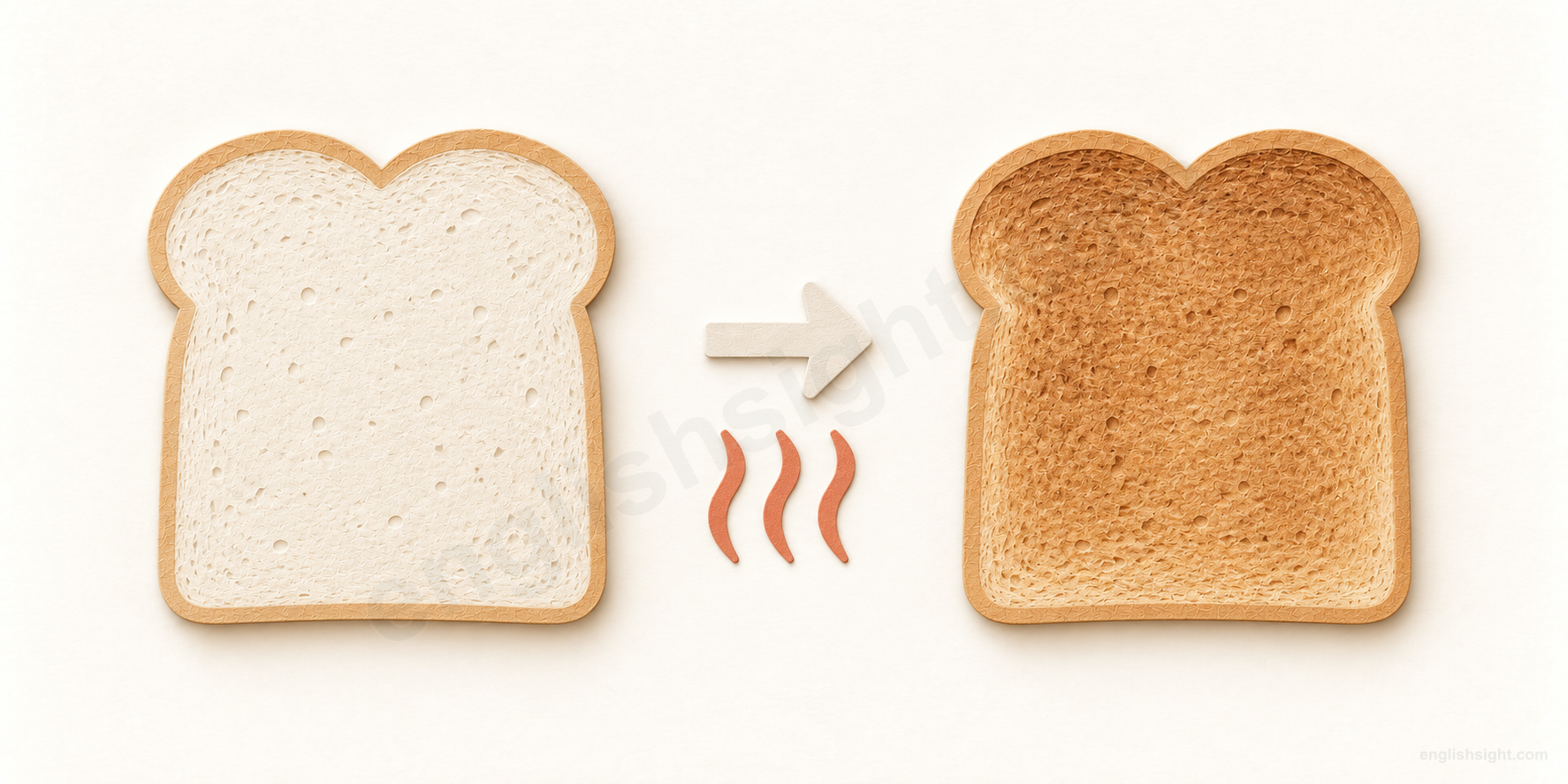
The same slice, still pale
brown
The surface has browned
Heat changes the surface colour.
The same slice becomes brown on the surface; toasting does not change its bread type.
Brown names a colour family familiar from earth and wood; the verb describes something taking on, or being given, that colour.
The bread example connects a colour state with a change of surface. It is one teaching example, not the source of all brown expressions or a claim that brown always means cooked.
Think of the range of colours found in earth, wood, and chocolate. Brown can describe that quality or name the colour itself. As a verb, it means become brown or make something brown.
The connection helps with a brown leaf and bread that browns. Food names and fixed expressions still need their own meanings: brown rice is not fried white rice, and browned off is not a visible colour change.
01
Describe a colour
Identify a visible quality, specify a shade, or name the colour itself. Describing skin and referring to social groups require different contexts.
01
brown + noun; subject + be + brown; paint + object + brown
brown eyes / a brown coat
describe something as having an earth-like or wood-like colour
Situation / starting point
You identify a coat by its visible colour.
Meaning / result
Your listener knows which coat you mean.
Brown describes the object; it does not name its material.
Brown is an adjective before a noun or after be: a brown coat; The coat is brown. The same colour word works with eyes, hair, fur, wood, paper, and many other things.
A brown table might be wooden, painted, or made of plastic. The adjective tells us its colour, not what it is made of. Paint the shelf brown puts brown after the object to specify the resulting colour.
In a sentence
I left my brown coat beside the door.
Watch the difference Keep the adjective unchanged: two brown coats, not two browns coats.
02
light / dark / golden brown; reddish-brown; brownish; browner than
light brown / dark brown / brownish
describe a shade or an approximate brown colour
Situation / starting point
Two samples are both brown, but one is lighter.
Meaning / result
You describe their difference more precisely.
Shade words refine the colour; -ish makes the description approximate.
Light brown and dark brown distinguish lighter and darker shades. Reddish-brown points toward red; golden brown describes a golden shade, often used for cooked food. These expressions refine brown rather than create new actions.
Brownish means somewhat brown. Browner is the comparative and brownest is the superlative: This leaf is browner than that one. Darker brown more specifically compares darkness within the colour family.
In a sentence
Choose light brown curtains for the smaller room.
Watch the difference Brownish means approximately brown, not necessarily pale brown.
03
in brown; a shade of brown; a warm brown; different browns
in brown / shades of brown
name the colour or a particular shade
Situation / starting point
You choose colours for a room or clothing.
Meaning / result
You discuss brown as a colour in its own right.
The noun can name colour generally or individual shades.
In I prefer brown, brown is a noun naming the colour. In brown can describe clothing or decoration in that colour: She was dressed in brown.
A warm brown names one shade, and several browns names several shades. A brown coat uses the adjective; a shade of brown uses the noun. The plural belongs to the noun, not to a colour adjective before a plural object.
In a sentence
The designer combined several browns with cream.
Watch the difference Use a brown for a particular shade; do not automatically add an indefinite article when naming the colour generally.
04
brown skin; go brown; brown in the sun; (as) brown as a berry
brown skin / go brown in the sun
describe natural skin colour or a change caused by the sun
Situation / starting point
You describe someone’s appearance or a suntan.
Meaning / result
The context shows whether the colour is natural or acquired.
Brown skin does not by itself say that someone has a tan.
Brown can describe naturally brown skin. After a holiday, She has gone brown can instead describe tanning; go brown is especially British. The verb occurs too: His skin browns easily. Tan is another way to name this sun-related change.
The comparison as brown as a berry means very tanned; it is a fixed comparison, not a claim about every berry’s colour.
In discussions of society, brown people can refer to population groups, rather than to a recent tan. This use depends on context and is not a precise nationality label. For a simple appearance description, brown skin is clearer than assigning someone a group.
In a sentence
Her skin is naturally brown; she has not been sunbathing.
Watch the difference Do not infer a person’s nationality, identity, or time in the sun from the colour adjective alone.
02
Have the colour or become that colour
Be brown describes a state. Turn brown and the verb brown describe a change; cooking offers a familiar example.
05
subject + turn / become + brown; subject + brown(s)
turn brown
change from another colour to brown
Situation / starting point
A cut apple has a pale exposed surface.
Meaning / result
The exposed surface becomes brown.
Turn contributes the change; brown supplies the resulting colour.
The apple is brown describes a state. The apple turns brown describes a change into that state. Leaves and grass can also turn brown; the cause comes from the situation, not from the colour word itself.
The verb brown can express a similar change: The grass is browning. An ongoing change allows is browning; ordinary is brown is simply be plus an adjective. The diagram uses a bread surface to show this state/change distinction.
In a sentence
The cut apple began to turn brown while we prepared the plates.
Watch the difference Brown does not itself mean rotten or burnt; the cause and condition need context.
06
brown + food; food + brown(s); be browned; cook until golden brown
brown the food / let it brown
cook food until its surface becomes brown
Situation / starting point
Bread or other food has a pale surface.
Meaning / result
Heating gives the surface a brown colour.
With an object, the cook causes the change; without one, the food undergoes it.
Brown the mushrooms gives an instruction with mushrooms as the object. The mushrooms are browning makes the food the subject and describes the process. Brown them uses the pronoun directly after the verb; this is not a separable particle verb.
The mushrooms were browned before the sauce was added is a passive description of the cook’s action. Cook until golden brown describes the intended colour at the end. Browning the surface does not, by itself, mean the food is cooked all the way through.
In a sentence
Brown the mushrooms in a wide pan, then add the stock.
Watch the difference Brown means develop a brown surface here; burn means damage by excessive heat.
03
Recognize food names
In food names, brown may identify an ingredient or a type of grain product. Do not assume that every brown food has been toasted.
07
brown rice; some / a bowl of brown rice
brown rice
rice with an outer layer retained, rather than polished away as in white rice
Situation / starting point
You choose between rice varieties at a meal.
Meaning / result
You identify the less fully milled grain product.
The food name describes the grain, not a frying step.
Brown rice retains the brownish outer layer of the grain that is removed to make white rice. Brown here helps identify a type of rice; it does not mean white rice that has been fried until dark.
In Would you like brown rice?, rice is normally uncountable. Use some brown rice or a bowl of brown rice when you need a quantity.
In a sentence
We ordered brown rice with the vegetables.
Watch the difference Brown rice and browned rice are different: browned describes a cooking result.
08
brown bread; a slice of brown bread
brown bread
a darker bread type, often made with wholemeal or other darker flour
Situation / starting point
You choose bread for a sandwich.
Meaning / result
You ask for the darker bread type.
A food category and a toasted surface are different things.
Brown bread commonly contrasts with white bread. It can be made with wholemeal or darker flour, or with other ingredients that give it a brown colour. The label alone does not guarantee that it is entirely wholemeal.
Could I have brown bread? asks for a bread type. Brown the bread asks someone to heat bread until it changes colour. A white-bread slice can have a browned surface without becoming the food category brown bread.
In a sentence
Please make my sandwich with brown bread.
Watch the difference Do not use brown bread as a general synonym for toast.
09
brown sugar; light / dark brown sugar
brown sugar
a brown-coloured sugar ingredient containing molasses
Situation / starting point
You choose an ingredient for baking.
Meaning / result
You use the kind of sugar specified by the recipe.
This names an ingredient, not an instruction to heat white sugar.
Brown sugar contains molasses, which gives it colour and flavour. It may retain molasses from processing or be made by adding molasses to refined sugar; brown does not guarantee that a product is wholly unrefined.
Add brown sugar names the ingredient. Let the sugar brown uses brown as a verb describing what happens during heating. The noun phrase and the cooking instruction are different even though both involve colour.
In a sentence
Stir two spoonfuls of brown sugar into the mixture.
Watch the difference Do not replace the ingredient name with browned sugar; that describes sugar changed by heating.
04
Learn the whole expression
These regional, informal, or compound expressions have established meanings. The colour model alone cannot predict them.
10
brown-bag it; brown-bag your lunch; a brown-bag lunch
brown-bag it / a brown-bag lunch
bring your own lunch to work or school
Situation / starting point
You need lunch away from home.
Meaning / result
You bring food with you instead of buying it there.
The paper bag stands for the practice of bringing lunch.
Brown-bag it is informal North American English for bringing your lunch to work or school. Brown-bag your lunch is possible too. A brown-bag lunch is a lunch brought with you, often in a bag.
The compound is associated with a brown paper bag, but its practical focus is the carried meal. A brown bag in an ordinary description can simply be any bag of that colour; the lunch meaning belongs to the established compound and its context.
In a sentence
I’ll brown-bag it tomorrow because I have a short lunch break.
Watch the difference The verb is brown-bag, with forms brown-bagged and brown-bagging; brown alone does not mean bring lunch.
11
be / get browned off (with somebody / something)
be browned off with…
feel fed up, unhappy, or annoyed
Situation / starting point
Repeated delays have worn down your patience.
Meaning / result
You describe your irritation or dissatisfaction.
This is a fixed emotional expression, not a cooking result.
I’m browned off with the delays means the delays have left me fed up. Be browned off describes the feeling; get browned off describes developing it. With can introduce the person or situation causing that feeling.
This is British informal usage, and Oxford also labels it old-fashioned. Fed up or annoyed is a useful alternative. Do not derive the feeling by imagining someone literally changing to a brown colour.
In a sentence
We were getting browned off with the constant changes to the schedule.
Watch the difference Learn browned off as a whole expression; off does not mean away from a physical surface here.
12
brown-nose + person; brown-nosing; a brown-noser
brown-nose someone
try to win favour through excessive praise or submissive behaviour
Situation / starting point
Someone wants better treatment from a person in authority.
Meaning / result
They flatter that person to gain an advantage.
The expression criticizes the motive behind the praise.
Brown-nose can take an object, as in brown-nose the manager, or stand without one: He keeps brown-nosing. Brown-noser names a person who behaves this way.
It is informal and disapproving, with a crude origin. It suggests self-interested flattery, not simply politeness or genuine thanks. Use it carefully when talking about people. It is a compound verb, not brown plus a movable particle.
In a sentence
They accused him of brown-nosing the supervisor to get easier shifts.
Watch the difference Calling someone a brown-noser is an insult, not a neutral description of respectful behaviour.
13
a brownout; brown out + area
a brownout / brown out an area
a reduction in an area’s electrical power supply; cause such a reduction
Situation / starting point
An area normally receives its usual electrical supply.
Meaning / result
The supplied power is reduced for a period.
This is an electricity term, not an object turning brown.
A brownout is a period of reduced electricity supply, especially in North American usage. It differs from a blackout, which involves a complete loss of power. Context may describe the lamps becoming dimmer.
The related American verb brown out can take an area as its object: a failure can brown out a district. Recognize this as a specific electrical expression, not a general rule that brown plus out means reduce anything.
In a sentence
A brownout left the streetlights dim for an hour.
Watch the difference The noun brownout is one word; the verb brown out has two words.
Keep colour, change, and convention apart
Forms and pronunciation
Brown is /braʊn/, rhyming with town. The adjective has browner and brownest. The verb has browns, browned, and browning. Browned has one syllable; its final sound is /d/. Browns can also be the plural noun for shades.
Read the job of the word
The bread is brown describes a state; The bread is browning describes an ongoing process; The bread was browned describes what was done to it. In paint it brown, brown is a result description, not a separate action verb.
Names and limited expressions
Brown is also a surname, written with a capital B; that does not describe the person’s colour. In a brown study means absorbed in thought, but is old-fashioned British usage. This lesson emphasizes modern everyday uses and includes selected expressions for recognition, without claiming every compound or specialist sense.
Choose by context
Decide whether brown names a colour, a change, an ingredient, or an established expression.
1. The apple was pale before, but its exposed surface is changing colour. Which sentence describes the change?
2. A recipe asks for a particular sugar ingredient. Which instruction asks for that ingredient rather than a colour change caused by heating?
3. You want to describe what is happening to mushrooms in the pan, without naming the cook. Which sentence fits?
4. A British speaker says, “I’m browned off with these delays.” What do they mean?
5. You toast a slice of white bread until its surface darkens. Which description avoids changing its food category?
Sources and teaching notes
The dictionaries below support the usage notes. Explanations and examples are original; the diagram is a teaching model connecting a colour state with a change.
The diagram illustrates a useful connection; it is not a picture shared by every native speaker.