Follow what crosses a surface, then learn the expressions that go beyond it.
Contact across a surface
Contact across a surface
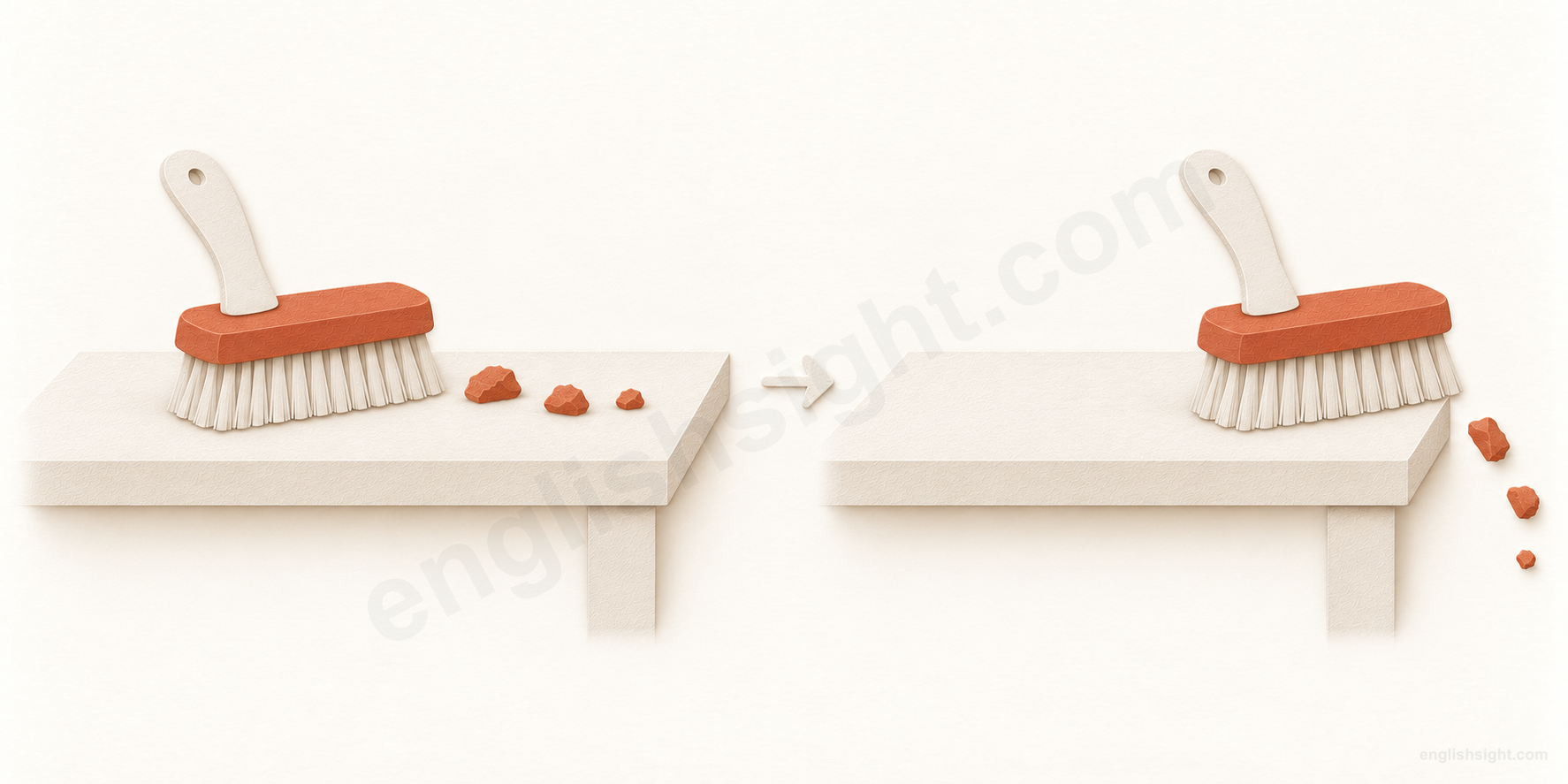
Three crumbs on the tabletop
brush
The crumbs fall beyond the edge
The bristles sweep right across the surface.
Contact and a sweep across a surface: here, crumbs are moved away. Brushing can also spread material or make a light passing touch.
A brush has many bristles; to brush can mean move it across a surface, make a similar sweeping movement, or make light contact while passing.
The sketch shows a brushing action moving crumbs away. Brushing can also spread a coating or smooth hair; light-contact uses need no tool. Fixed expressions and the vegetation noun cannot all be predicted from this model.
A brush is a tool with many bristles. As a verb, brush can mean work across something with that tool, move something with a similar sweeping action, or touch lightly in passing. The object and the following words tell you which action is meant.
Some connections are useful teaching comparisons: dismissing a concern can resemble sweeping it out of the way. Other meanings, including the landscape noun brush, need their own branch. These links are learning aids, not a shared mental picture claimed for every English speaker.
01
A tool and actions across a surface
Choose the object and direction to show what is cleaned, smoothed, coated, or moved away.
01
a / the + brush; brush for + noun / -ing; with a brush
a brush / brushes
a tool with many bristles for working on a surface
Situation before
You need a tool for painting a narrow edge.
Action or result
You choose a small paintbrush.
The noun names the tool; the job determines its type.
A brush has a group of hairs, fibres, or wires fixed to a base, often with a handle. A hairbrush, toothbrush, paintbrush, and wire brush do different jobs but share this basic design.
The tool is countable: a brush, two brushes. With a brush names the instrument. A brush stroke is one movement or the mark it leaves, especially in painting; it is not the whole tool.
In a sentence
Use a small brush to paint the edge of the shelf.
Watch the difference A comb has a row of teeth; a brush has bristles. They are different tools.
The direct object is the thing receiving the brushing.
Brush your teeth, brush your hair, and brush your shoes put the surface or body part after the verb. English normally uses a possessive with teeth and hair: I brush my teeth.
Brush the floor clean adds a result adjective: clean describes the floor after the action. Brushing need not be gentle; the tool and task determine the force. The core model concerns strokes across a surface.
In a sentence
Maya brushed her hair before the interview.
Watch the difference Brush my hair names the action on the hair; use my brush names using the tool.
03
brush + surface + with + liquid; brush + liquid + on / onto / over + surface
brush the pastry with butter
spread a liquid on a surface using a brush
Situation before
The pastry has no butter on top.
Action or result
A thin layer is spread over it.
The surface and the liquid can exchange grammatical positions.
Brush the pastry with butter names the receiving surface first. Brush butter over the pastry names the applied material first. Both describe using brush strokes to spread it.
The same choice works with paint or oil: brush paint onto the wood. Here with introduces the coating; in brush the wood with a soft brush, with introduces the instrument. Read the noun after with.
In a sentence
Brush the pastry with melted butter before baking it.
Watch the difference This use adds a coating. It does not mean brushing the butter away.
04
brush + object + off / from / out of + place; brush + object + away / back
brush crumbs off / brush tears away
move something away with sweeping strokes
Situation before
Crumbs are scattered over the seat.
Action or result
A hand sweeps them off the seat.
A brushing motion can be made with a hand, cloth, or tool.
Brush crumbs off the seat and brush dust from a sleeve name what is removed and where it comes from. Brush a strand of hair out of your eyes similarly moves it out of the way; brush your hair back gives its direction.
In brush the crumbs away / brush away the crumbs, away marks removal. With a pronoun, say brush them away. Brushing tears away commonly means wiping them with a hand or cloth, not using a hairbrush.
In a sentence
He brushed the crumbs off the seat with his hand.
Watch the difference Brush the seat names the surface being worked on; brush crumbs off the seat names the material removed.
05
brush at + mark / dirt / other target
brush at a stain
make brushing movements toward something
Situation before
There is a mark on your sleeve.
Action or result
You make several strokes at it, but it may remain.
At identifies the target without guaranteeing removal.
Brush at the stain focuses on the attempt or repeated movement directed toward it. Compare brush the dirt off, which normally presents removal as achieved.
The stain after at is the target of a preposition, not the direct object of brush. This is an ordinary verb-plus-preposition construction, not a separate idiom meaning remove successfully.
In a sentence
She brushed at the stain, but it would not come off.
Watch the difference Brushed at it does not mean that it disappeared.
06
brush + object + down / off; brush down + noun; dirt + brushes off
brush down a coat / brush yourself off
clean a surface or tidy clothing with brushing movements
Situation before
You get up after falling on a dusty path.
Action or result
You remove loose dust from your clothes.
The object can be a surface or a person whose clothing needs tidying.
Brush down a coat or a horse means clean it by brushing. Brush yourself off means tidy yourself, especially your clothes, often with your hands; British English also uses brush yourself down.
These combinations allow a noun before or after the particle: brush down the coat / brush the coat down. Put a pronoun before it: brush it down. Mud brushes off easily describes how readily mud can be removed; it is not a passive form with be.
In a sentence
After the fall, Ben stood up and brushed himself off.
Watch the difference Brush someone off can also mean ignore them. After a fall it can be literal tidying; the context matters.
07
give + object + a (quick / good) brush
give something a quick brush
perform a short act of brushing
Situation before
Your jacket has a little loose dust on it.
Action or result
You brush it briefly before leaving.
The noun can name an action as well as the tool.
Give your jacket a quick brush describes a short brushing action. In give my hair a brush, hair receives the action; give someone a brush can instead mean hand them the tool.
This action noun is normally singular in this pattern, with an article and often an adjective such as quick or good. It does not specify exactly one stroke.
In a sentence
I gave my jacket a quick brush before going out.
Watch the difference A quick brush is the action here, not a special fast-moving tool.
02
Passing contact and brief encounters
Brush can describe a light touch without a tool. A brush with something can also be a difficult encounter or a narrow escape.
08
brush + object; brush against + object; the brush of + thing + against / on + thing
brush against something
touch lightly while moving past or across it
Situation before
A branch hangs close to the path.
Action or result
It lightly touches your arm as you walk by.
No brush tool is needed; contact is light and passing.
A branch brushed my arm and my arm brushed against a branch describe the contact from different subjects. Brush something with something names what makes contact: she brushed his cheek with her fingers.
The noun can describe the same fleeting contact: the brush of a sleeve against my hand. Unlike brush your hair, this use need not involve repeated strokes or deliberate cleaning.
In a sentence
A low branch brushed against my arm as I walked past.
Watch the difference Against introduces the object touched; it does not automatically imply pushing or opposition.
09
brush past / by + person or thing
brush past / brush by someone
pass very close to someone, touching or nearly touching
Situation before
Someone stands near a narrow doorway.
Action or result
You pass close beside them and continue.
Past or by supplies the route; brush suggests close passing.
Brush past someone focuses on moving beyond them, with light or near contact. It need not describe a collision. Brush by is another way to describe this kind of passing. Collins marks this use as written; it is useful when narrating movement.
Past is followed directly by the person: she brushed past me. This is a movement construction, not the dismissive particle verb brush me off. A story may suggest impatience, but the movement alone does not prove hostility.
In a sentence
A passenger brushed past me on the way to the exit.
Watch the difference Brush past does not mean stop and clean the person.
10
have + a brush with + the law / person / authority
a brush with the law
a brief difficult encounter with authority
Situation before
Someone is stopped over a suspected offence.
Action or result
They have an encounter with the police or legal system.
With introduces the other party or trouble encountered.
A brush with the law means an episode of trouble involving legal authority. It does not tell you whether the person was convicted or how the case ended.
A brush with your boss can mean a short unfriendly encounter or disagreement. Here brush is countable: a brush, several brushes. The light-contact idea is a memory link, not a claim that the consequences are always minor.
In a sentence
His brush with the law began with an unpaid fine.
Watch the difference With the law refers to contact with legal authority, not a physical law brushing against him.
11
have / survive + a brush with + death / disaster
a brush with death / disaster
an experience of coming close to serious harm
Situation before
A rock falls close to a walker.
Action or result
The walker survives the dangerous event.
The expression presents a close encounter with danger.
A brush with death means coming close to dying and surviving. A brush with disaster or bankruptcy similarly presents a threatening encounter, often one narrowly avoided.
The noun phrase does not explain exactly what happened. Add the event for clarity. Unlike a brush with the law, a brush with death does not describe an argument with another person.
In a sentence
The walker had a brush with death when a rock fell beside him.
Watch the difference A brush with death describes surviving a near-fatal event, not dying.
03
Dismissing, refreshing, and fixed expressions
Learn these complete expressions with their objects and tone. Their meanings cannot all be calculated from a picture of a brush.
12
brush + person + off; brush off + noun; give + person + the brush-off
brush someone off
rudely refuse to listen or engage
Situation before
You try to ask a question.
Action or result
The other person gives you no proper attention.
A person is treated as someone to be pushed out of the conversation.
Brush someone off is an established phrasal verb for dismissive treatment. It can mean refusing a conversation or abruptly rejecting an approach, without physical contact.
With a pronoun, say she brushed me off, not she brushed off me. With a noun, she brushed off the caller and she brushed the caller off are both possible. Give someone the brush-off is a related informal noun expression.
In a sentence
The receptionist brushed me off when I asked about the delay.
Watch the difference Compare the literal He fell and brushed himself off: he tidied his own clothing.
13
brush off + concern / criticism; brush + it + off; be brushed off
brush off criticism
treat criticism or a concern as unimportant
Situation before
Someone raises a safety concern.
Action or result
A manager dismisses it without serious consideration.
The object is a message, problem, or reaction rather than a person.
Brush off a warning, a question, or criticism means refuse to take it seriously. The warning may be valid; brush off reports the response, not whether the warning deserves attention.
Put a pronoun between verb and particle: brush it off. The passive is natural when the dismissed issue is central: our concerns were brushed off. This use is figurative; no material is physically swept away.
In a sentence
The manager brushed off our concerns about the broken lock.
Watch the difference Ignoring a concern does not mean solving the problem behind it.
14
brush aside / away + idea or feeling; brush + object + aside / away
brush aside an objection
dismiss an idea, remark, or feeling without proper consideration
Situation before
Someone objects to a plan.
Action or result
The speaker continues as though the objection does not matter.
Aside presents the issue as being moved out of consideration.
Brush aside an objection or brush an objection aside is figurative dismissal. Brush away an idea or feeling can have a similar established meaning. Compare the literal brush hair aside, where something is physically moved.
With pronouns, use brush it aside / brush it away. The object tells you which reading fits. Unlike brush up on, this family concerns giving something less attention, not improving your knowledge.
In a sentence
She brushed aside my objection and continued with the plan.
Watch the difference Do not assume aside makes the dismissal temporary; the expression itself does not promise later discussion.
15
brush up on + skill / topic; brush + skill + up; brush up + skill
brush up (on) a skill
refresh or improve knowledge or a skill through practice
Situation before
You learned French but have not used it recently.
Action or result
You review and practise it before a trip.
The whole expression means refreshing ability; up is not a physical direction.
Brush up on my French and brush up my French both describe refreshing or improving it. Brush my French up is also possible. The phrase often concerns something learned before rather than an entirely new subject.
With brush up on, keep on before the topic: brush up on it. Without on, a pronoun goes before up: brush it up. Choose the full construction; do not combine them as brush it up on.
In a sentence
I am brushing up on my French before visiting Lyon.
Watch the difference Brush up on does not mean learn everything from the beginning or guarantee mastery.
16
be / get tarred with the same brush (as + person)
be tarred with the same brush
be judged to share someone else’s faults
Situation before
One member of a team behaves dishonestly.
Action or result
Other members are also judged dishonest.
The complete idiom concerns a shared negative judgment.
If people are tarred with the same brush, they are treated as having the same faults. The idiom is often used to object to unfair generalization from one person to a whole group.
It commonly appears in a passive form: be / get tarred with the same brush (as someone). The implied paintbrush helps the metaphor, but brush alone does not mean blame or stereotype.
In a sentence
One seller cheated, but the honest sellers were tarred with the same brush.
Watch the difference The judgment is negative; this is not a neutral way to say two people are similar.
17
be + (as) daft as a brush
(as) daft as a brush
very silly, in an informal British expression
Situation before
A friend does something amusingly foolish.
Action or result
Someone describes them with a familiar comparison.
Learn this as a fixed comparison, not a logical property of a tool.
Daft as a brush means very silly or foolish in British English. It can sound affectionate among friends, but it can also insult someone; the relationship and tone matter.
The first as is optional in familiar comparisons: he is daft as a brush / as daft as a brush. This expression does not provide a productive rule for making new meanings with brush.
In a sentence
He is as daft as a brush, but he always makes us laugh.
Watch the difference Avoid this informal personal judgment in a formal or sensitive conversation.
18
a broad-brush + approach / description / overview; paint + subject + with a broad brush
a broad-brush approach / paint something with a broad brush
an approach covering the general picture rather than details
Situation before
A report needs an opening overview.
Action or result
The writer gives only the main features.
A wide brush is a teaching metaphor for a general treatment.
Broad-brush is an adjective used before a noun: a broad-brush approach, a broad-brush description. It says the treatment is general rather than detailed.
This may be appropriate for an overview or too vague for a detailed decision. Context determines the evaluation. The adjective does not mean the person literally used painting equipment.
The related idiom paint something with a broad brush means describe it in general terms while leaving out details: The article paints village life with a broad brush. Here paint means portray, and the whole expression concerns a description rather than literal painting.
In a sentence
The first chapter gives a broad-brush description of the industry.
Watch the difference Broad-brush is a compound adjective, not a phrasal verb brush broad.
04
A separate landscape meaning
Uncountable brush can mean low, dense vegetation. Treat this as a separate branch.
19
thick / dense + brush; through the brush; a brush fire; a pile of + brush
thick brush / a brush fire / a pile of brush
low bushes and small trees, land covered by them, or cut branches
Situation before
A path passes through rough low vegetation.
Action or result
Walkers push through the dense growth.
This uncountable noun is a separate landscape branch.
Brush can name tangled low vegetation and the land it covers. In a brush fire, the vegetation burns; brush does not mean a collection of cleaning tools.
This meaning is normally uncountable: thick brush, an area of brush. A bush is an individual shrub: two bushes. Do not force the landscape sense into the surface-action diagram.
Brush can also mean cut or broken branches and twigs, often called brushwood: We piled the dry brush beside the path. The context distinguishes growing vegetation from collected branches; both uses are normally uncountable.
In a sentence
The narrow path disappeared into thick brush.
Watch the difference For growing shrubs, use two bushes. For cut material, use a pile of brush or some branches. Use brushes to count tools or encounters.
Choose the object, construction, and tone
Forms and grammar
The forms are brush, brushes, brushed, and brushing; brushed is pronounced /brʌʃt/. These action verbs allow ongoing forms: I am brushing my hair. Transitive uses allow passives: the pastry was brushed with oil. Ordinary have / get something brushed is possible when arranging the action, but brush has no special causative meaning.
A stroke does not always remove something
Brushing hair may smooth it; brushing butter over pastry adds material; brushing crumbs off removes material. Brush at a mark need not succeed. Read the object, result adjective, and direction instead of assigning one result to every use.
Particles and prepositions do different jobs
Off, aside, away, down, and up can occur in separable combinations: brush it off, brush it aside, brush it up. Against and past introduce a contact target or route: brush against it, brush past me. In brush up on it, the topic stays after on.
Scope of this lesson
The lesson covers everyday tool and action meanings, passing contact, encounters, main particle expressions, and selected idioms. The fox-tail sense, electrical motor brushes, drumming equipment, specialized optical uses, and rare historical senses are not expanded. Broad-brush and brush-off are included only as useful related forms.
Read the whole expression
Use the object and the situation to choose the intended meaning.
1. A recipe says: Brush the pastry with butter. What should you do?
2. Which sentence allows the stain to remain after the action?
3. You asked a question, but the manager rudely refused to listen. Which sentence fits?
4. You want to refresh a language you studied before. Which sentence is natural?
5. A path leads through thick brush. What is brush here?
Sources and teaching notes
Dictionary meanings and patterns were checked against the publisher pages below. Explanations, examples, and the sketch are original teaching material; the visual connection is a learning model.
The diagram illustrates a useful relationship; it is not a picture shared by every native speaker.