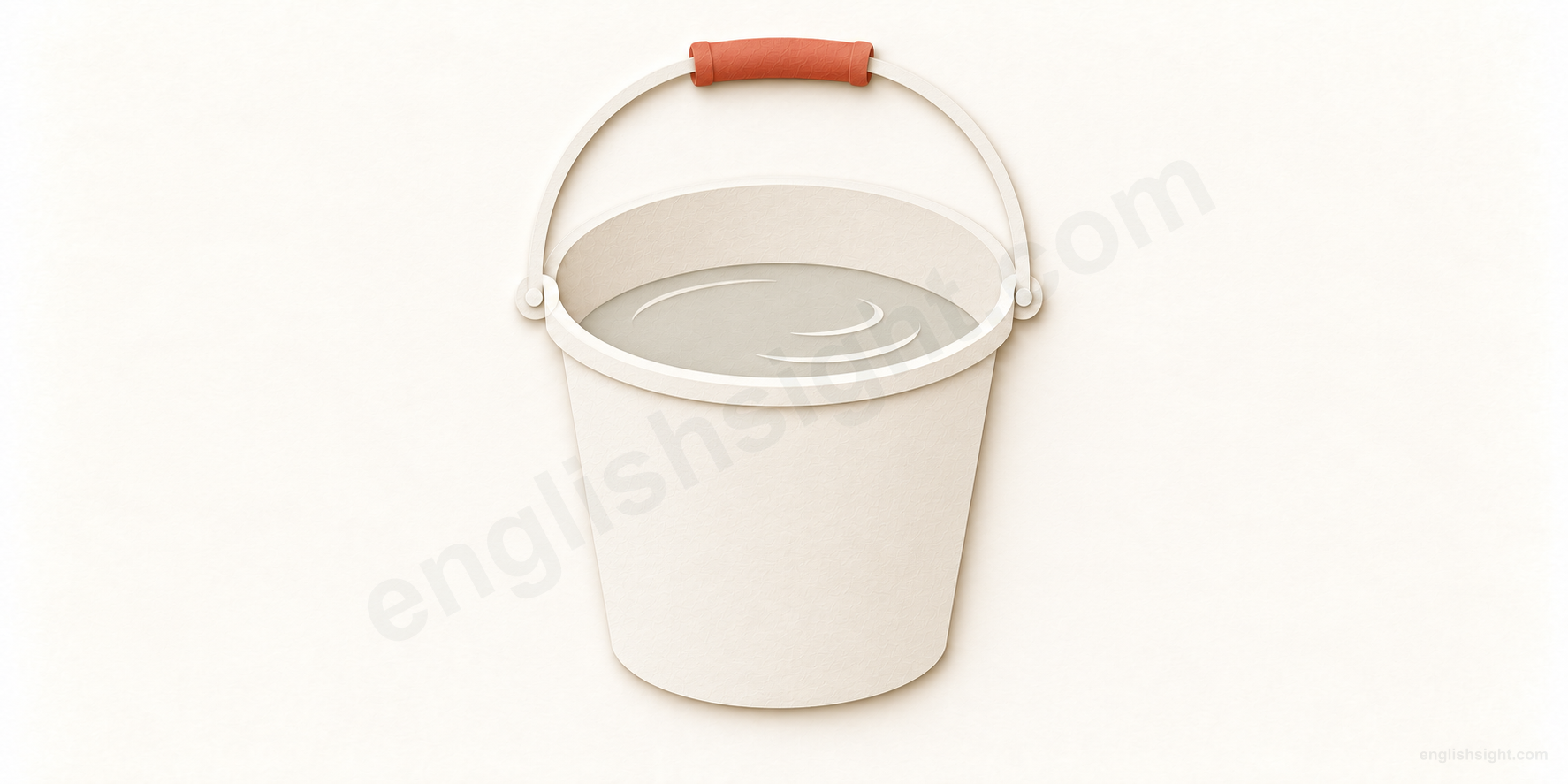
A container, a quantity, and a handful of fixed expressions.
See how bucket holds things together, measures an amount, and enters familiar phrases.
Holding a portable amount
Holding a portable amount
An open bucket with a carrying handle.
bucket
One contained amount, ready to be carried.
Its walls hold the water together.
The bucket holds water as one portable amount; its capacity is not specified.
A bucket is an open container that gathers and holds material so it can be used or carried.
The sketch shows a holding relationship, not a mandatory action or change. Amount expressions build on its contents; death idioms and compound names need their own explanations.
Start with an open container that holds liquids or loose material and can be carried. From there, distinguish a real bucket, a bucket-sized amount, and an exaggerated amount. Some expressions and names must be learned separately.
The picture is a teaching aid for the concrete meaning and its quantity connection. It is not a claim that everyone sees the same picture, and it cannot explain every idiom.
01
The container, its contents, and its work
Start with a real object. Then notice when bucket names a quantity, a machine part, or the tool used to move water.
01
a / the + bucket; adjective / noun + bucket
a bucket
a portable, open container
Situation / starting point
Loose material or liquid needs a container.
Meaning in this situation
A bucket holds it together for use or carrying.
Bucket names the vessel, whether empty or full.
A bucket is usually a deep, round container with a handle. It can hold water, sand, food, or other material. A bucket need not contain anything to remain a bucket.
Use a bucket for one object and buckets for more than one. A plastic bucket describes its material; an ice bucket names its purpose. In an ice bucket, ice keeps drinks cold. Mop and bucket and, in British English, bucket and spade name familiar pairs of equipment.
Pail can name the same kind of container. It is not the name of a different capacity. A bottle has a narrow neck, and a barrel is typically a larger storage container; these are not automatic substitutes for bucket.
In a sentence
Leave the empty bucket beside the mop.
Watch the difference An ordinary singular count noun needs a determiner: bring a bucket, not bring bucket.
02
fill + bucket + with + contents; empty + bucket + into + destination
fill a bucket with water
describe putting contents in or taking them out
Situation / starting point
The bucket is empty.
Meaning in this situation
Water goes into it; later it can be emptied.
The verb describes the action; bucket names the object being used.
Fill the bucket with water makes the bucket the object of fill and water the contents introduced by with. A bucket full of water describes its resulting condition. In pour water into the bucket, water is the object and into marks the destination.
Empty the bucket means remove its contents, not destroy the container. Empty the bucket into the sink gives their destination. Carry a bucket by the handle identifies the part you hold; water in the bucket identifies its location.
These are ordinary verb-and-noun combinations, not phrasal verbs built from bucket. Their changing meanings come mainly from fill, empty, carry, and the prepositions.
In a sentence
Fill this bucket with clean water, then carry it outside.
Watch the difference Compare fill the bucket with water with pour water into the bucket; do not simply exchange with and into.
03
number + buckets / bucketfuls + of + contents
two buckets of water
count amounts using a container
Situation / starting point
You need to say how much water to bring.
Meaning in this situation
You specify two container-sized amounts.
The container gives a rough unit; it does not supply a fixed number of litres.
A bucket of water can refer to a bucket together with its contents, or to the quantity it holds. Two buckets of water uses the countable bucket to measure the uncountable water. A bucket of apples uses the same construction with countable contents.
Bucketful makes the amount especially explicit: two bucketfuls of water. Without a stated bucket size, neither form tells you an exact volume. A ten-litre bucket, by contrast, states a capacity.
Compare a bucket for water, which names intended use and may be empty, with a bucket of water, which presents water as the contents or measured amount.
In a sentence
We used two buckets of water to rinse the tools.
Watch the difference Pluralize the measuring noun: two buckets of water. Water stays uncountable in this use.
04
the bucket of + machine; machine + bucket
the bucket of a digger
the scoop or lifting container on a machine
Situation / starting point
Soil lies on the ground.
Meaning in this situation
A machine scoop collects and lifts it.
A machine bucket shares the collecting or holding function of the portable vessel.
On a digger or excavator, the bucket is the scooping attachment, not a small pail carried by the operator. It can dig into earth and hold a load as the machine moves it.
This is an established extension by shape and function. Some lifting equipment also has a bucket for carrying material. The noun identifies the attachment; the verb tells you whether it scoops, lifts, tips, or empties.
In a sentence
The digger lowered its bucket into the soil.
Watch the difference A machine bucket need not have the handle or exact shape of a household bucket.
05
bucket + water + out (of + place)
bucket water out
move water using a bucket
Situation / starting point
Water has collected inside a boat.
Meaning in this situation
Someone removes it in bucketfuls.
Here bucket is a verb naming the tool-based action.
As a literal verb, bucket can mean lift or carry liquid in buckets. Bucket water out describes taking it out this way. This is useful to recognize, although carry water in buckets or bail water out is often clearer for a beginner.
The liquid can be the object: they bucketed water out of the boat. Out gives the direction, and out of the boat supplies the starting place. A passive is possible: the water was bucketed out. This is separate from the rain use, which has no water object.
In a sentence
They bucketed water out of the boat until help arrived.
Watch the difference The noun is not being emptied here: water is the object of the verb bucket.
02
Large amounts and heavy rain
An imagined bucketful can exaggerate quantity. Read the full construction to distinguish a noun from the rain verb.
06
buckets / bucketloads + of + noun; by the bucketful
buckets of money
a large amount, said informally
Situation / starting point
You want to emphasize abundance.
Meaning in this situation
You imagine much more than a small amount.
Plural buckets can exaggerate quantity without referring to actual containers.
Buckets of money and buckets of confidence mean a great deal of those things. There need be no physical bucket. The container-sized amount becomes a deliberately vivid measure.
By the bucketful similarly emphasizes large quantities: They sold popcorn by the bucketful. Context decides whether actual large servings or playful exaggeration is intended. Bucketloads of something is another informal large-amount expression.
Keep this wording for an informal tone. In a factual report, a precise amount or a large amount of is usually more informative.
In a sentence
The project needs patience and buckets of energy.
Watch the difference One literal bucket of water and figurative buckets of energy use the same quantity idea, but only one describes an actual container.
07
cry / weep / sweat + buckets
cry / sweat buckets
cry or sweat a great deal
Situation / starting point
An emotional film or hard exercise affects someone.
Meaning in this situation
They produce many tears or much sweat.
Buckets exaggerates an amount; it does not name a thing being cried or sweated.
Cry buckets and weep buckets describe intense crying. Sweat buckets describes heavy sweating. The image is of enough liquid to fill containers, but the speaker is not measuring real bucketfuls.
In these informal expressions, buckets follows the verb without of. Compare buckets of tears, a noun phrase with a stated substance. Sweat buckets can describe heat, physical effort, or nervousness; the phrase itself does not identify the cause.
In a sentence
I was sweating buckets after the climb.
Watch the difference Do not insert of after the verb: cry buckets, not cry of buckets.
08
rain / come down + in buckets; it rains buckets
rain in buckets
rain very heavily
Situation / starting point
The weather turns wet.
Meaning in this situation
Rain falls in an exceptionally heavy shower.
In buckets is a quantity image, not a report of containers falling.
The rain is coming down in buckets describes a downpour. It is informal exaggeration, drawing on the same imagined large amount as buckets of water.
Collins also records it rains buckets. In The rain came down in buckets, rain is the noun and came down is the verb phrase; buckets remains a plural noun after in. Compare the related verb in It is bucketing down.
In a sentence
The rain came down in buckets during the match.
Watch the difference Keep the preposition in in come down in buckets. This is different grammar from the verb bucket down.
09
it + bucket (down); it + be + bucketing (down)
It is bucketing down.
it is raining very heavily
Situation / starting point
You look outside before leaving.
Meaning in this situation
You notice a downpour.
Bucket is now the weather verb; the pronoun it is a dummy subject and does not name a container.
In British informal English, It is bucketing down means it is raining hard. You may also hear It is bucketing, without down. Down fits the downward fall of rain; it does not supply a new object.
The weather it does not stand for a bucket. The verb is intransitive in this use, so there is no ordinary passive. Forms include buckets, bucketed, and bucketing: no extra t is added before -ed or -ing.
In a sentence
Take a coat; it is bucketing down outside.
Watch the difference Use rain or it as the weather subject; I am bucketing down does not ordinarily mean I am caught in heavy rain.
03
Established expressions and compound names
Some expressions need to be learned as a whole. Others name a familiar shape or belong to a particular activity.
10
be + a drop in the bucket + compared with / to + need
a drop in the bucket
an amount too small compared with what is needed
Situation / starting point
A problem requires a great deal of help.
Meaning in this situation
One contribution covers only a tiny part.
The comparison concerns a small contribution relative to a much larger need.
The expression uses a tiny drop and a much larger bucket as a scale comparison. It can describe money, time, effort, or another contribution. The point is inadequacy relative to the need, not simply small physical size.
Oxford labels a drop in the bucket North American English and gives a drop in the ocean as the British equivalent. Compared with or compared to can make the larger need explicit. The judgment can sound discouraging, so consider its effect when discussing someone’s help.
In a sentence
Our small grant is a drop in the bucket compared with the cost of the repairs.
Watch the difference It does not mean the money has literally fallen into a container or that a small gift has no value to anyone.
11
person + kick the bucket
kick the bucket
die, expressed in a joking or blunt way
Situation / starting point
A speaker talks about someone’s eventual death.
Meaning in this situation
They choose an irreverent idiom instead of neutral wording.
This whole expression has an established meaning that the container diagram cannot predict.
Kick the bucket is an informal or slang expression for die, often humorous. It does not require any physical bucket or kicking action. Treat the full phrase as a unit rather than inventing a literal scene to explain it.
The verb changes with tense: kicks the bucket, kicked the bucket. The article the is part of the idiom. Because the tone can be insensitive, died or passed away is more suitable when offering sympathy. The example below uses a speaker joking about their own life.
In a sentence
I hope to learn the piano before I kick the bucket.
Watch the difference Kicked a bucket ordinarily describes a physical action; kicked the bucket may be idiomatic when the context is death.
12
experience + be + on + possessive + bucket list; add + experience + to + a bucket list
on my bucket list
among experiences I strongly hope to have in my lifetime
Situation / starting point
You think about an important personal ambition.
Meaning in this situation
You identify it as something you want to do during your life.
Bucket list names a list of life wishes, not objects to put in a bucket.
A bucket list records experiences or achievements someone wants before they die. You can have something on your bucket list or add it to the list. The expression is connected with the idiom kick the bucket; it is not a literal container list.
In the example, seeing the northern lights is the desired experience. It is a life wish, whereas a to-do list often records practical tasks. A bucket list does not imply that the person expects to die soon, and the term can be used cheerfully.
In a sentence
Seeing the northern lights is on my bucket list.
Watch the difference Use on my bucket list, as with other lists, rather than in my bucket list.
13
a bucket hat; plural bucket hats
a bucket hat
a soft hat with a brim that slopes downward
Situation / starting point
You choose a casual hat.
Meaning in this situation
Its soft crown and downward brim identify the style.
Bucket modifies hat as a shape-based name; hat is the main noun.
A bucket hat is a cloth hat with a soft, round crown and a downward-sloping brim. Its outline suggests an upside-down bucket, but it is made and worn as a hat.
The compound is a countable noun: one bucket hat, two bucket hats. Bucket stays singular as the first element. The word hat, rather than bucket alone, tells you what kind of object is being named.
In a sentence
She packed a bucket hat for the walking holiday.
Watch the difference A bucket hat is a particular hat style, not any hat worn while using a bucket.
14
a bucket seat; plural bucket seats
a bucket seat
a shaped seat for one person
Situation / starting point
You describe the seating in a car.
Meaning in this situation
You identify an individual seat with a curved back.
Seat is the main noun; bucket suggests the enclosing shape.
A bucket seat has a curved back shaped for a single person, especially in a car. It is not a container that someone has improvised as a chair.
Two bucket seats means two individual seats of this design. The first noun stays singular. Shape helps connect the compound with bucket, but learn the conventional name rather than calling every curved chair a bucket.
In a sentence
The car has two bucket seats in the front.
Watch the difference Bucket seat names a seat design, not a measure of the number of passengers in a vehicle.
15
score / get + a bucket
score a bucket
make a basket in basketball
Situation / starting point
A player takes a shot during a basketball game.
Meaning in this situation
The shot goes in and the player scores.
In basketball talk, a bucket can mean a successful basket, not a container.
In informal basketball usage, bucket can mean a field goal: a successful shot during play. Score a bucket and get a bucket belong to this sports context.
The score can come from a two-point or a three-point shot; bucket does not mean exactly two points. Context keeps the sporting meaning separate from household objects and the quantity metaphor.
In a sentence
Maya scored a bucket just before the buzzer.
Watch the difference This is sports language. It does not mean the player won an actual bucket or made a free throw.
Keep the noun, the verb, and the full expression apart
Read the head noun and the preposition
A bucket of water presents contents or an amount; a bucket for water names a purpose. A bucket hat is a hat, and a bucket seat is a seat. Fill the bucket with water and pour water into the bucket describe the same destination with different verb patterns.
Exaggeration is not measurement
Buckets of confidence, sweating buckets, and rain in buckets all emphasize quantity. No actual container or exact measurement is implied. A drop in the bucket emphasizes the opposite scale: a contribution small relative to a need.
Forms and grammatical limits
The noun is countable: bucket / buckets; bucketful has the plural bucketfuls. Verb forms are bucket, buckets, bucketed, bucketing. The literal water-moving verb can take an object and a passive; the weather verb is intransitive. There is no need to invent causative or complement families for this word.
Recognize the setting and tone
Bucket down is chiefly British and informal. Kick the bucket can sound insensitive in serious discussion of a death. Basketball bucket is informal sports usage. Choose neutral wording when the situation calls for it.
Useful boundaries
Specialized turbine and waterwheel parts, computing storage buckets, historical trading uses, and regional slang are outside this introductory lesson. Workplace talk also uses buckets for categories; that is a separate grouping metaphor, not a claim that the items are physically in a pail.
Choose the meaning from the whole expression
Use the situation and the surrounding words; the bucket picture alone is not enough.
1. The bucket is empty, but you bought it to carry water. Which phrase states its intended use?
2. You brought two bucketfuls of water. What can we conclude?
3. A British friend says, “It is bucketing down.” What is happening?
4. Repairs cost far more than your small grant. What does calling the grant “a drop in the bucket” emphasize?
5. A friend says, “Learning to sail is on my bucket list.” What do they mean?
Sources and teaching notes
The sources below support the meanings and usage distinctions. The explanations and examples are original; the container picture is a teaching model, not evidence for the origins of every phrase.
The diagram illustrates holding and quantity. Fixed expressions need their own context.