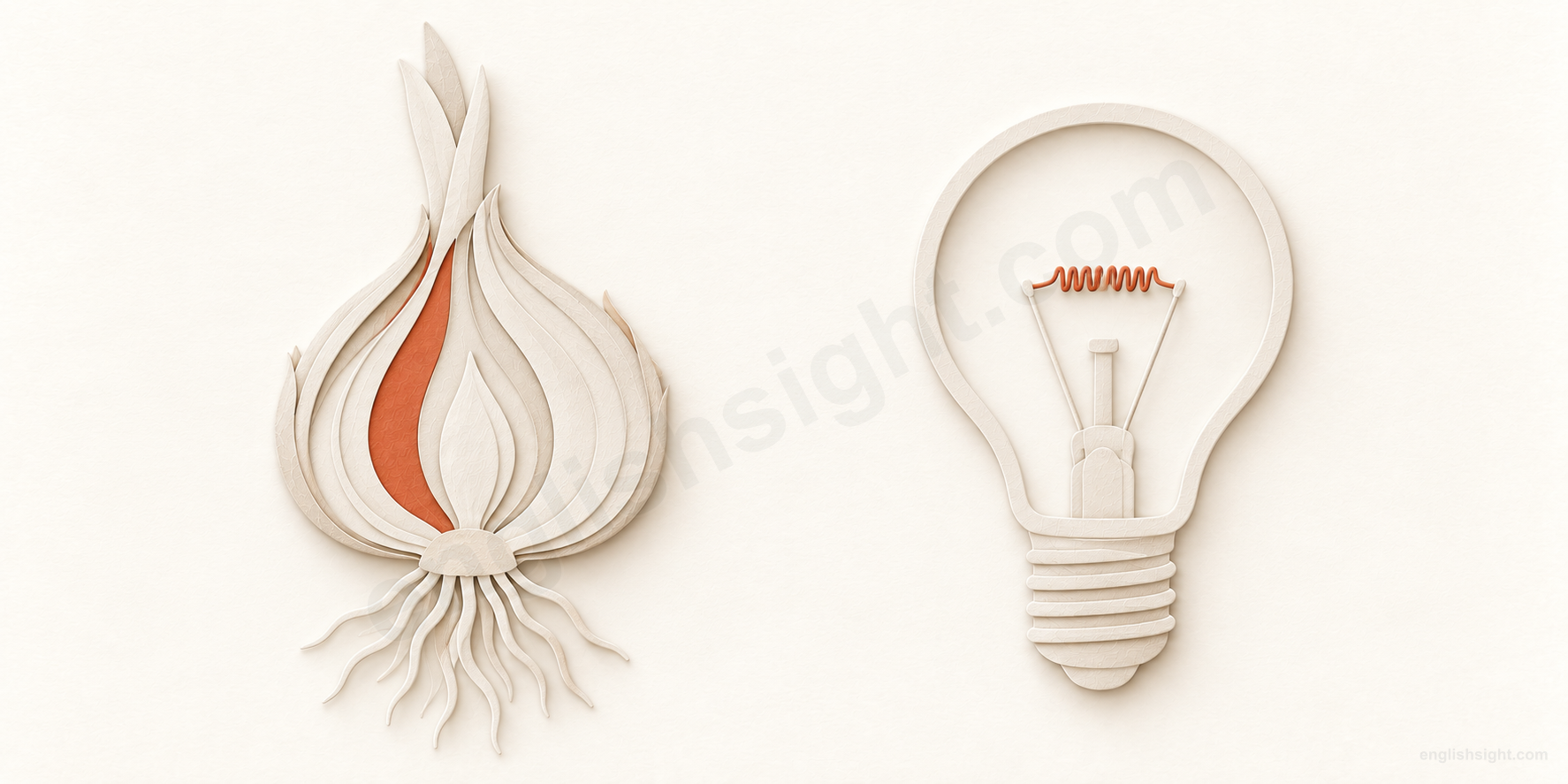
Recognize a light source, a plant’s storage organ, and a rounded part of an instrument.
Rounded form, different functions
Recognize the shape; check the function
A layered plant bulb with a shoot and roots.
bulb
A classic electric bulb with a filament and screw base.
Compare rounded bodies joined to narrower parts.
Similar rounded forms, different functions: these objects are not changing into one another.
Bulb can name a plant’s rounded storage organ or an object or part with a similar swollen shape, especially an electric light source.
The shape connection is a teaching aid with limits: modern light bulbs need not have the classic outline, and fixed figurative expressions must be learned as expressions.
In a lamp, bulb usually names the replaceable light source. In a garden, it names the thick, rounded part from which certain plants grow. Context tells you which object is meant.
A rounded body, often joined to a narrower part, offers a useful visual connection. It does not make all round objects bulbs or give every bulb the same function.
01
Lighting at home
Name the replaceable part, describe its condition, and ask for a replacement.
01
a / the light bulb; an LED bulb; two light bulbs
a light bulb / an LED bulb
the unit that produces light in an electric fitting
Context
You are choosing a replacement for the light in a room.
What is meant?
You name the light-producing unit, rather than the whole table lamp.
Light identifies the electric sense; LED specifies a type.
In an electrical context, a bulb is the light-producing unit fitted into a lamp or other light fitting. Light bulb makes this meaning explicit. Lightbulb is also an accepted spelling.
An LED bulb, a fluorescent bulb, and an incandescent bulb use different technologies. Bulb is not restricted to an old glass envelope with a glowing wire. The classic rounded outline is a useful recognition aid, not a requirement for every modern design.
In everyday home descriptions, a lamp often means the whole object, including its support and shade. Compare a bedside lamp with the bulb inside it. Technical writing may use lamp for the light source itself.
In a sentence
The bedside lamp needs a new LED bulb.
Watch the difference Bulb is countable: a bulb or two bulbs. Light is the modifier in light bulb; it is not an instruction to light something.
02
change + a / the bulb; replace + the bulb + with + another one
change / replace a bulb
remove the old bulb and fit another one
Context
The old bulb no longer works.
What is meant?
Another bulb takes its place.
Change or replace supplies the action; bulb names its object.
Change a bulb is a normal way to describe replacing it. It does not mean altering its colour or shape. Replace the bulb with a new one makes the substitution explicit.
Can you change it? uses it for the bulb already mentioned. The expression is an ordinary verb plus noun object, not a phrasal verb built from bulb.
In a sentence
We replaced the broken bulb with a new one.
Watch the difference Replacing a bulb changes the light source; replacing the lamp may mean replacing the complete household object.
03
the bulb has gone; the bulb has burned / burnt out
the bulb has gone / burned out
the bulb has stopped working
Context
The bulb used to give light.
What is meant?
It has failed and needs attention.
The predicate reports failure, not a new meaning of bulb.
The bulb has gone can mean that it has stopped working, especially in British English. In this context, gone does not normally mean that someone took the bulb away.
The bulb has burned out, also burnt out, describes failure of the light source. Burn out is the phrasal verb here. Compare The bulb is off: that may simply mean the light has been switched off and still works.
In a sentence
The bulb in the hallway has burned out again.
Watch the difference A bulb that is off is not necessarily broken. Read the whole predicate before deciding what happened.
04
a bare bulb; a naked bulb; a dim bulb
a bare / naked bulb
a bulb without a shade or decorative cover
Context
A room has an exposed light source.
What is meant?
You describe the missing cover, rather than its brightness.
Bare and naked describe the bulb’s surroundings.
A bare bulb or a naked bulb has no shade or decorative cover around it. It can still be connected and working.
A dim bulb gives little light; a bare bulb lacks a cover. These descriptions answer different questions, so one bulb can be both bare and dim.
In a sentence
A bare bulb hung above the table.
Watch the difference Bare does not mean broken, and naked is a conventional description of an exposed object here.
02
In the garden and kitchen
Use bulb for a plant structure and distinguish a whole garlic bulb from one small section.
05
plant + bulbs; grow from + a bulb; tulip / flower bulbs
plant bulbs / grow from a bulb
put plant storage organs in the soil or describe plants developing from them
Context
A rounded plant structure contains the basis for new growth.
What is meant?
Roots and a shoot can develop from it.
This is a plant structure, not an electric object or a seed.
A true plant bulb has a short stem and fleshy leaves or layers around a bud. Tulips, daffodils, and onions provide familiar examples. The layers store food for growth; the roots are separate parts growing below.
Plant bulbs uses plant as a verb and bulbs as its object. Grow from a bulb describes how a plant develops. Tulip bulbs names the kind; flower bulbs names bulbs grown for flowers.
Gardeners also sometimes use bulbs for the plants grown from them, as in The spring bulbs are flowering. Gardening usage may group bulb-like structures together; botanical distinctions are more precise.
In a sentence
We planted tulip bulbs along the garden path.
Watch the difference A bulb is not a seed, and a true bulb is not simply a thick root. The word is not a general name for every underground vegetable.
06
a bulb of garlic; a garlic bulb; a clove of garlic
a bulb of garlic
the whole rounded garlic head, containing separate cloves
Context
You are counting garlic for a recipe.
What is meant?
Bulb names the whole head; clove names one section.
The plant meaning helps you choose the correct amount.
A bulb of garlic or a garlic bulb is the whole head. A clove of garlic is one of the small sections inside it. A recipe asking for two cloves does not ask for two whole bulbs.
Garlic alone normally names the ingredient as a mass. Bulb and clove give you countable units: one bulb of garlic, two cloves of garlic.
In a sentence
Separate one bulb of garlic into individual cloves.
Watch the difference Do not substitute bulb for clove when following a quantity in a recipe.
03
Other rounded parts
The object’s name explains the function of the rounded part.
07
the bulb of + an instrument; a rubber bulb
the bulb of a thermometer / a rubber bulb
a rounded, enlarged part of an instrument
Context
An instrument has a narrow tube or stem and a wider end.
What is meant?
Bulb identifies its rounded enlargement.
Shape connects this use with the plant and electric senses; function comes from the instrument.
On a liquid-in-glass thermometer, the bulb is the widened reservoir at the end of the thin tube. A rubber bulb on a dropper is a flexible rounded part that you squeeze.
The bulb of a thermometer identifies a part of that instrument. A rubber bulb specifies material. Neither expression implies an electric light source, and not every thermometer has this kind of bulb.
In a sentence
Squeeze the rubber bulb at the top of the dropper.
Watch the difference Bulb identifies a shape-related part; it does not by itself tell you whether the part holds liquid, air, or a light source.
04
Ideas and judgments about people
These established expressions use light as a metaphor for understanding or intelligence.
08
have + a light-bulb moment; it was + a light-bulb moment
a light-bulb moment
a sudden realization, understanding, or useful idea
Context
You cannot see how to solve a problem.
What is meant?
The answer suddenly becomes clear.
The full expression compares understanding with a light coming on.
The expression have a light-bulb moment describes suddenly understanding something or having a good idea. It can concern a small practical solution, not only a major invention.
The expression draws on the cartoon convention of an illuminated bulb above a character’s head. It does not describe a real change in lighting, and bulb alone is not a general substitute for idea.
In a sentence
I had a light-bulb moment when I noticed the two pieces fitted together.
Watch the difference Say I had an idea or I had a light-bulb moment, not I had a bulb when you mean a new idea.
09
call + someone + a dim bulb; be + a dim bulb
a dim bulb
an informal, insulting description of a person considered unintelligent
Context
Someone uses a lighting description about a person.
What is meant?
The description criticizes intelligence rather than actual light.
The person sense belongs to the expression dim bulb.
Calling someone a dim bulb is an informal insult. It plays on the contrast between bright as giving light and bright as intelligent; dim suggests the opposite.
A dim bulb in a lamp is literal and gives little light. A person called a dim bulb is being mocked. The referent and context separate the two readings.
In a sentence
The reviewer unfairly called the main character a dim bulb.
Watch the difference This is useful to recognize, but it is not a neutral description to use about a learner or colleague.
Keep the object and the expression separate
Forms and sound
Bulb is a countable noun: a bulb, the bulb, bulbs. Pronounce /bʌlb/ with the l and final b; the plural ends /bz/. In light bulbs and tulip bulbs, the final noun carries the plural.
A useful shape connection, not a naming rule
A rounded shape helps connect several senses, but a ball is not automatically a bulb. Learn the object name in its setting. Plant bulbs, light bulbs, and instrument bulbs do different jobs.
Grammar and scope
This lesson covers noun uses and familiar combinations. Change, plant, grow, and burn out supply the actions in the examples; bulb does not acquire a phrasal-verb family from them. Specialized anatomy, ship design, and the photographic Bulb setting are outside the lesson.
Choose what bulb means here
Use the situation and the full expression to choose an answer.
1. A recipe needs one small section from a garlic head. Which phrase gives that amount?
2. The bulb is off, but it works when you press the switch. Which description fits?
3. A solution suddenly becomes clear to you. Which sentence expresses that?
4. An instruction tells you to squeeze the rubber bulb on a dropper. What do you squeeze?
Sources and teaching notes
Dictionary entries and collocation material support the usage described below. Explanations and examples are original. The shape comparison is a teaching model, not a claim that every sense has the same function.
The diagram offers a useful comparison; it is not a picture shared by every native speaker.