Follow burn from fire and damage to energy, feelings, and established expressions.
Change and consumption through heat
Material changes as it burns
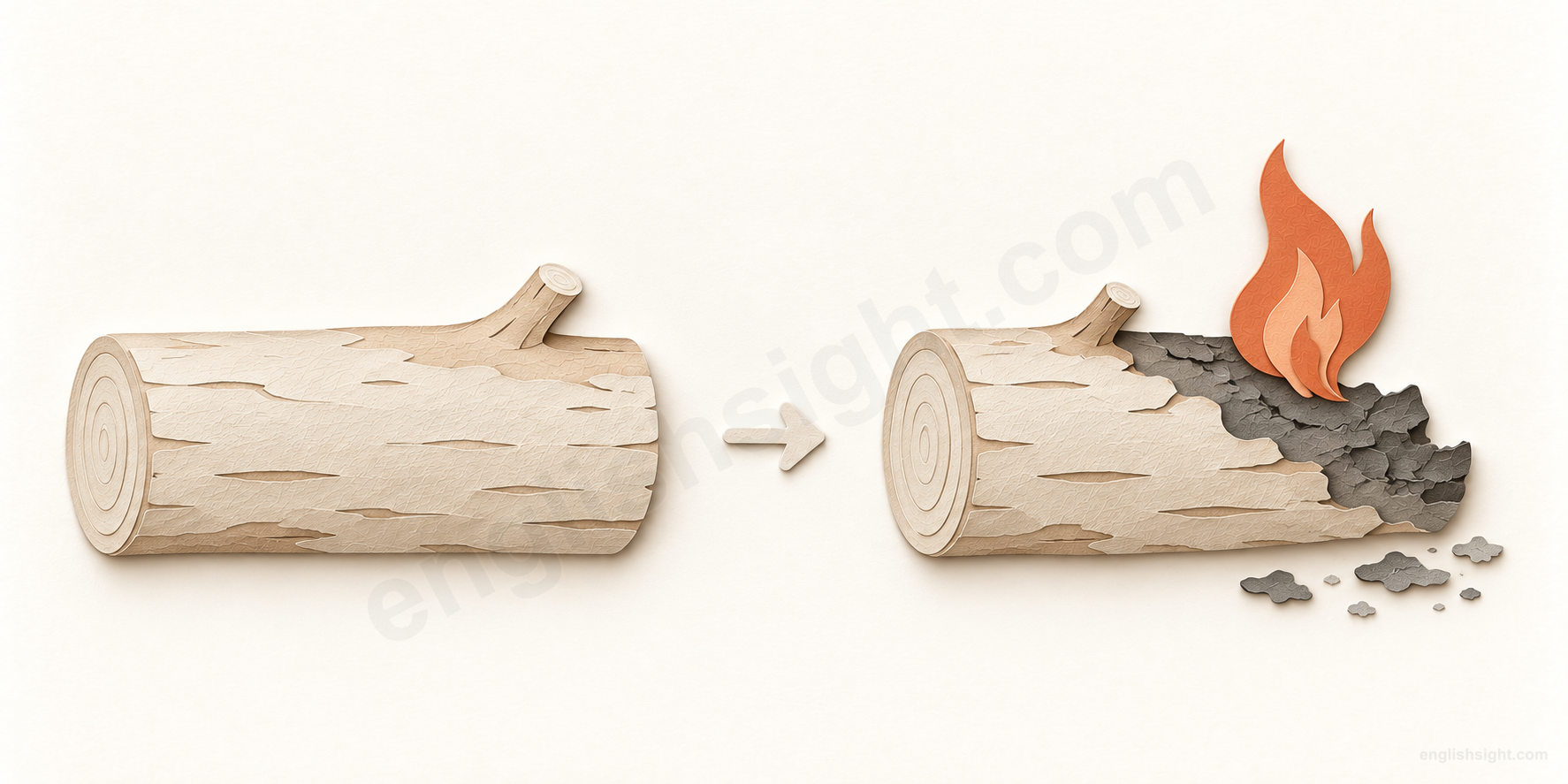
The log is intact.
burn
Part of the log is charred and consumed, with ash below.
Burning releases heat and changes the wood.
Burning changes and consumes the wood; the flame shows that the process is still continuing.
In its central fire use, burn describes material undergoing combustion, giving off heat and often light while being changed or consumed.
The sketch follows one piece of wood from intact fuel to a burning, partly consumed remnant. It is a teaching anchor for change and consumption, not a rule that every use involves fire or complete destruction.
A log can burn, a cook can burn the toast, and a runner can burn energy. Start with a process that gives off heat and changes or uses material; then notice which part of that experience an expression draws on.
Burn also describes injury, a hot or stinging feeling, and intense emotion. Those uses do not require visible flames. Fixed expressions such as burn your bridges have their own established meanings, so the whole phrase matters.
01
Fire, heat, and physical change
Identify the thing burning, the person or cause acting on it, and any result. Flames, heat damage, and bright light are related but distinct uses.
01
something burns; something is burning
The wood is burning.
undergo combustion or sustain a fire
Situation
A log has caught fire.
What happens / what is meant
It gives off heat while its material changes.
The subject can be fuel, a flame, or a fire.
In The wood is burning, wood is undergoing the process. A fire burns steadily describes the fire continuing. Neither sentence needs an object, and neither says the process has finished.
Light a candle and set something on fire focus on starting it; burn can describe what happens afterwards. A burning building has an ongoing fire. Burn easily describes a general property, whereas is burning describes an event now.
In a sentence
The dry branches burned slowly in the stove.
Watch the difference Do not treat is burning as meaning already completely destroyed.
02
burn + object; be burned/burnt; burn a hole in + material; burn (something) to ashes
burn something / burn a hole in something
damage, destroy, or produce a result through burning
Situation
A hot ember lands on fabric.
What happens / what is meant
The fabric is damaged and a hole remains.
The object may be what is damaged or the result created.
Burn the papers makes papers the affected material. The papers were burned inverts the viewpoint: the passive presents what happened to them without requiring the person responsible.
In burn a hole in the cloth, the hole is the result and the cloth is its location. Burn something to ashes and burn to the ground specify extensive destruction; burn alone can mean only partial damage. In reports, burn to death means die from fire, and be burned to death presents the event passively.
In a sentence
A spark burned a small hole in my sleeve.
Watch the difference Burn does not always mean reduce to ash; the result phrase or context supplies the extent.
03
something burns + fuel; fuel burns + adverb
burn gas / wood / fuel
use fuel to obtain energy
Situation
A heater needs an energy source.
What happens / what is meant
Fuel is consumed to provide heat.
The fuel is the object; it can also be the subject of burn.
A heater burns gas says what it uses for energy. This wood burns well describes how the fuel performs. The change-and-consumption anchor applies directly, without implying an accident.
Burn is not a general synonym for use electricity: a lamp uses electricity, while a fuel-burning heater burns fuel. The fuel may produce useful heat, light, or power.
In a sentence
Our old heater burned oil, but this one uses electricity.
Watch the difference Choose the verb for the energy source instead of replacing every use with burn.
04
burn + food; food burns; burnt/burned + food; burn (something) to a crisp
burn the food
spoil food with excessive heat
Situation
A pan remains over the heat too long.
What happens / what is meant
The food becomes dark, damaged, or unpleasant.
Food can burn without catching fire.
I burned the rice identifies the cook as the cause; the rice burned leaves the cause unstated. Burnt toast describes the result. Cooking something is intentional heating, whereas burning food usually means it has gone too far.
Burn something to a crisp or a cinder intensifies the result. Scorch often concerns surface heat damage; char emphasizes blackening. Some dishes are deliberately charred, so those words do not always carry the same judgment as I burned dinner.
In a sentence
I was answering the door and burned the onions.
Watch the difference Burning food is not the same as merely browning it.
05
burn + body part; burn oneself on + hot object; be/get burned
burn yourself on something hot
injure skin or another body part
Situation
Someone touches a hot tray.
What happens / what is meant
Contact causes a burn injury.
Reflexive yourself refers back to the injured subject.
I burned my hand puts the body part after burn. I burned myself on the tray names me as the affected person and uses on for the contact surface. The tray burned my hand makes the hot object the cause; my hand was burned focuses on the injury.
Burn covers injuries from heat and other damaging agents, including chemicals; visible flames are not necessary. Scald is more specific to very hot liquid or steam. Singe describes slight damage to edges, hair, or a surface rather than necessarily a serious injury.
In a sentence
Leila burned her wrist on the oven rack.
Watch the difference On identifies the contact surface here; it is not a particle in a phrasal verb burn on.
06
burn easily; burn in the sun; get burned/burnt
burn in the sun / get burned
suffer skin damage from sunlight
Situation
Someone spends time in strong sunlight.
What happens / what is meant
Their exposed skin is affected.
Sunburn belongs to the injury branch, not the flame picture.
I burn easily describes a tendency for skin to be damaged by the sun. I got burned yesterday reports an event. The sun burned my shoulders makes the sun the subject and shoulders the object.
Sunburn is also a noun, and sunburned or sunburnt can describe the affected skin. The context distinguishes this literal skin damage from getting burned in a risky deal.
In a sentence
My shoulders got burned during the boat trip.
Watch the difference A person burning in the sun need not be on fire.
07
a light/lamp burns; lights are burning
a light burning
give light or remain lit
Situation
A room is otherwise dark.
What happens / what is meant
One light is still shining.
This use focuses on illumination rather than damage.
A candle burning can involve an actual flame. A light burning can simply mean a light is on, including an electric light. The subject and setting tell us which reading fits.
The illumination use often has a descriptive or literary tone. In everyday instructions, leave the light on is generally plainer than keep the light burning.
In a sentence
One lamp was still burning in the empty office.
Watch the difference The sentence does not say the lamp is damaged or the office is on fire.
02
Sensation, emotion, and memory
English draws on the intensity of heat without claiming that a body or a feeling is literally on fire.
08
body part burns/is burning; something burns + body part; cheeks burn with embarrassment
My eyes are burning.
feel hot, sore, or stinging
Situation
Smoke irritates someone’s eyes.
What happens / what is meant
They feel a hot discomfort.
A burning sensation does not by itself establish a burn injury.
My eyes burn and my throat is burning describe a sensation. Smoke burns my eyes makes the irritant the subject. Hurt is broader: it does not specify the hot or stinging quality that burn evokes.
My cheeks burned with embarrassment describes a hot, often flushed face caused by an emotion. Here with gives the cause or accompanying feeling; it does not mean a physical instrument. Literal discomfort and emotional flushing share heat-like intensity, but they are not identical situations.
In a sentence
My eyes were burning after I walked through the smoke.
Watch the difference Do not infer actual flames or permanent injury from the sensation verb alone.
09
burn with + emotion; be burning to + verb; a burning desire/question
burn with anger / be burning to do something
feel an emotion or desire intensely
Situation
A person has a strong reaction or eager wish.
What happens / what is meant
The feeling is presented as intense inner heat.
With introduces a feeling; to introduces the desired action.
Burn with anger, shame, or ambition gives the feeling a heat metaphor. Be burning to ask a question expresses strong eagerness to ask it. The to-infinitive names what the person wants to do; it is not a physical destination.
These are vivid, often literary or emphatic expressions, not neutral substitutes for every feel or want. Burning can also modify desire or ambition. A burning question is an urgent or pressing question, an established adjective use rather than something literally heated.
In a sentence
Mara was burning to hear how the interview had gone.
Watch the difference Burn to hear expresses desire; burn something to ashes uses to for a resulting state.
10
something is burned/burnt into someone’s memory
be burned into someone’s memory
remain as a strong, lasting mental impression
Situation
Someone witnesses an unforgettable scene.
What happens / what is meant
The image stays vivid afterwards.
Burning is used as an image of leaving a deep mark.
The scene was burned into my memory means it was impressed there so strongly that it remains hard to forget. No fire is needed. The passive emphasizes the lasting impression rather than a person deliberately memorizing something.
Into links the image to the mind or memory where it is fixed. This is figurative marking, not the resource-consumption use, and it is more vivid than simply I remember it.
In a sentence
The sight of the empty playground is burned into my memory.
Watch the difference Do not use this as the ordinary expression for saving a file to computer memory.
03
Energy, money, and recorded data
Consumption extends to resources; recording a disc is a conventional technical use. Read the object and context.
11
burn calories; burn off/up + energy/calories; burn it off/up
burn calories / burn off energy
use energy in bodily activity
Situation
Someone goes for a long walk.
What happens / what is meant
Their activity uses energy.
The body is not literally producing flames.
Burn calories is ordinary language for using energy. Burn off energy or calories and burn up energy or calories emphasize their expenditure; the particles do not imply a guaranteed amount or rate.
Children burning off energy is a familiar way to describe active play. With a separable object you can say burn it off or burn it up. This is different from a fire burning up paper and from a person burning up with a fever.
In a sentence
The children burned off some energy in the park.
Watch the difference These phrases describe usage, not a precise calculation of exercise effects.
12
burn through + money/resources; burn cash; burn rate
burn through money
spend a resource rapidly
Situation
A team has a limited budget.
What happens / what is meant
Its available cash falls quickly.
The consumption model is extended to spending.
Burn through a budget suggests using it quickly, often faster than is comfortable. Through precedes the resource: burn through it. This pattern is not separable like burn it up.
Business English also uses burn cash or burn money for ongoing spending, and burn rate for the rate of that spending. These expressions do not themselves mean someone literally destroys banknotes or necessarily spends dishonestly.
In a sentence
The repairs burned through most of our savings.
Watch the difference Say burn through it, not burn it through, for this resource pattern.
This is a conventional computing use, not destruction.
Burn a CD names the disc receiving the recording. Burn music to or onto a CD names the content first and then the destination. A suitable disc-writing device is understood.
This use is still useful when discussing optical media, though not every modern device has a disc drive. Copying files to a phone, downloading music, and streaming it are not normally called burning a CD.
In a sentence
I burned the recordings onto a CD for the archive.
Watch the difference The disc is being written, not set on fire; burn is not the general verb for every digital transfer.
04
What away, off, down, out, and up add
The small word can highlight disappearance, removal, destruction, an ending, or intensity. These combinations have several established meanings.
14
burn away; burn something away; burn something off; fog burns off
burn away / burn something off
disappear through burning or be removed with heat
Situation
Material covers a surface or forms part of an object.
What happens / what is meant
Burning reduces or removes it.
Away highlights disappearance; off highlights removal.
Part of the candle burned away says its material disappeared as it burned. Burn something away is also possible. Burn a coating off or burn off a coating treats the coating as something removed from a surface; with a pronoun, use burn it off.
The morning fog burned off uses the removal idea for fog clearing as the sun warms the air: The sun burned off the fog. It does not mean the fog caught fire. The exercise use of burn off belongs to the energy entry.
In a sentence
By ten, the sun had burned off the mist above the field.
Watch the difference Burn away and burn off overlap, but do not assume every object sounds equally natural with both.
15
something burns down; burn something down; burn it down; be burned/burnt out; be burned out of one’s home
burn down / be burned out
suffer destructive fire in a building or vehicle
Situation
Fire spreads through a structure.
What happens / what is meant
The structure is destroyed or its interior is gutted.
Down and out can focus on different destructive results.
The shed burned down presents the destruction without naming a cause; someone burned the shed down or burned it down presents a cause. Down is part of the destruction expression, not a direction of ordinary travel.
A car or building was burned out often means fire destroyed the interior, leaving an outer shell. A burned-out car is not just a car with an overheated motor. Burn down and burn out are therefore not interchangeable in every description.
People can also be burned out of their homes: a fire has made their homes unusable, so they must leave. The fire burned several families out of their homes names the cause. Here the people lose their accommodation; the phrase does not by itself say they suffered burns or became exhausted.
In a sentence
The workshop burned down, leaving only the chimney standing.
Watch the difference A car burned out by fire and a motor that burned out are different situations.
16
a fire burns out; a fire burns itself out
the fire burns itself out
stop because there is no more fuel to burn
Situation
A fire consumes the available fuel.
What happens / what is meant
The fire eventually stops.
Out marks the ending of the process.
The fire burned out and the fire burned itself out describe the process reaching an end through using its fuel. Itself refers to the fire, not to a person putting it out.
Put the fire out introduces an action that extinguishes it. The distinction matters: burned itself out explains why it ended, while was put out describes intervention.
In a sentence
The small fire had burned itself out before dawn.
Watch the difference Burn out does not mean start a fire or make its flames larger.
17
a device burns out; burn a device out; burn it out
a motor burns out
stop working through overheating or excessive use
Situation
A device works under too much strain.
What happens / what is meant
A component fails.
The equipment may fail without a visible fire.
The motor burned out makes the failed component the subject. Running it continuously burned the motor out identifies the cause; it burned it out uses a pronoun between verb and particle.
A bulb can burn out when it reaches the end of its working life. Compare a burned-out car after a fire, where out describes destructive fire damage rather than just one failed component.
In a sentence
The pump’s motor burned out after months of heavy use.
Watch the difference Burn out is more specific than the general break down; it is not every kind of mechanical failure.
18
burn out; burn oneself/someone out; feel burned/burnt out
burn yourself out / feel burned out
become seriously exhausted through prolonged demands
Situation
Someone works intensely over a long period.
What happens / what is meant
Their energy and ability to continue are depleted.
The consumed-fuel image becomes an exhaustion metaphor.
You may burn out describes what happens to you. You may burn yourself out emphasizes the effect of your own sustained effort. A workload can also burn someone out; use burn them out with a pronoun.
Feel burned out or burnt out describes the resulting state. Burnout is a related noun. In this use, the point is prolonged strain, not merely being sleepy after one late night.
In a sentence
After taking on three projects at once, I felt completely burned out.
Watch the difference Burned out here is figurative; it does not mean someone suffered a fire injury.
19
something burns up; burn something up; burn it up; a fire burns up
burn up / burn something up
be destroyed by heat or consume something by burning
Situation
Intense heat acts on an object.
What happens / what is meant
The object is consumed or destroyed.
Up can emphasize consumption rather than upward movement.
The fragment burned up needs no object. The fire burned the papers up or burned up the papers makes papers the object; with a pronoun, say burned them up. In this destruction use, up commonly gives a sense of thorough consumption.
Burn up is not identical in every context to burn out: a fire burns out when it stops, while paper burns up when it is consumed. A fire can also burn up in the separate sense of its flames becoming stronger. The subject and surrounding sentence distinguish the readings.
In a sentence
The fragment burned up as it entered the atmosphere.
Watch the difference Up does not always mean completion: a fire burning up can be growing stronger.
20
someone is burning up
You’re burning up.
feel or be extremely hot, often with a fever
Situation
Someone’s body feels unusually hot.
What happens / what is meant
The speaker emphasizes that high temperature.
The progressive phrase describes intense body heat.
You are burning up is an informal way to say that someone is extremely hot, often because of a fever. It is not a literal claim that the person is being consumed by fire.
This construction normally has the person as its subject and no object. Compare the object pattern in the fire burned the paper up and the anger pattern in it burns me up.
In a sentence
You’re burning up, and your forehead feels very hot.
Watch the difference This is an everyday expression, not a diagnosis or a measurement.
21
something burns someone up; it burns me up; someone burns up at/over something
That really burns me up.
make someone very angry, or become very angry
Situation
Someone describes unfair treatment.
What happens / what is meant
The speaker reacts with strong anger.
The irritating event is the subject; the angry person is the object.
That burns me up means that makes me very angry. This is especially North American informal English. The pronoun belongs between burn and up: it burns me up.
Bare burn someone can also mean anger them in North American informal use. The whole phrase and context distinguish this from heat injuring a person. For a neutral alternative, say that makes me angry.
North American informal English also uses burn up without an object to mean become angry: He burns up whenever he hears that accusation. This differs from the fever reading of You’re burning up; an anger-triggering context makes the intended meaning clear.
In a sentence
It burns me up when they take credit for our work.
Watch the difference Do not confuse burns me up with I’m burning up, which may describe fever.
05
Whole expressions for everyday situations
Learn these as phrases. The image can help you remember them, but it cannot supply every idiomatic meaning.
22
burn one’s bridges; British also burn one’s boats
burn your bridges
remove the possibility of going back
Situation
Someone leaves a job or relationship.
What happens / what is meant
Their actions prevent an easy return.
The bridge is a metaphor for the route back.
To burn your bridges is to act so that returning to a previous position becomes impossible. It often warns against damaging relationships while leaving. Keep the possessive linked to the person: I do not want to burn my bridges.
British English also has burn your boats. Neither phrase requires a real bridge or boat, and neither simply means make any change; the loss of a return option is central.
In a sentence
I left politely because I didn’t want to burn my bridges.
Watch the difference The phrase concerns future options, not necessarily physical destruction.
23
be/get burned; burn one’s fingers; get one’s fingers burned/burnt
get burned / get your fingers burned
suffer from misplaced trust or a risky choice
Situation
Someone enters a deal without seeing the danger.
What happens / what is meant
They lose money or otherwise suffer.
Physical injury becomes an image of an unpleasant experience.
I got burned on that deal is informal: the deal went badly for me, perhaps because someone deceived me. Be burned also occurs. The passive-like viewpoint foregrounds the person who suffered.
Burn your fingers and get your fingers burned or burnt are related established idioms, often about business risks. Context separates these from the literal hand injury. A bad experience can make a person more cautious next time.
In a sentence
We got our fingers burned by the last investment, so we asked more questions this time.
Watch the difference This describes suffering a setback, not necessarily admitting to setting a literal fire.
24
burn the midnight oil
burn the midnight oil
work or study late at night
Situation
A deadline is approaching.
What happens / what is meant
Someone stays up working.
The oil-lamp image supplies the phrase, not a requirement to use oil.
This established expression describes late-night work or study. Midnight is part of the idiom; the speaker need not have checked that the clock passed exactly twelve.
It can sound more colorful than work late. It does not necessarily mean the work was effective, nor that the person also got up early.
In a sentence
We burned the midnight oil finishing the presentation.
Watch the difference Do not use this for merely staying awake to watch television without a work or study context.
25
burn the candle at both ends
burn the candle at both ends
leave too little sleep by staying up late and rising early
Situation
Someone combines late nights with early starts.
What happens / what is meant
They become very tired.
Both ends represent demands cutting into rest from both sides.
The complete idiom is burn the candle at both ends. It commonly describes a tiring schedule with late nights and early mornings, whether caused by work, social life, or both.
Burn the midnight oil concerns late-night work or study. The candle expression adds the problem of insufficient rest across the schedule; it does not simply mean be busy or perform two tasks at once.
In a sentence
With evening shifts and early classes, Ana was burning the candle at both ends.
Watch the difference Keep at both ends; burn both candles is not this idiom.
26
money burns/is burning a hole in someone’s pocket
money burns a hole in your pocket
feel eager to spend money immediately
Situation
Someone has just received money.
What happens / what is meant
They can hardly wait to spend it.
The money is the grammatical subject of the expression.
That money is burning a hole in your pocket means you seem unable to leave it unspent. It is a playful image of money being uncomfortable to keep, not an account of damaged clothing.
The phrase can describe a small sum, including a child’s pocket money. It does not imply the person is wealthy; that is the different idea in have money to burn.
In a sentence
Your birthday money is burning a hole in your pocket already!
Watch the difference Compare a cigarette literally burning a hole in a pocket; context matters.
27
have money/energy to burn
have money to burn
have more than enough money to spend freely
Situation
Someone can afford costly extras.
What happens / what is meant
They need not be careful about every expense.
To burn expresses abundant availability, not the act of spending now.
Have money to burn describes plentiful spending money. It may be exaggerated or critical rather than a literal report of wealth. We do not have money to burn often rejects wasteful expense.
The broader pattern can occur with energy to burn: plenty of energy available. Compare burning through money, which describes rapid consumption, and money burning a hole in your pocket, which describes eagerness to spend it.
In a sentence
We don’t have money to burn, so let’s repair the chairs.
Watch the difference Having money to burn and wanting to spend a small gift immediately are different ideas.
28
someone’s ears are/were burning
Were your ears burning?
playfully suggest someone was being talked about
Situation
Friends mention someone who is not there.
What happens / what is meant
When that person arrives, they refer to the earlier talk.
The expression invokes a familiar saying rather than physical evidence.
Were your ears burning? can mean we were talking about you. My ears were burning can jokingly suggest I had the feeling you were talking about me. The talk can be unkind, though the phrase is also used playfully in friendly conversation.
This idiom does not assert that people can reliably sense distant conversations. Literal ears burning from cold or irritation remains possible in a different context.
In a sentence
We were just discussing your new book—were your ears burning?
Watch the difference Interpret the social context; it need not be a complaint about ear pain.
29
burn rubber; burn + along/down + route
burn rubber
drive very fast
Situation
A driver accelerates sharply.
What happens / what is meant
The vehicle moves away at speed.
This informal phrase evokes tyres under force.
Burn rubber is an informal expression for driving very fast, often with rapid acceleration. The wording evokes tyres, but the phrase does not require the speaker to have seen smoke or actual damaged rubber.
Burn along or down a road can also describe moving very fast. In The car burned down the road, down introduces the route; it is different from The garage burned down, where burn down means destruction by fire.
In a sentence
In the film, the getaway car burned rubber as it left the bank.
Watch the difference Down the road is a route phrase; not every burn followed by down is the destruction phrasal verb.
30
someone/something crashes and burns
crash and burn
fail badly and suddenly
Situation
An ambitious plan runs into trouble.
What happens / what is meant
It ends in a major failure.
The whole expression supplies the failure meaning.
A plan that crashes and burns fails dramatically. The phrase is informal and can apply to careers, projects, or attempts, not just vehicles.
A literal aircraft crash and fire is also possible, so identify the subject and context. In the idiom, burn does not separately mean every kind of failure; the established combination carries that meaning.
In a sentence
Our plan crashed and burned when the only sponsor withdrew.
Watch the difference This is stronger and more dramatic than simply saying a small detail went wrong.
06
A burn, the burn, and a verbal burn
The noun may name a physical injury or mark, a sensation during exercise, or an informal cutting remark.
31
a burn on + surface/body part; burns to + body part; burn marks
a burn / burns / a burn mark
an injury or mark caused by burning
Situation
Heat or another damaging agent affects a surface.
What happens / what is meant
An injury or mark remains.
Countable a burn names the result rather than the process.
A burn on your arm identifies the location; burns to the hands identifies affected body parts. Serious burns uses the plural for multiple injured areas. Chemical burn and sunburn specify a cause or type.
A burn can also be a mark on an object, as in a burn on the tabletop. A burn mark makes that reading explicit. Compare the smell of burning, where burning names the process, not one countable injury.
In a sentence
The hot pan left a burn mark on the wooden counter.
Watch the difference A burn need not come from visible flames; the cause is supplied by context.
32
the burn; feel the burn
feel the burn
feel heat-like discomfort in working muscles
Situation
Someone repeats a demanding exercise.
What happens / what is meant
Their muscles develop a burning sensation.
The singular the burn refers to a sensation in this fitness expression.
In exercise talk, the burn is a hot, tiring sensation in working muscles. Feel the burn is a familiar phrase, sometimes used as encouragement in a workout.
This is different from a burn injury and from burning calories, which describes energy use. The phrase names a sensation; it does not establish how much energy someone has used or offer a rule for judging exercise.
In a sentence
By the last repetition, I could feel the burn in my thighs.
Watch the difference The language expression is not a promise that pain proves a workout is useful.
33
a burn; that was a burn; a sick burn
a burn / a sick burn
a sharp remark that embarrasses someone
Situation
Someone responds with a cutting comment.
What happens / what is meant
Listeners notice how pointed the remark was.
This slang noun extends the idea of hurt to words.
That was a burn comments on a cutting or mocking remark. A sick burn uses sick as slang praise for how effective the put-down was, not as a reference to illness.
This is casual slang and can sound unkind. Use criticism or a sharp remark in more neutral description. It is separate from the formal injury noun and from a person burning with anger.
In a sentence
“That was a burn,” Jo said after the actor’s sharp reply.
Watch the difference Do not use this slang sense as a neutral term for every disagreement or helpful correction.
Read the grammar and the context
Forms and pronunciation
Burn /bɜːn/ in British English and /bɜːrn/ in American English has burns and burning. Both burned and burnt are past and past-participle forms. Burned is usual as a verb form in American English; British English uses both. Burnt is also familiar before nouns, as in burnt toast.
Change, cause, passive, and result
The rice burned and I burned the rice describe the affected thing and its cause from different viewpoints. The rice was burned is passive. I had the papers burned uses the wider have + object + past participle construction for arranging an action; burn itself does not mean arrange. Burning, burned, and a phrase such as to ashes describe different stages or results.
Small words are not interchangeable
Use burn it up, burn them down, burn it off, and burn yourself out in the relevant separable patterns. Use burn through it for rapid resource consumption. Burn with anger and burn yourself on a tray use prepositions that introduce the feeling or contact surface; they are not separate particle verbs.
One anchor, several branches
Physical combustion supports the drawing. Heat-like sensations, consumption of resources, and intense feelings offer useful connections, while disc recording and fixed idioms need their own learning. These teaching links do not prove a single origin for every meaning or a mental picture shared by all speakers.
Scope of this lesson
This selection covers modern everyday uses and several useful informal or descriptive expressions, without a frequency ranking. The Scottish noun burn meaning a stream is a separate word history. Specialist rocket-engine burns, industrial heat treatment, card-game uses, execution slang, and the less central idiom do a slow burn are not developed here.
Choose the meaning that fits
Look at the subject, object, small word, and situation before choosing.
1. You were cooking and ruined the rice with too much heat. Which sentence names you as the cause?
2. A fire stopped after consuming all its available fuel. Which description fits?
3. The project quickly used nearly all the budget. Choose the natural pronoun pattern.
4. A friend feels extremely hot and may have a fever. Which expression fits?
5. You leave a team politely so that working together again remains possible. Which explanation fits?
6. During repeated leg exercises, someone says they feel the burn. What do they mean?
Sources and teaching notes
Modern uses were checked against the dictionary pages below. Explanations and examples are original; the visual connection is a teaching model, not a dictionary claim about everyone’s thoughts.
The diagram is a teaching aid; people do not all imagine burn in the same way.