Connect burst to sudden force, then let the construction tell you what changes.
Containment gives way
From containment to sudden release
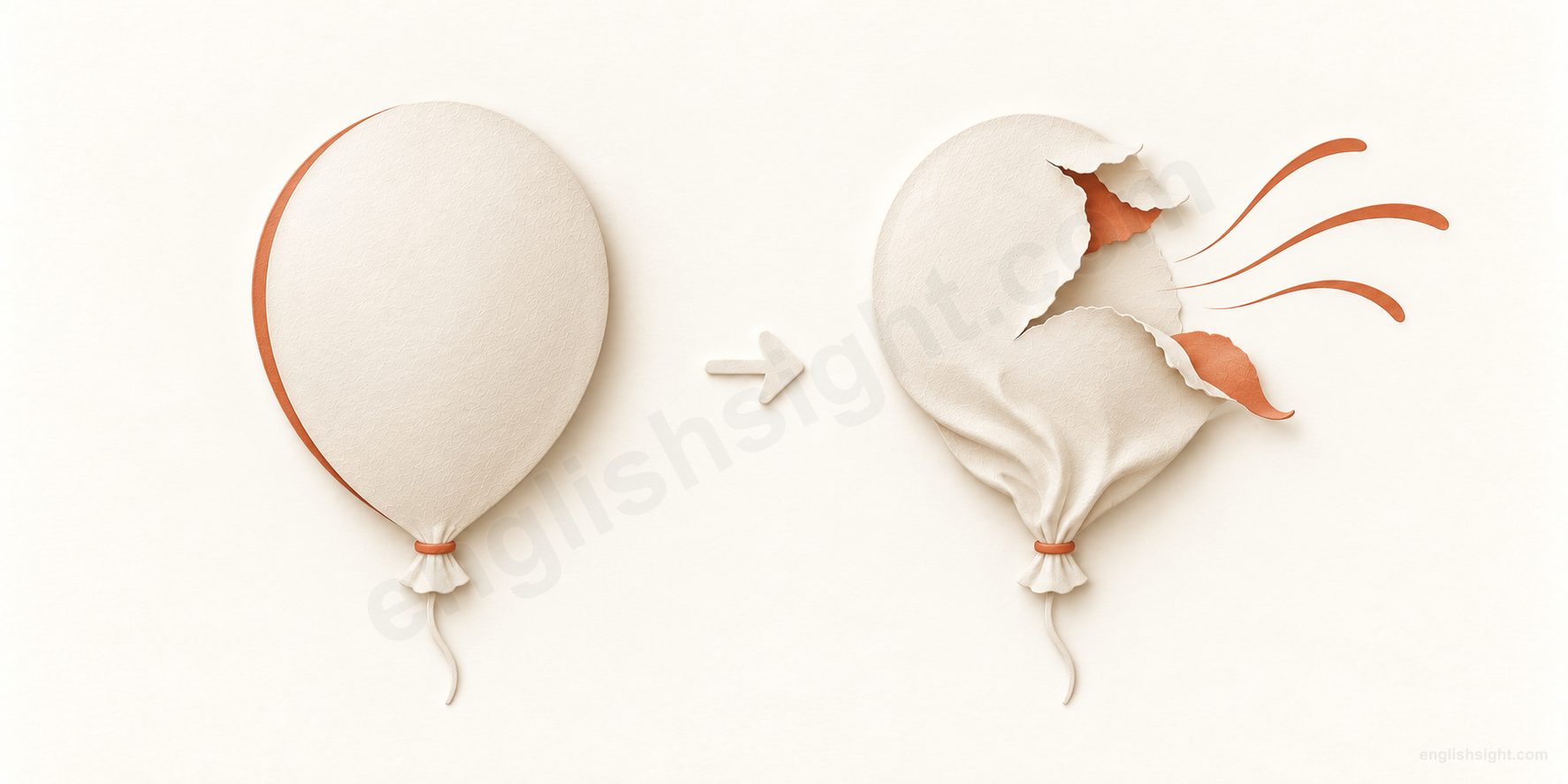
Air is held inside an inflated balloon.
burst
The torn balloon begins to collapse as air escapes.
The stretched skin suddenly tears.
The containing skin suddenly gives way, releasing the air.
Burst often marks a sudden breaking open, release, or onset; the construction tells us what gives way or begins.
The balloon illustrates physical containment giving way. It helps connect some extensions, but does not mean that laughter, an arrival, or eager anticipation involves a literal rupture.
A balloon can burst, a person can burst into a room, and laughter can burst out. Suddenness links these uses, but the physical object, the route, and the activity come from different parts of the sentence.
Use the pressure-and-release picture as a teaching connection. Fullness expressions can describe being near a limit without anything breaking, and fixed idioms need to be learned as whole expressions.
01
When something gives way
A skin, pipe, barrier, or closure can suddenly fail. Notice whether the subject breaks or causes something else to break.
The thing that breaks can be the subject or the object.
The balloon burst reports the event without naming a cause. I burst the balloon makes the person the subject and the balloon the object. Burst it keeps the same order; there is no particle to move.
A pipe can burst and release water; a firework can burst in the air. An explosion is one possible event, not a requirement for every burst. A small tear can be enough for a balloon to lose its air.
Burst apart emphasizes separation into parts. A blood vessel can burst too: the same verb describes a rupture, not a particular cause or a medical diagnosis.
In a sentence
One balloon burst while we were decorating the room.
Watch the difference For neutral standard English, the past and participle are burst: it burst yesterday; it has burst.
02
something bursts open; someone/something bursts + object + open
burst open / burst something open
open abruptly and forcefully
Situation before
A door is closed.
What happens or is meant
A sudden push throws it open.
Open states the result; burst describes the sudden force.
The door burst open makes the door the subject. The wind burst the door open names a cause and puts the door between the verb and its result. With a pronoun, use burst it open.
The door may remain in one piece. Compare the door broke, which says it was damaged, and the door opened, which does not emphasize force. Burst open is a result pattern, not an ordinary separable particle verb.
In a sentence
A gust burst the shed door open.
Watch the difference Do not assume burst open means the whole door exploded.
03
river + burst + its banks
a river bursts its banks
river water escapes beyond its usual boundaries
Situation before
The river is within its banks.
What happens or is meant
High water spreads onto nearby land.
Banks are the sides containing the river, not financial institutions.
This established expression describes flooding when the water rises beyond the sides of a river. A river can burst its banks after heavy rain. The river is the subject and its banks is the object.
It need not mean a solid wall has shattered. Compare a dam burst: a dam is a built barrier that physically fails. The expression is useful when reading weather warnings and flood reports.
In a sentence
After two days of rain, the river burst its banks.
Watch the difference Use the possessive its with a singular river: burst its banks.
02
Sudden movement and appearance
Burst adds force and suddenness; a direction phrase identifies the route. Some established combinations describe interruption or public attention.
04
burst + in / into + place / out of + place / through + opening
burst in / into / out of / through
move or emerge suddenly with force
Situation before
Someone is outside the kitchen.
What happens or is meant
They rush into it unexpectedly.
The direction comes from the following word or phrase.
Burst into the kitchen describes entering; burst out of the kitchen describes leaving. Burst in works when the place is already understood. These spatial phrases are readable combinations, not separate arbitrary meanings of burst.
Burst through a doorway emphasizes the route. In Sunlight burst through the clouds, light appears suddenly through a gap; the clouds do not have to break like a balloon. The subject may be a person, light, or another thing that emerges.
From identifies a source: Water burst from the pipe. The more literary burst forth also describes a sudden outward emergence; forth supplies the outward direction.
In a sentence
Leo burst into the kitchen with the missing dog.
Watch the difference Burst into it is possible for a place; burst it into does not express entering it.
05
burst in on + person / activity
burst in on someone / something
interrupt by entering suddenly and noisily
Situation before
Two colleagues are having a private discussion.
What happens or is meant
An unexpected arrival interrupts them.
On names the person or activity disturbed by the arrival.
Burst in on us makes us the people being interrupted by a sudden, noisy arrival. Burst in on a meeting similarly identifies an activity that is interrupted. The whole combination adds this social effect to sudden entry.
Compare burst into the office, which identifies a destination. In burst in on our interview, the interview is not a container. Keep in on together before its complement, including a pronoun.
In a sentence
A visitor burst in on our interview to ask for directions.
Watch the difference Say burst in on us, not burst us in on.
06
burst on / onto + the scene; burst onto + field + scene
burst onto the scene
appear suddenly and attract attention
Situation before
A singer is little known.
What happens or is meant
A first release brings wide public attention.
The scene is a field of public activity, not necessarily a stage.
A performer can burst onto the music scene when people suddenly notice their work. The phrase presents a striking arrival; it does not say that the performer had no earlier training.
Burst on the scene is also used. On or onto introduces the field in which the person or thing becomes noticeable. This expression is especially useful in profiles and news writing.
In a sentence
The band burst onto the local music scene last summer.
Watch the difference Do not use burst the scene to mean become publicly known.
03
When an action or state suddenly starts
Tears, laughter, speech, flames, and activity need different following forms. Learn the whole combination rather than translating one small word.
07
burst into + tears / laughter / song
burst into tears / laughter / song
suddenly begin crying, laughing, or singing
Situation before
A child is listening quietly.
What happens or is meant
The child suddenly begins to cry.
Into introduces the noun naming what starts.
Burst into tears highlights the sudden start of crying. Burst into laughter and burst into song follow the same noun pattern. The expression does not imply physical damage to the person.
The feeling may have a different cause each time: someone can cry from relief or laugh from embarrassment. Burst alone does not tell you why. Into marks entry into the activity, rather than entry into a room.
In a sentence
When she heard her brother’s voice, Maya burst into tears.
Watch the difference Use burst into tears, not burst into cry; compare burst out crying.
08
burst out + laughing / crying; sound + burst out
burst out laughing / crying
start laughing or crying abruptly
Situation before
Everyone is trying to stay serious.
What happens or is meant
Laughter suddenly breaks the silence.
Out is followed by an -ing form in this pattern.
Burst out laughing focuses on an abrupt reaction, often one the person could not hold back. Burst out crying is also natural. The -ing word names the action that starts.
Compare burst into laughter: laughter is a noun. Both patterns can describe the same event, but their complements differ. Out is not an object and cannot be moved after laughing as though this were a separable verb with an object.
The sound itself can also be the subject: Cheers burst out when the winner appeared. Here out has no following -ing complement; the subject names the sound that suddenly begins. Compare We burst out cheering, where we names the people producing it.
In a sentence
We all burst out laughing when the puppy stole the hat.
Watch the difference Choose burst out laughing or burst into laughter; avoid burst out laugh.
09
“direct speech,” + subject + burst out
“Stop!” she burst out
say something suddenly with strong feeling
Situation before
A speaker has been holding back a reaction.
What happens or is meant
An emotional remark comes out abruptly.
Burst out can introduce direct speech.
In a story, a quotation followed by he burst out reports a sudden, emotional way of speaking. It is stronger and more dramatic than he said, so it is useful for a particular reaction rather than every line of dialogue.
Here out does not describe leaving a room. Compare He burst out of the room, where out of is followed by a place. A quote supplies the words spoken, not a movable physical object.
In a sentence
“That isn’t fair!” Ben burst out.
Watch the difference Do not read burst out as physical exit when it introduces a quotation.
10
burst into + flames / life
burst into flames / life
suddenly start burning or become active
Situation before
A stalled engine is silent.
What happens or is meant
It suddenly starts running.
The noun after into identifies the new state or activity.
Burst into flames means suddenly begin burning. It does not necessarily mean explode. Burst into life can describe an engine starting or a previously quiet place suddenly becoming active.
Life here is a conventional image for activity, not proof that an engine is alive. In a report about a fire, flames names a real visible result; the same grammatical shape does not make the two expressions equally literal.
In a sentence
After several attempts, the old engine burst into life.
Watch the difference For this meaning say burst into flames, not burst in flames.
11
plant + burst into + bloom / flower / leaf
burst into bloom / flower / leaf
suddenly produce or open flowers or leaves
Situation before
A tree has buds but few open flowers.
What happens or is meant
Flowers open across it.
Into names a newly visible stage of plant growth.
Burst into bloom presents flowering as sudden and striking. Burst into flower and burst into leaf use similar uncountable nouns. This is a descriptive expression often encountered in garden writing.
The tree does not need to break apart. The connection is a sudden visible emergence, not an explosion. Here bloom follows into as a noun; ordinary The tree is blooming describes the process without the same abrupt emphasis.
In a sentence
The cherry tree burst into bloom during the warm weekend.
Watch the difference In this expression use into bloom, not into a bloom.
04
Fullness, feelings, and expectations
Some expressions describe being near a limit rather than actually breaking. Others use a bubble as a conventional image for hopes or a favorable situation.
12
be bursting with + contents; be full to bursting
be bursting with clothes / people
be extremely full of something
Situation before
A suitcase is packed tightly.
What happens or is meant
It seems unable to hold much more.
Bursting can describe fullness without an actual rupture.
A cupboard bursting with clothes is very full. With identifies what fills it. Full to bursting and filled to bursting point likewise emphasize a limit: they do not report that the container has already split.
Contrast The suitcase burst: that reports a sudden event. The suitcase is bursting with clothes describes its present condition. The -ing form is useful here even though no breaking is happening.
In a sentence
The small cupboard is bursting with winter coats.
Watch the difference Be bursting with does not guarantee that anything will actually break.
13
be bursting with + emotion / ideas; feel as if + subject + will burst
be bursting with pride / excitement / ideas
have a very strong feeling or an abundance of ideas
Situation before
A parent hears good news.
What happens or is meant
The parent feels intense pride.
Emotional fullness is a comparison, not physical injury.
With pride or excitement, bursting emphasizes intensity. With ideas, it describes having many ideas ready to share. The with-phrase names the feeling or content, not someone who causes a rupture.
About to burst and feel as if you will burst can also exaggerate strong feelings. A speaker may be delighted or angry; the particular emotion comes from the context. These expressions are more vivid than simply feel proud.
In a sentence
Noah was bursting with excitement before his first flight.
Watch the difference Bursting with pride does not mean crying; burst into tears names a different event.
14
be bursting to + verb
be bursting to do something
be extremely eager to do something
Situation before
You know a surprise.
What happens or is meant
You can hardly wait to reveal it.
The to-infinitive names a strongly desired action.
I’m bursting to tell you describes eagerness, not an action that has already happened. The person may still keep the news secret. This is a fixed expression of near-uncontainable desire.
Compare bursting with excitement: with is followed by a noun; bursting to tell has an infinitive. Do not extend this eagerness pattern to arbitrary objects such as bursting a story.
In a sentence
I’m bursting to tell you what happened at rehearsal.
Watch the difference Be bursting to tell does not imply you have already told anyone.
15
be bursting at the seams (with + people / things)
be bursting at the seams
be packed full or beyond comfortable capacity
Situation before
A small venue receives many guests.
What happens or is meant
There is hardly any space left.
The word seams supplies the image of an overfilled container.
A place bursting at the seams is extremely crowded or full. A seam is where pieces of material join, but a building has no need to have literal stitched seams for the idiom to work.
With can introduce the contents: a room bursting at the seams with guests. This expression emphasizes crowding or strain on capacity. By contrast, the door burst open describes an actual opening event.
In a sentence
By noon the little café was bursting at the seams.
Watch the difference Learn at the seams as a fixed phrase; do not replace at with into.
16
be bursting; be bursting for a pee
I’m bursting!
urgently need to use the toilet
Situation before
Someone has had to wait a long time.
What happens or is meant
They need the toilet immediately.
This is a very informal bodily-urgency expression.
In informal British English, I’m bursting can mean I urgently need to urinate. For a pee can make the meaning explicit. Context distinguishes this from bursting with excitement.
This wording suits familiar conversation, not a formal request. I really need to use the toilet is a more direct alternative when the idiom might be unclear.
In a sentence
Can we stop at the next service station? I’m bursting!
Watch the difference Do not assume every occurrence of I’m bursting has this meaning; check the context.
17
burst + someone’s bubble
burst someone’s bubble
spoil a hopeful or pleased view by revealing unwelcome reality
Situation before
A friend believes a prize trip is free.
What happens or is meant
You explain the extra costs.
The bubble stands for an appealing belief or expectation.
Burst your bubble is an informal way to describe puncturing someone’s optimistic picture. A speaker may use Sorry to burst your bubble before giving disappointing information.
It can sound dismissive or patronizing even with sorry, so consider the relationship. Compare simply explain the costs when no comment on the other person’s optimism is needed. Keep the possessive: your bubble, not you bubble.
In a sentence
I hate to burst your bubble, but the prize doesn’t include the flights.
Watch the difference This idiom concerns expectations or beliefs, not a literal bubble around a person.
18
the bubble + burst / has burst
the bubble bursts
a favorable but fragile situation suddenly ends
Situation before
Prices have risen on unrealistic hopes.
What happens or is meant
Those hopes collapse and the boom ends.
Here the bubble is the situation, rather than a person’s possession.
The bubble has burst describes a sudden end to a period of success or optimism. In financial news, it often refers to a boom based on inflated expectations coming to an end.
Compare someone burst my bubble: that names an action affecting my hopes. The bubble burst leaves the cause unstated and focuses on the collapse of the favorable situation. The image alone does not explain the economic causes.
In a sentence
When buyers stopped bidding, the property bubble burst.
Watch the difference Use burst for the past as well: the bubble burst, not bursted in this neutral learner pattern.
05
A burst: an event or a short spell
As a countable noun, burst can name a brief surge, a series of shots, or an actual rupture. The following noun tells you which.
19
a burst of + activity / feeling; in (short) bursts
a burst of energy / activity / laughter
a brief, often sudden spell of something
Situation before
Work has been slow.
What happens or is meant
A short spell of energetic activity follows.
The noun packages an activity or feeling as a countable event.
A burst of energy means a short surge of energy. A burst of laughter or applause names a brief occurrence of that sound. Of introduces what the burst consists of; it is not a direction.
In short bursts describes repeated short spells rather than one continuous period: I work in short bursts. You can count two bursts, but the following activity word can remain uncountable. A burst of speed means a brief increase in speed.
In a sentence
A burst of energy helped me finish the last shelf.
Watch the difference For repeated short spells say in bursts, not in burst.
20
a burst of gunfire; bursts of shots
a burst of gunfire
a short series of shots
Situation before
There is a pause in shooting.
What happens or is meant
Several shots are fired close together.
One burst may contain several shots.
In reports, a burst of gunfire groups a short series of shots into one event. Several bursts means several such series, not necessarily several individual bullets.
This is a specific noun use within the broader idea of a brief intense occurrence. It is useful for understanding news or a story, without needing technical knowledge of weapons.
In a sentence
We heard a short burst of gunfire in the film.
Watch the difference A burst of gunfire is not necessarily a single shot or a bomb exploding.
21
a burst in + pipe; a burst pipe
a burst in a pipe
a rupture or the damaged opening it leaves
Situation before
A water pipe is intact.
What happens or is meant
A rupture leaves an opening for water to escape.
Burst can name the failure or its resulting damage.
A plumber can locate a burst in a water pipe. Here burst is a countable noun, not the past-tense verb. The in-phrase identifies where the rupture is.
Compare The pipe burst, where burst is a past verb, and a burst pipe, where burst describes the damaged pipe before a noun. The short-spell meaning in a burst of laughter is a different noun use.
In a sentence
The plumber found a burst in the pipe under the floor.
Watch the difference Do not interpret a burst pipe as a short period of piping activity.
Read the full construction
Forms and grammar
The neutral learner forms are: base form burst, third-person singular bursts, past tense burst, past participle burst, and -ing form bursting. Some dictionaries also record bursted; use burst for the past and participle in this lesson. Transitive physical burst can be passive: The balloon was burst by a sharp twig. The active The balloon burst is often simpler when the cause is unimportant. A burst pipe describes a resulting condition. You can say make the balloon burst, but not burst someone to do something as a general causative.
Onset is not duration
She burst into tears highlights when crying starts. She was crying describes the ongoing activity. Was bursting with excitement describes a state of intense feeling. A noun burst of activity normally suggests a short spell; the verb burst into an activity does not by itself give its duration.
Everyday choices, not interchangeable synonyms
Break is broader than burst and need not suggest sudden release. A balloon may pop or burst, while start is a neutral choice for beginning an activity. Burst adds vivid suddenness or intensity. With, into, out, and to are not interchangeable; learn their complement patterns.
Coverage boundary
This lesson covers modern everyday uses and recognizable news or descriptive expressions. It does not expand specialist printing, electronics, or military terminology. Literary burst forth is briefly explained with movement. The use of burst out for a problem appearing is noted in the coverage record rather than developed into a separate unit.
Choose the construction
Decide whether the sentence describes a rupture, a sudden start, fullness, or a brief spell.
1. A balloon split open yesterday. Which neutral standard form fits?
2. Maya suddenly begins to cry. Which noun pattern fits?
3. Everyone suddenly starts laughing. Complete Everyone burst out ___.
4. The cupboard is bursting with coats. What does this sentence assert?
5. I’m bursting to tell you the news. Have I necessarily told you already?
6. Which expression means working in repeated brief spells?
Sources and teaching notes
Usage and construction choices were checked against the dictionary pages below. The explanations, examples, and visual teaching model were created for this lesson.
The visual is a teaching connection, not a picture shared by every native speaker.