A soft food, a spreading action, and familiar expressions.
Connect the dairy food with buttering a surface, then learn where whole phrases take their own meanings.
Food becomes a layer on a surface
From a piece of butter to a layer on a surface
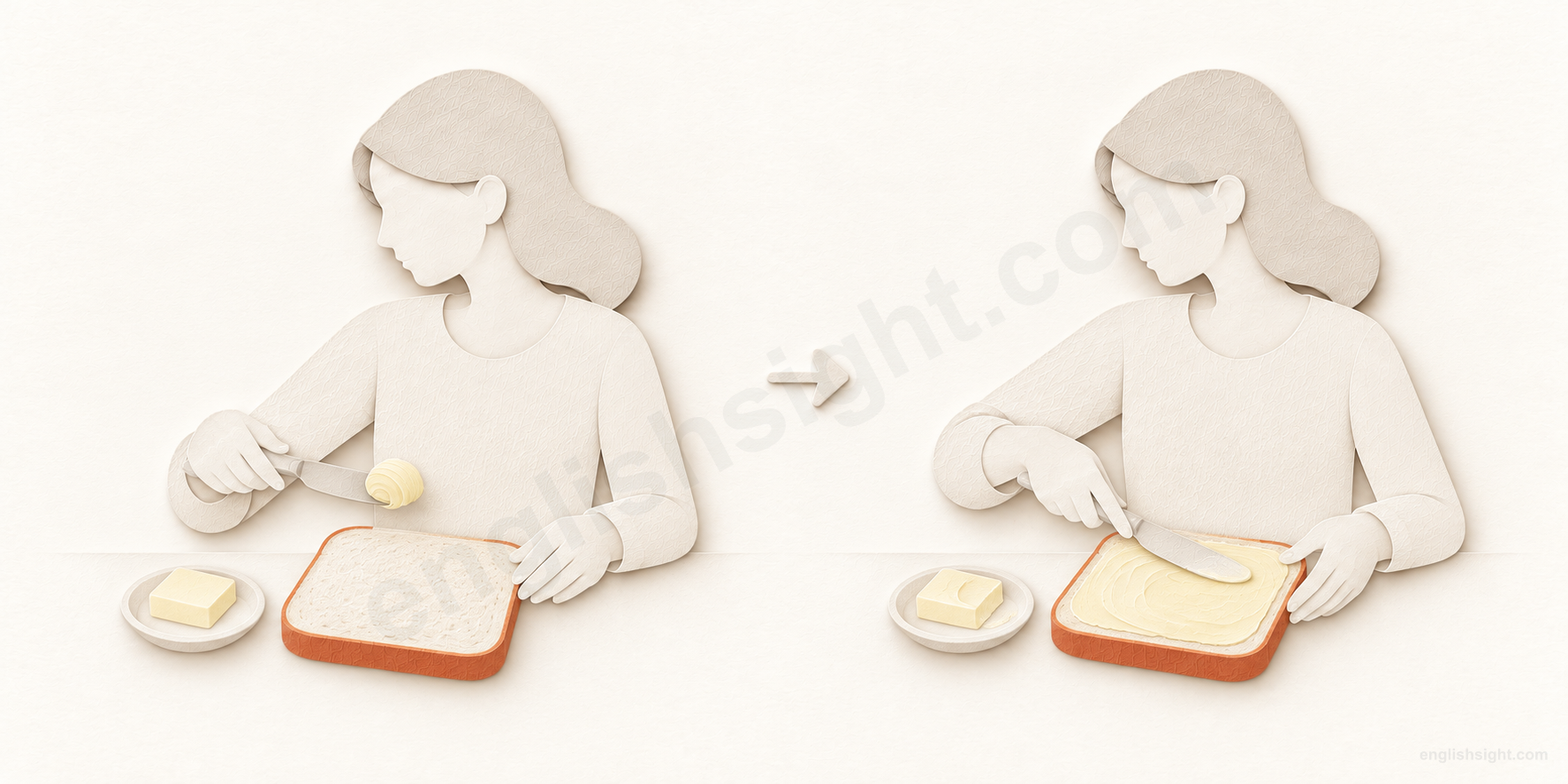
A pat of butter sits beside plain bread; a curl of butter is on the knife.
butter
A thin layer of butter coats the bread.
She spreads the butter over the bread’s surface.
The noun names the food; the verb names spreading it on something.
Butter names a soft dairy fat; as a verb, it means to spread that fat on something.
The picture connects the substance with the surface that receives it. It does not explain every compound or idiom, and it is a teaching aid rather than a shared mental picture of all English speakers.
Butter usually names the soft dairy fat used on bread and in cooking. The same word can name the action of spreading that food onto something.
That concrete connection is a useful starting point. Expressions about praise, income, and innocence need their own contexts; they are not rules you can calculate from the food.
01
The food, its amounts, and related names
Talk about butter at the table, in a shop, or in a recipe. Learn which words name a quantity and which identify a different product.
01
some / a little / the + butter; butter + noun
some butter
the dairy food used as a spread or ingredient
Situation before
Plain bread is on the table.
Meaning or result
Someone asks for butter to put on it.
Butter names the substance, not a number of individual objects.
Ordinary butter is a fatty food made from cream, commonly by churning. It is often pale yellow and can be spread when soft. Here butter is a noun: it names what you want.
For an unspecified amount, say some butter, a little butter, or much butter in a question such as How much butter do we need? Use the butter when the listener can identify the particular butter.
Bread and butter can literally mean bread spread with butter. A butter knife is a knife for spreading it; a butter dish holds it. These noun combinations describe purpose, rather than knives or dishes made of butter.
In a sentence
Could you pass me the butter, please?
Watch the difference For the ordinary substance, say some butter, not a butter or three butters. Special servings or varieties can be counted in a suitable context.
02
a pat / knob / tablespoon / stick of butter
a pat of butter
a small portion, measured amount, or package of butter
Situation before
A recipe or meal needs a particular amount.
Meaning or result
A portion word makes the quantity clear.
The countable word is pat, knob, tablespoon, or stick.
A pat of butter is a small piece or portion, often served with bread. A knob of butter is a small lump, especially in British cooking instructions. Neither expression promises one exact weight.
A tablespoon of butter is a measured amount. A stick of butter is a familiar American package measure. If accuracy matters, follow the weight or measurement printed in the recipe or on the pack.
One pat of butter becomes two pats of butter: pluralize the portion word. Butters can refer to kinds, as in a tasting of different butters; this does not make the everyday substance countable in every sentence.
In a sentence
Add two tablespoons of butter to the pan.
Watch the difference A knob is an approximate lump; do not assume it equals a tablespoon or a whole stick.
describe butter’s condition or how it is used in cooking
Situation before
Cold butter is firm.
Meaning or result
Softening or melting changes how it can be used.
Softening and melting are different changes.
Softened butter is still soft solid butter; melted butter has become liquid. The verbs soften and melt supply the change, while butter remains the name of the ingredient.
Melt the butter makes butter the object of an action. The butter melted describes the change without naming someone causing it. Fry the mushrooms in butter uses in to name the cooking fat.
Salted butter contains added salt; unsalted butter has no added salt. Garlic butter is butter flavored with garlic. These are useful ingredient descriptions, not new meanings of the verb butter.
In a sentence
Let the butter soften before you spread it.
Watch the difference Softened does not mean fully melted. Butter is not a synonym for every cooking oil or spread.
04
peanut / almond / cocoa / shea + butter
peanut butter / cocoa butter
a spread or fat named for its butterlike texture or use
Situation before
A label names a product with butter in its name.
Meaning or result
The first word identifies what kind of product it is.
A compound containing butter need not name dairy butter.
Peanut butter and almond butter are spreads made from peanuts or almonds. In these established names, butter points to a spreadlike consistency or use; the name does not itself say that dairy butter is an ingredient.
Cocoa butter and shea butter name plant fats. They are not simply dairy butter flavored with cocoa or shea. Compare garlic butter, which normally is dairy butter with added garlic.
Read the full product name and ingredient list when the ingredients matter. The shared word is a useful resemblance, not a rule that every product called butter has the same composition.
In a sentence
We bought peanut butter for the sandwiches.
Watch the difference Do not infer milk content or suitability for an allergy from the word butter alone.
02
Putting butter on something
The food name also works as a verb. Its object is the thing that receives the butter.
05
butter + food / dish; buttered + noun; be buttered
butter the toast
spread butter on a surface
Situation before
The toast has no butter on it.
Meaning or result
A layer of butter covers part or all of its surface.
In butter the toast, the toast receives the butter.
Butter is also a transitive verb: butter the toast means put butter on the toast. Compare spread butter on the toast, where butter is the object of spread and the toast follows on.
You can butter a baking dish or tin to coat its inside before cooking. Grease the dish is broader: the fat need not be butter. The verb butter specifies butter in the ordinary cooking use.
The forms are butter, butters, buttered, and buttering. I am buttering the rolls describes an action in progress. The rolls were buttered before serving is passive; buttered toast describes the resulting food. Have someone butter the toast uses the ordinary have + person + verb construction, not a separate sense of butter.
In a sentence
Please butter the toast while I make the tea.
Watch the difference Say butter the toast or spread butter on the toast. Do not replace spread with butter in butter butter on the toast.
03
Praise, income, appearances, and ease
These established expressions reach beyond the food. Learn the whole phrase and its tone; the spreading picture cannot predict every meaning.
06
butter + somebody + up; butter up + noun
butter somebody up
praise someone to gain a favor or support
Situation before
A person wants another person’s help.
Meaning or result
They use flattering words to make that person more willing.
The purpose behind the praise is central to this informal phrasal verb.
To butter someone up is to say pleasing or flattering things because you want something from them. It often suggests that the praise is strategic rather than simply sincere appreciation.
A noun can go between the verb and up, or after up: butter the manager up; butter up the manager. A pronoun goes between them: butter her up, not butter up her.
The idea of making an interaction smoother can help you remember it, but that is a teaching association. Up is part of this established expression; it does not mean moving the person upward, and butter alone is not the usual learner’s choice for this request-related meaning.
In a sentence
Are you buttering me up because you need a lift?
Watch the difference A genuine compliment without a wish for a favor is not automatically buttering someone up.
07
something + be + somebody’s bread and butter
your bread and butter
the work or business that provides your main income
Situation before
A designer has occasional special projects and regular repair work.
Meaning or result
The regular work pays the everyday bills.
Here the whole phrase names a livelihood, not a meal.
Someone’s bread and butter is their main source of earnings. For a company, it can be the service, product, or customer activity that keeps income coming in.
The food pairing offers an association with everyday support, but the income meaning belongs to the established phrase. It does not mean that the person works with actual bread or dairy products.
Contrast some bread and butter on a plate with Repairs are our bread and butter. The surrounding words tell you whether the phrase names food or financial support. The income phrase can be treated as one source of support: My bread and butter is repair work.
In a sentence
Small repair jobs are our bread and butter.
Watch the difference Do not interpret this as extra pocket money when the speaker means the main income.
08
bread-and-butter + noun
bread-and-butter issues
basic matters that are practically important
Situation before
People discuss many ambitious proposals.
Meaning or result
They focus on everyday needs such as pay and housing.
Before a noun, the compound describes basic practical importance.
Bread-and-butter issues are basic concerns with a direct effect on everyday life. The adjective can also describe the ordinary essential work or skills that a person repeatedly needs.
Write the compound with hyphens before a noun: bread-and-butter issues. Compare the noun phrase in This work is our bread and butter, which identifies the source of income.
Basic does not mean unimportant. A bread-and-butter concern may matter more to someone than a dramatic new idea.
In a sentence
The meeting focused on bread-and-butter issues such as rent and wages.
Watch the difference Use this adjective before its noun; it is not a general substitute for butter or buttery.
09
look as if butter wouldn’t melt in + possessive + mouth
butter wouldn’t melt in somebody’s mouth
someone looks innocent although their behavior suggests otherwise
Situation before
A child has been mischievous.
Meaning or result
The child now wears a very innocent expression.
This informal idiom contrasts appearance with what someone is really like.
Say someone looks as if butter wouldn’t melt in their mouth when they seem especially innocent or harmless but you know or suspect that they are not. It can be teasing or critical.
The contrast is part of the idiom. It is not a statement about the temperature of someone’s mouth, and it is not an ordinary compliment meaning that they are kind.
The familiar wording uses wouldn’t melt. Learn it as a whole expression rather than substituting another food or treating wouldn’t as a future plan.
In a sentence
After hiding my keys, Nina looked as if butter wouldn’t melt in her mouth.
Watch the difference The phrase suggests deceptive innocence; it can offend if used seriously about someone.
10
go / cut / move through something + like a knife through butter
like a knife through butter
very easily, with little resistance
Situation before
A task might be expected to be difficult.
Meaning or result
Someone or something gets through it easily.
Soft butter offers a comparison for lack of resistance.
Like a knife through butter compares easy progress with a knife moving through soft butter. It can describe literal cutting or a figurative task such as getting through a defense.
The comparison describes how easily the action happens; it does not change the object into food. A sharp tool, a powerful team, or an efficient process may supply the context.
The image helps with the comparison, but it does not promise that every real block of cold butter is easy to cut. The established expression emphasizes ease, not a cooking instruction.
In a sentence
The new saw cut through the boards like a knife through butter.
Watch the difference Through is part of the comparison; like a knife with butter does not express the same idiom.
11
know which side + possessive + bread is buttered (on)
know which side your bread is buttered on
recognize where your own advantage or support comes from
Situation before
A person depends on an important customer.
Meaning or result
They take care to keep that customer satisfied.
This idiom concerns practical self-interest, not food preparation.
Someone who knows which side their bread is buttered on understands who or what benefits them and acts to protect that advantage. The phrase can imply a calculating choice about whom to please.
The possessive changes with the person: I know which side my bread is buttered on; she knows which side her bread is buttered on. Oxford also records the expression without final on.
Compare bread and butter, which names the income itself. This longer idiom adds awareness of how to preserve a beneficial position. It is not necessarily praise for generosity or fairness.
In a sentence
He never ignores his best customer; he knows which side his bread is buttered on.
Watch the difference Do not use it merely to say that someone knows how to spread butter neatly.
Read the food, grammar, and full expression
Pronunciation and word class
The noun and verb share their pronunciation: British /ˈbʌtə/ and American /ˈbʌtər/. Both have first-syllable stress. Some butter names the food; butter the bread names the action.
Ordinary substance versus servings and types
Butter is normally uncountable for the ingredient. A packet, a pat, or a tablespoon provides a countable unit. A specialized plural for varieties does not justify I need three butters when you mean three tablespoons.
Learn the whole idiom
The surface-spreading model connects the food with the ordinary verb. It does not establish a historical origin for butter up or predict all idioms. Technical coating and welding senses, historical chemical names, and separate words such as butterfly are outside this everyday lesson.
Choose the expression that fits
Use the situation to decide whether butter names a substance, an action, or part of an established phrase.
1. You need two measured spoonfuls for a recipe. Which wording states the amount clearly?
2. The bread is plain, and you want someone to spread butter on it. What do you ask?
3. Someone praises your driving, then asks you to drive them to the airport. You suspect a motive. Which question fits?
4. A photographer says, “School portraits are my bread and butter.” What does she mean?
5. A child hides the biscuits and then looks perfectly innocent. Which phrase can teasingly describe that look?
Sources and teaching notes
The dictionary pages below were read to check senses, forms, and expressions. Explanations and examples are original; the picture is a teaching connection.
The diagram is a teaching aid; English speakers need not share one mental picture.