Use button for clothing, controls, and familiar expressions about reactions and closure.
A button secures two fabric edges
Through the hole, holding the edges together
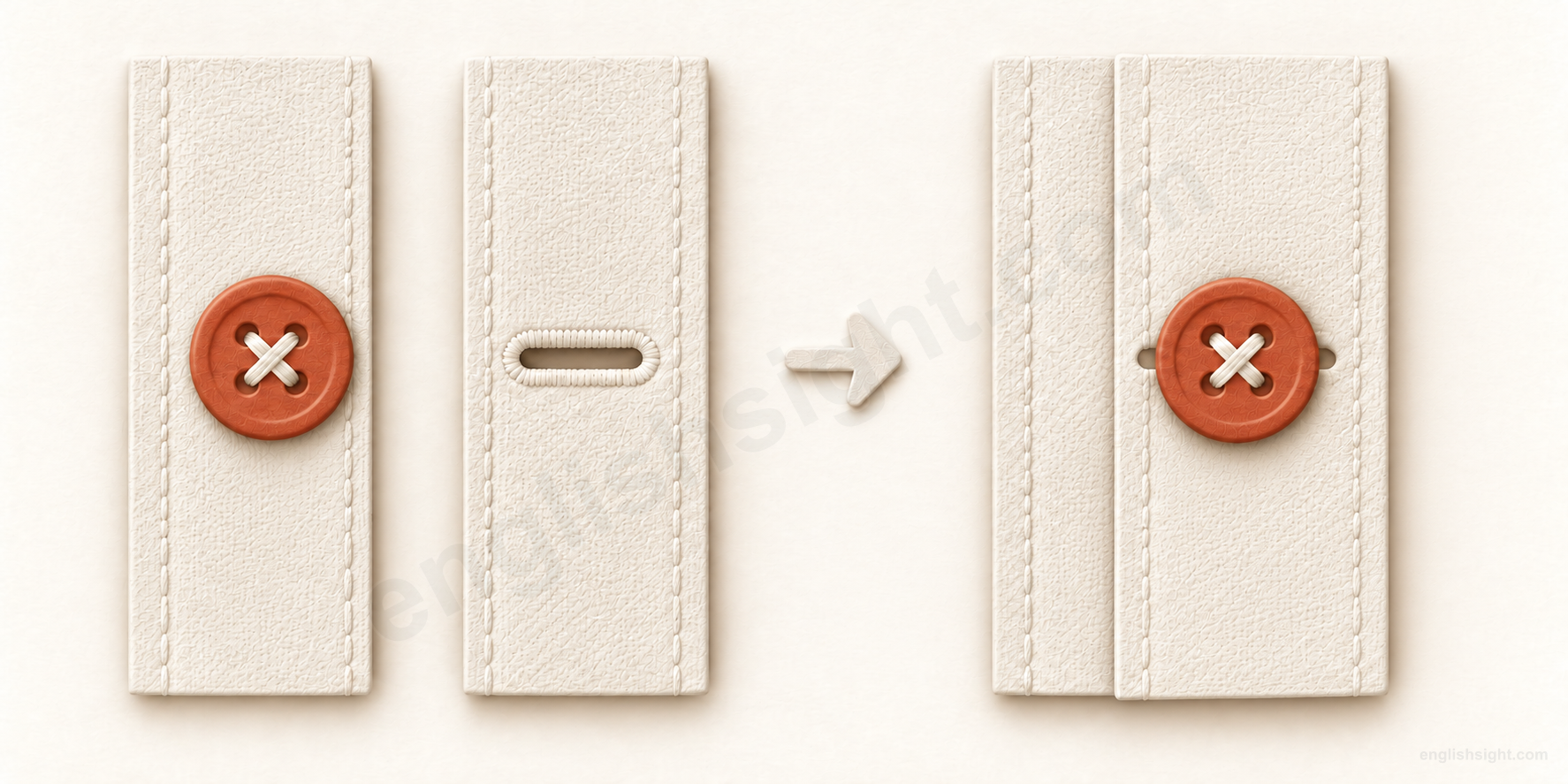
Two fabric edges are separate; an orange button is sewn to one, and the other has a buttonhole.
button
The button holds the overlapping fabric edges together.
The sewn button passes through the other edge’s buttonhole.
A sewn button passes through a buttonhole to fasten two fabric edges.
A clothing button holds two fabric edges together when it is passed through a matching hole.
This fastening relation explains button a coat and helps with metaphors of closing. A control button instead triggers an operation when pressed or selected. Shape-related compounds and fixed similes need their own explanations.
A button on a shirt and a button on a screen share a name but do different jobs. Start with the object and its context, then learn what the full construction adds.
The diagram shows a clothing button securing two fabric edges. Control buttons form another everyday branch; fixed expressions must be learned in context rather than predicted from one picture.
01
Fastenings and getting dressed
Distinguish the sewn object, the action of fastening, a garment’s design, and repair.
01
a / the + button; shirt / coat + button; do up / undo a button
a shirt button
a small fastener attached to clothing
Situation before
Two fabric edges can come apart.
Meaning or result
A button through a hole holds them together.
A clothing button joins fabric; it is not a control to press.
A button is a countable object: a button, two buttons. A shirt button or coat button names it by the garment. A buttonhole is the opening it passes through; decorative buttons need not actually fasten anything.
The phrase do up a button or fasten a button describes closing the fastening; undo a button or unbutton it describes opening it. The button can stay attached to the cloth throughout. Some fastenings use a loop instead of a cut buttonhole; the diagram shows the buttonhole design.
In a sentence
I left the top button of my shirt undone.
Watch the difference Undoing a button is different from pulling it off the fabric.
02
sew a button on; sew on a button; sew it back on
sew a button on
attach or replace a garment’s button with thread
Situation before
A button has come off the jacket.
Meaning or result
Thread secures it to the cloth again.
Sewing attaches the object; buttoning closes the garment.
A button may be loose, missing, or come off. Sew a button on, sew on a button, and sew a button back on describe attaching it with thread. Back indicates restoration after it came off.
With a pronoun, say sew it on. This is the grammar of sew on, not a special meaning of the verb button.
In a sentence
A button came off my jacket, so I sewed it back on.
Watch the difference Button your jacket means fasten it; it does not mean repair it.
03
button + garment / button; button + person + into + garment
button your coat
close clothing using its buttons
Situation before
The coat is open.
Meaning or result
Its buttons hold the front closed.
The verb names fastening with buttons.
Button takes a garment or a button as object: button a coat; button the top button. You can also button a child’s coat for them. The garment receives the action.
Button someone into a coat describes fastening that coat around the person. It does not mean forcing the person into a small space. A buttoned coat describes the resulting state; unbutton reverses the fastening.
In a sentence
I buttoned my daughter into her warm coat.
Watch the difference Use press the button for a machine; button the machine is not the usual instruction.
04
garment + buttons (up) + at the front / back; won’t button
The dress buttons at the back.
describe where or how a garment fastens
Situation before
You examine a dress before putting it on.
Meaning or result
You learn that its fastenings are behind you.
The garment is the subject, and no object is needed.
A dress can button at the back or button up at the front. This describes its fastening arrangement, not an action the dress performs by itself.
This coat won’t button can mean you cannot get its buttons fastened, for example because it is too tight. Won’t need not express a person’s refusal here.
In a sentence
This dress buttons at the back, so I may need some help.
Watch the difference The dress buttons and She buttons the dress have different subject roles.
05
button up + garment; button + garment / it + up
button up your jacket
fasten a garment, often making it fully closed
Situation before
Your jacket is hanging open in the cold.
Meaning or result
You close its buttons before going out.
Up belongs to a separable fastening expression; it is not a direction.
Button up often has the same practical meaning as button. Say button up your jacket or button your jacket up. With a pronoun, use button it up.
In a clothing context, Button up! can be a short instruction to fasten your clothes. The context supplies the garment. Compare zip it up for a zip: the action is similar, but the fastening mechanism differs. In other contexts button up can mean keep quiet; see button your lip below.
In a sentence
It is windy; button your jacket up before you leave.
Watch the difference With a pronoun, use button it up, not button up it.
06
a button-down + collar / shirt; a button-down + style / culture
a button-down collar
a collar whose tips fasten to the shirt with buttons
Situation before
The collar tips could lift away from the shirt.
Meaning or result
Small buttons hold the tips down.
Down refers to the fastening of the collar tips.
In the collar-specific clothing sense, a button-down shirt has a collar with tips secured by buttons. The term is an adjective modifying collar or shirt. Merriam-Webster also records button-down for a shirt with buttons running from collar to waist, so the shirt label does not always guarantee buttoned collar tips.
For an unambiguous description of the collar, say a button-down collar. Button up your shirt is an instruction to fasten it; button-down describes a design. The adjective can also describe a conventional, conservative style or manner: a button-down office culture follows traditional expectations.
In a sentence
He chose a blue shirt with a button-down collar.
Watch the difference Check the collar or product description rather than assuming every shirt called button-down has buttoned collar tips.
02
Machines and screens
A control button takes a press, click, or tap. The label tells you which operation it requests.
07
press / push / hit + the + function + button
press the power button
operate a device using a small control
Situation before
The machine is waiting for an input.
Meaning or result
A press requests a particular operation.
This button receives pressure to control a device.
Press or push a button to operate a machine; power, start, stop, play, and alarm identify its function. Hit the button is also used informally for pressing it, without necessarily striking hard.
Unlike a clothing button, a control button does not fasten fabric. Not all buttons are round, and pressing one may stop a process instead of starting it.
In a sentence
Press the power button to turn the speaker off.
Watch the difference A button is one kind of control; a switch may work by sliding or flipping instead.
08
click (on) / tap + the + label + button
click the Save button
select an on-screen control
Situation before
An app is waiting for your choice.
Meaning or result
Selecting a screen area requests an action.
A software button behaves like a control even though it is not a separate physical part.
A screen button can be selected with a mouse click or a touch. Click the button and click on the button are both possible; tap is natural for a touchscreen.
A mouse button is a physical part of the mouse. The Save button is an area in the app. Read the label to know what selecting it will do.
In a sentence
Tap the Save button after you change your name.
Watch the difference Use click or tap a button, not button a button, for this action.
09
do something / be available + at the touch of a button
at the touch of a button
very easily and quickly through a simple control action
Situation before
An operation would otherwise require several steps.
Meaning or result
Technology makes the operation easy to request.
The phrase emphasizes convenience, beyond naming a control.
At the touch of a button describes something becoming available with very little effort, usually through technology. It may describe an actual button press or more generally the ease of an electronic service.
The expression can sound promotional. It does not guarantee that every stage of a real process finishes instantly.
In a sentence
The curtains open at the touch of a button.
Watch the difference Keep the full phrase, including of a button; touch alone does not express this idea.
03
Badges and shape-related names
These nouns identify a badge, a body part, a food, or a shape. They do not all share the function of fastening.
10
wear + a campaign / lapel + button
a campaign button
a small badge showing a message or support
Situation before
You want to display support publicly.
Meaning or result
A badge on your clothes carries the message.
A message button is worn as a badge, rather than used as a fastening.
Especially in American English, a button can be a small badge with a design or slogan, often pinned to clothing. A campaign button expresses support for a candidate or cause.
British English normally calls this a badge. The label comes from the small object’s form; it need not have a buttonhole or control a machine.
In a sentence
She wore a campaign button on her jacket.
Watch the difference Context distinguishes a coat’s fastening buttons from a badge pinned to it.
11
my / your / the + belly button
belly button
the everyday informal name for the navel
Situation before
Someone asks you to identify a body part.
Meaning or result
You point to the navel on the abdomen.
This is a fixed body-part name, not a working fastener.
Belly button means navel, the small mark on the front of the abdomen left from the umbilical connection. Tummy button is another informal name.
Learn the two-word expression as a unit. It does not mean a shirt button near your stomach.
In a sentence
The child pointed to her belly button.
Watch the difference Use navel when a more neutral or anatomical term is needed.
12
a button mushroom; button mushrooms
button mushrooms
small young mushrooms used for cooking
Situation before
You are choosing ingredients.
Meaning or result
You select small mushrooms with rounded caps.
Here button helps name a food by its compact shape.
Button mushroom is a compound noun for a small young mushroom used in cooking. In the plural, add s to mushroom: button mushrooms.
The name identifies the food; it does not describe fastening it or pressing it. This is a separate shape-related branch of the noun.
In a sentence
Add the sliced button mushrooms to the pan.
Watch the difference The usual plural is button mushrooms, not buttons mushroom.
13
have + a button nose
a button nose
a small rounded nose
Situation before
You describe the shape of someone’s face.
Meaning or result
The listener imagines a compact rounded nose.
The resemblance concerns shape, not a nose’s function.
Button nose is a descriptive noun phrase for a small rounded nose. A person can have a button nose; it does not mean that a button is attached to their face.
The head noun is nose. Button modifies it by suggesting a small rounded shape. Physical fastening is not part of the meaning.
In a sentence
The portrait shows a child with a button nose.
Watch the difference Do not infer that all small noses are literally circular or flat.
04
Reactions, precision, and closing up
Some expressions extend controls or closure; others are established idioms. Read the whole phrase and its social tone.
14
push / press + someone’s + buttons
push someone’s buttons
trigger a person’s emotional reaction
Situation before
Someone knows a topic that affects you.
Meaning or result
Their remark produces a strong reaction.
The metaphor treats sensitivities like controls that trigger a response.
Push or press someone’s buttons means make them react emotionally. It often describes deliberate irritation, but context can also show a positive response; it does not always mean anger.
The possessive identifies whose sensitivities are involved: my buttons, her buttons, Alex’s buttons. This figurative reaction belongs to the whole expression.
In a sentence
He kept joking about my mistakes just to push my buttons.
Watch the difference Do not confuse this with literally pressing buttons on someone’s device.
15
push / press + (all) the right button(s)
push all the right buttons
do or say things that get a desired response
Situation before
You want an audience to respond well.
Meaning or result
Your choices appeal to what matters to them.
Right marks the effective choice of emotional or persuasive triggers.
Push all the right buttons often means please someone or achieve the response you want. Press the right button is another form, especially in British English.
The tone can be approving or suggest calculated persuasion. Unlike pushing my buttons in an argument, this expression highlights effectiveness, not necessarily annoyance.
In a sentence
The proposal pushed all the right buttons by promising shorter hours and better pay.
Watch the difference The right buttons are suitable triggers in this metaphor, not buttons on the right-hand side.
16
a hot button; a hot-button + issue / topic
a hot-button issue
a topic that provokes strong feelings and argument
Situation before
A public discussion reaches a sensitive subject.
Meaning or result
People react strongly and disagree.
Hot describes emotional sensitivity, not temperature.
A hot button is a strongly contested or emotionally sensitive subject. Hot-button commonly modifies issue or topic. The expression is associated especially with North American informal usage.
This extends the idea of triggering reactions: the subject itself is sensitive. It need not involve one person deliberately provoking another.
In a sentence
Parking fees have become a hot-button issue in our town.
Watch the difference A hot-button issue is more specific than any topic that happens to be popular.
17
press / push + the panic button
press the panic button
react suddenly or extremely because of fear
Situation before
Unexpected bad news alarms people.
Meaning or result
They consider an urgent or excessive reaction.
The idiom borrows the image of an emergency control.
A literal panic button calls for help in danger. Figuratively, press or push the panic button means react suddenly or extremely because something has frightened you.
Don’t press the panic button yet asks someone to avoid a hasty alarmed response. It need not be an instruction about a real alarm system.
In a sentence
One late delivery is no reason to press the panic button.
Watch the difference The context decides whether the phrase refers to a real emergency control or a reaction.
18
button + possessive + lip; Button it!; person + button up (keep quiet)
button your lip
keep quiet, often despite wanting to speak
Situation before
You feel tempted to make a remark.
Meaning or result
You hold back and say nothing.
Closing a garment becomes a metaphor for keeping words in.
Button your lip means remain silent or refrain from saying something. I buttoned my lip reports self-restraint. As a direct order, Button your lip! can sound harsh.
Button it! is a British informal command to be quiet and is explicitly rude. These fixed expressions do not describe putting real buttons on lips.
Button up can also mean become or remain silent, especially in American usage: When I asked about the surprise, everyone buttoned up. Here the people stop talking; in Button your coat up, the garment is the object and the action is fastening. A command such as Button up! can therefore be abrupt as well as ambiguous without context.
In a sentence
I wanted to argue, but I buttoned my lip.
Watch the difference For a polite request, use Could you be quiet for a moment? rather than Button it!
19
time + on the button; be + (right) on the button
on the button
exactly at the stated time or exactly right
Situation before
You compare an arrival or judgment with a target.
Meaning or result
It matches precisely.
This fixed expression means precision; no fastener is involved.
On the button can mean exactly at a specified time: eight on the button. It can also mean exactly correct, as in Your estimate was right on the button.
It is informal. Learn the phrase with on and the; neither an ordinary clothing button nor a screen control explains the meaning by itself.
In a sentence
The train left at eight on the button.
Watch the difference Being on time can allow a practical margin; on the button emphasizes exactness.
20
(as) bright as a button
as bright as a button
quick to understand, alert, or lively
Situation before
A child responds quickly and intelligently.
Meaning or result
You praise their sharpness.
Bright describes mental liveliness here, not reflected light.
As bright as a button is a mainly British informal simile for someone who is quick to understand. It can also suggest energy or cheerfulness; Collins marks the expression as old-fashioned.
You may hear bright as a button without the first as. The phrase is a conventional comparison, not a rule about the intelligence of people who wear buttons.
In a sentence
Even after the long trip, Maya was as bright as a button.
Watch the difference Bright as a button praises alertness or intelligence; cute as a button praises attractiveness.
21
(as) cute as a button
as cute as a button
very cute or charming
Situation before
You see a small puppy.
Meaning or result
You describe it affectionately.
The conventional simile intensifies cute.
Cute as a button and as cute as a button mean very cute. The phrase is informal and affectionate, suitable for a puppy, a baby, or something charming.
The phrase does not require a person or thing to be round. Its meaning belongs to the whole comparison; it is not another way to say intelligent.
In a sentence
Their new puppy is cute as a button.
Watch the difference Avoid using this affectionate phrase when a neutral or formal description is needed.
22
a buttoned-up + person; someone + is buttoned up
a buttoned-up person
someone reluctant to reveal personal thoughts or feelings
Situation before
A conversation becomes personal.
Meaning or result
One person keeps their feelings private.
The adjective presents emotional reserve as being closed up.
A buttoned-up person does not readily discuss personal thoughts and feelings. This informal adjective describes manner, not necessarily the state of their clothes.
The surrounding noun resolves the meaning: a buttoned-up coat is fastened; a buttoned-up colleague is reserved. It does not simply mean that the colleague has finished work.
In American descriptions, buttoned-up can also suggest a conservative, formal professional style: The firm prefers a buttoned-up style at client meetings. This need not mean that everyone is emotionally distant. A buttoned-up operation can instead be carefully organized; that work-related sense is explained separately below.
In a sentence
He is friendly at work but rather buttoned up about his private life.
Watch the difference Being reserved is not the same as being unfriendly or dishonest.
23
button up + details / agreement; button + them + up
button up the details
finish or settle outstanding arrangements
Situation before
A few parts of an agreement remain unsettled.
Meaning or result
You resolve the remaining details.
Figurative button up presents completion as closing remaining openings.
In informal business use, button up can mean bring work or arrangements to a satisfactory conclusion. The object can be details or an agreement rather than clothing.
Say button up the details or button the details up. With a pronoun, use button them up. The object and context distinguish this completion sense from fastening clothes.
In a sentence
We need to button up the last few details before we sign.
Watch the difference The phrase is informal; finalize the details is a more neutral alternative.
24
a buttoned-up + operation / company
a buttoned-up operation
an operation that is carefully planned and managed
Situation before
You want reliable work with the details under control.
Meaning or result
The organization uses careful procedures and supervision.
Here buttoned-up describes thorough organization, not a person keeping feelings private.
In American English, the adjective buttoned-up can describe something that is carefully planned, run, or supervised. A buttoned-up operation or company has its practical details under control. This is a state of organization, not necessarily a single completed task.
Compare We buttoned up the agreement, which describes finishing it, with They run a buttoned-up operation, which describes how they manage their work. The idea of leaving no loose details is a useful teaching link; it does not replace learning this established adjective sense.
In a sentence
They run a buttoned-up operation, with every order checked before it leaves.
Watch the difference The noun and context matter: a buttoned-up person may be reserved; a buttoned-up operation may be well organized.
Choose the object and read the whole phrase
Noun and verb forms
The noun is countable: button, buttons. Regular verb forms are button, buttons, buttoned, buttoning. The usual pronunciation is /ˈbʌtn/, with the first vowel as in cup. She is buttoning her coat describes an ongoing action; Her coat is buttoned describes its fastened state.
Fastening, pressing, and sewing
Button a shirt closes it with its buttons. Press a button operates a control. Sew a button on attaches the object with thread. These actions have different objects and results even when they involve something called a button.
Up, down, and politeness
Button up is separable: button it up. Button-down is an adjective for a collar design, not an instruction to undo buttons. Button it! is a rude command to stop speaking; a polite request uses different words.
Scope of this lesson
These are modern everyday senses, useful compounds, and selected informal idioms, not a frequency ranking. Specialized meanings in fencing, metallurgy, rowing, welding, plants, and boxing, and older regional sayings are not developed here. The picture is a teaching aid, not a claim about a mental image shared by all English speakers.
Choose the action or interpretation
Look at the object, the whole construction, and the speaker’s intent.
1. A fastening has fallen off your shirt. What repairs the shirt?
2. You want to keep your changes in an app. Which instruction fits?
3. Your jacket is open. Replace your jacket with it in an instruction.
4. Someone repeatedly mentions a topic because they know it annoys you. What are they doing?
5. A meeting started at nine on the button. When did it start?
6. A buttoned-up colleague says little about personal feelings. What does buttoned-up describe?
Sources and teaching notes
Dictionary entries below support the senses, constructions, and usage labels. Explanations, examples, and the fastening diagram are original teaching material; the diagram is a limited teaching model.
The diagram explains a fastening relation; it does not represent every use of button.