Read by as a relation whose meaning is completed by the surrounding words.
Keep a reference point in view
Keep a reference point in view
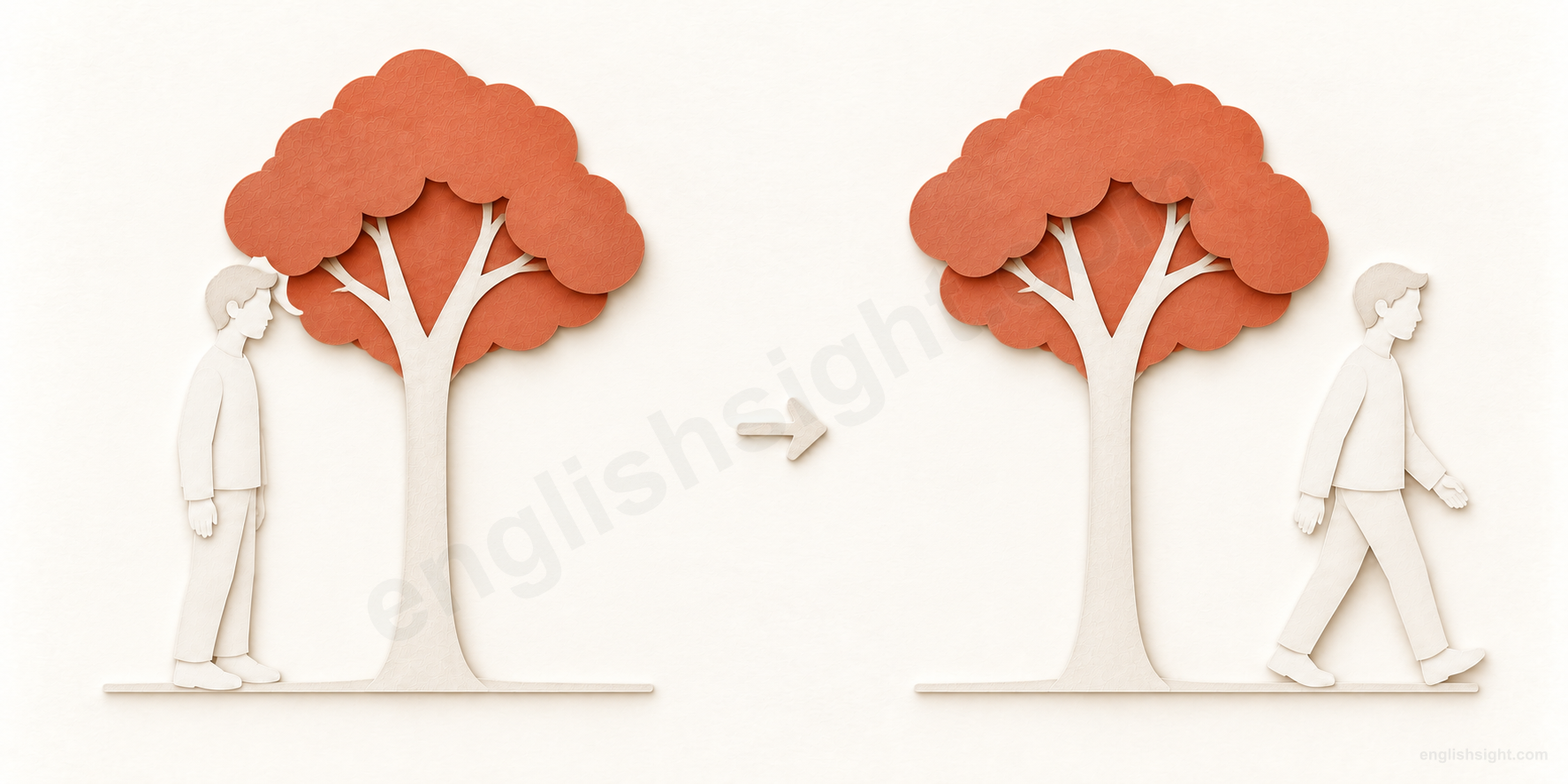
A man stands by a tree.
by
The same man is now beyond the tree.
He walks past the tree, which stays in place.
The tree is a reference point: standing by it shows nearness; walking by it shows passing. Movement comes from walk, not by alone. Other uses depend on their constructions.
On the left, a person is near a window. On the right, a path passes a marker. The reference point helps interpret position or movement; other uses need their own grammatical cues.
The marker is a teaching analogy for a reference point. It is not a proof that agent, deadline, measurement, and idiomatic meanings are identical.
By is mainly a preposition, and also an adverb or particle. It can locate something near a point, mark passing, identify a doer or method, or supply a time limit and a scale. These are related teaching branches, not one rule that predicts every phrase.
The sketch is a memory aid. It does not claim that every native speaker imagines the same picture, or that all modern uses come from one visible movement.
01
A place beside a reference point
Position, movement, routes, and the part used to hold something.
01
by + person / place
by the window
beside or near
Situation / reference
Choose a place to read.
Relation / result
The chair is near the window.
The following noun supplies a location.
By places something beside or near a reference point; it does not require contact. Close by can stand alone: A café is close by. Side by side places two things next to each other.
In a sentence
There is a reading chair by the window.
Watch the difference By the window does not mean through the window.
02
movement verb + by (+ reference point)
walk by / time goes by
move past; time passes
Situation / reference
Someone approaches your position.
Relation / result
They continue beyond it.
Movement comes from the verb and context.
Walk by the shop means pass it; walk by can omit an understood reference point. Time goes by uses passing as a metaphor for elapsed time. A chance can also pass you by if you fail to use it.
In a sentence
A cyclist rode by while we were waiting.
Watch the difference By alone does not mean stop or enter.
03
by + route; by way of + place / noun
by the back door / by way of
use a route or an intermediate point
Situation / reference
You need a way into the garden.
Relation / result
You use the side entrance.
A route differs from a nearby position.
Enter by a gate names the route, not merely its location. By way of Paris means via Paris. In a different, formal use, by way of an apology means as a form of apology: He sent flowers by way of an apology.
In a sentence
We entered the garden by the side gate.
Watch the difference Distinguish by the door with sit (location) and enter (route).
04
hold / take / catch + object + by + the + part
hold it by the handle
grip a particular part
Situation / reference
You need to lift the suitcase.
Relation / result
Your hand holds its handle.
By names the point of contact.
The handle is the part you grip. Take someone by the hand uses the same construction, usually with the rather than a possessive before the body part. The object being held comes before by.
In a sentence
Lift the suitcase by the handle.
Watch the difference Compare hold it with both hands: with names the hands doing the holding.
02
Who did it, and how?
Separate the actor, method, channel, and circumstances of an action.
05
passive + by + agent; work + by + creator
made by a local artist
name the doer, creator, or cause
Situation / reference
You ask who made the bowl.
Relation / result
The artist is identified.
The passive puts the bowl in subject position.
By introduces the agent in a passive. A poem by Maya identifies its writer without a complete passive clause. Things can be causes too: The delay was caused by fog. Compare cut with a knife: with usually introduces the tool.
In a sentence
This bowl was made by a local artist.
Watch the difference A book by Maya names the author; a book about Maya names its subject.
06
by + -ing
by checking the list
explain the action used as a method
Situation / reference
Duplicate orders are possible.
Relation / result
Checking helps prevent them.
The -ing clause answers how.
After prepositional by, use an -ing form, not a to-infinitive. Usually the person doing the main action also performs this method. The method need not be deliberate: By leaving early, we missed the announcement.
In a sentence
You can avoid duplicate orders by checking the list first.
Watch the difference By working describes a method; while working describes timing.
07
by + transport / communication / payment; by means of + noun
by bus / by email
name a channel or means
Situation / reference
A receipt must reach the customer.
Relation / result
Email is the channel.
Many method expressions use a noun without an article.
Use by bus, by train, by air, by phone, and by credit card for methods. A particular vehicle takes another construction: in my car, on the bus. Say on foot and pay in cash. By means of is a formal way to introduce a method or instrument.
In a sentence
Please send the receipt by email.
Watch the difference Say by bus, not by the bus, when naming the travel method.
08
verb + by hand
by hand
manually; delivered personally
Situation / reference
The scarf is delicate.
Relation / result
A person washes it manually.
The whole phrase names a method.
By hand contrasts manual work with machine work. A letter delivered by hand is carried directly by a person rather than sent through the postal system. These uses do not mean that by can replace with before any tool.
In a sentence
Please wash this scarf by hand.
Watch the difference Write with a pen, not by a pen.
09
know / learn + object + by heart
know it by heart
know from memory
Situation / reference
You have learned the lines.
Relation / result
You can repeat them without reading.
This is a fixed memory expression.
By heart means from memory, especially for words learned well enough to repeat. British English also uses off by heart. The heart is not a physical tool here; learn this conventional phrase as a unit.
In a sentence
I know the opening lines by heart.
Watch the difference In my heart concerns inner feelings, not memorized wording.
10
by + chance / accident / mistake / design
by chance / by mistake
describe whether an event was intended
Situation / reference
Two contacts have the same first name.
Relation / result
You accidentally choose the wrong one.
The noun specifies the circumstance.
By chance means without planning; by accident means unintentionally; by mistake stresses an error. By design means deliberately. By any chance can soften a question: Do you have a charger, by any chance? It asks about a possibility.
In a sentence
I sent the invitation to the wrong Alex by mistake.
Watch the difference These fixed phrases normally have no article: by mistake, not by a mistake.
11
by + reflexive pronoun
by myself
alone or without help
Situation / reference
The desk needs assembling.
Relation / result
You do the work without help.
Context separates solitude from independence.
I live by myself means I live alone. I built it by myself means without help, even if others were nearby. Match the reflexive to the person: herself, ourselves, themselves. All by myself adds emphasis.
For a thing, by itself can also mean automatically, without anyone doing anything: The door closed by itself. A house standing by itself is separate from other buildings; this is the alone sense.
In a sentence
I assembled the desk by myself.
Watch the difference I did it myself emphasizes the doer; by myself can additionally emphasize no help.
03
Time limits and conditions
A deadline differs from a period during which something continues.
12
by + time
by Friday / by now
at or before a time limit
Situation / reference
The key must be returned.
Relation / result
Six is the latest acceptable time.
By sets a deadline, not a duration.
By six allows an earlier return and includes six as the limit. By now and by then look at what is already true at a reference time. Until six means a state or activity continues to six: Keep the key until six.
In a sentence
Please return the key by six.
Watch the difference By Friday does not specify a clock time; clarify the exact deadline when necessary.
13
by the time + clause, main clause
by the time…
use an event as a time boundary
Situation / reference
Your arrival is expected later.
Relation / result
Lunch will already be prepared then.
The clause identifies the reference time.
By the time introduces a full clause. For a future event, use a present form in that time clause, not will. The main clause often uses a perfect form for earlier completion, but need not: By the time we arrived, it was dark.
In a sentence
By the time you arrive, I will have prepared lunch.
Watch the difference Say by the time you arrive, not by the time you will arrive.
14
by + day / night / light source
by day / by candlelight
during a period or using available light
Situation / reference
It is too dark to read unaided.
Relation / result
A torch supplies the light.
These established phrases describe conditions.
By day and by night mean during daytime or nighttime, often in descriptions of routines. By candlelight, by moonlight, and by torchlight name illumination. They are not deadlines; day and night have no article in these phrases.
In a sentence
We read the map by torchlight.
Watch the difference At night is also ordinary; by night often emphasizes a contrast with daytime.
04
Amounts, units, and stages
Read the quantity after by as a difference, charging unit, step, or dimension.
15
change / comparison + by + amount; by far + superlative
increase by ten / by far
measure a change, margin, or degree
Situation / reference
The price is twenty dollars.
Relation / result
It becomes twenty-five dollars.
By gives the difference, not the final value.
Rise by five gives the increase; rise to twenty-five gives the result. Win by two points and miss by an inch measure margins. By far the cheapest means much cheaper than all the others, without stating an exact gap.
In a sentence
The price rose by five dollars, from twenty to twenty-five.
Watch the difference By far normally strengthens a superlative or comparison, not a plain adjective such as cheap.
16
by + the + unit
by the hour / by the dozen
charge, sell, or count in units
Situation / reference
You rent a tool for some time.
Relation / result
The charge depends on the number of hours.
The noun names the unit of calculation.
By the hour means each hour is a charging unit; by the kilo names a selling unit. By the dozen can mean in groups of twelve, or many at a time. Here the is usual, unlike by bus.
In a sentence
The workshop rents tools by the hour.
Watch the difference Paid by the hour describes how pay is calculated, not how often wages arrive.
17
unit + by + same unit
one by one / day by day
proceed in successive units or groups
Situation / reference
The children wait outside.
Relation / result
Each pair enters in turn.
Repetition supplies the size of each step.
One by one means separately in succession; two by two means in pairs. Step by step and bit by bit suggest gradual progress. Day by day follows change across successive days; it does not simply promise one event every day.
By the minute describes change as each minute passes: The queue is getting longer by the minute. Here it emphasizes continuing, often rapid change; it does not mean charging for each minute.
In a sentence
The children entered two by two.
Watch the difference Side by side describes an arrangement; one by one describes a sequence.
18
number + by + number; multiply / divide + object + by + number
three by four / divide by
state dimensions or a mathematical operation
Situation / reference
You need the mat’s size.
Relation / result
Its two sides measure two and three metres.
The surrounding words determine the calculation.
Two metres by three metres gives two dimensions, not an area of five square metres. In arithmetic, multiply six by two gives twelve; divide six by two gives three. By introduces the multiplier or divisor.
In a sentence
The mat is two metres by three metres.
Watch the difference A 2 by 3 metre mat has an area of 6 square metres.
05
A basis for identification or judgment
Evidence, rules, identity, and intended meaning supply different reference points.
19
tell / judge / know + by + clue; go by + evidence
tell by / judge by
use evidence for recognition or judgment
Situation / reference
You hear someone on the phone.
Relation / result
Her voice tells you who she is.
The noun after by is the clue or basis.
Know someone by sight means recognize their appearance without necessarily knowing them personally. Judge by the results and go by the facts use a basis for evaluation. By comparison introduces a contrast: By comparison, this room is quiet.
In a sentence
I recognized the caller by her voice.
Watch the difference The clue is not necessarily the cause: she was recognized by her voice, not made by it.
20
by + rule / standard / criterion
by law / sort by size
use a rule, standard, or organizing criterion
Situation / reference
The files are mixed together.
Relation / result
Their dates determine their order.
By names what governs the decision.
By law refers to legal authority; by our standards states a standard of judgment. Sort by date and arrange by size identify criteria. The more formal abide by the rules means obey them; keep by before its object: abide by them.
In a sentence
Please sort the files by date.
Watch the difference By date names a sorting criterion; by Friday names a deadline.
21
quality + by birth / nature / profession; go by + name
by birth / by name
specify an aspect of identity
Situation / reference
You ask what work she does.
Relation / result
Engineering is her profession.
The following noun limits the basis of the description.
By birth concerns origin, by nature an inherent characteristic, and by profession occupation. Know someone by name means know their name; call someone by their first name concerns address. She goes by Jo means Jo is the name she uses.
In a sentence
She is an engineer by profession.
Watch the difference By name does not imply close personal acquaintance.
22
mean + something + by + expression / action
What do you mean by…?
ask for an intended meaning
Situation / reference
Someone promises to reply soon.
Relation / result
You ask what timescale they intend.
By links an intention to the words or action expressing it.
What do you mean by soon? asks how the speaker uses that word. What do you mean by that? can also challenge a remark or behavior; tone matters. It need not be an accusation when asked calmly for clarification.
In a sentence
What do you mean by “soon”?
Watch the difference Ask What does soon mean? for a word’s general meaning; mean by asks about someone’s intended use.
06
Fixed expressions in conversation
These combinations have conventional functions; learn the whole expression.
23
by the way, + comment / question
by the way
introduce a related or separate aside
Situation / reference
You are discussing tomorrow’s plans.
Relation / result
You add a question about the keys.
The whole phrase manages conversation.
By the way introduces an extra thought, sometimes only loosely related to the current topic. It can also come at the end of a question. This is an idiom, not a literal route description. Informal writing may abbreviate it BTW.
In a sentence
By the way, did you find your keys?
Watch the difference On the way means during a journey, not an aside.
24
by and large, + clause
by and large
make a generally true assessment
Situation / reference
Some details could improve.
Relation / result
Overall, the timetable works.
Allow room for exceptions.
By and large presents an overall assessment rather than a claim true in every case. Its modern conversational meaning is learned as a whole; the spatial sketch does not explain it word by word.
In a sentence
By and large, the new timetable works well.
Watch the difference Do not confuse it with by and by, an old-fashioned expression meaning before long.
25
by all means; be + by no means + complement
by all means / by no means
give willing permission or strongly deny
Situation / reference
Someone asks permission.
Relation / result
You readily agree.
All and no create different conventional expressions.
By all means is a willing yes to a request. By no means means not at all: The task is by no means easy. By any means means using any available method, so these three phrases are not interchangeable.
Fine by me and OK by me mean acceptable to me: “Shall we leave at nine?” “That’s fine by me.” Here me gives a viewpoint, not the agent of a passive.
In a sentence
“May I open the window?” “By all means.”
Watch the difference By no means easy means definitely not easy, not just a little easy.
26
by default / by choice
by default / by choice
follow the preset or unchosen outcome
Situation / reference
You have changed no settings.
Relation / result
Files are saved on the device.
Default does not necessarily mean deliberate preference.
By default describes what happens unless another choice is made. A team can also win by default when its opponent does not take part. By choice means deliberately through preference; by necessity means because circumstances require it.
In a sentence
The app saves files locally by default.
Watch the difference A default setting can be changed; it is not automatically a rule that must always apply.
07
By with verbs
Some combinations preserve movement; others have meanings established by usage.
27
drop / stop / come + by (+ place)
drop by / stop by / come by
make a short visit
Situation / reference
You will be near the office.
Relation / result
You visit briefly.
The verb combination adds a visiting meaning.
Drop by and stop by are ordinary expressions for a brief visit, with or without a named place. Come by also has this use, especially in North American English. Unlike merely walking by, the visitor stops to see someone.
In a sentence
I’ll drop by your office after lunch.
Watch the difference Walking by need not involve a visit; dropping by normally does.
28
come by + object
come by something
manage to obtain or acquire
Situation / reference
You are searching for a room.
Relation / result
Finding an affordable one is difficult.
An acquired object differs from a place visited.
Come by a room means obtain one; come by the office can mean visit it. How did you come by that bruise? asks how you acquired it, not necessarily through deliberate effort. The meaning depends on the object and context.
In a sentence
Affordable rooms are hard to come by here.
Watch the difference Keep the object after by: come by it, not come it by.
29
get by (on / with / in + noun)
get by on / with / in
manage with available resources or skills
Situation / reference
Only one person is earning.
Relation / result
You can cover essential needs for now.
This established sense concerns coping.
Get by on names money or resources; get by with names what is sufficient; get by in Spanish concerns usable language ability. It often suggests adequacy rather than comfort. Literal I can’t get by means I cannot pass an obstruction.
In a sentence
We can get by on one income for a while.
Watch the difference Get by in Spanish does not claim fluency.
30
stand by; stand by + person / statement
stand by
be ready, support, remain committed, or fail to intervene
Situation / reference
Your friend has lost a job.
Relation / result
You continue to support them.
The object and context select the sense.
Stand by alone can mean wait ready to act, or watch without intervening. Stand by a person means support them; stand by a statement means continue to defend it. Standing by the door may simply describe position.
In a sentence
I’ll stand by you while you look for another job.
Watch the difference The verb is two words; standby is a noun or adjective.
31
put + money + by; put by + money
put money by
save for later use
Situation / reference
Repairs may be needed later.
Relation / result
A little money is reserved monthly.
This is an established saving expression.
Put money by means save it, especially in British English. Put aside is a common alternative. The noun can go before or after by, but an unstressed object pronoun goes between: put it by. No physical location needs to be named.
In a sentence
I put a little money by each month for repairs.
Watch the difference Put it by saves it; put it by the door places it near the door.
32
swear by + noun
swear by something
strongly trust something’s usefulness
Situation / reference
Your aunt repeatedly uses the recipe.
Relation / result
She is convinced that it works well.
The recommendation belongs to the whole expression.
Swear by a recipe means strongly believe it is good or reliable; this sense is normally not progressive. In a different setting, swear by God invokes God as a witness to a serious promise. Neither means swear at someone.
In a sentence
My aunt swears by this recipe for bread.
Watch the difference Keep the object after by: swears by it, not swears it by.
Read the construction, not a single translation
Preposition, adverb, and particle
By a window has an object; walk by can stand without one. A prepositional object can be a noun, pronoun, or -ing clause. In Who was it written by?, the preposition naturally appears at the end. By has no tense or verb inflections.
Common contrasts
By Friday sets a deadline; until Friday describes continuation. By bus names a method; on the bus locates a passenger. Made by an artist names an agent; made with a tool names an instrument. Learn exceptions such as on foot and in cash.
Limits of the model
A spatial relation helps with near and past, but by heart, by and large, and many verb combinations need conventional meanings. Buy is a verb meaning purchase; bye is a farewell. They sound like by but are different words.
Choose the relation
Use the situation and the complete pattern.
1. You must return a key no later than six. Which instruction fits?
2. Name the tool used to cut the paper.
3. A price changes from 20 to 25. Which describes the increase?
4. A friend promises to support you during a difficult period. Which fits?
Sources and teaching notes
Definitions and usage were checked against the sources below. Explanations, example sentences, and the diagram were written for this lesson; the visual connection is a teaching interpretation.
This diagram helps explain a connection; it is not a picture shared by every native speaker.