Use cake for food, shaped material, and familiar expressions whose meanings belong to the whole phrase.
A whole item and its portions
One item or an amount of food
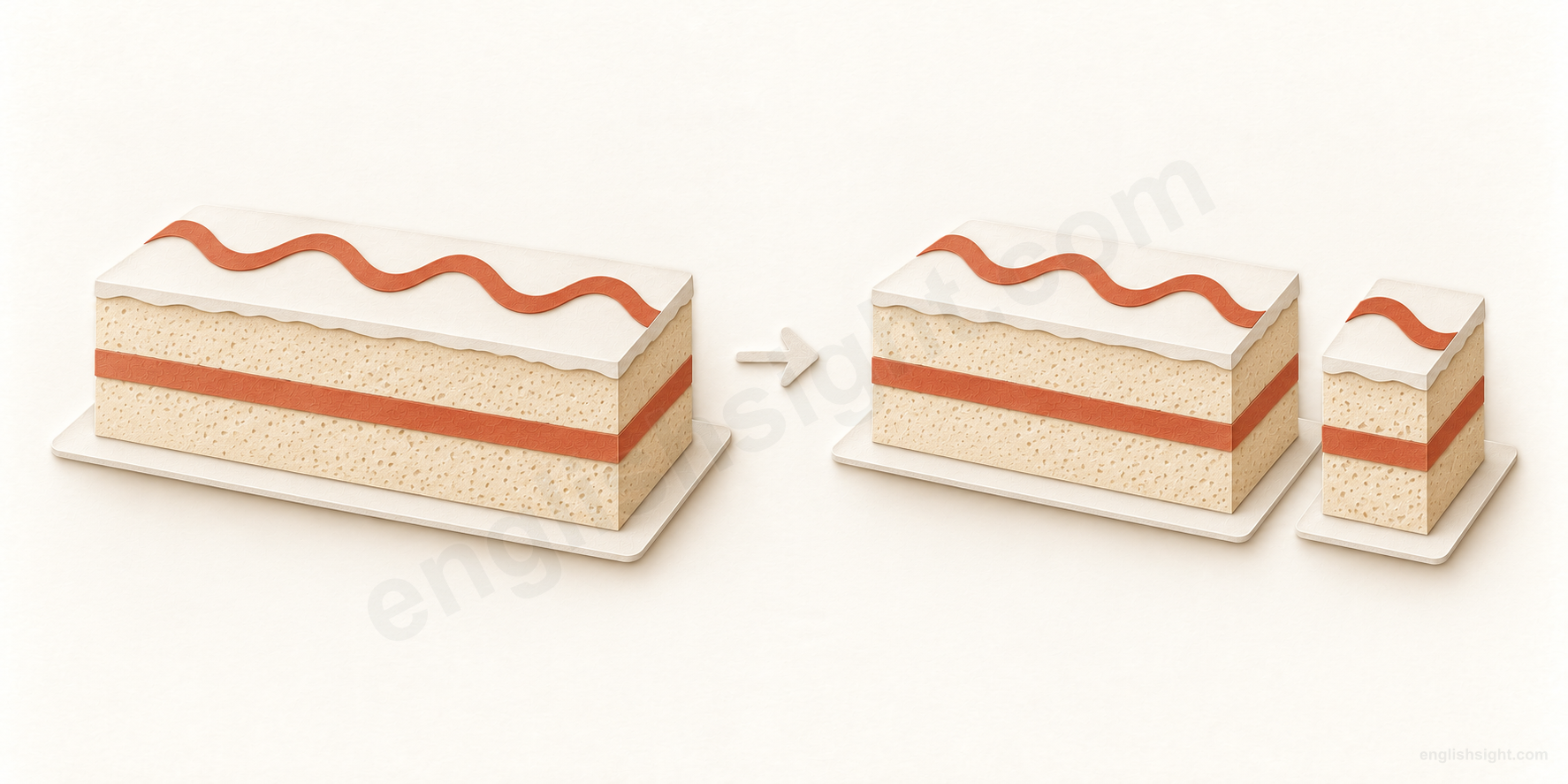
One whole cake rests on a serving board.
cake
The slice sits apart from the shorter remainder; both are cake.
One end slice is cut from the whole.
A cake counts the whole item; a slice of cake counts a portion of the food.
Cake can name a whole baked item or the food served in portions. A slice remains cake, but it is a slice of a cake rather than another whole cake.
Shaped masses and hardened coatings form another useful branch. Ease, bonuses, trade-offs, and sales are established meanings of complete expressions, not predictable meanings of cake alone.
A cake can be one complete baked item; cake can also name the food you eat in portions. Start with that change of viewpoint, then keep the material uses and fixed expressions distinct.
The diagram is a teaching aid for the whole-and-portion contrast. It does not explain every idiom or represent a mental image shared by all English speakers.
01
A whole cake and a portion of cake
Count separate items with a cake or cakes; use cake for the food, and piece or slice to count portions. Cooking and celebration words add context.
01
a / one + cake; number + cakes; chocolate / birthday / wedding + cake
a cake / two cakes
count separate baked items
Situation / starting point
A bakery has several finished cakes.
Meaning / result
You choose one complete item.
A countable cake is an individual item, large or small.
A cake is usually a sweet baked food. A birthday cake may serve a group; a small cake may serve one person. Size does not determine whether the noun is countable.
Say a cake for one item and cakes for more than one. Chocolate cake names a kind by flavor; birthday cake and wedding cake name the occasion. These modifiers identify the flavor or occasion while cake remains the name of the food.
In a sentence
We ordered two small cakes for the celebration.
Watch the difference Two cakes counts separate items. Two slices of cake counts portions, which may come from one cake.
02
some / a little + cake; a piece / slice of cake; two pieces / slices of cake
some cake / a slice of cake
name the food or count a portion
Situation / starting point
There is a cake on the table.
Meaning / result
Someone cuts a portion for a guest.
Cake names the food; slice or piece supplies the countable unit.
Would you like some cake? offers an amount of food, not necessarily a whole item. I like cake talks about the food in general. In both, cake is uncountable.
Use a slice of cake for a cut portion, often with an even thickness; a piece of cake is a broader description and need not have a neat shape. In two pieces of cake, pluralize pieces, not cake.
In a sentence
Would you like another slice of lemon cake?
Watch the difference A piece of cake is literal when serving dessert; in That test was a piece of cake, it is an idiom.
03
make / bake / cut / serve + a / the cake; have + some cake; cake + noun
make / bake / cut a cake
describe preparing and serving cake
Situation / starting point
You have ingredients and a baking pan.
Meaning / result
A finished cake is ready to cut and serve.
The action comes from make, bake, cut, or serve, not from the noun cake.
Make a cake covers preparing it; bake a cake specifies cooking it in an oven. Cut the cake means divide the already identified cake, often at a celebration. Have some cake means eat some in an ordinary food invitation.
In cake recipe, cake mix, and cake crumbs, cake modifies another noun. A cake tin is the usual British term for the baking container; cake pan is the North American term.
In a sentence
Let the cake cool before you cut it.
Watch the difference For preparing the dessert, say bake a cake, not simply cake it. The verb cake has a different meaning.
02
Shaped masses and hardened layers
Cake also names shaped food or a block of material. As a verb, it describes material forming a mass or a crust on a surface.
04
fish / potato + cake; plural cakes
fish cakes / potato cakes
name food shaped into a flat portion
Situation / starting point
A mixture of fish or potato is prepared.
Meaning / result
It is shaped and cooked as separate flat portions.
In these food names, cake refers to the formed portion, not sweetness.
Fish cakes and potato cakes can be savory. Their names do not promise icing, sugar, or a dessert. The ingredient word helps you identify which food is meant.
These cakes are countable: two fish cakes. Fishcake is also written as one word. Learn the established food name rather than assuming that every food in a round shape is called a cake.
In a sentence
I served two potato cakes with the salad.
Watch the difference A fish cake is not a sweet cake with fish decoration. The full food name identifies the dish.
05
a cake of + substance
a cake of soap
a shaped block of a substance
Situation / starting point
Soap has been formed into a solid block.
Meaning / result
You refer to the individual block as a cake.
This noun use describes a mass, not a baked food.
A cake of soap means one solid piece of soap. For everyday shopping, a bar of soap is a useful alternative. The block need not resemble a decorated dessert.
The broader shaped-mass sense also allows a cake of ice. The material follows of; it is not an ingredient that makes the object edible.
In a sentence
A small cake of soap rested beside the basin.
Watch the difference Distinguish a cake of soap, a block made of soap, from a slice of cake, a portion of food.
06
substance + cake; substance + cake on + surface
mud cakes / cakes on a surface
form a hardened mass or crust
Situation / starting point
Wet mud sticks to a surface.
Meaning / result
As it dries, it forms a firm layer.
The substance is the subject of the intransitive verb.
When mud cakes, it dries into a solid layer or lumps. Mud caked on the steps places that change on a surface. Here on tells you where the layer forms; it is not a particle that means baking.
The forms are cake, cakes, caked, caking: drop final e before -ing. A process can be progressive: The mud is caking on the wheels. The meaning is physical hardening, not cooking a dessert.
In a sentence
By morning, the mud had caked on the steps.
Watch the difference Mud caked describes the material hardening; the steps were caked with mud describes the affected surface.
07
object + be / become / get caked with / in + material
be caked with / in mud
be covered by a thick, often dried layer
Situation / starting point
Boots go through wet ground.
Meaning / result
A thick coating of mud remains on them.
The coated object is the subject; with or in introduces the covering material.
His boots were caked with mud describes the boots, not a pile of mud by itself. Be caked in mud is also possible. With and in introduce material; neither means that someone has put the boots inside a cake.
The verb is transitive in this use and usually passive. Caked can also describe a resulting state. The coating may be make-up or dirt; actual drying need not be the point when the speaker emphasizes a thick, heavy covering.
In a sentence
Her boots were caked with mud after the walk.
Watch the difference Caked with suggests a substantial coating. Covered with is broader and does not itself suggest a crust or thick layer.
03
Learn the whole expression
These familiar expressions use cake imagery, but their meanings belong to the complete phrases. They are not literal recipes or rules for inventing new idioms.
08
task / activity + be + a piece of cake
a piece of cake
a very easy task
Situation / starting point
You expect a task to be difficult.
Meaning / result
Someone describes it as easy to do.
The whole phrase evaluates difficulty; no food needs to be present.
The repair was a piece of cake means the repair was very easy. The expression is informal and can reassure someone. It expresses the speaker’s judgment; another person might still find the task hard.
Keep the normal unit phrase a piece of cake. Cake alone can also mean something easy in informal American usage, as in The quiz was cake, but a piece of cake is the fuller expression to learn first.
In a sentence
After all that practice, the final exercise was a piece of cake.
Watch the difference A slice of cake is a normal food portion, but it is not the standard replacement in this ease idiom.
09
have + possessive + cake and eat it (too); cannot have…
have your cake and eat it (too)
try to keep two incompatible advantages
Situation / starting point
One choice gives a benefit but involves a trade-off.
Meaning / result
Someone wants the benefit while avoiding that trade-off.
Having the cake means keeping it available, while eating it uses it up.
You can’t have your cake and eat it too points out a conflict between desired advantages. Keeping the very same cake intact and consuming it cannot both be achieved. This is a teaching explanation of the phrase, not a claim about how every speaker pictures it.
The expression often criticizes an unreasonable demand, but can also appear positively when an arrangement really offers both benefits. Too is optional; change your to his, her, or their as appropriate.
In a sentence
You want total control but no responsibility—you can’t have your cake and eat it too.
Watch the difference This idiom is about a trade-off. It does not merely describe eating dessert after buying it.
10
extra benefit + be + the icing / frosting on the cake
the icing on the cake
an extra benefit in an already good situation
Situation / starting point
You already have a welcome result.
Meaning / result
A further advantage makes it better.
The cake stands for the good result; icing represents an added bonus.
The icing on the cake is welcome but not essential to the main success. The expression is useful when distinguishing the main achievement from an enjoyable extra.
American English also uses the frosting on the cake. Here on belongs to the fixed noun phrase; it does not turn cake into a verb or imply that the main achievement was incomplete.
In a sentence
The new job was exciting; the shorter commute was the icing on the cake.
Watch the difference A basic requirement is not normally the icing on the cake. The usual idiom assumes an already good situation.
11
product + sell / go like hot cakes / hotcakes
sell / go like hot cakes
be bought quickly and in large numbers
Situation / starting point
A popular product goes on sale.
Meaning / result
Many buyers purchase it quickly.
The subject is the item being bought, even when it is not food.
The new mugs are selling like hot cakes describes strong demand. Selling is active in form here, but the mugs are what people buy; the mugs are not doing the buying.
Go like hot cakes has the same sales meaning. Hotcakes is also written as one word. Keep the plural in the expression; the product itself need not be warm, edible, or cheap.
In a sentence
The new reusable cups are selling like hot cakes.
Watch the difference Selling like hot cakes does not by itself mean sold out. It describes rapid sales, not necessarily the final stock level.
12
a slice / share of the cake; a larger / smaller slice of the cake
a slice / share of the cake
a portion of available money or benefits
Situation / starting point
There is a total amount to divide.
Meaning / result
A person or group seeks a portion.
A divisible cake provides a model for sharing a limited total.
A larger slice of the cake can mean more of a budget, income, or other available benefits. The cake is the total, and the slice is one party’s portion.
This expression is particularly British. A slice or piece of the pie is an alternative used in both British and American English. Learn which full expression fits your context rather than substituting food words freely.
In a sentence
Smaller clubs want a larger slice of the funding cake.
Watch the difference A slice of the cake concerns allocation. A piece of cake used as a task description concerns ease.
13
person / thing / behavior + take the cake; that takes the cake
take the cake
stand out as an extreme or astonishing example
Situation / starting point
Several things have been annoying or surprising.
Meaning / result
One example seems more remarkable than the rest.
The expression evaluates an extreme; it does not describe taking dessert.
That takes the cake often expresses surprised disapproval: something is especially rude, ridiculous, or annoying. Context supplies the quality being compared. This informal expression is especially North American; British English also uses take the biscuit.
It can more broadly refer to something surpassing the others, and a literal prize-winning sense is recorded. In everyday use, do not assume it is a compliment. The complaint around it often determines the meaning.
In a sentence
He charged us for correcting his own mistake—that takes the cake!
Watch the difference The usual critical tone differs from the positive bonus in the icing on the cake. Neither expression is a separable phrasal verb.
Keep the noun, verb, and idioms distinct
Count the right thing
A cake is a separate item; some cake is food; two slices of cake are two portions. Cakes can be small or large, and counting them does not tell us how many people they serve.
Not every cake is dessert
Fish cakes are shaped food; a cake of soap is a block. The verb cake means form a mass or a coating, not bake a dessert. Its regular forms are cakes, caked, and caking. Cake is pronounced /keɪk/, one syllable; the plural cakes ends in /s/ and the past form caked ends in /t/.
Read the full expression
A piece of cake evaluates ease; a slice of the cake describes a share; the icing on the cake adds a bonus. Their meanings cannot be exchanged by changing one food word.
Coverage boundary
This lesson covers everyday food grammar, the material and coating branch, and familiar idioms. Specialist filter cake and animal-feed cake, regional cake names, and separate derived words such as cakewalk are not expanded. No claim of a complete frequency ranking is made.
Choose the meaning in context
Use countability, the subject, and the complete expression to decide.
1. You want one portion from a large cake, not another whole item. What do you ask for?
2. After walking through mud, your boots have a thick dried coating. Which description fits?
3. A job offer is already excellent, and free lunches are a welcome extra. Which phrase fits the lunches?
4. Someone wants complete control while refusing all responsibility. Which idiom points out that conflict?
5. The mugs are selling like hot cakes. What must the sentence mean?
Sources and teaching notes
The dictionary pages below were read to check meanings, grammar, and expressions. The explanations and examples are original; the whole-and-portion diagram is a teaching model.
The diagram supports one useful distinction; it is not a picture shared by every native speaker.