Name the device, describe the shot, and distinguish on, off, and in camera.
A scene becomes an image
A scene becomes an image
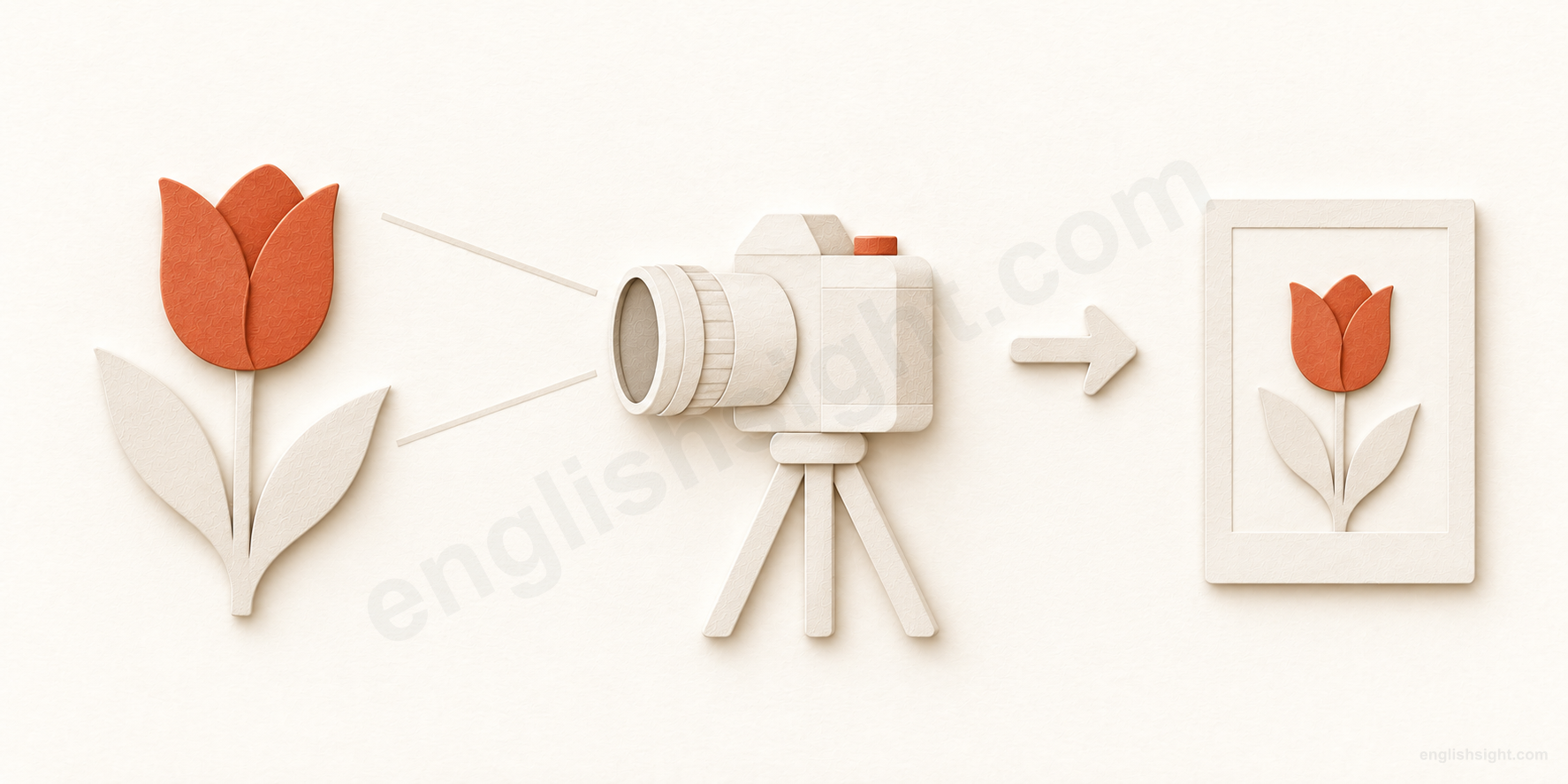
A tulip stands in the scene.
camera
An image shows the same tulip.
The camera captures its appearance.
The camera produces an image; the flower stays in place.
A camera uses light from a scene to produce a still or moving image for recording or transmission.
The flower, camera, and framed image show the subject–device–image relationship. The arrow marks image production, not an object passing through the lens; the drawing is not an optical engineering diagram.
A camera turns a view of the world into still or moving images that can be recorded or transmitted. Start with the connection between a subject, the device, and its image; then learn the expressions used around filming.
The diagram offers one teaching model. It does not claim that every English speaker pictures the word alike, and it does not explain the separate legal expression in camera.
01
The device and its uses
Name the equipment, choose a kind, and explain what you use it for. A camera may be a separate object or a component of another device.
01
a / the / possessive + camera; plural cameras
a camera / cameras
equipment that produces still or moving images
Situation / subject
You want a picture of a flower.
Result / interpretation
You choose equipment that can capture its image.
The camera is the device; the photograph or video is its output.
Camera is a countable noun: a camera, my camera, two cameras. It can refer to equipment for photographs, film, video, or television pictures. It does not mean only a traditional still-photo camera.
A phone can have a camera built into it. Saying My phone has two cameras counts camera units, not two photographs. Say I bought a camera, with a determiner before the ordinary singular noun.
Example
I packed a camera and two spare batteries.
Watch the difference A camera takes or records pictures; it is not itself a picture.
02
modifier + camera
a digital / film / video camera
specify how a camera works or what it is for
Situation / subject
You compare equipment before a trip.
Result / interpretation
You choose the type that suits your purpose.
The modifier narrows the type; camera remains the head noun.
A digital camera produces electronic images; a film camera uses photographic film. A video camera records moving images. These labels describe technology or purpose, not wholly separate meanings of camera. Many modern devices can take both photographs and video.
A phone camera is the camera in a phone. A disposable camera is designed for limited use rather than repeated reloading. The words before camera tell you which kind is meant; they do not all describe the same feature.
Example
We used a video camera to record the school play.
Watch the difference Film camera usually means one using photographic film; video camera is a clearer choice when you mean equipment for recording video.
03
security / CCTV / speed / hidden / body + camera
a security camera / a speed camera
equipment used to monitor a place or record traffic offences
Situation / subject
A shop wants a visual record of its entrance.
Result / interpretation
A fixed camera records activity there.
A camera can observe automatically, without someone holding it.
A security camera helps monitor a place, for example a shop entrance. CCTV cameras are used in a closed-circuit television system. These are uses of the same image-producing device, not a new meaning involving a human photographer.
A speed camera records vehicles exceeding a speed limit. The term is especially associated with British English. A hidden camera describes concealment; a body camera is worn on a person. These modifiers identify placement or purpose, not a promise that every event is recorded.
Example
A security camera recorded the delivery at the back door.
Watch the difference A security camera is not a security guard. A speed camera concerns road speed, not simply a camera that takes photographs quickly.
02
Using a camera and describing its view
Distinguish aiming, recording, and changing the view. Ordinary verbs describe these actions; camera itself normally names the equipment.
04
take a photo / picture of + subject + with + camera; use a camera to + verb
take a photo with a camera
name the instrument used to make a picture
Situation / subject
You want a picture of the bridge.
Result / interpretation
You use your camera to take it.
With introduces the equipment; of introduces the subject of the picture.
In take a photo of the bridge with my camera, the photo is the result, the bridge is what is pictured, and the camera is the instrument. Use take a photo or take a picture for the action, not take a camera unless you mean carry or bring the device.
Use a camera to film something or to record a video for moving images. Camera stays a noun in these ordinary expressions; photograph, film, and record supply the action.
Example
Can you take a photo of us with my camera?
Watch the difference Take my camera can mean bring or carry it; it does not by itself mean take my photograph.
05
point / aim the camera at + target; focus the camera on + subject
point the camera at / focus the camera on
choose the direction and subject of a shot
Situation / subject
The camera is facing the wrong way.
Result / interpretation
You aim it toward the flowers and bring them into focus.
At marks the target of pointing; on marks the subject of focusing.
Point or aim the camera at something describes its direction. Focus the camera on something describes adjusting or directing attention to the intended subject; in a literal photography instruction it often means making that subject sharp.
You can also hold the camera steady or put it on a tripod. Aiming at a subject does not itself say that you have pressed the shutter or started recording.
Example
Point the camera at the flowers, then focus on the nearest one.
Watch the difference Use point at and focus on in these patterns. Pointing the camera is preparation, not proof that a picture was taken.
06
the camera + capture / pan / zoom; cameras roll / click
the camera captures / pans / zooms in
describe recording or a change in the view
Situation / subject
A wide shot shows the whole room.
Result / interpretation
The view becomes closer to one detail.
The device can be the grammatical subject even when a person controls it.
The camera captured a smile describes the image it recorded. The camera panned across the room describes a view moving across the scene; the camera zoomed in on the clock describes a closer-looking view, without necessarily moving the whole camera nearer.
When cameras roll, filming is taking place or beginning. In Cameras were clicking, clicking evokes repeated photographs. These meanings come from capture, pan, zoom, roll, and click used with the equipment; they are not meanings of a verb camera.
Example
The camera zoomed in on the clock above the door.
Watch the difference Zooming changes the view; it does not necessarily mean carrying the camera forward.
07
camera + noun
camera lens / angle / crew / footage
use camera to identify related equipment, perspective, people, or images
Situation / subject
A team prepares to film an interview.
Result / interpretation
The crew sets the equipment and chooses a view.
Camera can modify another noun without becoming the main noun.
A camera lens is an optical part of the camera; a camera angle is the viewpoint from which a shot is taken. A camera crew is a team working with the filming equipment. Read the final noun to find out whether the expression names a part, a perspective, or people.
Camera footage means moving images recorded by a camera. Footage is normally uncountable: some footage or a piece of footage, not three footages. A camera operator is a person who operates the equipment; the camera itself remains the device.
Example
The camera crew chose a lower camera angle for the interview.
Watch the difference A camera crew is a group of people, not a collection of cameras. Camera usually stays singular as a noun modifier.
03
Being filmed, being seen, and staying private
Small changes around camera matter. On camera, off camera, and in camera are established expressions with different meanings.
08
be / speak / appear + on camera; an on-camera + noun
be / speak on camera
be filmed or speak while being filmed
Situation / subject
The interview is about to be recorded.
Result / interpretation
The guest speaks as the camera records her.
On camera concerns appearing in the recorded or televised action.
If you speak on camera, your speech is being filmed. Someone can look relaxed on camera even if they feel nervous. The expression concerns the filming situation, not physical contact with the equipment.
Say on camera without an article in this fixed expression. On the camera can instead refer to the physical device: There is a button on the camera. An on-camera interview uses a hyphenated modifier before the noun.
Example
She agreed to explain the problem on camera.
Watch the difference On camera does not necessarily mean live television; the video may be shown later.
09
catch / capture + person or event + on camera; be caught on camera + -ing
catch / capture something on camera
record an event or action in images
Situation / subject
A fox crosses the garden at night.
Result / interpretation
The recording shows its visit.
Catch here means record, not physically seize.
Catch something on camera emphasizes obtaining a visual record, often of a brief or unexpected event. It can describe wildlife, a memorable moment, or an offence. It does not inherently mean wrongdoing.
Use an active sentence such as The camera caught the fox entering, or a passive one such as The fox was caught on camera. In caught on camera stealing, the -ing form identifies the recorded activity; caught does not by itself say anyone was arrested.
Example
A fox was caught on camera carrying a shoe across the garden.
Watch the difference Caught on camera means recorded visually; it need not mean captured by the police.
10
speak / happen + off camera; off-camera + noun
off camera / off-camera
outside the filmed view or away from filming
Situation / subject
An interviewer stands beside the lens.
Result / interpretation
You hear her question but do not see her.
Off camera can describe being outside the shot, even if sound is recorded.
Off camera can mean outside the area being filmed: a person may be speaking off camera while their voice is audible. It can also mean when not being filmed, as in discussing something after a recording ends.
An actor’s off-camera manner describes behavior away from filming or public performance. Before a noun, the compound is commonly hyphenated: an off-camera voice. This is an established media expression, not a command to turn a device off.
Example
The interviewer asked another question off camera.
Watch the difference Off camera does not guarantee that no microphone is recording. Turn the camera off is a separate instruction about the device.
11
face the cameras; pose for the cameras; in front of / behind the camera
face / pose for / be in front of the cameras
appear before photographers or a filming audience
Situation / subject
Reporters wait outside the building.
Result / interpretation
The visitors stop to be photographed.
The cameras can stand for the media situation surrounding the equipment.
Pose for the cameras means deliberately arrange yourself for photographs. Face the cameras can mean turn toward them or confront the attention of photographers and television crews. The context supplies the public-exposure sense.
In front of the camera can describe a physical position or someone’s experience performing while being filmed. Behind the camera can describe operating or making a film, rather than appearing in it. Neither position alone guarantees that recording is happening.
Example
The players posed for the cameras after the final.
Watch the difference For in pose for names the intended audience or equipment; pose on the camera would suggest an odd physical location.
12
be camera-shy; a camera-shy + person
camera-shy
uncomfortable about being photographed or filmed
Situation / subject
Someone suggests taking a group photograph.
Result / interpretation
One person feels nervous about appearing in it.
Shy describes the person’s response to being photographed.
Camera-shy is an adjective for someone uneasy about having their photograph taken or being filmed. It can apply to one situation or a usual preference; it does not mean that the person is shy in every social setting.
Say She is camera-shy or a camera-shy guest. This compound describes discomfort with being photographed or filmed; it does not describe a faulty camera or poor photography skills.
Example
My brother is camera-shy, so I asked before taking his photo.
Watch the difference Do not confuse being camera-shy with being unable to use a camera.
13
a hearing / trial + be held in camera
hold a hearing in camera
conduct formal proceedings privately, excluding the public
Situation / subject
A hearing is normally open to the public.
Result / interpretation
This hearing is conducted without public or press attendance.
This legal expression concerns privacy, not taking pictures.
In legal or formal reporting, a hearing held in camera is conducted in private, with the public and press excluded. Learn in camera as a whole expression. It preserves an older chamber-related use rather than the modern picture-making device.
Compare on camera, meaning while being filmed. In camera does not mean that the hearing is being filmed; it describes who may attend. The phrase itself does not tell you whether a recording is made. A phrase such as images stored in the camera, with the article, is an ordinary literal reference to the device and is different again.
Example
The judge ordered that the next hearing be held in camera.
Watch the difference This formal legal phrase does not mean live, filmed, or broadcast.
Keep device, image, and expression apart
Camera is normally a noun
Use a camera to take photographs, film, or record. The normal plural is cameras. This lesson does not build a verb family, causative pattern, or phrasal verbs from camera; verbs such as turn off and zoom in have their own grammar.
Learn the preposition with its meaning
With a camera names an instrument; on camera means being filmed; off camera concerns absence from the shot or filming; in camera is a formal privacy expression. On the camera and in the camera can instead locate something on or inside the actual device.
Scope and pronunciation
The usual pronunciation is /ˈkæmrə/; /ˈkæmərə/ is also recorded. We cover everyday equipment, filming expressions, and recognition of the legal idiom. Historical chamber senses, camera obscura, specialist camera-ready printing usage, and detailed camera engineering are not developed here.
Choose the intended meaning
Use the whole expression and the situation.
1. You want a friend to photograph you using your device. Which request fits?
2. A report says a hearing was held in camera. What does it mean?
3. You hear an interviewer but cannot see her in the filmed shot. Which description fits?
4. A recording shows a fox carrying a shoe. What does caught on camera tell you?
Sources and teaching notes
The dictionary pages below support the equipment meanings, collocations, and fixed expressions. Explanations and examples are original; the diagram is a teaching model.
The diagram connects a subject, a device, and an image. It is a learning aid.