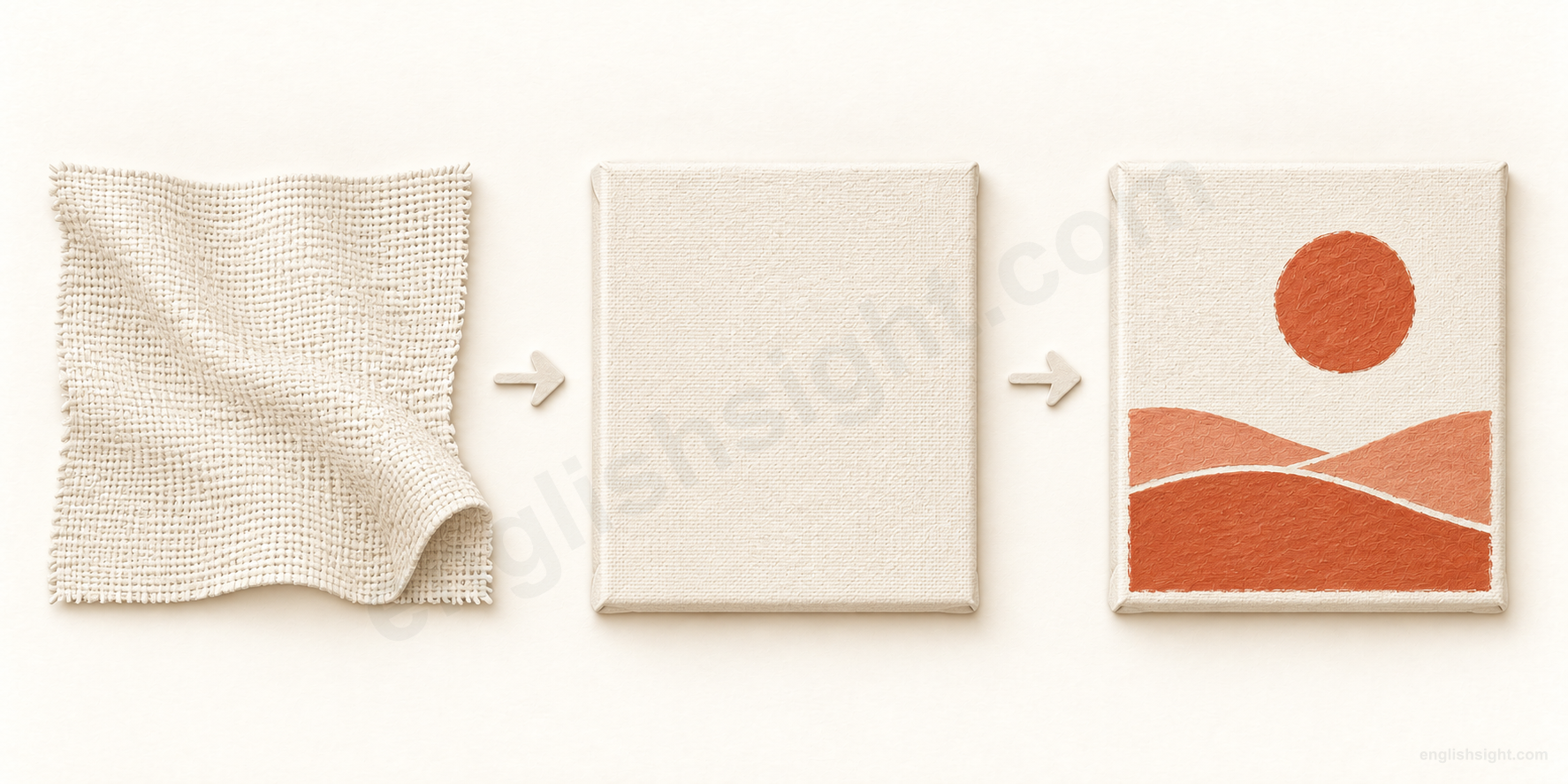
See how canvas names a fabric, a painting surface, and familiar extensions.
Cloth becomes a surface that carries a picture
Cloth becomes a surface that carries a picture
Loose woven cloth
canvas
The prepared canvas carries a painted picture.
The cloth is stretched into a blank painting surface.
Canvas can name the cloth, the prepared painting surface, or the work painted on it.
Canvas is sturdy woven cloth that can serve as a useful covering or support; in art, a prepared piece carries a painting and can give its name to the finished work.
The diagram selects the material-to-painting connection. Bags, tents, sails, and ring floors are other uses of the material; figurative creative space is a comparison with a painter’s surface.
Imagine a sturdy piece of woven cloth. It can become a bag or tent covering, or carry a painted picture. English can name the material, a prepared surface, or the finished painting with canvas.
A blank canvas also offers a useful comparison for something you can develop. Other expressions depend on camping, sailing, or sport. Their meanings are conventional uses to learn in context, not automatic results of one picture.
01
Material and things made from it
Start with the fabric. Notice when canvas names a material and when it describes another noun.
01
canvas as an uncountable noun; made of / from canvas; a piece / roll of canvas
made of canvas
strong woven cloth, considered as a material
Situation / starting point
A maker chooses fabric for a tool bag.
What is being described
The chosen material is canvas.
The material is not counted as individual objects.
Canvas names a sturdy fabric used in such things as bags and tents. Here it is an uncountable noun: some canvas, heavy canvas, or a roll of canvas. Cotton canvas identifies the fibre used to make it.
In made of canvas, of introduces the material. The verb made does not give canvas a new meaning. Compare two pieces of canvas with two canvases: the first measures pieces of fabric; the second normally suggests separate painting surfaces or paintings.
Canvas is a kind of cloth, not a name for every strong material. Calling a bag canvas also does not, by itself, guarantee that it is waterproof.
In a sentence
The tool bag is made of thick canvas.
Watch the difference For the material, say some canvas or a piece of canvas, rather than a canvas.
02
canvas + object noun
a canvas bag
an object whose material is canvas
Situation / starting point
You compare a leather bag and a fabric bag.
What is being described
You identify the fabric bag by its material.
The last noun names the object; canvas names its material.
In a canvas bag, canvas modifies bag. The same pattern gives canvas shoes and a canvas tent. These are ordinary material descriptions, not separate idioms.
Make the object plural when necessary: two canvas bags, not two canvases bags. In a canvas painting, however, the relationship is painting support rather than a bag-like object made from fabric; the head noun and context matter.
In a sentence
I keep my sketchbook in a canvas bag.
Watch the difference Canvas describes the material; it does not mean that the object contains a painting.
02
A painting surface and a finished work
In an art shop, a canvas may still be empty. In a gallery, canvases may already be paintings. The surrounding words tell you which.
03
paint on canvas; a canvas / canvases; stretch a canvas; oil on canvas
paint on canvas
use canvas as the surface that carries paint
Situation / starting point
The artist has fabric prepared for painting.
What is being described
Paint is applied to its surface.
On names the surface; canvas is the support, not the paint.
You can paint on canvas without counting a particular piece. A canvas is one prepared painting surface: I bought a small canvas. It may be stretched over a support or attached to a backing.
An art label such as oil on canvas identifies paint and support separately: oil is the painting medium, and canvas is what carries it. Compare a picture of a boat, which identifies what the picture shows.
Stretch a canvas describes making the fabric taut over its support. A stretched canvas is ready as a physical surface; the phrase alone does not say that a picture has been painted on it.
In a sentence
For this portrait, Maya will paint on canvas rather than paper.
Watch the difference Use on for the support: paint on canvas. Paint in oils describes the medium; paint a canvas can mean paint a picture on one.
04
a canvas by + artist; an artist’s canvases
the artist’s canvases
paintings made on canvas
Situation / starting point
An artist has completed several works.
What is being described
A gallery displays the finished paintings.
The name of the support can stand for the work on it.
In an exhibition, a canvas can mean a finished painting, especially an oil painting. The plural is canvases. Words such as exhibit, sell, and by an artist often help identify this reading.
Compare three blank canvases in an art shop with three canvases by a painter in a gallery. The countable noun can refer either to the prepared surfaces or to the completed works; countability alone does not decide.
Painting is the broader everyday word. A painting on paper is still a painting, but calling it a canvas would normally misidentify its support.
In a sentence
The gallery is showing three canvases by a local painter.
Watch the difference Canvases does not necessarily mean unused pieces of fabric. Check whether the context is buying supplies or viewing art.
03
Room to create
A painting surface offers a useful comparison for a place, project, or story. These uses need a creative or descriptive context.
05
be / offer a blank canvas; a blank canvas for + person / activity
a blank canvas
something open to many possible changes or developments
Situation / starting point
An empty room has no design imposed on it yet.
What is being described
You can choose what to make of the space.
Blank highlights possibilities that have not yet taken shape.
Literally, a blank canvas has no picture on it. Figuratively, a room, project, or other starting point can be a blank canvas: it leaves room for someone to shape it.
The expression compares development to making a picture. It need not mean that absolutely nothing exists: an unfurnished room already has walls and a floor. What remains open is its design or use.
A blank slate is a related established expression. Learn the whole phrase; blank supplies the idea of an unmarked starting point. Canvas alone does not mean a fresh start.
In a sentence
The empty shop is a blank canvas for our new café.
Watch the difference A blank canvas offers possibilities; it does not promise that the future design will be successful.
06
a canvas for + ideas / creativity; a broad / vast canvas
a canvas for ideas; a broad canvas
a setting or field in which something can be created or presented
Situation / starting point
A writer chooses the people, places, and years a story will cover.
What is being described
The story can develop within a large setting.
The comparison concerns creative space or scope, not physical cloth.
A garden can be a canvas for a designer’s ideas: it is the place where those ideas take form. Unlike a blank canvas, it need not be empty or untouched.
In a novel with a broad canvas, canvas means the range or setting of the account. Many lives, places, or events can fit within it. Broad describes that scope, not the width of a real painting.
These are figurative uses suited to discussion of creation, design, and storytelling. For a simple factual description, setting, range, or space may be clearer. A creative context makes the comparison understandable.
In a sentence
The novel uses a broad canvas, following four families across a century.
Watch the difference A broad canvas does not necessarily mean a long book, and a canvas for ideas does not necessarily mean a blank starting point.
04
Camping, sailing, and sport
Some expressions name an object or place through its canvas covering. Learn the setting along with the expression.
07
sleep / live / stay under canvas; a night under canvas
sleep under canvas
sleep in a tent
Situation / starting point
You choose a tent rather than a room for the night.
What is being described
You spend the night camping.
In this expression, the tent is named through its covering.
Spend a night under canvas, sleep under canvas, and live under canvas describe staying in a tent. Under connects the person with the shelter above them; canvas stands for the tent covering.
This is an established camping expression, not a requirement to check the tent’s exact fabric. In a travel conversation, sleep in a tent is a straightforward alternative.
Under the canvas can also be a literal location below a particular piece of fabric. The established camping expression normally has no the: We stayed under canvas.
In a sentence
We spent two nights under canvas beside the lake.
Watch the difference Under canvas in a camping account means in a tent, not under a painting.
08
sail / move under canvas; under full canvas
sail under canvas
travel using sails
Situation / starting point
A boat can move under sail rather than by its engine.
What is being described
Its sails are set to use the wind.
In nautical use, canvas can name the sails collectively.
In a sailing account, under canvas means with sails set or by means of sails. Under full canvas describes a vessel carrying its full set of sails. This is a nautical use to recognize, rather than a general meaning of under.
Compare spending the night under canvas on land with a boat moving under canvas at sea. The camping and sailing readings share the material association, but the setting determines the object being named.
For an everyday explanation, under sail is often the simpler choice. Do not use under canvas to say that a motorboat has an ordinary fabric roof.
In a sentence
With the engine off, the yacht moved slowly under canvas.
Watch the difference The sailing reading does not say that the crew are camping inside a tent.
09
hit the canvas; on / off / from the canvas
hit the canvas
fall onto the floor of a boxing ring
Situation / starting point
A boxer loses balance after a blow.
What is being described
The boxer falls onto the ring floor.
The covering gives its name to the surface of the ring.
In boxing or wrestling, the canvas is the covered floor of the ring. Hit the canvas means fall onto that floor; hit describes contact with it, not a punch aimed at a painting.
The boxer can also lie on the canvas or get up from the canvas. Here on and from express ordinary position and movement; canvas supplies the sport-specific surface.
A fall does not by itself tell you that the boxer has lost the match. Read the rest of the report before concluding that there was a knockout.
In a sentence
The boxer hit the canvas but got up before the count ended.
Watch the difference In a sports report, the canvas is the ring floor, not the ropes or the whole arena.
Choose the meaning through grammar and context
Material or countable object?
Canvas as fabric is uncountable. A canvas can be a prepared painting surface or a finished painting; the regular plural is canvases. The usual pronunciation is /ˈkænvəs/, with stress on the first syllable.
Canvas and canvass
In ordinary modern writing, use canvass for seeking votes or opinions: Volunteers canvass the neighbourhood. Canvas is the usual spelling for cloth and paintings. The words sound alike. Some dictionaries record spelling variants, but keeping this distinction is the clearest learner choice.
Scope of this lesson
Specialist needlework canvas, the rowing term for a covered end of a racing boat or a narrow winning margin, and the uncommon verb meaning cover with canvas are outside the expanded lessons here. Software products named Canvas and technical programming interfaces need their own context. This noun has no everyday phrasal-verb family to memorize.
Find the right canvas
Use the setting and the words around canvas to choose its meaning.
1. You need fabric to make a bag, rather than an artist’s prepared surface. Which request is clearest?
2. A gallery announces “five early canvases by the artist.” What are visitors most likely to see?
3. Friends spent the weekend under canvas at a campsite. Where did they sleep?
4. An empty shop is a blank canvas for a café. What does the speaker emphasize?
5. A boxer hit the canvas and immediately got up. What happened?
Sources and teaching notes
The sources below were used to check senses, constructions, and established expressions. Explanations and examples are original; the diagram is a teaching connection, not a dictionary definition.
The diagram highlights a useful connection; English speakers do not all share one mental picture.