From messages and payment to game pieces, hidden plans, and useful advantages.
A compact carrier with a particular purpose
A flat piece carries something useful
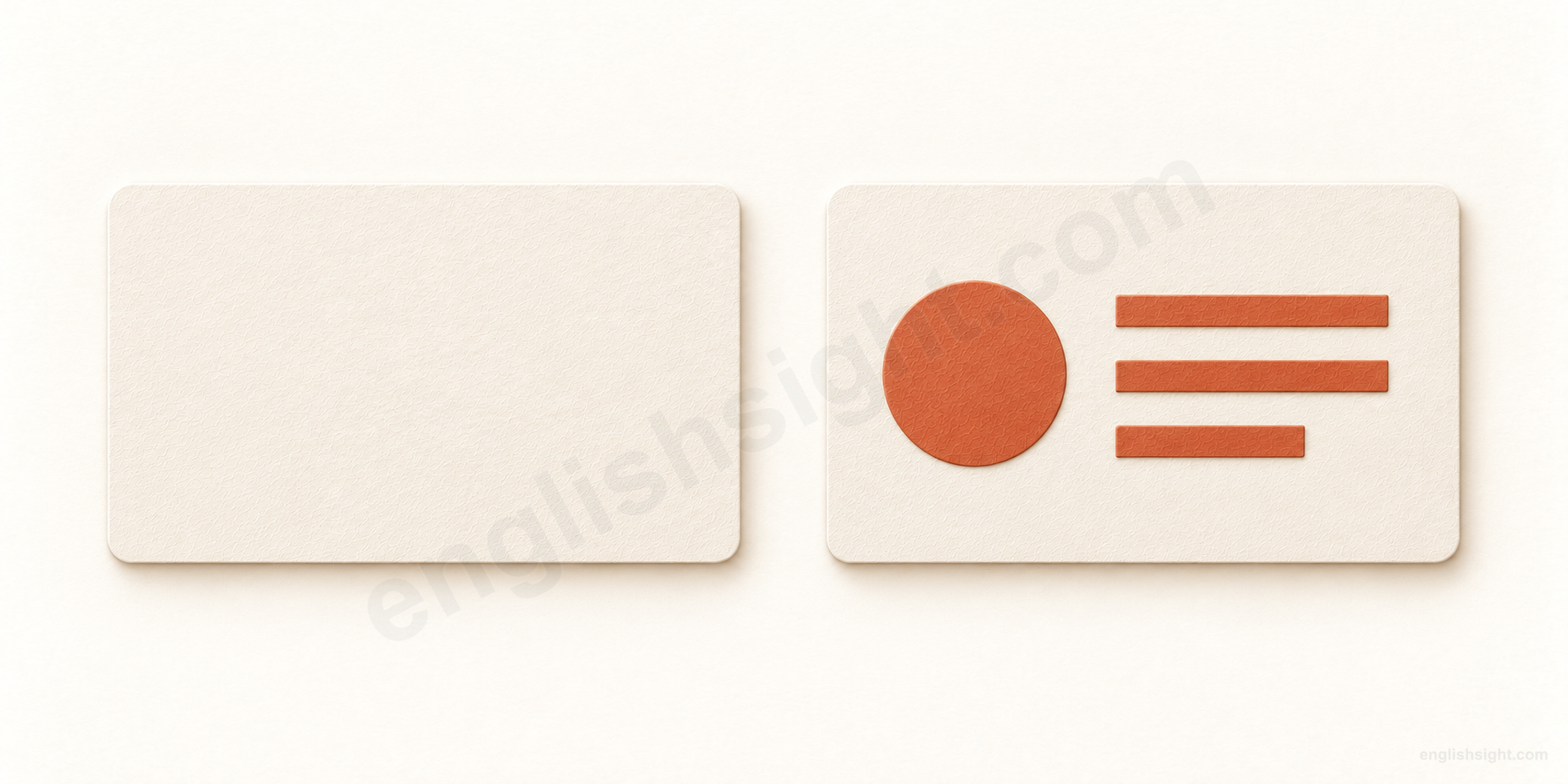
A blank card is already a card.
card
A marked card has the same thin, firm form.
Its surface can carry information.
Blank or marked, a card is a separate flat piece you can handle.
The compact form gives information, a message, or a game value a separate object that can be handled and used.
The sketch illustrates a physical carrier, not a compulsory change of state. Blank cards are still cards. Digital cards reuse the name without a physical carrier. Game-based idioms, the material meaning, and specialist homonyms cannot all be reduced to the markings in the sketch.
A card is often a separate, thin, fairly stiff piece whose surface or stored information serves a purpose. Ask what kind of card it is and what people do with it: read it, show it, pay with it, or play it.
That is a useful teaching connection, not one definition that predicts every expression. Card also names a material; digital cards, electronic components, and fixed idioms need their own explanations. No single mental picture is shared by every English speaker.
01
Paper, messages, and small records
Start with the separate flat object, then ask what its surface is used for. The material and the individual object have different countability.
01
a / two / several + card(s); some / a piece of + card
a card / a piece of card
one stiff, flat piece, or the material it is made from
Situation / starting point
You need a firm surface for a name label.
Meaning / result
You cut a rectangle from thick paper.
A card is an individual object; card can also name the material.
An individual card is countable: one card, two cards. It is typically a thin, flat piece of stiff paper or plastic. A blank card is still a card before you write anything on it.
Especially in British English, uncountable card means the stiff paper material: made of card, some white card, a piece of card. Use pieces or sheets when counting the material. Cardboard overlaps with this material meaning; it does not normally name your bank card or a birthday greeting.
In a sentence
We made six name cards from one sheet of white card.
Watch the difference Say some card for the material. Some cards means several separate objects.
02
send / give + someone + a card; send a card to someone; sign a card
send someone a birthday card
send a personal message for an occasion
Situation / starting point
A colleague has a birthday tomorrow.
Meaning / result
Everyone adds a message to a card for her.
The occasion tells us what kind of greeting the card carries.
Birthday card, Christmas card, get-well card and thank-you card name cards by their message or occasion. They are often folded, with a picture outside and a message inside. Sign a card means add your name, often with a short greeting.
Send her a card and send a card to her put the recipient in different positions. A card for her names the intended recipient even before it is sent. British greetings card corresponds to North American greeting card.
An e-card is a greeting displayed on a screen and sent electronically. “I sent her an e-card for her birthday” describes a digital message, not a piece of paper sent through the post.
In a sentence
We all signed a get-well card for Ana.
Watch the difference A gift card provides spending value; a greeting card carries a message. A birthday card is not automatically a gift card.
03
send / write / receive + a postcard; a card from + place
a card from your holiday
a short message sent on a postcard
Situation / starting point
You are visiting the coast.
Meaning / result
Your friend receives a picture and a short message.
In travel correspondence, card can be short for postcard.
A postcard travels through the post without an envelope. A picture may be on one side, with a message, address and stamp on the other. Card can stand for postcard when the holiday or postal context makes that clear.
A postcard from Lisbon can mean it was sent from Lisbon. A postcard of Lisbon describes the picture. Neither card nor postcard means the holiday itself.
In a sentence
Your card from Lisbon arrived this morning.
Watch the difference From gives the origin; of can describe the pictured subject. An ordinary folded greeting card usually goes in an envelope.
04
my / your business card; exchange business cards; hand out cards
Here’s my card.
offer your professional contact details
Situation / starting point
You meet a possible customer.
Meaning / result
They have your name and a way to contact you.
My card often means my business card in a professional introduction.
A business card carries a person’s name and professional details. Exchange business cards means each person gives the other a card. Hand out cards means distribute them to several people.
The possessive identifies whose details are on the card. “Here’s my card” is a conventional way to make later contact possible; it is not a general way to announce any card you own.
In a sentence
Here’s my card; my work email is on the back.
Watch the difference Write information on a card. In a card usually refers to the inside of a folded card.
05
write something on a card; use index cards / flashcards
index cards / flashcards
organize information or practise recall in small units
Situation / starting point
Your notes are spread across a long page.
Meaning / result
Each separate card holds one useful item.
The card is a small carrier; its learning or filing purpose comes from the compound.
An index card is a small card used to record information and keep it with other cards in a file or box. A recipe card holds a recipe. These names describe the information or its use, rather than a new material.
A flashcard presents a word, picture, question or other prompt for quick practice. You can put a prompt on one side and the answer on the other. Flashcards can also be digital; the screen imitates separate information units.
In a sentence
I put the picture on the front of each flashcard and the word on the back.
Watch the difference Front and back describe the two faces. A card game is a game played with cards; a flashcard activity need not be a card game.
06
get / receive a report card; a report card on + subject
a report card
a record evaluating performance
Situation / starting point
A school term has ended.
Meaning / result
A family receives a record of the student’s results.
A report card presents an assessment, rather than a greeting or an identity.
In American English, a report card gives a student’s results and often teachers’ comments. British English commonly uses school report or report for this school document.
American journalism also uses report card for an assessment of an organization, policy or country: a report card on local transport. This need not be a small physical piece of stiff paper.
In a sentence
Maya’s report card shows that her reading has improved.
Watch the difference The meaning is evaluation, not simply any report printed on a card.
02
Identity, access, and payment
Cards can establish who you are, open a door, or connect a purchase to a payment arrangement. The modifier and the surrounding action matter.
07
show someone your card; an ID / membership / library card
show your ID / membership card
prove who you are or your membership status
Situation / starting point
A receptionist needs to check your identity or membership.
Meaning / result
You present the card with the relevant details.
A card can carry evidence of a person’s identity or entitlement.
An identity card, or ID card, identifies its holder. Identification card is another North American term. A membership card shows that you belong to an organization; a library card lets the library recognize your account.
Show someone your card means let them see it; hand someone your card involves physically passing it to them. A cardholder is the person who holds or is entitled to use a card. The type of card determines what it proves.
In a sentence
Please show your membership card at reception.
Watch the difference Not every card is official identification. A business card gives contact details but does not by itself prove legal identity.
08
use a key card; tap / swipe / insert a card
a key card
use recorded information instead of a metal key
Situation / starting point
You have checked into a hotel.
Meaning / result
The room’s reader recognizes your card and unlocks the door.
The flat card carries access information that a reader can use.
A key card works as an electronic door key. North American English also uses card key. The card’s function is access; it need not display the room number or a written explanation.
Tap, swipe and insert describe different physical actions: bring the card to a reader, slide it through a reader, or put it into a slot. Follow the device: these verbs are not interchangeable instructions for every key card.
In a sentence
Tap your key card on the reader beside the door.
Watch the difference A card reader reads the information; a key card carries the information used for access. The reader is not the card itself.
09
pay by card; pay with a card; put something on my card; accept cards
pay by card / put it on my card
use a payment card to settle a purchase
Situation / starting point
You need to pay for lunch.
Meaning / result
You choose your bank card as the payment method.
By names the method; on links the charge to a particular card.
Pay by card names a payment method, like pay in cash. Pay with a card focuses on the instrument. Do you take cards? and Do you accept cards? ask whether card payment is available.
Put the bill on my card means charge the purchase to that card. It does not mean write the bill on the plastic. If a card is declined, the payment has not been authorized; the expression does not explain why.
In a sentence
Can I pay by card, or do you only take cash?
Watch the difference Use by card without a or my when naming the method. On my card does not itself tell you whether it is a credit or debit card.
10
pay by credit / debit card; a card number; a card expires
a credit card / a debit card
distinguish borrowing from payment through a bank account
Situation / starting point
Two cards are offered as ways to pay.
Meaning / result
You identify which payment arrangement the speaker means.
The modifier tells us how the payment is funded.
A credit card lets you make purchases and pay for them later. A debit card takes payment directly from a bank account. Both can be called a card when the distinction is already understood.
Card number, card details and expiry date name information associated with a card. “My card expires next month” means its validity ends then. These expressions describe the instrument, not the balance in the bank account.
A cash card in British English, or ATM card in American English, is used to get money from a cash machine. “I used my cash card to withdraw some money” describes getting cash, rather than paying a shop directly. The name identifies this function; it does not tell you every other feature the card may have.
In a sentence
I used my debit card, so the payment came from my bank account.
Watch the difference Credit and debit are different card types, not synonyms. A card’s expiry date is not a deadline for spending every penny in the account.
11
give someone a gift card; use a loyalty card; collect points
a gift card / a loyalty card
spend a gift’s value or collect customer rewards
Situation / starting point
A shop gives customers different kinds of cards.
Meaning / result
One provides spending value; another records rewards.
Gift and loyalty describe different functions, even if the cards look alike.
A gift card has a stated spending value that can be exchanged for goods or services. It is often given as a present. A loyalty card records points or rewards earned by returning to a shop.
Use a gift card to buy something; use a loyalty card to collect points or claim a reward under that shop’s rules. The word card alone does not say which arrangement applies.
In a sentence
I paid with a gift card and scanned my loyalty card for points.
Watch the difference A greeting card may contain good wishes but has no automatic spending value. A loyalty card is not necessarily a payment card.
03
Information and electronic functions
Electronic cards keep a compact physical form while storing data, identifying a subscription, or providing a computer function.
12
a memory / SIM card; insert a card into + slot; remove a card
a memory card / a SIM card
carry stored data or mobile-service identity
Situation / starting point
A device needs a small electronic component.
Meaning / result
The inserted card provides storage or identifying information.
An electronic card carries information that a machine reads.
A memory card stores files or other data for a device. An SD card is one familiar type. A SIM card identifies a mobile subscription; it is not simply extra space for photos.
Insert a card into a slot means put it in; remove the card means take it out. The compound tells you the function. The flat, compact form connects these objects with physical cards, while their information is electronic.
In a sentence
The camera saves its photos on a memory card.
Watch the difference Do not treat memory card and SIM card as names for the same function. Their similar size does not make them interchangeable.
13
a graphics / sound / network card; install a card
a graphics / sound card
an electronic board that provides a computer function
Situation / starting point
A computer needs a particular hardware capability.
Meaning / result
A circuit board supplies graphics or sound processing.
Here card names a component, rather than stiff paper or a payment method.
A graphics card or sound card is an electronic circuit board used as part of a computer. Install a card means fit or set up that component. The modifier identifies its technical purpose.
This is another established electronic use of card. You do not need a separate physical card for every function in every computer: the expression names the component when such a card is used.
In a sentence
The technician installed a new graphics card in the computer.
Watch the difference A graphics card is hardware; a picture or a digital greeting card is content.
04
Playing cards and sports decisions
Distinguish the game activity from one playing piece, and the actions of players from an official’s disciplinary card.
14
play cards; play a card; a pack / deck of cards; a card game
play cards / play a card
play a game, or use one piece during the game
Situation / starting point
Friends have a pack of playing cards.
Meaning / result
They begin a game and each takes a turn.
Plural cards can name the activity; a card names an individual piece.
Play cards means take part in a card game. Play a card means put one particular card into play on your turn. A game of cards names one game or occasion of playing.
A pack of cards is the usual British expression; a deck of cards is especially North American. Card game and card player use singular card before another noun. The familiar 52-card pack is one type; not every card game uses the same set.
In a sentence
We played cards after dinner, and Nina played the final card.
Watch the difference Play card is not the ordinary expression for the activity. Add -s for the game activity or a determiner for one piece.
15
shuffle the cards; deal someone cards; draw a card; a hand of cards
shuffle / deal / draw a card
distinguish the actions that organize a card game
Situation / starting point
The cards need to be prepared and distributed.
Meaning / result
Each player receives cards and later takes another.
The action comes from the verb; card identifies the game piece.
Shuffle the cards mixes their order. Deal the cards distributes them to the players. Draw a card means take one from the available pile according to the rules. Your hand is the set of cards you currently hold in the game.
Deal each player five cards and deal five cards to each player express the same distribution. These are ordinary verb-and-object combinations, not phrasal verbs built from card.
In a sentence
Shuffle the cards, then deal three to each player.
Watch the difference Draw a card can mean take a game piece; in an art task draw can instead mean make a picture. Read the situation.
16
show someone a yellow / red card; receive a card; card someone; be carded for + offence
a yellow / red card; be carded
receive an official warning or penalty in sport
Situation / starting point
A player has broken a rule.
Meaning / result
The referee signals a warning or dismissal.
The displayed card communicates a decision; the verb names that official action.
In football (soccer), a yellow card is a formal warning and a red card means the player must leave the match. Some other sports use these cards too, but their detailed rules can differ.
Card a player means show the player a disciplinary card. The passive is common: the player was carded for a foul. Yellow-carded and red-carded specify the type; carded alone does not necessarily mean sent off.
In a sentence
The referee showed the defender a yellow card for the foul.
Watch the difference A sports report saying She was carded usually concerns discipline. A North American bar saying We card everyone concerns identity checks.
05
Advantages, openness, uncertainty, and fragile plans
Many established expressions use card games as a comparison. Learn what each complete expression says; a single picture cannot predict them all.
17
a strong / trump card; play your trump card; play the + issue / quality + card
a strong / trump card; play the … card
use a resource or argument to gain an advantage
Situation / starting point
A team has a useful strength that its rivals lack.
Meaning / result
They make use of that strength during a negotiation.
A useful resource is compared to a valuable card available to a player.
Your strongest card is an advantage you can use. A trump card is a particularly powerful advantage, sometimes kept for a surprise. In some card games, a trump card belongs to the suit given special power by the rules; it is not automatically the highest-numbered card.
Play the … card means bring a particular issue or quality into a situation for advantage. “He played the experience card and stressed his years in the job” describes a tactic. This wording can sound critical: the speaker may think the issue is being used manipulatively.
In a sentence
Free repairs are our strongest card when customers compare the two offers.
Watch the difference This is a game-based metaphor, not a claim that business is literally a card game. The full expression supplies the strategic meaning.
18
if + someone + plays their cards right, + possible result
play your cards right
handle an opportunity skilfully
Situation / starting point
You have a chance to join a project.
Meaning / result
Careful choices may help you obtain a place.
The emphasis is on using your situation well, not merely possessing an advantage.
Play your cards right means act wisely or skilfully so that you gain something you want. If you play your cards right often introduces advice about an opportunity.
The possessive changes with the person: I played my cards right; she played her cards right. The idiom can describe work, relationships or other choices without any physical cards.
In a sentence
If you play your cards right, they may invite you to lead the next project.
Watch the difference Right is the fixed adverb here: play your cards right. The idiom does not guarantee success regardless of circumstances.
19
someone + holds / held + all the cards
hold all the cards
have the advantages that give you control
Situation / starting point
Only one supplier can provide what you need.
Meaning / result
That supplier can dictate many of the terms.
Holding the valuable resources puts one side in a powerful position.
Hold all the cards means have the advantages that allow you to control a situation. It describes the balance of power, not how cleverly someone is acting.
Compare play your cards right, which emphasizes good choices. Someone may hold all the cards and still handle a discussion badly. All is part of this familiar expression.
In a sentence
They own the only suitable building, so they hold all the cards.
Watch the difference Holding all the cards does not mean doing all the work or being responsible for every task.
20
have / keep + a card + up your sleeve
have a card up your sleeve
keep a useful plan or resource in reserve
Situation / starting point
Your first proposal may not persuade the other side.
Meaning / result
You have a further option ready if it is needed.
The advantage is available but has not yet been revealed.
A card up your sleeve is a hidden plan, idea or resource that could help you. You can have another card up your sleeve when you still have an additional option.
Unlike hold all the cards, this expression does not say that you already control the situation. It highlights something kept in reserve. It need not accuse someone of literal cheating.
In a sentence
If they reject this price, we still have a card up our sleeve: free delivery.
Watch the difference Learn up your sleeve as part of the idiom. Up does not form a phrasal verb with card.
21
keep / hold / play + your cards + close to your chest
keep your cards close to your chest
avoid revealing your plans or intentions
Situation / starting point
Someone asks what you will offer.
Meaning / result
You choose to keep your plans private.
Other people cannot inspect the metaphorical cards you hold.
Keep, hold or play your cards close to your chest means keep your thoughts, plans or intentions secret. The expression describes limited disclosure, not a lack of plans.
Compare a card up your sleeve, which emphasizes a useful reserve option. Keeping your cards close to your chest focuses on how much you tell others.
In a sentence
Leah is keeping her cards close to her chest until the meeting.
Watch the difference The possessive follows the person: her cards close to her chest. Do not treat chest as a literal location in the figurative reading.
22
put / lay + your cards + on the table; show your cards / hand
put your cards on the table / show your cards
make your position or intentions known
Situation / starting point
Neither side knows what the other really wants.
Meaning / result
One side states its terms openly.
The hidden information becomes available to the other people.
Put or lay your cards on the table means speak openly about your plans, feelings or position. It often invites frank discussion. Show your cards or show your hand means reveal your plans or intentions; the revelation need not always be deliberate.
These expressions contrast with keeping your cards close to your chest. The table makes an image of information being exposed to view; the idiom does not require an actual table.
In a sentence
Let’s put our cards on the table: we need a decision by Friday.
Watch the difference Openness about a position is different from granting someone permission or giving them control.
23
the cards / odds + are stacked + against someone / in someone’s favour
the cards are stacked against you
the conditions make success unlikely
Situation / starting point
A small group faces a much larger, well-funded rival.
Meaning / result
The circumstances strongly favour the rival.
The metaphor concerns an uneven situation, not just someone’s ability.
The cards are stacked against you means the conditions make it hard for you to succeed. The odds are stacked against you expresses a similar idea. The cards are stacked in your favour reverses the advantage.
The passive form presents the situation as already arranged. The expression can suggest unfairness, but it does not by itself prove that a particular person deliberately cheated.
In a sentence
With no funding and only two days left, the cards were stacked against us.
Watch the difference Against identifies the disadvantaged side. This does not mean success is logically impossible.
24
something + is / was + on the cards (BrE) / in the cards (AmE)
on the cards / in the cards
expected or likely to happen
Situation / starting point
A team has discussed moving to a larger office.
Meaning / result
A move now looks likely.
This fixed expression concerns a possible future event.
British English uses on the cards where North American English uses in the cards. Both can say that something is likely or expected to happen. “A move is on the cards” is not a statement that it has already happened.
The plural and the definite article belong to the expression. A written address on a card is literal information; a move on the cards is the idiomatic future reading.
In a sentence
A move to a bigger office is on the cards next year.
Watch the difference Keep the regional preposition with the idiom. The expression suggests likelihood, not a guaranteed schedule.
25
use a wild card; give / receive a wild card for + competition
a wild card in a game or tournament
a flexible game piece or an exceptional route into a competition
Situation / starting point
A rule permits a special card or an extra tournament entrant.
Meaning / result
The ordinary value or qualifying route does not apply.
The full expression wild card has distinct conventional game and sports meanings.
In a card game, a wild card can stand for another card as the rules allow. “In this game, you can use the joker as a wild card” gives it that role under the game’s rules. This is different from a trump card, whose power comes from the designated suit.
In sport, a wild card is permission to enter a competition without qualifying in the usual way, or the entrant who receives that permission. The organizers gave her a wild card describes entry, not the outcome of the tournament.
In a sentence
The young player received a wild card for the tournament.
Watch the difference A wild-card entrant is not automatically an unpredictable person or the likely winner.
26
someone / something + is a wild card; a wild-card search
a wild card in a situation or search
an unpredictable factor, or a symbol standing for variable characters
Situation / starting point
An outcome depends on something not yet predictable.
Meaning / result
That factor may change the result in unexpected ways.
Wild card can signal an open value, but the context determines the exact meaning.
A person or factor described as a wild card is difficult to predict. “Weather is the wild card” means its effect may change the outcome; the phrase does not simply mean dangerous or bad.
In computing, a wild card is a symbol that stands for other characters in a search or pattern. An asterisk is commonly used, but the software’s rules decide what it matches. “Use an asterisk as a wild card to find several file names at once” illustrates this search use. This is a technical meaning, not a prediction about the search result.
In a sentence
The weather is the wild card in our plans for the outdoor concert.
Watch the difference Context separates the unpredictable factor from the sports entrant, game piece and search symbol.
27
be / build + a house of cards; collapse like a house of cards
a house of cards
an arrangement that can easily collapse
Situation / starting point
A plan depends on several weak assumptions.
Meaning / result
One small failure could bring the whole plan down.
Fragility comes from a structure balanced from cards, not from secret game strategy.
A literal house of cards is built by balancing playing cards against one another. Figuratively, the expression describes a plan, organization or arrangement with weak support that could fail easily.
This is a separate visual comparison. You cannot derive it just from card meaning an advantage: the whole structure and its instability matter.
In a sentence
Without a reliable income, the whole business plan is a house of cards.
Watch the difference The expression criticizes stability or foundations; it does not simply mean that something is small.
28
something + is + someone’s calling card; use something as a calling card
someone’s calling card
a recognizable sign of someone’s identity or abilities
Situation / starting point
A pianist repeatedly performs in a distinctive style.
Meaning / result
Listeners recognize the pianist from that style.
A sign can identify its source as a physical name card once did.
Figuratively, a calling card is a recognizable quality, action or piece of work that identifies someone or demonstrates their ability. It can be a characteristic style or a work sample used to attract attention.
The older literal sense is a small name card left during a formal visit; British English also uses visiting card. North American calling card can also refer to a phone-payment card. Business card is clearer when you mean current professional contact details.
In a sentence
The pianist’s gentle, unhurried style has become her calling card.
Watch the difference A figurative calling card need not be made of paper, and it does not mean an incoming phone call.
06
When card is a verb
An informal North American use names an identity check. The person being checked becomes the object or the subject of a passive sentence.
29
card + person; be / get carded; be carding + people
card someone / get carded
ask someone for identification, especially to check age
Situation / starting point
A customer wants an age-restricted purchase.
Meaning / result
A staff member asks for identification.
The person is the verb’s object; the card is the evidence being requested.
In informal North American English, to card someone means ask to see identification, especially to check that the person is old enough. Staff card customers; customers are carded or get carded.
The verb is regular: card, cards, carded, carding. Active, progressive and passive forms are possible: They are carding everyone tonight. There is no need to add a particle. This ID-checking sense differs from a referee carding a player.
In a sentence
I got carded at the entrance, so I showed my ID.
Watch the difference Get carded does not mean receive a bank card. The context tells you whether carded refers to checking ID or a sports penalty.
Read the kind of card and the whole expression
Countable objects, uncountable material
Use a card and cards for individual objects. Especially in British English, card can name the material without an article. Play cards names an activity; play a card names one action within a game.
Compounds and verbs do different work
Card game, card reader and card number normally use singular card before a noun. Credit card and key card specify the type. Send, show, tap, shuffle and deal supply their own actions; these are not all phrasal verbs involving card.
Verb forms and context
Carded and carding can describe identity checks or sports penalties. The specialist verb meaning comb wool or cotton belongs to a separate historical word family. It is not explained by this lesson’s carrier model.
Recognition beyond the main lesson
An unusual or amusing person can be called a card in old-fashioned informal usage: He’s quite a card. In sports reporting, a card can be a programme of races or fights. These recognition notes are less central than the everyday objects and expressions above.
Choose the meaning the situation needs
Use the complete expression, its grammar, and the situation.
1. You need stiff paper for a craft project. Which sentence asks for the material rather than several finished objects?
2. You want to ask whether a shop accepts card payment. Which question fits?
3. Friends want to spend the evening on a card game. Which invitation names that activity?
4. A manager refuses to reveal her plans yet. Which sentence describes her behaviour?
5. An American colleague says a promotion is in the cards. What interpretation fits?
6. At a bar in North America, a customer says I got carded. Which explanation fits?
Sources and teaching notes
Dictionary sources support the uses and distinctions below. The explanations, examples, and visual connection were created for this lesson; the connection is a teaching model rather than a complete history of the word.
The diagram is a teaching aid, not a mental picture shared by every English speaker.