A carriage can be a vehicle or support; carriage can also name transport, its cost, or a person’s bearing.
A support moves with what it carries
A support moves with what it carries
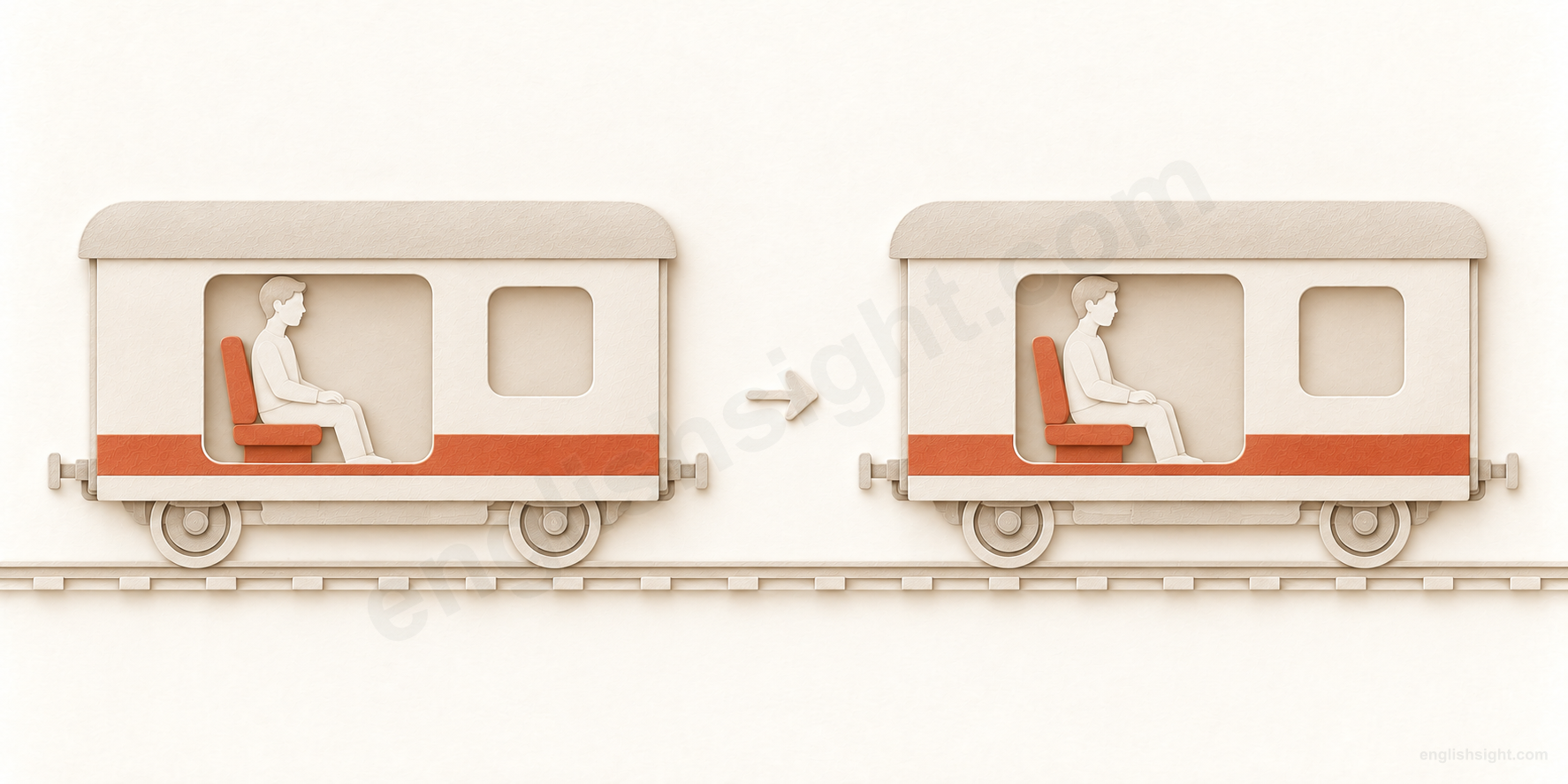
A passenger sits supported inside a railway carriage.
carriage
The same passenger remains seated inside the carriage farther along.
The carriage moves right with its passenger.
The carriage changes position while its passenger stays supported inside.
A physical carriage holds people or supports an object while it moves. Related uses name transport itself or its cost; the body-bearing sense is a separate descriptive branch.
The sketch shows one railway example of support during movement. It does not explain every established compound, and it does not make all carriages trains.
Start with the relationship between what carries and what is carried. A railway carriage holds passengers as it moves; a machine carriage supports a moving part. The noun can also name transporting goods or the charge for doing so.
Context matters. British train travel, American baby care, formal delivery wording, and literary descriptions select different meanings. The carrying connection is a teaching aid, not a claim that every native speaker imagines the same picture.
01
Vehicles that carry people
Distinguish the passenger vehicle or section from the whole journey. The type of carriage and regional usage matter.
01
a / the + (train / railway) carriage; in a carriage; plural carriages
a train carriage
one passenger section of a train, especially in British English
Situation / context
You need to find a seat on a train.
Meaning in this context
You choose one section of the train.
The carriage carries passengers; it is one part of the train.
In British English, a carriage is a passenger section of a train. A train may have several carriages. American English usually calls this a car or passenger car; British coach can also have this railway meaning.
An empty carriage, the first carriage, and a carriage door describe the section, its position, or one of its parts. In the carriage locates you inside it. You get into or out of a carriage, while get on or off the train describes boarding or leaving the train as a whole.
In a sentence
We found two empty seats in the last carriage.
Watch the difference A carriage is not the whole train, and it does not mean a private motor car in ordinary British usage.
02
a horse-drawn carriage; ride in a carriage; travel by carriage; a carriage ride
a horse-drawn carriage
a passenger vehicle pulled by a horse or horses
Situation / context
Visitors want a traditional ride around the park.
Meaning in this context
They ride in a vehicle pulled by a horse.
A horse provides the pull; the carriage carries the passengers.
This countable sense belongs to historical travel and also to present-day ceremonial or tourist rides. Horse-drawn tells you what pulls the vehicle; carriage names the vehicle itself. Open carriage describes one without a closed roof.
Ride in a carriage makes you a passenger. Drive a carriage can mean controlling the horse or horses pulling it. A carriage ride names the outing. By carriage gives the means of travel without an article; in a carriage places someone inside a particular vehicle.
In a sentence
We took a short carriage ride through the park.
Watch the difference Carriage alone does not specify a horse in every context: the railway and baby senses use different means of movement.
03
a baby carriage; push a baby carriage; a baby in a carriage
a baby carriage
a wheeled vehicle that an adult pushes with a baby inside
Situation / context
A parent is taking a baby outdoors.
Meaning in this context
The baby travels in a small wheeled vehicle.
The adult pushes the carriage; the baby rides inside.
Baby carriage is a North American expression, corresponding to British pram. The baby can lie in it. The first noun baby tells you the intended passenger; it is not a carriage pulled by a baby.
Push a baby carriage describes the adult’s action; in a baby carriage describes the baby’s location. Once the context is clear, American English can use carriage alone. Stroller is another word you will meet for a child’s pushchair; do not assume every product called a stroller has the same lying-down design as a traditional baby carriage.
In a sentence
The baby slept in the carriage while her father pushed it along the path.
Watch the difference Regional vocabulary matters: a British listener may expect pram rather than bare carriage for this object.
04
a hackney carriage; hackney carriage + licence / driver
a hackney carriage
an official British term for a taxi
Situation / context
You read a British taxi-licensing notice.
Meaning in this context
You recognize an official name for the taxi.
This established name survives even when the vehicle has an engine.
Hackney carriage is used in official British language for a taxi. Historically, these vehicles were pulled by horses. A modern notice using the term does not require the taxi to be horse-drawn.
Learn hackney carriage as a complete expression. In everyday conversation, taxi is the straightforward choice. The historical connection helps explain the name, but the present-day reference is set by established usage.
In a sentence
The driver showed us his hackney carriage licence.
Watch the difference Do not replace taxi with carriage alone in ordinary conversation and expect the same meaning.
02
Transport and its cost
On contracts, quotations, and shipping documents, uncountable carriage can name the activity or the charge. Some payment labels need to be learned as whole expressions.
05
the carriage of + goods; carriage by + transport method
the carriage of goods
the process of transporting goods, in formal usage
Situation / context
A company must arrange for boxes to reach a customer.
Meaning in this context
A transport service moves the boxes between places.
Carriage names the transport activity rather than a vehicle.
This uncountable use is especially associated with formal British and business English. In the carriage of goods, of introduces what is transported. Carriage by road or by sea identifies the transport method.
The picture’s carrying relationship offers a useful link, but a horse or a train carriage is not implied. For everyday arrangements, transport or delivery may be clearer: We need to arrange delivery. A contract can use the more formal wording carriage of goods.
In a sentence
The contract covers the carriage of goods by sea.
Watch the difference Use uncountable carriage for this process, not a carriage of goods when you mean the transport service.
06
including / plus carriage; carriage charges
including carriage
including the cost of delivering goods
Situation / context
You compare a product price with its delivery cost.
Meaning in this context
You find out whether the quoted price includes transport.
In a price statement, carriage can mean the charge for transport.
In British commercial wording, carriage can name the delivery cost. Including carriage says the price covers that cost; plus carriage says there is an extra charge. Carriage charges explicitly names the fees.
This cost sense is related to the transport activity, but the price context selects the financial meaning. Delivery charge or shipping cost is often clearer in ordinary international shopping. In carriage charges, charges is plural; carriage remains the noun modifier.
In a sentence
The replacement part costs £24 including carriage.
Watch the difference Including carriage concerns the price. It does not mean the item comes with a passenger vehicle.
07
send goods carriage paid / carriage forward
carriage paid / carriage forward
commercial labels identifying who pays the transport charge
Situation / context
Sender and receiver need to know who will pay for transport.
Meaning in this context
The shipping wording identifies the payment arrangement.
These established labels concern payment, not the direction of a vehicle.
Carriage paid indicates that the sender pays the transport charge. Carriage forward indicates that the receiver is to pay it. These are commercial expressions, especially worth recognizing on British transport paperwork.
Paid and forward belong to the full labels: do not read forward as simply moving ahead. These short labels do not by themselves explain every contract detail. For a normal parcel enquiry, ask Is delivery included? or Who pays for shipping?
In a sentence
The boxes were sent carriage forward, so the receiver had to pay the transport charge.
Watch the difference Carriage paid is not a promise of free goods, and carriage forward does not simply mean express or faster delivery.
03
Bearing, supports, and a typing expression
These uses are useful to recognize in descriptions and technical contexts. They have their own limits and are not all kinds of passenger vehicle.
08
someone’s carriage; an upright / graceful carriage
her upright carriage
the way someone holds and moves their head and body
Situation / context
You notice how a person stands and walks.
Meaning in this context
You describe the person’s bearing.
The body is being held in a certain way; no vehicle is involved.
This use is literary or old-fashioned. Her carriage or an upright carriage describes bearing, especially the way the head and body are held during standing or walking. It is usually singular, often with a possessive.
This branch can be linked for learning to how someone carries themselves. It is a connection for memory, not a rule for deriving every sense. In everyday conversation, posture or the way she stands is often more natural than carriage.
In a sentence
Her upright carriage made her easy to recognize in the crowd.
Watch the difference This does not name her clothes, her bag, or the vehicle she owns. Read the body-description context.
09
a typewriter / lathe carriage; the carriage of a machine
a machine carriage
a moving support that holds another part of a machine
Situation / context
A machine component needs support while it moves.
Meaning in this context
A moving assembly carries the component.
The carriage supports another part and can move with it.
In machinery, carriage can name a moving support or assembly. A typewriter carriage holds the paper and its roller. A lathe carriage supports and moves the cutting tool. The machine context tells you which physical part is meant.
Unlike the passenger-vehicle sense, this need not involve road or rail travel. What connects the uses is support while moving. This is technical recognition vocabulary; it does not mean that every moving machine part is called a carriage.
In a sentence
The technician checked that the typewriter carriage moved smoothly.
Watch the difference Use the machine’s actual part name; carriage is not a general replacement for motor, wheel, or gear.
10
a carriage return; the carriage return character
carriage return
a typewriter return mechanism or a text-positioning command
Situation / context
Typing has reached the end of a line.
Meaning in this context
The typing position goes back to the left margin.
Return names resetting the typing position; carriage recalls the moving typewriter support.
On a typewriter, carriage return names the mechanism or action used to return to the beginning of the next line. The expression is connected with the moving carriage, not a returning passenger vehicle.
In computing, carriage return also names a control character or command that returns the text position to the left margin. Do not assume it always also advances to the next line: line feed is a distinct operation, although some systems use the two together. This is a technical compound, not a phrasal verb.
In a sentence
The instructions explain how the program handles a carriage return.
Watch the difference Carriage return and a visible new line can be related, but they are not interchangeable in every text-file format.
11
a gun carriage; the gun’s carriage
a gun carriage
a wheeled support for a heavy gun
Situation / context
A heavy gun needs a base for support and movement.
Meaning in this context
A wheeled frame carries the gun.
Carriage names the supporting frame, not the weapon itself.
A gun carriage is a wheeled support for a gun such as a cannon. It belongs mainly to historical, military, or museum descriptions. Here carriage has the support sense rather than the passenger-vehicle sense.
The noun gun identifies what is supported. In a museum label, the gun and its carriage can be described as separate components. This is useful recognition vocabulary; it is not a name for every vehicle that transports military equipment.
In a sentence
The museum displayed the cannon on its wooden gun carriage.
Watch the difference Do not confuse the carriage with the cannon or assume the phrase means a train carriage containing a gun.
Choose the sense and the register
Countable objects; uncountable transport
Say a carriage or two carriages for vehicles and machine parts. For transporting goods or its cost, use uncountable carriage: carriage of goods, plus carriage. The body-bearing use is usually singular, often someone’s carriage.
A noun with several contexts
Carriage is a noun, pronounced /ˈkærɪdʒ/; its regular plural is carriages. Use carry for the ordinary verb. Verb tense, passive, causative, and particle-verb patterns are therefore not a family of carriage constructions.
An everyday word in some settings
Railway carriage is ordinary British transport vocabulary. The horse vehicle is familiar from history and tourist rides. Transport-cost wording is formal or commercial; body carriage is literary or old-fashioned. Machine and gun uses are context-specific recognition vocabulary.
Compounds have their own meanings
Baby carriage, hackney carriage, gun carriage, and carriage return need their full context. Related headwords such as carriage house and carriageway are not additional meanings of bare carriage. This lesson covers selected useful uses, not every historical, regional, or specialist term.
Read the situation before choosing
Use the context, countability, and regional or technical clues.
1. A British station announcement mentions the last carriage. What does it mean?
2. A quotation says “£18 plus carriage”. How should you interpret it?
3. The boxes are sent carriage forward. Who is to pay the transport charge?
4. A novel describes how a woman walks and praises her “graceful carriage”. What is the description about?
5. An official British taxi notice uses “hackney carriage”. Must the vehicle be pulled by a horse?
Sources and teaching notes
Dictionary meanings and usage labels were checked against the sources below. Explanations, examples, and the compatibility sketch were written for this lesson; the carrying connection is a teaching interpretation.
The sketch illustrates a carrying relationship; it does not represent an image shared by every native speaker.