From a wheeled carrier to moving loads, online shopping, and two familiar idioms.
Support the load; move it with the carrier
Support the load; move it with the carrier
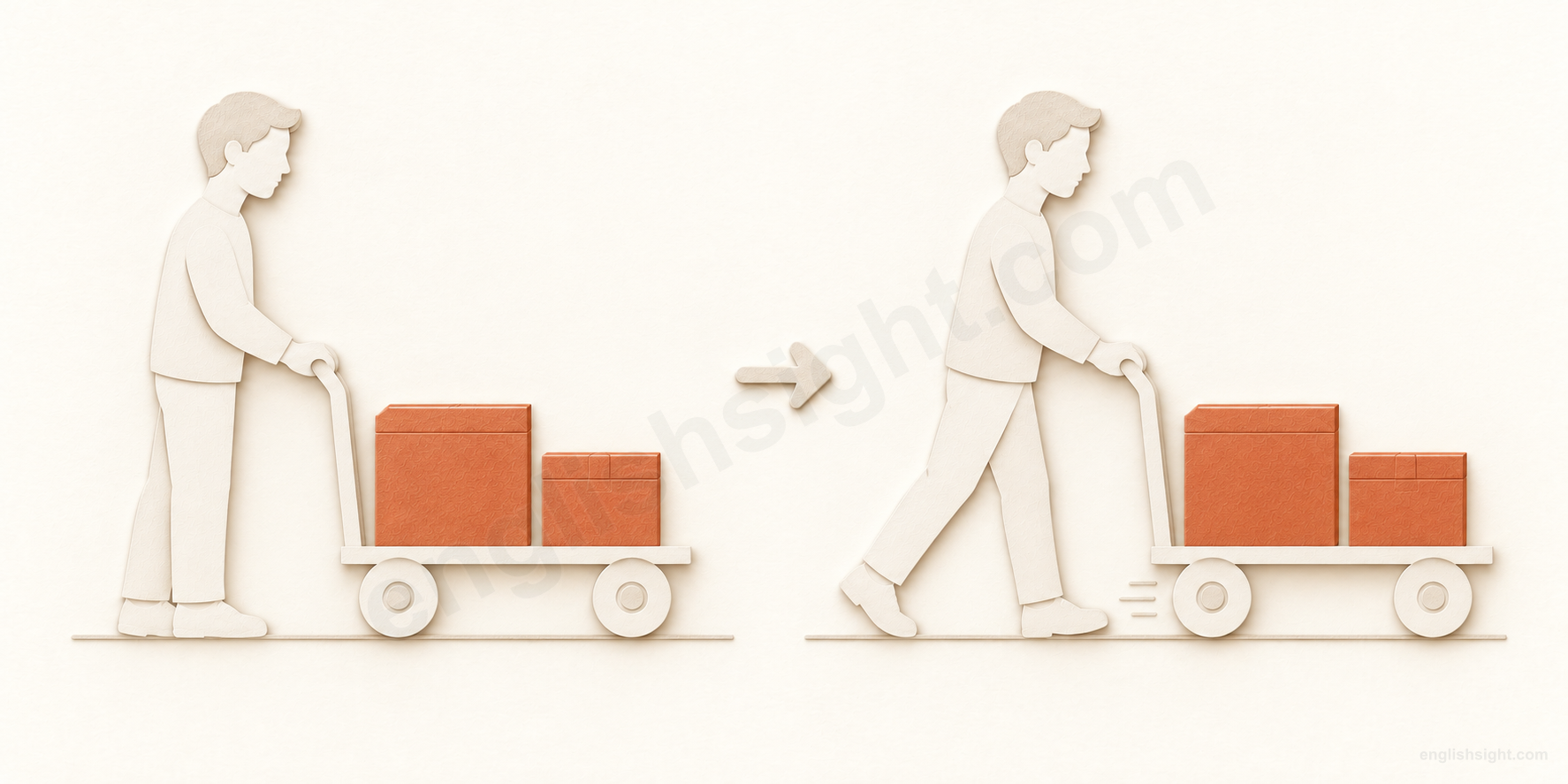
Two boxes rest on a cart supported by wheels.
cart
The boxes travel with the cart, still supported on its deck.
The person pushes the cart forward.
A cart supports a load on wheels so it can move with the carrier. The verb cart can also describe transport without a literal cart; fixed idioms need separate explanations.
A cart supports a load on wheels so the load can move with it.
This is a teaching model for the wheeled carrier and its extensions. It does not make every cart a shopping basket, or every use of the verb a journey on wheels.
A cart supports a load on wheels so it can be moved. This concrete relationship helps connect many uses of the noun. Modern carts may be moved by a person, an animal, or a motor.
As a verb, cart focuses on transporting something or someone, often with effort or little ceremony. A real cart is not always involved. The shopping website sense and fixed idioms need their own explanations.
01
Carriers, shopping, and small vehicles
Start with what a cart is and what it carries. Notice the regional names and the digital extension.
01
a / the + cart; horse-drawn cart; by cart
a horse-drawn cart
a wheeled vehicle pulled by an animal
Starting situation
Crates need to reach the market.
Meaning in context
An animal pulls the vehicle carrying them.
The cart bears the load; the horse supplies the pulling force.
A horse-drawn cart carries goods or people. Horse-drawn tells you what pulls it; cart names the vehicle. Donkey cart and ox cart name other animals used to pull one.
Use load the cart with crates or load crates onto the cart to describe putting the load aboard. By cart names the means of transport: They sent the sacks by cart.
The traditional vehicle often has two wheels, but wheel count is not a rule for every use of cart. A horse and cart names the animal and vehicle together.
In a sentence
A horse pulled a cart loaded with sacks of grain.
Watch the difference A cart is the vehicle, not the animal pulling it. Do not treat cart as another spelling of car.
Wheels let the load move while the carrier supports it.
A handcart is pulled or pushed by a person. Push a cart, pull a cart, and wheel a cart describe how someone moves it; cart itself is the noun in all three.
Luggage cart and baggage cart name the load. A serving cart carries food or drinks, often on shelves; a food cart can be a small mobile place for selling food. These compounds identify a purpose rather than a new grammar pattern.
In North American English, cart covers many carriers called trolleys in British English, such as luggage trolleys. The best name depends on the particular carrier and setting.
In a sentence
We pushed a luggage cart from the entrance to the check-in desk.
Watch the difference The cart carries the luggage; the person pushes the cart. A cart need not have a basket.
03
a shopping cart; put something in the cart
a shopping cart
a basket on wheels used while shopping
Starting situation
You choose several items in a supermarket.
Meaning in context
You put them in a wheeled basket as you shop.
The physical cart holds selected goods and moves with the shopper.
Shopping cart is the usual North American expression; British English uses shopping trolley for this physical object. Once the setting is clear, cart alone is enough.
Put the milk in the cart describes placing a product inside. Push the cart describes moving the whole carrier. Return the cart asks you to take the carrier back after use.
A shopping basket held in your hand is a different object from a shopping cart. The online use of basket works differently, as the next entry explains.
In a sentence
Please put the bread in the cart while I choose some fruit.
Watch the difference Use shopping trolley for the usual British name of the wheeled supermarket carrier.
04
add something to your cart; remove something from your cart
add to cart
a website’s record of items selected for purchase
Starting situation
You choose a product on a shopping website.
Meaning in context
The site records it among the items you may buy.
The online cart holds a selection rather than a physical load.
A website cart is a digital version of the shopping carrier. Add to cart is a short button label; in a full sentence, say Add this book to your cart.
View your cart means inspect the selected items. Remove an item from your cart changes the selection; an empty cart has no items selected. These are ordinary verb-and-preposition combinations, not phrasal verbs built from cart.
Selecting something is not the same as paying for it. Adding an item to a cart alone does not say that you have bought it. British websites also use basket for this feature.
In a sentence
I added two notebooks to my cart but have not paid yet.
Watch the difference Cart here is a noun. Say add it to my cart, not cart it, when describing the website button.
05
a golf cart; drive / ride in a golf cart
drive a golf cart
a small vehicle used to carry people and equipment
Starting situation
Players and their clubs need to travel around a golf course.
Meaning in context
A small vehicle takes them between locations.
Some carts have motors and carry passengers as well as equipment.
Here, golf cart means the small motorized vehicle that carries players and equipment around a course; British English also uses golf buggy. Golf cart can also mean a small wheeled carrier for a golf bag. Drive a golf cart and ride in a golf cart select the motorized vehicle sense.
Drive a golf cart describes controlling it. Ride in a golf cart describes traveling as an occupant. An electrically powered cart can be called an electric cart; motorized alone does not mean electric.
This branch broadens the simple wheeled-carrier picture: a cart is not necessarily hand-pushed or animal-drawn. It does not follow that any small car should be called a cart.
In a sentence
They rode in a golf cart to the next hole.
Watch the difference Golf is part of the vehicle’s name; a golf cart is not a supermarket shopping cart.
02
Moving a load or taking someone away
As a verb, cart names the transporting. The object, direction words, and tone determine what is being moved and how the speaker presents it.
06
cart + something + to / into / out of + place; be carted + destination
cart soil to the garden
transport a load, using a cart or another vehicle
Starting situation
A pile of soil is beside the driveway.
Meaning in context
The soil is moved to the garden.
As a verb, cart focuses on moving the load rather than naming the carrier.
The subject does the transporting and the object is the load. A destination introduced by to tells you where the load goes. A van, truck, or other vehicle can be used; the verb does not guarantee a literal cart.
Compare push the cart with cart the soil: the first has the vehicle as its object; the second has the transported material as its object.
The passive is natural when the load matters more than the workers: The soil was carted to the garden. Carting is the -ing form, and carted is both the past tense and past participle.
In a sentence
The workers carted the soil from the driveway to the garden.
Watch the difference Cart is usually transitive in these everyday uses: identify what is being moved. Transport is a more neutral choice in formal instructions.
07
cart + something + upstairs / home / across + place
cart bags upstairs
carry something awkward or heavy, often with effort
Starting situation
The bags are downstairs and there is no lift.
Meaning in context
Someone struggles to carry them upstairs.
The verb can suggest the work of moving a load even without wheels.
In informal speech, cart can make carrying sound tiring, awkward, or inconvenient. It suits complaints about heavy bags or equipment. This sense extends the load-moving idea beyond actual vehicles.
Upstairs, home, and across the room supply the direction or destination. They do not each create a separate dictionary meaning: I carted the boxes home describes a different journey using the same carrying sense.
Carry is the broader, neutral verb. I carried her glass to the table simply reports the action; cart would make such a small task sound exaggerated or humorous unless the context supplies a burden.
In a sentence
I had to cart three heavy bags upstairs because the lift was broken.
Watch the difference No actual cart is required. Avoid using cart as the neutral verb for every small act of carrying.
08
cart something around / about; cart it around
cart equipment around
take a load with you from place to place
Starting situation
You need equipment in several locations.
Meaning in context
You keep carrying it along with you.
Around or about adds repeated or varied movement, often with a sense of inconvenience.
Cart something around means carry or transport it from place to place. Cart equipment about is a similar expression. The load-moving sense comes from cart; around or about supplies the roaming or repeated movement.
The object can stand before or after around when it is a noun: cart the equipment around or cart around the equipment. With a short pronoun, use cart it around.
The expression often suits a complaint, but repeated carrying need not be a bad thing. The speaker’s tone and the kind of load determine how burdensome it sounds.
With people as the object, cart can describe repeated driving rather than lifting or arrest: My brother carts the children from one activity to another on Saturdays. This informal wording presents the journeys as a transporting job, often an inconvenient one; it does not imply forced removal.
In a sentence
I am tired of carting this heavy laptop around all day.
Watch the difference Use cart it around, not cart around it, for carrying it with you. Around it could instead describe a path around an obstacle.
09
cart something away / off; cart it away; be carted away
cart rubbish away / off
transport something away from its current place
Starting situation
Old furniture is blocking the garage.
Meaning in context
A removal team takes it elsewhere.
Away or off supplies removal from the present location.
Cart something away or off often describes clearing out unwanted or bulky material. A truck may do the carrying, so the picture is not limited to a small handcart.
Both cart away the old furniture and cart the old furniture away are possible. With a pronoun, use cart it away. A passive such as The furniture was carted away leaves the removal team unstated.
The removal can be routine. With things, carted away does not automatically mean theft or violence; context tells you why the material is being taken.
In a sentence
The removal team carted the broken furniture away before noon.
Watch the difference Away marks removal; it does not tell you the final destination. Add to the recycling centre if that information matters.
10
cart somebody off / away; be carted off to + place
be carted off to…
be taken somewhere, often roughly or with difficulty
Starting situation
Someone is removed from a place or needs help traveling.
Meaning in context
Other people take them to another location.
With a person as the object, cart can make the transfer sound forceful or undignified.
Cart somebody off or away is informal and can suggest being taken without much choice or ceremony. In a police context, it often describes forceful removal. The person being taken is the object, not the person driving.
The passive is familiar: He was carted off to the police station. With a pronoun in an active clause, put it before off: They carted him off.
Context matters: someone can also be carted off to hospital because they are unable to travel unaided. That does not imply arrest. For a neutral or sensitive report, was taken to hospital avoids the rough or casual tone of carted off.
In a sentence
The police carted him off to the station after the fight.
Watch the difference Do not use carted off as a polite neutral replacement for every journey involving another person.
03
Two fixed expressions about plans
Learn these as whole expressions: one concerns doing tasks in the wrong order; the other concerns disrupting an arrangement.
11
put the cart before the horse; be putting the cart before the horse
put the cart before the horse
do things in an unsuitable order
Starting situation
A later decision depends on work that has not been done.
Meaning in context
Someone acts on that decision too soon.
The whole idiom criticizes the order of actions, not a real vehicle.
A horse normally pulls a cart behind it. The idiom uses a reversed arrangement to suggest starting with something that should come later. It can criticize a plan even if no physical things are being moved.
Use put or putting according to the sentence: Don’t put the cart before the horse; You are putting the cart before the horse. Keep the in both parts of this fixed expression.
It concerns sequence or priorities. It does not simply mean that someone is slow, works hard, or has too much to carry. The diagram’s moving load does not by itself predict this idiom.
In a sentence
Booking the venue before setting a budget is putting the cart before the horse.
Watch the difference Learn the full expression. Before compares the order of the tasks here, rather than giving a travel destination.
12
upset the apple cart
upset the apple cart
disrupt plans or an established arrangement
Starting situation
People have a plan that is working.
Meaning in context
A change threatens to spoil that arrangement.
The fixed expression is about disruption, not the order of steps.
Upset the apple cart means disturb an arrangement or cause plans to fail. You can remember a loaded cart being tipped over, but the real situation may involve only schedules, agreements, or decisions.
In this expression upset is a verb meaning disrupt; it does not describe the cart as emotionally unhappy. Keep the whole expression together when learning or using it.
Compare putting the cart before the horse: that criticizes sequence. Upsetting the apple cart describes damaging an arrangement, even when its steps were in the right order.
In a sentence
A last-minute change of supplier could upset the apple cart.
Watch the difference Do not replace apple with another load and expect the same idiom. This is an established expression.
Choose the vehicle, construction, and tone
Countable noun; regular verb
Say a cart, the cart, or two carts. The verb forms are cart, carts, carted, and carting. Carted has an extra spoken syllable at the end. A noun modifier normally stays singular: a cart wheel, not a carts wheel.
Cart, car, and trolley
Cart is not a spelling variant of car. Cart covers particular wheeled carriers and small vehicles; car normally names a passenger motor vehicle. In many physical carrying contexts North American cart corresponds to British trolley. In online shopping, British basket is also usual.
Read the complete construction
Cart the bags upstairs moves the bags; push the cart moves the carrier. Away and off often add removal, around adds movement from place to place, and to introduces a destination. These combinations do not all require unrelated new senses.
Scope and register
This lesson covers modern everyday noun and verb uses and two established idioms. It does not expand cart as technical shorthand for cartridge, the acronym CART, obsolete chariot uses, specialist sporting uses, or older regional expressions such as on the water cart. No frequency ranking is claimed.
Choose the meaning that fits
Use the setting, the object of the verb, and the whole expression.
1. In a British supermarket, what is the usual name for the wheeled basket you push?
2. You have added a notebook to your online cart. What does that tell us?
3. “I had to cart those bags upstairs.” Must there have been a real cart?
4. Choose the natural pronoun position when a team removes the old furniture.
5. Someone books an expensive venue before deciding what they can spend. Which expression criticizes the sequence?
Sources and teaching notes
The sources below support the meanings, patterns, and regional labels. Explanations and examples are original; the diagram is a teaching model.
This diagram explains a useful relationship; speakers need not imagine the same picture.