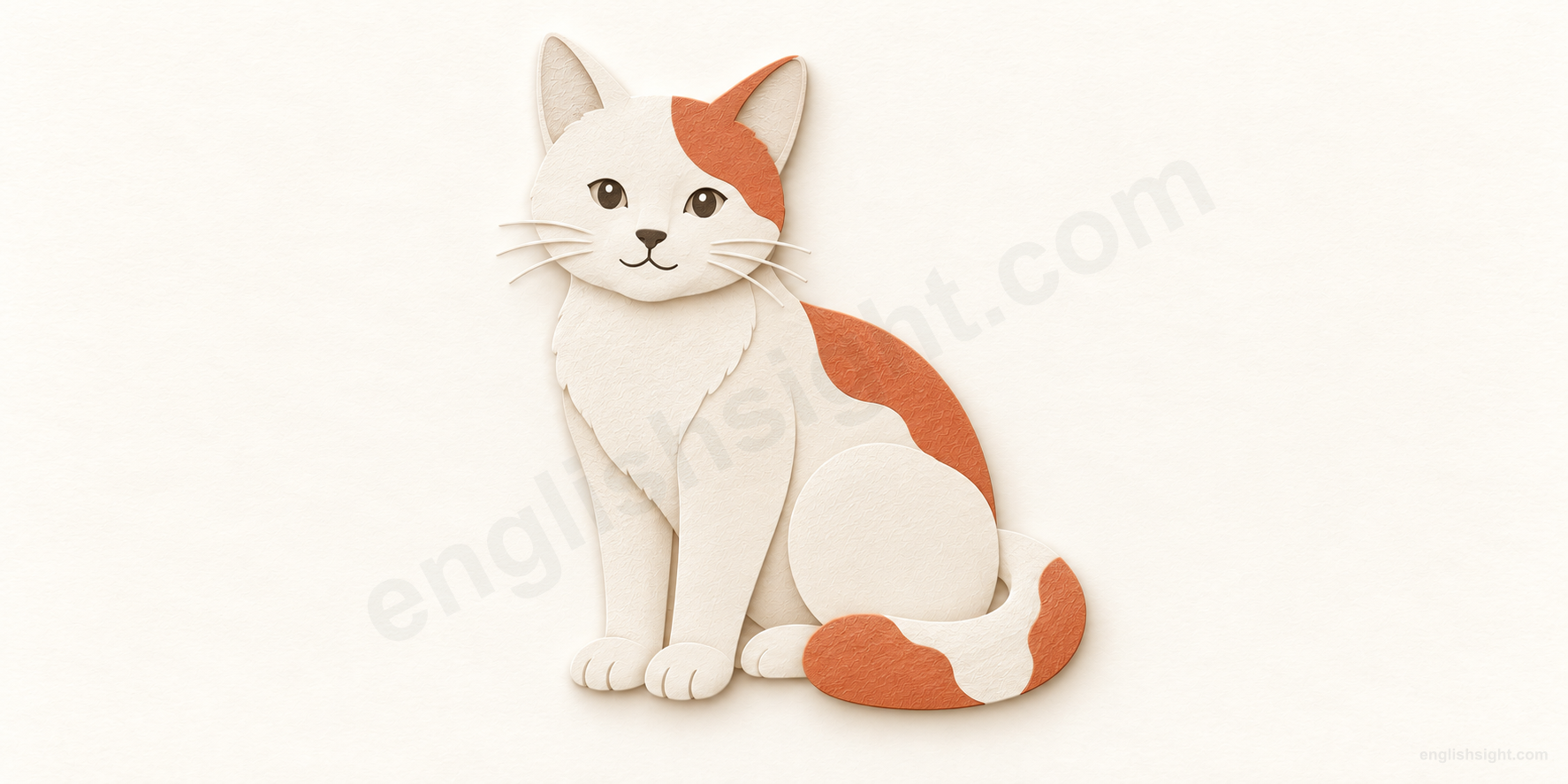
Recognize the cat, describe its place in daily life, and learn whole expressions about people.
Recognize a member of the cat family
Recognize a member of the cat family
Pointed ears, whiskers, paws, and a curled tail identify the visible animal.
cat
One cat is shown; cat is a countable animal noun.
Recognize this seated domestic animal as a cat.
A recognizable domestic cat anchors the animal noun.
Cat names the domestic animal and, in a broader animal sense, members of its family; modifiers and whole expressions add their own meanings.
The sketch anchors the concrete noun. It does not derive the idioms, and it does not represent a shared mental picture in every English speaker.
Cat most often names the familiar domestic animal; it can also name a member of the wider cat family. Grammar and context tell you whether you mean one pet, cats in general, or a wild species.
Many expressions containing cat are established idioms or sayings. Their meanings belong to the complete expression, not to a hidden meaning of cat that predicts every phrase.
01
Name and describe the animal
Start with the countable noun. Age, species, living conditions, and surrounding nouns add different information.
01
a / the / my + cat; cats; cat’s / cats’
a cat / cats
the familiar domestic animal
Situation or clue
You see a small animal with paws, whiskers, and pointed ears.
What the expression conveys
You identify it as a cat.
Cat names an animal; it does not specify its sex.
In ordinary pet conversation, a cat usually means a domestic cat. The noun can refer to a male or a female. Say a male cat or a female cat when that distinction matters.
Cat is countable: a cat, one cat, two cats. Cats can refer to the kind generally: Cats need clean water. My cat identifies a particular animal; the possessive replaces a or the.
The singular possessive is the cat’s bowl; the plural possessive is the cats’ bowls. The apostrophe marks possession, while cats without an apostrophe is the ordinary plural.
In a sentence
We adopted a cat, and now our cat sleeps beside the window.
Watch the difference Say I have a cat, not I have cat, when you mean one pet.
02
a kitten; kittens; a cat and her kittens
a cat / a kitten
distinguish the animal from its young
Situation or clue
A shelter has adult cats and very young ones.
What the expression conveys
You ask specifically about a kitten.
Kitten adds age; cat is the broader everyday name.
A kitten is a very young cat. Calling an animal a cat does not by itself tell its age, but kitten makes the youth explicit.
Compare We have two cats with We have a cat and three kittens. In the second sentence, the contrast makes cat refer to the older animal. Both kittens and adult cats still belong to the same animal kind.
In a sentence
The cat is resting while her kittens play nearby.
Watch the difference A small adult cat is not necessarily a kitten; kitten describes youth, not just size.
03
a big cat; big cats; a member of the cat family
a big cat
an animal in the wider cat family
Situation or clue
You are reading about lions and tigers.
What the expression conveys
You recognize them as members of the cat family.
The broader animal sense includes wild species.
Cat can also name a member of the wider animal family that includes lions and tigers. In wildlife discussion, big cats refers to large members of that family.
Context matters: Our cat is getting big describes the size of a domestic animal. Tigers are big cats classifies a wild species. Big cat is not simply a name for every overweight pet.
In a sentence
The guide explained that tigers are big cats.
Watch the difference Do not assume cat always means a household pet; check a wildlife context.
04
a stray / feral cat; stray / feral cats
a stray cat / a feral cat
describe different living conditions
Situation or clue
You find a domestic cat outside.
What the expression conveys
You distinguish a lost or wandering domestic cat from one living wild.
Being outdoors alone does not settle which description fits.
A stray cat is a domestic cat that is lost or wandering without its owner, often after leaving a home. Feral describes an animal living wild, especially one of a normally domesticated species. Stray alone does not tell you whether an owner can be found.
These are modifiers of cat, not separate senses of the noun. A cat that is outdoors is not automatically feral. A wild species, such as a tiger, is also different from a domestic cat living in a feral state.
In a sentence
They found a stray cat and tried to locate its owner.
Watch the difference Use the available facts; do not call every cat outside a feral cat.
05
cat + noun; cat food; cat owner / owners
cat food / a cat owner
use cat to specify what another noun concerns
Situation or clue
You are buying supplies for your pet.
What the expression conveys
Cat identifies the intended animal or connection.
The final noun names the thing or person.
Cat can come before another noun: cat food is food for cats, and a cat owner is a person who owns a cat. This is a noun used as a modifier, not a new verb or a claim that the owner is a cat.
The modifying noun normally stays singular: cat owners, even when the owners have several cats. Compare the cat’s food, which identifies food belonging to a particular cat, with cat food, which names the type of food.
In a sentence
The cat owners bought enough cat food for the weekend.
Watch the difference Pluralize the head noun: cat owners, not cats owners.
02
Care, preferences, and a short rest
Everyday combinations help you talk about looking after cats or liking them. Catnap is a separate compound with a human use too.
06
feed / stroke + a cat; a cat purrs
feed / stroke a cat
describe ordinary care and contact
Situation or clue
A neighbor asks you to look after her pet.
What the expression conveys
You describe feeding it and gently touching its fur.
The action comes from feed or stroke; cat names its object.
Feed a cat means give it food. Stroke a cat means move a hand gently over its fur. These are ordinary verb–object combinations, not phrasal verbs built from cat.
A cat purrs describes the low, soft sound it makes. In The cat is purring, cat is the subject; in I am feeding the cat, it is the object. The verb and context tell you what is happening.
In a sentence
I fed the cat before leaving for work.
Watch the difference Cat does not mean care for an animal as an everyday verb; use a suitable action verb.
07
be + a cat person; cat people
a cat person
someone who likes or prefers cats
Situation or clue
A friend asks which pets you like.
What the expression conveys
You describe your preference.
Person carries the preference construction.
A cat person is someone who likes cats or prefers them as pets. Compare a dog person. You can be a cat person without currently owning a cat.
The whole noun phrase describes a person’s preference. It does not mean someone is partly an animal, and it does not establish a fixed personality type.
In a sentence
I’m a cat person, but my apartment does not allow pets.
Watch the difference A cat owner owns a cat; a cat person likes cats. Those descriptions need not match.
08
take / have + a catnap; catnap
take a catnap
have a brief, usually daytime sleep
Situation or clue
You feel sleepy during a break.
What the expression conveys
You sleep for a short time.
Catnap is a compound with a meaning of its own.
A catnap is an informal word for a short sleep, often during the day. A person can take or have a catnap; no actual cat needs to be present.
Catnap is also an intransitive verb: I catnapped on the train. Its forms are catnaps, catnapped, and catnapping. These belong to catnap, not to the everyday noun cat.
In a sentence
I took a catnap before the evening shift.
Watch the difference A catnap is a short sleep, not the general name for a cat’s bed or every sleep a cat has.
03
Secrets, silence, and conflict
These are established expressions about people. Learn the complete wording and its social effect; cat alone does not carry each meaning.
09
let + the cat + out of the bag
let the cat out of the bag
reveal a secret, often unintentionally
Situation or clue
A party is meant to be a surprise.
What the expression conveys
A remark gives the plan away.
The full idiom means reveal secret information.
The person who lets the cat out of the bag reveals something that was meant to remain secret. The disclosure is often accidental, though an accident is not required in every use.
Treat the wording as an established idiom. The word cat does not independently mean secret. In a literal story about an animal in a bag, the same words could describe a physical action; context decides.
In a sentence
I let the cat out of the bag when I mentioned the surprise dinner.
Watch the difference Keep the fixed wording in the idiomatic use; let a cat out of a bag normally invites a literal reading.
10
Cat got your tongue?
Cat got your tongue?
ask teasingly why someone is silent
Situation or clue
A usually talkative friend says nothing.
What the expression conveys
You draw attention to the silence.
This informal question can sound impatient or teasing.
Cat got your tongue? asks why the listener is not speaking. It is an informal shortened question, not a statement about an injury or an actual animal.
Use care with its social tone: the question can embarrass a shy person or sound demanding. Is everything okay? is a gentler alternative when someone seems upset.
In a sentence
You usually have plenty to say—cat got your tongue?
Watch the difference Do not use it as a neutral or formal request for information; it comments on the listener’s silence.
11
play cat and mouse with + someone; a game of cat and mouse; cat-and-mouse + noun
play cat and mouse
engage in pursuit, evasion, or calculated teasing
Situation or clue
One side pursues while the other keeps escaping.
What the expression conveys
The contest continues through tricks and delays.
The animal image suggests pursuit rather than cooperation.
Play cat and mouse describes a contest involving pursuit, avoidance, deception, or teasing. One participant may deliberately delay a final move; in other contexts both sides try to outwit each other.
You can play cat and mouse with someone or describe a game of cat and mouse. Before a noun, the expression is often hyphenated: a cat-and-mouse chase. Game need not mean harmless entertainment.
In a sentence
The detective and the suspect played cat and mouse for weeks.
Watch the difference Do not treat every chase as a friendly game; this expression can describe a threatening contest.
12
put / set + the cat + among the pigeons
put the cat among the pigeons
cause upset by introducing something disruptive
Situation or clue
A group expects an ordinary meeting.
What the expression conveys
An unexpected proposal alarms or angers people.
The idiom describes disruption, not secret disclosure itself.
Put the cat among the pigeons means introduce something that causes trouble or upset. Set the cat among the pigeons is also used. This is a British expression.
An announcement can both reveal a secret and cause an uproar, but the two idioms emphasize different results: let the cat out of the bag focuses on disclosure; put the cat among the pigeons focuses on disturbance.
In a sentence
Her proposal to close the office really put the cat among the pigeons.
Watch the difference The disturbance is part of the whole idiom; cat does not generally mean trouble.
13
fight like cat and dog; fight like cats and dogs
fight like cat and dog
argue fiercely or repeatedly
Situation or clue
Two people keep disagreeing.
What the expression conveys
Their arguments are described as intense.
The comparison describes people’s behavior.
Fight like cat and dog is an established comparison for frequent, fierce arguments. The people need not be physically fighting. Fight like cats and dogs is a familiar variant labeled chiefly US and informal by Merriam-Webster.
The pattern is fight plus a comparison beginning with like; it is not a phrasal verb. It draws on a conventional animal image, not a factual claim that all cats and dogs cannot live peacefully together.
In a sentence
The brothers fight like cat and dog over the smallest things.
Watch the difference Use argue if you want a plain description without the colorful comparison.
04
Describe people and situations
Animal comparisons can make a description vivid. Some sound teasing, critical, or regional, so a plain alternative is useful.
14
look / act + like the cat that got the cream
like the cat that got the cream
looking delighted and pleased with yourself
Situation or clue
Someone gets exactly what she wanted.
What the expression conveys
Her expression shows obvious satisfaction.
This mainly British comparison highlights satisfaction.
Look like the cat that got the cream describes looking very pleased with yourself. It can suggest amused criticism of someone’s self-satisfaction, depending on tone.
The expression contains a comparison introduced by like. The cream is part of the conventional image; neither actual food nor a cat is necessary in the situation.
In a sentence
After winning the prize, Lena looked like the cat that got the cream.
Watch the difference It describes satisfaction, not nervous restlessness; compare like a cat on a hot tin roof.
15
be / act + like a cat on a hot tin roof; like a cat on hot bricks
like a cat on a hot tin roof
very uneasy, agitated, or restless
Situation or clue
Someone is anxiously waiting for news.
What the expression conveys
He cannot settle down.
The comparison conveys an unsettled state.
Like a cat on a hot tin roof describes unease or agitation. Like a cat on hot bricks is a variant found in British English.
The image helps you remember restlessness, but it does not specify the cause. A deadline, worry, or impatience might explain the behavior in the surrounding sentence.
In a sentence
Waiting for the results, he was like a cat on a hot tin roof.
Watch the difference Do not use this to mean relaxed warmth or satisfaction.
16
look + like something the cat dragged / brought in
look like something the cat dragged in
look very untidy or dirty
Situation or clue
You arrive with muddy clothes and messy hair.
What the expression conveys
You describe your rough appearance.
The expression can be humorous or insulting.
Look like something the cat dragged in describes a very untidy or dirty appearance. Brought in is a recorded variant. The person’s appearance is being compared with an unwelcome thing carried indoors.
It can work as a joke about yourself, but saying it to someone else can be unkind. The idiom describes how someone looks; it does not diagnose illness or prove how they feel.
In a sentence
After clearing the flooded shed, I looked like something the cat dragged in.
Watch the difference Keep something in the familiar wording; the phrase is not a polite greeting.
17
a fat cat; fat cats; fat-cat + noun
a fat cat
a rich, powerful person viewed critically
Situation or clue
A report criticizes excessive executive rewards.
What the expression conveys
The beneficiaries are described disapprovingly.
The figurative phrase targets wealth and power.
A fat cat is a disapproving name for a rich and powerful person, especially when the speaker considers their advantages unfair. The plural is fat cats.
A literal fat cat is an overweight animal. Context separates the readings. Figuratively, the expression does not tell you the person’s body size, and it is not a neutral compliment.
In a sentence
The article accused corporate fat cats of protecting their own bonuses.
Watch the difference For neutral reporting, use a specific term such as wealthy executives instead.
18
it + rain + cats and dogs
rain cats and dogs
rain extremely heavily
Situation or clue
Rain is pouring down outside.
What the expression conveys
You describe its intensity colorfully.
The weather idiom has a fixed plural pair.
It’s raining cats and dogs means the rain is very heavy. It is a colorful, informal alternative to It’s raining heavily or It’s pouring.
The grammatical subject it is the ordinary weather subject. Cats and dogs is fixed wording in the idiom; the sentence does not report animals falling from the sky.
In a sentence
We stayed indoors because it was raining cats and dogs.
Watch the difference Keep cats and dogs plural; raining a cat and a dog does not express the idiom.
05
Sayings and emphatic expressions
Recognize these familiar sayings and figurative phrases without taking their animal imagery literally. They are a selection, not a frequency ranking.
19
Curiosity killed the cat.
Curiosity killed the cat.
warn someone against prying or risky curiosity
Situation or clue
Someone keeps asking about a private matter.
What the expression conveys
A speaker tells them to stop investigating.
This saying can discourage unwanted questions.
Curiosity killed the cat is used to warn against trying to discover something that may not concern you. It can be playful, dismissive, or threatening depending on context.
It is a saying, not scientific advice that curiosity is always bad. If you need to set a clear boundary, That’s private says so more directly.
In a sentence
“What’s in that private folder?” “Curiosity killed the cat.”
Watch the difference Do not assume the listener will hear a friendly joke; tone and relationship matter.
20
When the cat’s away, the mice will play.
When the cat’s away, the mice will play.
people relax rules when authority is absent
Situation or clue
The supervisor goes out.
What the expression conveys
The team stops working and starts playing games.
The cat represents authority in this saying.
The saying comments on people doing what they want, often misbehaving, when a person in charge is absent. It can be a joking observation about a boss, teacher, or parent.
Cat’s here contracts cat is: when the cat is away. It is not the possessive apostrophe in the cat’s bowl. Will presents the familiar expected behavior within the saying.
In a sentence
The manager left and everyone opened the football stream: when the cat’s away, the mice will play.
Watch the difference The saying implies an authority relationship; it does not just mean friends are enjoying time together.
21
have / has + nine lives
have nine lives
survive repeated dangers or serious setbacks
Situation or clue
Someone keeps escaping serious trouble.
What the expression conveys
You emphasize their repeated survival.
The saying supplies a figurative image of survival.
Have nine lives describes repeatedly escaping dangerous or difficult situations. Used about a person, it may refer to physical escapes or continued survival in a job or public role.
It draws on the familiar saying that a cat has nine lives. It is figurative, not a claim that animals can return from death or that someone is safe from harm.
In a sentence
After surviving another attempt to remove him, the chairman seemed to have nine lives.
Watch the difference Lives is the plural of life here, pronounced /laɪvz/, with the vowel in five. The verb in She lives nearby is /lɪvz/, with the vowel in sit. Both forms contain /v/.
22
there is no / barely room to swing a cat; cannot swing a cat
no room to swing a cat
very little room in a small or crowded place
Situation or clue
You enter a cramped room.
What the expression conveys
You emphasize its lack of space.
This exaggeration describes space, not an action to perform.
There’s no room to swing a cat means a place is extremely cramped. You can also say You can’t swing a cat in here or There’s barely room to swing a cat.
The whole expression is figurative. A plain alternative is There’s hardly any space. The lesson uses the expression for recognition and does not make a claim about its disputed origin.
In a sentence
With six desks in the office, there was no room to swing a cat.
Watch the difference Do not confuse no room with no chance; they describe different limitations.
23
there is more than one way to skin a cat
There’s more than one way to skin a cat.
there are alternative ways to reach a goal
Situation or clue
One method has failed.
What the expression conveys
You suggest trying a different method.
The whole saying concerns alternative methods.
This saying means that a result can be achieved in several ways. Speakers may use it to encourage flexibility after an unsuccessful attempt.
The animal image is violent even when the intended meaning is ordinary problem solving. There’s more than one way to do it is a clear alternative without that image. You need not use the saying to understand it.
In a sentence
The shortcut was closed, but there’s more than one way to skin a cat—we took the main road.
Watch the difference It offers another method; it does not mean that any method is acceptable or guaranteed to succeed.
24
not have + a cat in hell’s chance + of + -ing
not a cat in hell’s chance
no realistic chance at all
Situation or clue
The deadline is impossible to meet.
What the expression conveys
You strongly deny any prospect of success.
This British expression intensifies a negative judgment.
Not have a cat in hell’s chance means have no chance at all. A following of plus an -ing form can specify the outcome: no chance of finishing.
This is emphatic informal language, and hell may sound strong in some settings. We have no chance of finishing is a neutral alternative. Cat in hell’s chance is not an ordinary name for a small positive probability.
In a sentence
We haven’t a cat in hell’s chance of finishing tonight.
Watch the difference Keep the negative meaning; do not use the phrase as a formal numerical estimate of risk.
Keep the noun and the whole expression distinct
Sound and ordinary noun grammar
Cat is pronounced /kæt/, with the vowel in hat. Its ordinary plural is cats /kæts/. Use a determiner with a singular count noun: a cat, the cat, or my cat. Cats as a general plural needs no article.
Animal comparisons are conventional images
A phrase may borrow an image of pursuit, agitation, or satisfaction, but that is a teaching connection, not proof that every real cat behaves that way. An idiom’s actual meaning and tone must be learned from usage.
Other senses and look-alikes
Older slang cat for a person or jazz musician, derogatory personal labels, nautical verbs and equipment, boat abbreviations, the computing command cat, and medical CAT abbreviations are outside this everyday animal lesson. They are not additional ordinary pet meanings.
A selected set, not an exhaustive catalogue
This lesson prioritizes ordinary animal talk and a range of established expressions. Recognition entries include regional or strongly worded sayings. It is not a frequency ranking or a claim to cover every compound containing cat.
Read the context and the complete phrase
Decide what the speaker means, then compare the alternatives.
1. You own one pet. Which sentence is ordinary standard English?
2. A wildlife guide says Tigers are big cats. What does cats mean?
3. Can someone be a cat person without owning a cat?
4. You accidentally reveal the surprise party. Which expression fits?
5. A newspaper calls certain executives fat cats. What is the effect?
6. It is raining cats and dogs. What should you understand?
Sources and teaching notes
Animal senses and expressions were checked against the dictionary pages below. Explanations and examples are original; visual links are teaching interpretations, and idioms are learned as complete expressions.
The sketch anchors the animal noun; it is not a picture shared by every native speaker.