Connect a source with its result, then distinguish reasons for reacting and purposes worth supporting.
A source brings about a result
A source brings about a result
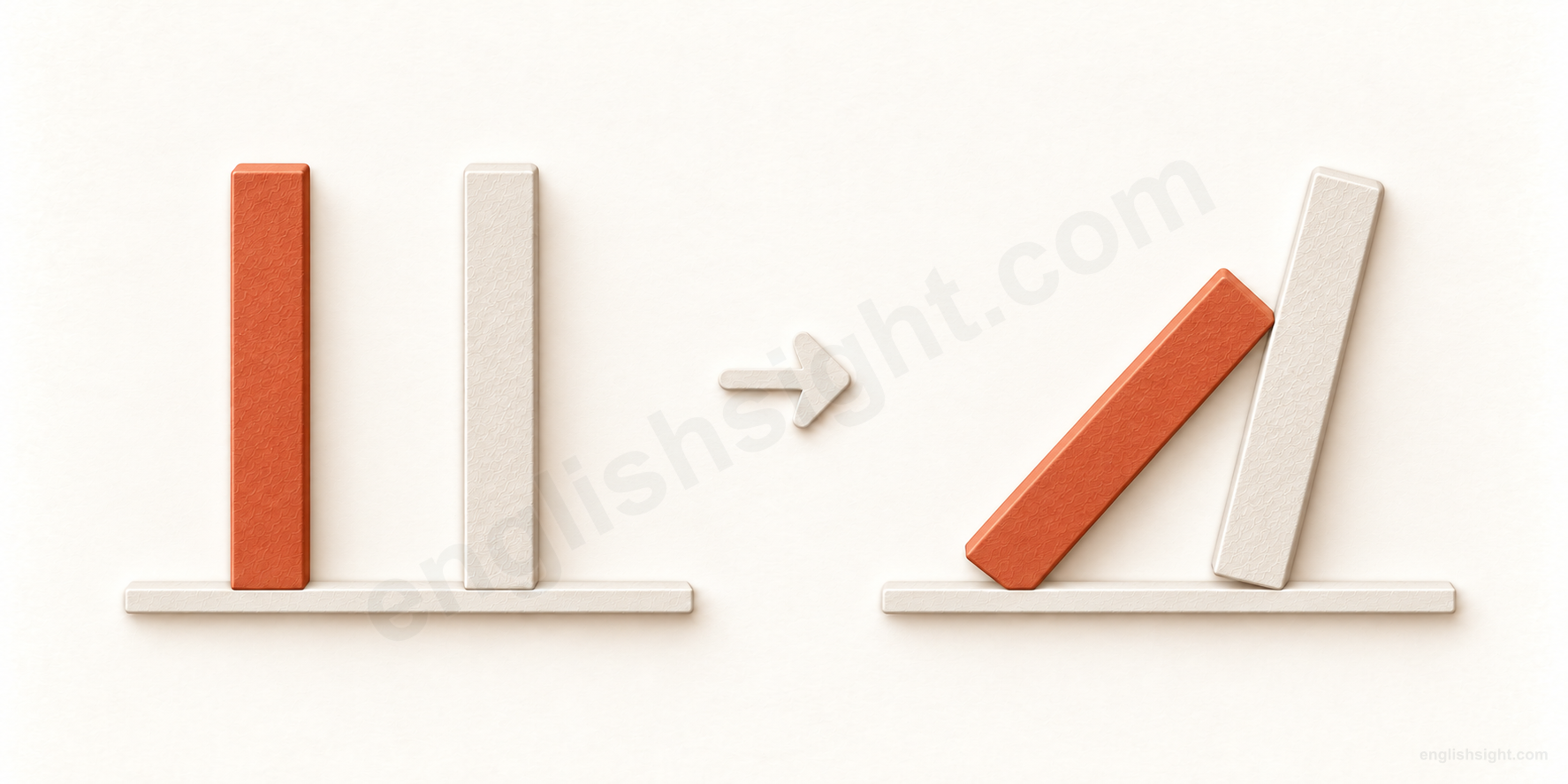
The orange tile and the ivory tile stand upright, separated by a gap.
cause
The ivory tile begins tipping right as the orange tile pushes it.
The orange tile tips right and presses against the ivory tile.
The orange tile’s contact brings about the ivory tile’s movement.
One event or condition brings about another event or state.
The first tile’s contact makes the second tile tip. Real causes can be indirect, ongoing, or multiple; intention and physical contact are not required. Grounds for a response and a supported purpose need their own explanations.
A cause is what produces a result; to cause something is to bring it about. Start with that connection, then read the construction to see whether you are naming a source, describing a result, or giving grounds for a response.
A cause can also be a purpose people work for. This is a separate everyday branch, not a literal chain of falling objects. The sketch is a teaching example, not a claim that every English speaker imagines the same picture.
01
Finding what produced a result
The noun can name a source of an event, distinguish an underlying problem from its trigger, or connect a cause with its effect.
01
a / the cause of + event or condition; causes of + noun
the cause of the problem
the person, thing, or situation that produces an event
Starting situation
Water has appeared under the sink.
Result or interpretation
You identify a loose connection as its source.
The cause produces the problem; it is not the problem itself.
Ask What is the cause of the leak? when you want to identify what brought it about. Of introduces the event or condition being explained. Find, identify, and determine a cause describe discovering that source.
This noun is countable: a possible cause, the main cause, several causes. Saying a cause leaves room for others. Saying the cause may identify the relevant one in the present discussion; it does not prove that only one factor exists.
Reason overlaps with cause, but the familiar noun patterns differ: the cause of the leak and the reason for the delay. Reason why introduces a clause. For a personal decision, the reason I left often sounds more natural than the cause of my leaving.
In a sentence
A loose connection was the cause of the leak.
Watch the difference Do not turn cause of into a general connector before a clause: use because the connection was loose, not cause of the connection was loose.
02
the root / underlying / immediate cause of + problem; the cause lies in + noun
the root cause
an underlying source rather than only the immediate trigger
Starting situation
The same fault keeps coming back.
Result or interpretation
You look beyond each breakdown to the deeper problem.
Root highlights the level of explanation being sought.
The root cause is the underlying problem that helps explain why the visible trouble occurs. Root is a metaphor here: nothing needs to be growing in the ground.
An immediate cause is the event or condition directly leading to an outcome. A power interruption might be the immediate cause of a shutdown, while neglected equipment is identified as the root cause. The distinction comes from the whole noun phrase, not from two different verbs.
Main, major, and leading describe importance; underlying and root point beneath the surface. The cause lies in poor maintenance means the source is to be found there, not that an object is physically lying somewhere.
In a sentence
Replacing the fuse helped for a day, but it did not address the root cause.
Watch the difference A root cause is an explanation to establish, not a label that makes a guess certain.
03
cause and effect; a cause-and-effect relationship
cause and effect
the relationship between what produces a change and the resulting change
Starting situation
One tile tips into another.
Result or interpretation
The second tile begins to fall.
Cause and effect name the two sides of a causal relationship.
In the sketch, the first tile tipping into the second is the cause; the second tile starting to fall is the effect. The words do not mean two separate reasons.
Cause and effect often names the relationship in general, so the pair can appear without articles. You can also discuss the cause and the effect of one particular incident.
A cause may act through several steps, and a result may have several causes. The sketch illustrates a direct physical interaction; English cause also describes less visible or longer processes. Merely happening earlier is not the same as producing the result.
In a sentence
The teacher used falling tiles to explain cause and effect.
Watch the difference Do not reverse the labels: the effect is what results, while the cause brings it about.
04
die of / from natural causes
die of natural causes
die through illness or age rather than accident or violence
Starting situation
A report describes how someone died.
Result or interpretation
The report attributes the death to illness or age.
Natural causes is an established plural expression about death.
In reports and obituaries, natural causes groups illness and age-related death together, in contrast with accident or violence. It need not specify the exact illness.
Both die of natural causes and die from natural causes are used. The plural belongs to the established wording; it does not tell you how many separate illnesses were involved.
In a sentence
The obituary said that the retired painter had died of natural causes.
Watch the difference Natural does not mean pleasant or painless here, and the phrase is not a general label for every event in nature.
02
Saying what makes something happen
The verb connects a person, event, or condition with a result. Its object and any following infinitive tell us exactly what happens to whom.
05
cause + result noun; be causing + result noun
cause a delay / cause trouble
bring about an event or situation
Starting situation
A delivery vehicle blocks the entrance.
Result or interpretation
People have to wait to enter.
The subject brings about the result named by the object.
In The van caused a delay, the van is the subject and a delay is the object. Cause goes straight before that object: it does not need of or to.
Problems, damage, confusion, pain, and trouble are familiar objects, so cause often appears when describing unwelcome outcomes. It is not limited to bad results: the announcement caused delight is possible too.
Cause presents a causal link; it does not by itself say that anyone acted deliberately. A person, a condition, an action, or an event can be the subject. The present progressive is ordinary when the effect continues: The noise is causing problems.
In a sentence
The van blocking the entrance caused a short delay.
Watch the difference Say caused a delay, not caused of a delay. Use an article with countable delay; ordinary trouble and damage are uncountable.
06
cause + person + difficulty / experience; cause problems for + person
cause someone trouble
bring an unwelcome experience or difficulty to someone
Starting situation
You change a meeting at short notice.
Result or interpretation
Your colleague has extra arrangements to make.
The first object names the affected person; the second names the difficulty.
Cause me trouble and cause us some inconvenience have two objects. Me or us is the person affected; trouble or inconvenience is the resulting experience. Nothing is being handed to that person.
This construction is useful in apologies: I’m sorry I caused you extra work. Cause problems for someone is another natural pattern, especially when the result noun comes first.
Choose the whole combination naturally. Cause her pain and cause her a problem work, but cause her happy does not: happy is an adjective. Use make her happy or cause her to feel happy.
In a sentence
I hope the change has not caused you too much inconvenience.
Watch the difference Keep the two roles clear: in caused you inconvenience, you is affected and inconvenience is the result.
07
cause damage to + person / thing; cause problems for + person / group
cause damage to something
produce damage and identify what is damaged
Starting situation
Water enters the building.
Result or interpretation
The floor is damaged.
To introduces the affected thing after the result noun.
In caused damage to the floor, damage is the direct object of cause. To the floor attaches to the damage being described; it is not a verb particle or the start of an infinitive.
Compare caused the shop problems and caused problems for the shop. The affected party can appear as an earlier object or in a later phrase, but the appropriate preposition depends on the noun: damage to a building, problems for a business.
Cause damage to the floor can also be expressed as damage the floor. The longer expression explicitly names the result as a noun and is useful in reports.
In a sentence
The burst pipe caused damage to the wooden floor.
Watch the difference Use ordinary damage without a plural -s here. In cause the floor to bend, to instead starts an infinitive.
08
cause + person / thing + to + base verb
cause someone / something to do something
bring about an action or change involving someone or something
Starting situation
A cold wind reaches an open doorway.
Result or interpretation
The door swings shut.
The object of cause is also the subject of the following action.
In The wind caused the door to close, the wind produces the change; the door does the closing. The object can be a person too: The smell caused us to leave the room.
The to-infinitive supplies the event, so this pattern can express a change without naming a separate result noun. The cause need not be a person giving orders, and the affected person need not act willingly.
Compare make: The wind made the door close uses the base verb without to in this active construction. Cause is often more formal or explanatory. Caused the door to be closed instead presents a passive event; it does not simply mean the door swung shut by itself.
In a sentence
A gust of wind caused the door to close.
Watch the difference Use caused it to close, not caused it close or caused it closing. Keep cause distinct from active make + object + base verb.
09
result + be + caused by + source; noun + caused by + source
be caused by
put the result first and identify its source
Starting situation
You are discussing a power failure.
Result or interpretation
You explain that a damaged cable brought it about.
Passive grammar puts the result in the subject position.
A damaged cable caused the power failure and The power failure was caused by a damaged cable describe the same direction of causation. The passive is useful when the failure is already the topic.
By introduces the cause, which can be a thing or condition as well as a person. It is not a separable particle. If the cause is unknown, the by-phrase can be left out: We do not know how the damage was caused.
Caused by also follows a noun in a shortened passive description: delays caused by roadworks means delays that are caused by roadworks. The form caused is the past participle in both patterns.
In a sentence
The power failure was caused by a damaged cable.
Watch the difference The cable is the cause in both active and passive sentences; the power failure does not cause the cable.
10
cause a stir (among + people); cause / make a splash
cause a stir
produce excitement, anger, or surprise among people
Starting situation
An unexpected announcement is made.
Result or interpretation
Many people react and discuss it.
The reaction comes from the noun stir, not a new meaning of cause.
Cause a stir describes a noticeable reaction among a group. Depending on the context, people may be excited, shocked, or angry; the phrase does not guarantee approval.
A stir here is not the physical action of mixing food. Among can identify the people reacting: It caused a stir among the staff.
Cause a splash is an informal expression for attracting attention or excitement, often in public life; make a splash is also familiar. Learn these noun combinations as whole expressions rather than inventing a particle-verb meaning for cause.
In a sentence
The plan to close the library caused quite a stir among local residents.
Watch the difference A stir can be an angry reaction; it does not necessarily mean success or admiration.
03
Having a reason to react or act
Cause can mean grounds for worry, pleasure, belief, or action. This is a basis for a response, which need not actually occur.
11
(there is) cause for + feeling / response; give someone cause for + noun
cause for concern / celebration
a basis for having a particular feeling or response
Starting situation
You notice something that might be wrong.
Result or interpretation
You judge whether worry is justified.
For names the possible response, not necessarily an event already produced.
There is cause for concern means there is a reason to be concerned. No cause for alarm reassures someone that alarm is not justified. Concern, alarm, complaint, and celebration are useful nouns after for.
Cause is often uncountable in this use: no cause, little cause, or good cause for concern. A cause for celebration is also possible when one thing is presented as a source of the feeling. Do not apply an absolute ban on the article a.
The news gives us cause for celebration identifies both the basis and the people who have it. Having cause to celebrate does not say a celebration has actually taken place. Compare caused concern, which says concern was produced.
In a sentence
A small delay is not necessarily cause for concern.
Watch the difference Cause for concern is grounds for worry; the cause of the delay is what made the delay happen.
12
have (good) cause + to-infinitive
have cause to believe
have grounds for a belief, feeling, or action
Starting situation
Several facts point in the same direction.
Result or interpretation
You have a basis for a conclusion.
Cause is a noun after have; the infinitive describes the justified response.
Have cause to believe says there is a basis for believing something. Have cause to complain and have cause to be grateful similarly describe grounds for a response.
This wording is fairly formal; have reason to believe is another natural choice. It does not itself tell us whether the evidence is strong enough to prove the conclusion.
Compare The message caused me to complain. That has the verb caused, a person as object, and an actual resulting action. I had cause to complain names a reason and leaves open whether I complained.
In a sentence
After two missed payments, we had cause to question the arrangement.
Watch the difference Have cause to question does not mean cause someone to question: the first contains a noun and the second a verb.
13
with / without (good) cause
without good cause / with good cause
without or with a sufficient reason for acting or feeling as someone does
Starting situation
Someone refuses a reasonable request.
Result or interpretation
You ask whether the refusal was justified.
With and without indicate the presence or absence of grounds.
Without cause and without good cause describe an action or reaction as lacking an adequate reason. With good cause says that the person has a sound reason.
This use is often more formal than for no good reason. Cause is normally uncountable here; good describes the adequacy of the reason, not whether the resulting feeling is pleasant.
These expressions often evaluate someone’s justification. They do not make a scientific claim that the event has no physical cause anywhere.
In a sentence
The tenants were angry, and with good cause: the heating had failed again.
Watch the difference Without good cause is about sufficient grounds, not about a missing person or organization to support.
04
Supporting a purpose or a shared effort
A cause can be something people work for. These uses concern a purpose, a movement, or an effort rather than the source of an accident.
14
a good / worthy / deserving cause; donate to + cause
a good / worthy cause
a purpose, organization, or effort considered worth supporting
Starting situation
You want to help people who need support.
Result or interpretation
You choose a charitable purpose for a donation.
A cause is something to work for, not the explanation of an event.
A good cause can be a charitable project or another purpose that helps people. Worthy and deserving similarly present the purpose as worth supporting. The noun is countable: one cause, several causes.
Compare a good cause with good cause for concern. The first can name the purpose of a fundraiser; the second gives grounds for a response. The adjective good alone does not choose the meaning.
The sketch’s falling tiles do not explain this branch literally. Learn the purpose sense on its own terms: people give their time, money, or effort to help something they care about.
In a sentence
Each month, the shop donates part of its profits to a local cause.
Watch the difference A worthy cause is a purpose judged worth supporting; it is not necessarily a well-supported explanation of why something happened.
15
support / take up / champion a cause; fight for / further / advance the cause
support / take up a cause
work for an idea or purpose that people want to advance
Starting situation
You learn that a local habitat is threatened.
Result or interpretation
You begin campaigning to protect it.
Cause names the purpose; the other verb tells us what the supporter does.
A cause need not be a registered charity: it may be animal welfare, equal access, or another principle people defend. Support a cause can include speaking for it, donating, or helping with practical work.
Take up a cause means begin supporting or actively working for it. Champion a cause emphasizes defending it strongly; fight for a cause need not involve physical fighting.
Further or advance the cause means help its progress. The cause of animal welfare names a purpose, while the cause of the leak names an event’s source. Of alone does not choose between the meanings; read the following noun and the situation.
In a sentence
She took up the cause of protecting the village pond.
Watch the difference Take up the cause is a combination with take up; it does not make cause into a phrasal verb.
16
(be) (all) for / in a good cause
all for a good cause
worth the effort because it helps others
Starting situation
Organizing an event takes a lot of work.
Result or interpretation
The money raised helps a community project.
For introduces the beneficial purpose of the effort.
It is all for a good cause can encourage someone to accept an effort, expense, or mild inconvenience because it benefits others. The word all can refer to the work or trouble already mentioned.
It is all in a good cause is also established. In this expression, in does not place someone inside a physical location. The whole phrase evaluates why the effort is worthwhile.
For a good cause says what the effort supports; with good cause says someone has a sound reason. Keep the article and preposition with the intended expression.
In a sentence
We spent the whole evening packing boxes, but it was all for a good cause.
Watch the difference Do not interpret for a good cause as saying the cause itself produced the packing work.
17
in the cause of + principle / goal
in the cause of freedom
in order to support or defend a principle
Starting situation
People choose to work or make sacrifices for a principle.
Result or interpretation
Their actions are described in terms of that principle.
In the cause of marks the purpose being served.
In the cause of justice, freedom, or peace is formal language for serving or defending that goal. It is common in serious descriptions of campaigns and sacrifice, rather than routine explanations of a delay.
The phrase does not mean because of. In the cause of peace tells us what someone is working for; because of the storm tells us why an event happened.
The goal is presented as the supporter’s purpose. The phrase alone does not establish that the actions succeeded or that everyone approves of them.
In a sentence
They worked together for many years in the cause of peace.
Watch the difference Do not replace because of with in the cause of when explaining an ordinary event’s source.
18
make common cause with + person / group (to + verb)
make common cause with someone
join others in working toward a shared aim
Starting situation
Two groups have different interests in general.
Result or interpretation
They cooperate on one issue they share.
Common means shared here, not frequent or ordinary.
Make common cause with another group is a formal expression, often found in reporting. The groups act together on an issue; they may still disagree about many other things.
With identifies the partner. A following phrase can state the goal or opponent: They made common cause with residents to protect the park.
A common cause can also name a shared purpose. In a medical explanation, a common cause of a symptom instead means a frequent source. Grammar and context distinguish the readings.
In a sentence
The shopkeepers made common cause with residents to keep the bus route open.
Watch the difference Making common cause does not mean the groups create the same problem or agree about everything.
19
be / look like a lost cause; consider + someone / something + a lost cause
a lost cause
an effort, situation, or person judged to have no real hope of success
Starting situation
People consider whether more effort can help.
Result or interpretation
They judge success to be out of reach.
Lost expresses hopelessness, not a missing explanation.
Calling a project a lost cause says that trying to make it succeed seems pointless. It can also describe a game, a situation, or a person considered beyond help.
This is an assessment, not proof that change is impossible. It can sound dismissive when applied to a person. Not a lost cause rejects that pessimistic assessment.
Do not read the words as an instruction to look for an unknown cause. The whole expression concerns prospects of success.
In a sentence
The garden looked like a lost cause, but the volunteers brought it back to life.
Watch the difference An unknown cause is an explanation you have not found; a lost cause is something judged unlikely to succeed.
05
Recognizing a different spoken form
Informal ’cause is a shortened because. Recognize it in conversation while keeping it separate from the noun and verb.
20
clause + ’cause + reason clause (informal)
’cause (= because)
an informal shortened form introducing a reason
Starting situation
Someone asks why you are leaving.
Result or interpretation
You give a reason in casual speech.
This is a conjunction shortened from because, not the verb cause.
In conversation and writing that imitates speech, ’cause can stand for because. It introduces a clause giving a reason: I left ’cause I was tired.
Unlike the verb cause, it does not take an object followed by to. Unlike the noun cause, it does not name a thing that produces a result. Its grammar belongs to because.
Use the full form because in neutral or formal writing. Other informal spellings include ’cos and cos, especially in British English, and coz in British and North American English. You do not need to adopt these spellings to understand them.
In a sentence
“Why are you taking the bus?” “’Cause my bike has a flat tyre.”
Watch the difference Do not use ordinary cause as a neutral written substitute for because. The apostrophe signals the shortened form here.
Keep the relation and the grammar clear
Cause, reason, and effect
Cause points to what produces an event; effect names the result. Reason often gives an explanation, motive, or justification. The meanings can overlap, so use the established patterns: cause of an event, reason for an action, and cause for concern.
Not necessarily deliberate, immediate, or bad
A cause can be a condition or an unintentional action. Cause often accompanies bad outcomes but also permits neutral or pleasant ones. A single sentence may identify one contributor without giving a complete explanation.
Forms and complements
The verb forms are cause, causes, caused, and causing. The final sound of cause is /z/; caused ends in /zd/. Causes is also the noun plural. Ordinary result-producing cause is transitive; use a result noun or an object with to + verb. Compare cause her to worry, make her worry, and give her cause for concern.
Read prepositions in their constructions
Cause of, cause for, and with good cause contain the noun. By in be caused by belongs to passive grammar. These are not a family of separable phrasal verbs. Legal cause, probable cause, and cause of action have specialist meanings beyond this everyday lesson.
A diagram is an example, not a rule for every phrase
Falling tiles illustrate a causal connection. They do not define a charitable cause, predict the meaning of lost cause, or explain the shortened conjunction ’cause.
Choose the relation and the construction
Read who or what brings about the result, and whether cause names a source, a reason, or a purpose.
1. A loose connection produces a leak. Which statement assigns the roles correctly?
2. Choose the standard active cause construction for a wind-driven closing door.
3. Nothing in the report justifies worry. Which reassurance fits?
4. People donate money to help a community food project. What does cause mean in for a good cause?
5. A coach says the match is not a lost cause. What does the coach mean?
6. A damaged cable caused a power failure. Choose the passive sentence with the same causal direction.
7. I had cause to complain, but I stayed silent. What does the first clause say?
8. In casual dialogue, I stayed home ’cause it was raining uses ’cause as what?
Sources and teaching notes
The sources below support the meanings and constructions. The explanations, examples, and causal sketch were created for this lesson; the visual model is a teaching interpretation.
The diagram illustrates one causal relationship; it is not a shared mental picture of every English speaker.