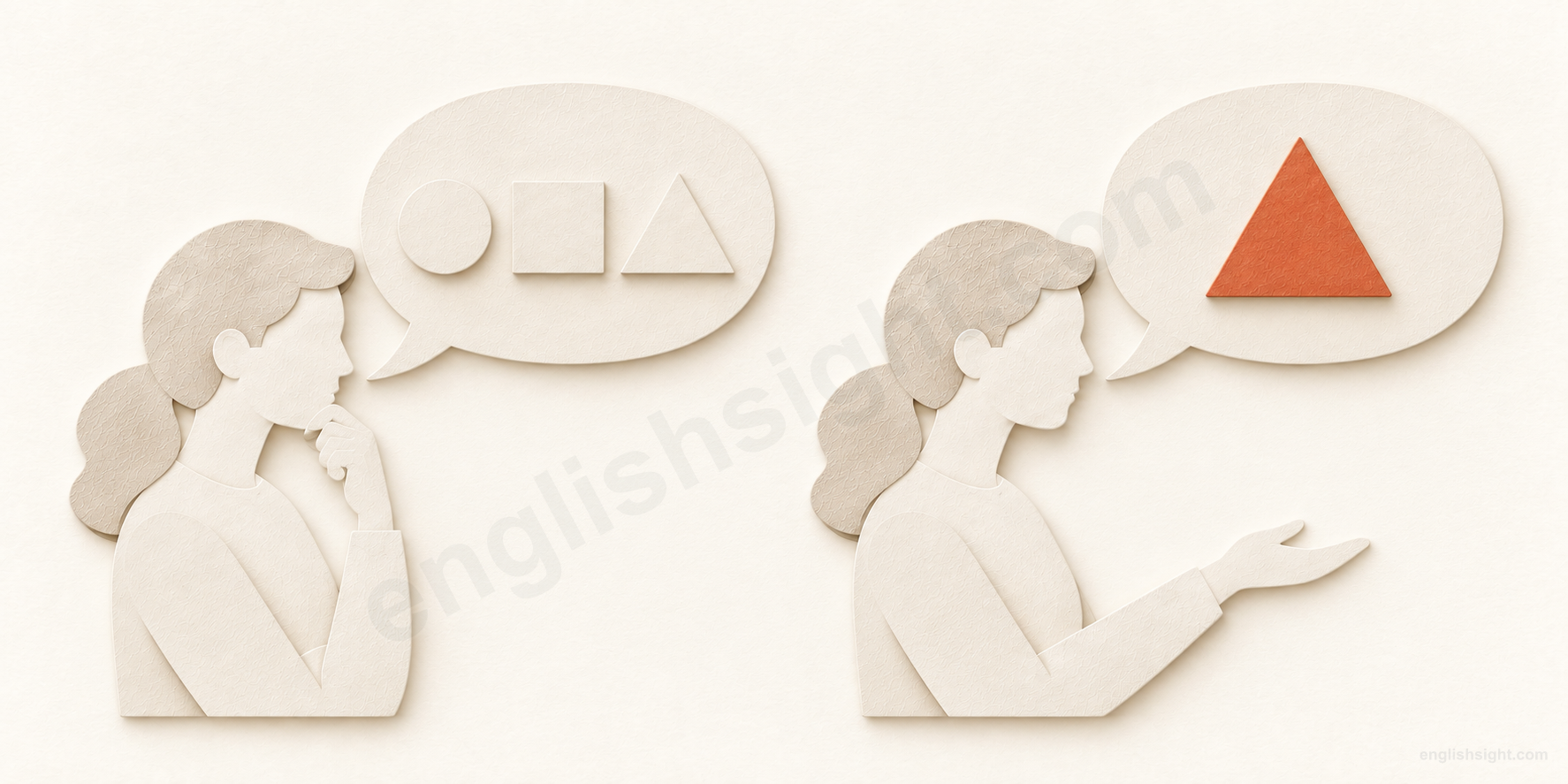
A settled claim—or a particular thing left unnamed.
Read the pattern to distinguish confidence, assured results, and unspecified people or amounts.
A claim treated as settled
A claim treated as settled
Several possible answers remain open in her mind.
certain
She now expresses one settled belief.
She comes to hold one answer without doubt.
One answer is now settled in her mind; confidence does not prove it true.
In the confidence use, a person treats a claim as settled, leaving no doubt from their point of view.
The illustration models confidence, not proof. Unnamed people, quantities, and qualities form a separate branch; the picture cannot predict every use of certain.
When you are certain, you treat a belief as settled rather than doubtful. When a result is certain, it is presented as sure to happen. Neither use requires a physical action or a change of location.
Before a noun, certain also has a different job: a certain person or certain conditions picks out something particular without fully identifying it. Keep this branch visible instead of forcing every use into a picture of confidence.
01
Having no doubt
Name the person who feels sure, then say what they are sure about. Confidence belongs to that person; it does not prove the belief correct.
01
person + be / feel certain + (that) + clause
be certain (that)…
feel no doubt that a statement is true
Situation / starting point
You remember putting the key in the drawer.
What is expressed
You state your belief firmly.
The person is certain; the that-clause gives the content of the belief.
In I am certain that I put it here, I is the person holding the belief. That introduces a whole statement and can be omitted: I am certain I put it here. Be and feel can both link a person to certain.
The statement describes confidence, not guaranteed accuracy. You can be certain and later discover that you were mistaken. Are you certain? asks someone to reconsider how sure they are.
Absolutely or completely certain strengthens the claim. Fairly certain and almost certain leave some doubt; not certain and not entirely certain openly limit confidence. These are useful shades of commitment, not numerical probabilities.
In a sentence
I’m certain that I left the key in the top drawer.
Watch the difference Say I am certain, not I certain. Certain is an adjective; certainly is an adverb.
02
person + be certain of / about + noun or pronoun
be certain of / about…
feel sure about a fact, person, or situation
Situation / starting point
You have checked the booking details.
What is expressed
You express confidence in those details.
Of and about introduce what the confidence concerns.
Be certain of the date and be certain about the date both express confidence concerning the date. A noun or pronoun follows the preposition: certain of it, certain about the details.
About is convenient for a topic or issue; of is also common with facts and outcomes. They overlap, so do not invent a strict rule that one always means facts and the other always means feelings.
Compare I’m certain of the answer with a certain answer. The first says I feel sure; before a noun, a certain answer can mean one particular answer that has not been identified.
In a sentence
Are you certain about the departure time?
Watch the difference Do not say certain on the time for this meaning. Use of or about.
03
be (not) certain + whether / who / what / where / how + clause; not certain what / whether + to-infinitive
not certain whether / what / how…
be unsure about an unanswered question
Situation / starting point
You have two possible train times.
What is expressed
You admit that the time is not settled in your mind.
An embedded question specifies the missing information.
Not certain whether the shop is open leaves a yes-or-no question unresolved. Not certain who called, what happened, or how it works leaves another kind of question unresolved.
Use statement word order inside the embedded question: I’m not certain where the office is. The direct question is Where is the office? but that inversion does not continue after certain.
When the issue is an action to choose, I’m not certain what to do or whether to wait is natural. This uncertainty pattern differs from He is certain to arrive, which predicts an arrival.
In a sentence
I’m not certain whether the last train leaves at ten.
Watch the difference Say not certain where it is, not not certain where is it.
02
Treating facts and outcomes as settled
A situation can be certain, or an event can be certain to happen. Here the grammar need not describe the subject’s own thoughts.
04
subject + be certain + to-infinitive
be certain to…
be sure to do something or to happen
Situation / starting point
The road ahead is completely blocked.
What is expressed
A delay is presented as unavoidable.
The subject is the person or thing involved in the predicted event, not necessarily a believer.
A delay is certain to follow predicts the delay firmly. A delay cannot have beliefs: certain to here concerns the event, rather than the subject’s confidence.
Maya is certain to win predicts Maya’s victory; Maya is certain that she will win reports Maya’s own confidence. The prediction and her belief can differ.
Almost certain to happen expresses a very strong expectation with some room for doubt. Also notice scope: not certain to happen leaves the outcome open, while certain not to happen confidently rules it out.
In a sentence
With the only bridge closed, delays are certain to follow.
Watch the difference Do not assume the subject feels confident: The roof is certain to leak is a prediction about a roof.
05
be certain of + noun / -ing form
be certain of getting…
be assured of an outcome
Situation / starting point
A class has only a few places left.
What is expressed
Booking early secures a place.
Of plus an -ing form presents an outcome as assured.
Be certain of getting a seat can describe having a seat assured, not merely feeling optimistic about it. The surrounding facts tell us whether the speaker is reporting confidence or a secured result.
After of, use an -ing form: certain of getting, not certain of get. Compare certain to get, which directly predicts what the subject will get.
You can also use a noun: certain of success. Neither this construction nor the prediction pattern says that a person deliberately decided to perform the action.
In a sentence
Book a place now to be certain of getting into the workshop.
Watch the difference Certain of doing and certain to do can overlap, but do not replace of with to while keeping getting.
06
it + be certain + that-clause; certain + outcome noun; to my certain knowledge
It is certain that… / certain defeat
present a fact or result as beyond doubt
Situation / starting point
The venue has confirmed a later opening.
What is expressed
The later opening is treated as settled.
The claim or outcome itself is presented as certain.
It is certain that the doors will open late treats a whole proposition as settled. It is a placeholder; the that-clause supplies the proposition. One thing is certain can introduce the one fact you do regard as settled amid other unknowns.
Before an event noun, certain can mean inevitable: certain defeat or certain failure. Contrast a certain person, which usually means a particular unnamed person. Position and the kind of noun help identify the meaning.
To my certain knowledge means according to what I definitely know: To my certain knowledge, this door has been locked since noon. It explicitly identifies the speaker’s basis rather than making the statement independent of a speaker.
In a sentence
It is certain that the doors will open later than planned.
Watch the difference A certain victory can mean an assured victory in context; a certain visitor normally means a particular visitor, not a confident visitor.
03
Knowing, checking, and ensuring
For certain describes how firmly something is known. Make certain can mean check the facts or take action so that a result happens.
07
know / say / find out + for certain; know for certain + that-clause
know / say / find out for certain
know or establish something without doubt
Situation / starting point
You have heard a possible explanation.
What is expressed
You distinguish a rumor from definite knowledge.
For certain describes the certainty of knowing or stating something.
Know for certain means know without doubt; say for certain means state with confidence. Find out for certain describes obtaining a definite answer. The phrase often appears in negatives: We don’t know for certain yet.
I know it for certain and I know for certain that it happened are both possible. For certain is a fixed phrase, not an example of certain naming an object.
For sure is a familiar alternative in this use. Do not confuse for certain with certainly: I certainly know him emphasizes the assertion, while I know for certain that he called emphasizes the lack of doubt about that fact.
In a sentence
We won’t know for certain until the station confirms it.
Watch the difference Keep for in this phrase: I know for certain, not I know certain.
08
make certain + (that-clause); make certain with an understood complement
make certain: check
check that something is really so
Situation / starting point
You think you attached the file.
What is expressed
You inspect the message before sending it.
The action establishes whether a belief is correct.
Make certain can ask someone to verify a fact: I think it is attached, but open the message to make certain. The complement can be understood from context rather than repeated.
Make certain that the address is correct asks for a check. In a different setting, make certain that everyone receives a copy asks you to bring about a result. The whole context distinguishes checking from ensuring.
Make sure is an everyday alternative. Make certain is an established expression, not a separable phrasal verb.
In a sentence
Open the draft once more to make certain that the file is attached.
Watch the difference Checking a claim does not automatically make the claim true.
09
make certain + (that) + clause; make certain of + noun / -ing form
make certain: ensure
take action so that a wanted result happens
Situation / starting point
Everyone needs the updated schedule.
What is expressed
You send it directly to every team member.
The action secures a result, rather than just confirming a belief.
Make certain everyone gets a copy asks you to arrange or do what is necessary. Simply checking an old list may be insufficient; you need to ensure delivery.
Make certain of getting a seat similarly means act so that a seat is assured, for example by reserving one. Of is a preposition, so it takes getting. A that-clause instead has its own subject and verb.
The checking and ensuring uses are related, but distinct: checking the door’s state supplies information; locking it ensures that it is locked. Both can be part of one instruction.
In a sentence
Send the schedule to each person to make certain that everyone gets a copy.
Watch the difference After of use getting, not to get: make certain of getting a seat.
04
Particular, but not specified
Before a noun, certain often picks out people, things, amounts, or qualities without identifying them fully. This is a separate use, not a claim that those people feel confident.
10
certain + plural noun; under certain conditions; in certain circumstances
certain people / under certain conditions
refer to particular people, things, or circumstances without listing them
Situation / starting point
Some rooms require an access card.
What is expressed
You refer to those rooms without naming every one.
Certain selects a particular set without specifying its members.
Certain rooms means particular rooms, rather than all rooms. It does not say the rooms are definite, reliable, or confident. Certain people may disagree can leave people unnamed, sometimes deliberately.
Under certain conditions and in certain circumstances restrict when a statement applies. Certain types of plastic similarly selects types. Learn the surrounding preposition with the full phrase; certain itself does not supply under or in.
This use normally comes before the noun. The people are certain instead describes their confidence, not their membership in an unnamed set.
In a sentence
An access card is required for certain rooms.
Watch the difference Certain people are waiting means particular people are waiting; The people are certain means they feel sure.
11
a certain + singular countable noun; a certain + title / name
a certain person / a certain Ms Lane
refer to one particular person without fully identifying them
Situation / starting point
A caller gives a name unfamiliar to you.
What is expressed
You report the name without claiming to know the caller.
A certain can leave an identity unnamed or introduce an unfamiliar name.
A certain person has called can mean a particular person whose name you choose not to give. In a playful context, the listener may be expected to guess the person; secrecy is a contextual effect, not a necessary meaning.
A certain Ms Lane called gives a name but signals that the person is not known or has not been introduced. This wording is more formal or distant than Someone called Ms Lane phoned.
With a singular countable noun, include a: a certain person, a certain day, a certain type of music. Certain people has no a because people is plural.
In a sentence
A certain Ms Lane called while you were out.
Watch the difference This does not mean Ms Lane was sure of something. Do not omit a before singular person.
12
certain of + the / these / those + plural noun; certain of + plural pronoun
certain of the members
some particular members of a defined group
Situation / starting point
A committee has received a proposal.
What is expressed
You identify an unnamed subset as requesting more time.
Certain of… acts as a plural expression meaning some of….
Certain of the members support it is a formal way to say some particular members support it. Of introduces the larger group: certain of them is also possible.
This is not the adjective pattern in The members are certain of success. In Certain of the members agree, the whole phrase is the subject and certain picks members; in The members are certain, certain describes their confidence.
Oxford calls this certain a pronoun; Collins COBUILD labels this use a quantifier. The labels differ, but the usage agrees: some members of an identified group, with a plural verb.
In a sentence
Certain of the members have asked for more time.
Watch the difference Use have with this plural subject: Certain of them have…, not Certain of them has….
13
a certain amount of + uncountable noun; a certain number of + plural noun; a certain + quality noun
a certain amount / a certain charm
acknowledge an amount or quality without specifying it precisely
Situation / starting point
A repair needs preparation and skill.
What is expressed
You acknowledge an unspecified level of skill.
The quality or amount exists, but its exact degree is left open.
A certain amount of skill means some skill without an exact measure. It can suggest a limited or moderate amount, but does not by itself give a number or always mean very little. A certain number of seats similarly leaves the number unstated.
A certain charm acknowledges a noticeable but hard-to-define charm: The little shop has a certain charm. This is an assessment of a quality, not confidence held by the shop.
Use amount of with an uncountable noun such as patience, and number of with a plural countable noun such as seats. The a belongs to amount, number, or a quality expression; it is not put directly before an uncountable noun in every use.
In a sentence
Repairing this clock takes a certain amount of skill.
Watch the difference A certain amount of time is unspecified time, not necessarily a fixed appointment time.
14
to a certain extent / degree; up to a certain point
to a certain extent / degree
say that something is partly, but not completely, true
Situation / starting point
You agree with part of a proposal.
What is expressed
You accept it within limits.
The phrase limits how far the statement applies.
To a certain extent and to a certain degree mean partly or within limits. They are useful for qualified agreement: I agree to a certain extent, but the cost still worries me.
The expression leaves the extent unspecified. It does not claim absolute certainty, despite containing certain. This use belongs with an unspecified amount or degree.
Up to a certain point can also mark a limit: The method works up to a certain point. A later clause often makes the limit clearer.
In a sentence
The new timetable helps to a certain extent, but the late bus is still crowded.
Watch the difference Keep to a in to a certain extent. It does not mean completely or without doubt.
15
person / people + of a certain age
of a certain age
refer indirectly to someone who is no longer young
Situation / starting point
An old song is familiar to an older audience.
What is expressed
You mention that age group without giving ages.
The idiom leaves age unstated while suggesting a later stage of life.
People of a certain age is an indirect, sometimes humorous way to refer to people who are no longer young, commonly middle-aged. It does not supply an exact age.
The phrase was traditionally often applied to women, but is also used for men or mixed groups. Since it comments indirectly on age, context and tone matter; use it carefully when addressing someone personally.
Contrast children of a certain age in a discussion of school admission: that can simply mean children of a particular, unspecified age. The surrounding topic determines whether the special idiom or the ordinary particular-age meaning is intended.
In a sentence
Listeners of a certain age will remember hearing this song on the radio.
Watch the difference The idiom does not refer to people who know their exact age with certainty.
Choose the meaning from the whole construction
Certain and sure
Both can describe confidence or an assured outcome: I’m certain / sure that…, certain / sure to happen. Certain can sound more formal. Do not replace certain with sure in certain people when you mean particular unnamed people.
Adjective, pronoun, and related words
Certain is mainly an adjective here. Formal certain of the members uses it as a pronoun or quantifier, depending on the dictionary’s grammar labels. Certainly is the related adverb and certainty the noun; they are not interchangeable word forms in the same sentence.
Grammar that does not apply
Certain is not a verb: it has no verb tense forms, passive, separable particles, or ordinary progressive form. In make certain, make supplies the action and certain is part of an established expression. Modifiers such as more certain describe changes or degrees of confidence.
Coverage boundary
The lesson covers contemporary confidence, assured outcomes, unspecified reference and degree, and familiar idioms. Additional descriptions such as his certain aim, meaning an unfailing aim, obsolete steadfast uses, and legal formulae are not expanded into separate lessons.
Read the pattern, then choose
Distinguish whose confidence is involved, what is guaranteed, and what remains unspecified.
1. Maya privately doubts she can win, but you strongly predict her victory. Which sentence states your prediction without reporting her belief?
2. You mean that some particular committee members have asked for more time. Which sentence fits?
3. You think the address is right and reread it to verify this. What does make certain mean here?
4. The change helps to a certain extent. How much help does the speaker claim?
5. I was certain the meeting was on Tuesday, but it was actually on Wednesday. Is this a contradiction?
Sources and teaching notes
The linked publisher entries support the meanings and patterns. The explanations, examples, and visual model are original teaching material; the model is not a dictionary definition.
The diagram is a teaching model, not an image shared by every native speaker.