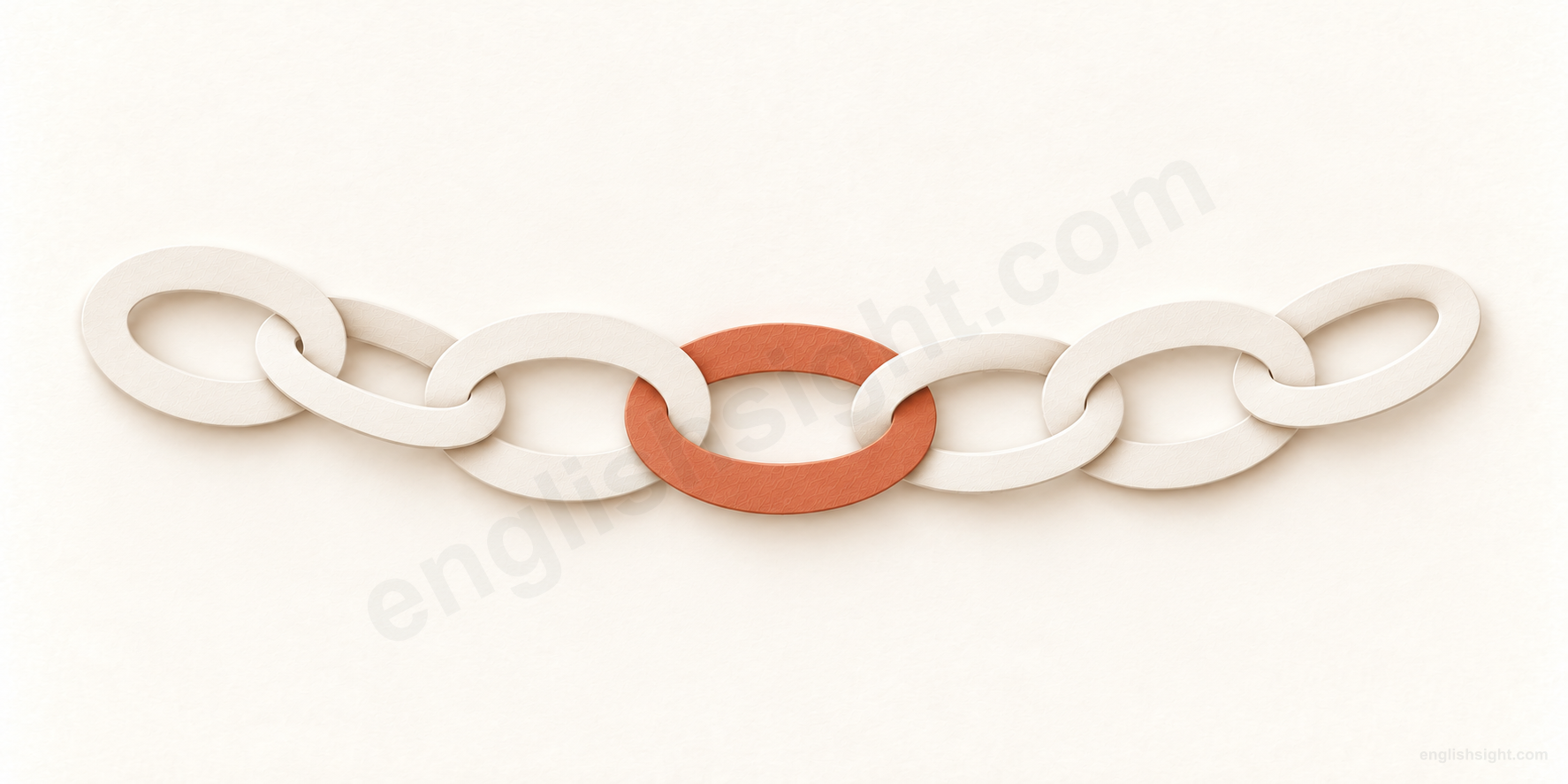
See how chain connects objects, events, businesses, and constraints.
Separate links, connected whole
Members connected one after another
Each oval remains a distinct link.
chain
The links form one continuous chain.
Neighbouring links interlock.
Each link is distinct; their connections make one chain.
A chain joins distinct links into a connected whole; figurative uses carry different parts of that relationship into sequences, organizations, and restrictions.
The sketch shows physical interlocking. Events need not touch, businesses need not form a line, and constraints belong to particular uses rather than every occurrence of chain.
Chain /tʃeɪn/ is both a noun and a verb. Start with separate links joined into a flexible whole. The connections help explain many extensions, but each established expression still needs its own context.
A chain can connect useful stages or hold something back. This lesson uses that contrast as a teaching model, not as a claim that all English speakers share one mental picture.
01
Metal links and their uses
Start with connected links. The same object can hold, drive, decorate, or restrict; the surrounding words identify its job.
01
a chain; a length of chain; bicycle / door chain
a chain / a length of chain
a flexible object made of joined links
Situation
A gate needs a flexible fastening.
What follows
A chain holds the gate shut.
Links remain distinct but join into one usable length.
A chain bends at its links while remaining connected. A bicycle chain carries movement between parts of a bicycle; a security chain helps fasten something. A link is one member, while the chain is the connected whole.
Use a chain for one complete item, two chains for two items, and some chain or a length of chain when treating it as material. These are different ways of counting the same kind of object, rather than different materials.
Example
We need a longer chain to secure this gate.
Watch the difference A rope is normally made of twisted or woven strands; a chain has connected links.
02
wear + a gold / silver chain; a chain of office
wear a gold chain
wear linked metal as an ornament
Situation
A small pendant needs something to hang from.
What follows
It hangs from a chain around someone’s neck.
A chain can be decorative rather than a restraint.
A gold or silver chain can be worn on its own or carry a pendant. Necklace is a broader word for an ornament worn around the neck: a necklace can use beads instead of links.
A chain of office is a special ceremonial chain showing someone’s official position, for example a mayor’s. Office here means a public role, not a room at work.
Example
Nora wears a small key on a silver chain.
Watch the difference Not every necklace is a chain, and a chain need not be jewellery.
03
be in chains; keep someone in chains; keep an animal on a chain
in chains / on a chain
held by metal restraints or a tether
Situation
Someone or something could otherwise move away.
What follows
A chain limits that movement.
The preposition distinguishes restraints from a tether.
In chains commonly describes a person wearing restraints; chains is plural in this fixed expression. An animal on a chain is attached by a length of chain. Off its chain means no longer attached to that tether.
In chains describes the restrained condition; chain someone describes the action of fastening them. A person wearing a decorative necklace is not normally described as in chains.
Example
The museum display shows how prisoners were kept in chains.
Watch the difference Do not use in a chain for the usual expression about prisoners wearing restraints.
04
snow chains; tire chains (US); put chains on the tyres
snow chains
linked metal fitted to vehicle tyres for grip
Situation
A vehicle must travel over a slippery snowy surface.
What follows
Chains around its tyres provide extra grip.
Here chains names equipment used on wheels.
Snow chains, also called tire chains in American English, are sets of links fitted around tyres. In a winter-driving context, chains alone can refer to this equipment.
The compound tells you the purpose. It does not mean a chain made from snow, and it is different from the chain that transmits power on a bicycle.
Example
The driver stopped to put snow chains on the tyres.
Watch the difference This is usually plural equipment vocabulary: snow chains, not a snow chain when referring to the set.
02
People, places, and connected steps
A chain can join separate members physically, geographically, in time, or in reasoning. The connection matters more than a perfectly straight shape.
05
form / make + a human chain
form a human chain
make a connected line of people
Situation
People need to pass supplies across a gap.
What follows
Each person passes supplies to the next.
People act as successive links.
A human chain is a line of people working as connected members. They may hold hands for a demonstration or pass objects from one person to the next. Metal is no longer part of the meaning.
Form a chain describes making the arrangement. A queue emphasizes waiting in order; a human chain emphasizes the people’s connection or shared action.
Example
We formed a human chain to pass the boxes up the steps.
Watch the difference A random crowd is not automatically a human chain.
06
a chain of + plural noun; an island / mountain chain
a chain of islands / mountains
a line or series of related natural features
Situation
You look at several islands on a map.
What follows
You recognize a connected geographical group.
The members need not touch like metal rings.
An island chain is a group of islands arranged along a line or curve. A mountain chain similarly groups mountains extending through a region. Their geographical relationship supplies the connection.
Both a chain of islands and an island chain are possible. In the first pattern, islands is plural after of; in the second, singular island modifies chain.
Example
A chain of small islands stretches along the coast.
Watch the difference Chain does not require the islands to touch or form a straight line.
07
a chain of + events / mistakes; set in motion a chain of events
a chain of events
connected happenings in sequence
Situation
A minor delay changes several later arrangements.
What follows
You trace how one happening led to others.
Chain presents events as related steps rather than an unrelated list.
A chain of events invites us to follow the connections between happenings. A chain of accidents or mistakes can work similarly. What happened first may help explain what followed.
Use lead to, start, or set in motion with this expression. A series of events is more neutral about their relationship; chain often draws attention to links, but does not by itself prove a causal explanation.
Example
A missed call started a chain of events that delayed our trip.
Watch the difference Do not claim that chronological order alone proves one event caused another.
08
follow / examine + a chain of reasoning
a chain of reasoning
successive connected steps in an argument
Situation
A conclusion seems difficult to understand.
What follows
You follow the intermediate reasoning.
A later step depends on earlier steps.
A chain of reasoning connects starting information to a conclusion through intermediate steps. Follow the chain means understand how the steps fit together, not walk behind something.
A missing link can mean a missing connection needed to make the explanation work. Calling something a chain of reasoning describes its structure; the steps might still contain mistakes.
Example
I can follow her chain of reasoning, but I disagree with the first assumption.
Watch the difference Connected reasoning is not automatically correct reasoning.
03
Businesses and linked house sales
These established uses describe relationships between businesses or transactions. They do not require a visible line of objects.
09
a chain of + shops / hotels; a hotel chain; a chain store
a hotel chain / a chain store
related businesses under shared ownership or management
Situation
You notice the same hotel name in several cities.
What follows
You identify the hotels as part of one business group.
The link is organizational, not a physical line.
A chain can have branches far apart. A restaurant chain, supermarket chain, or chain of hotels names the group. A chain store is one shop belonging to such a group, not the whole group.
The broad business use includes establishments under common ownership, management, or control; franchise arrangements also occur. Sharing a type of product alone does not make unrelated shops a chain.
Example
This small hotel is part of a national chain.
Watch the difference Distinguish one branch from the chain containing it.
10
be in a chain; a property chain; chain-free
a property chain
linked home purchases and sales (British English)
Situation
Several buyers need to sell their own homes before buying.
What follows
One delayed sale holds up other transactions.
The transactions depend on one another.
In British house-buying language, a chain links buyers and sellers whose transactions depend on other sales. A problem lower down the chain can delay a person’s own purchase.
A chain-free property is offered by a seller whose sale does not depend on an onward purchase. A buyer with no chain does not need to sell another property to fund the purchase. These expressions concern transaction dependencies, not the building’s structure.
Example
Our buyer’s sale fell through, so the whole chain was delayed.
Watch the difference This regional property meaning cannot be inferred from a physical chain on a door.
04
Processes, messages, and dependence
Learn these whole expressions. Each names a particular kind of connection, so food, supply, and command cannot simply be exchanged.
11
trigger / set off + a chain reaction
a chain reaction
an effect that produces further effects in turn
Situation
One cancellation forces another change.
What follows
Further changes follow from those effects.
Successive effects generate new effects.
In everyday use, a chain reaction emphasizes a spreading causal process: one change triggers another, which triggers more. Set off or trigger a chain reaction names the initial cause.
The expression also has a scientific meaning in which products of a reaction cause further reactions. The everyday metaphor does not mean every chain of events is literally a chemical or nuclear process.
Example
One cancelled flight set off a chain reaction of missed connections.
Watch the difference A chain reaction emphasizes successive causation, not merely several reactions happening together.
12
a supply chain; supply chain problems; a link in the supply chain
the supply chain
the linked stages that bring goods to users
Situation
A shop has no replacement parts.
What follows
You check production, transport, and delivery.
A product reaches users through connected processes.
A supply chain covers stages from making or growing goods through supplying them to buyers or users. A problem at one stage can affect availability at later stages.
Use supply chain problems, a disruption to the supply chain, or a link in the supply chain. A shop chain groups related businesses; a supply chain connects processes and participants that may belong to different companies.
Example
A shortage of packaging has disrupted our supply chain.
Watch the difference Supply chain and chain of stores name different relationships.
13
a food chain; enter / move up the food chain
the food chain
feeding relationships or the route food takes to consumers
Situation
A class studies how organisms get food.
What follows
It traces feeding links from plants to animals.
Food connects members through feeding or production stages.
In ecology, a food chain follows who feeds on what: grass is eaten by a rabbit, which may be eaten by a fox. An organism is higher or lower in that feeding sequence. A food web describes interconnecting feeding relationships rather than one simple chain.
Food chain can also refer to stages from growing or producing food to selling and eating it. For example, “The unsafe meat was destroyed before it could enter the food chain” describes preventing it from reaching consumers. Reports about contamination entering the food chain may refer to supply stages or ecological feeding relationships; context decides.
Example
The children drew a food chain with grass, a rabbit, and a fox.
Watch the difference The ecological meaning concerns feeding relationships, not a group of restaurants.
14
at the top of / low down (on) the food chain
at the top of the food chain
at a powerful or important level (informal)
Situation
People compare their influence at work.
What follows
They describe the most powerful group metaphorically.
An ecological ordering becomes a metaphor for status.
In informal talk about business or society, the top of the food chain means the powerful or successful end of a hierarchy. Low down the food chain suggests relatively little influence.
This can sound competitive or cynical, as if people occupy predator-and-prey positions. For a neutral statement about authority, say senior managers or describe the actual reporting structure.
Example
As a new assistant, I’m fairly low down the food chain here.
Watch the difference This informal metaphor is not a literal claim about what someone eats.
15
up / down / through + the chain of command
the chain of command
the hierarchy through which instructions pass
Situation
A team needs approval for an unusual decision.
What follows
The request goes to the appropriate higher level.
The links represent authority relationships.
A chain of command identifies who gives instructions to whom. Orders can pass down it, while requests and decisions needing approval can go up it.
This is a hierarchy, not necessarily the order in which people joined the organization. Going through the chain of command means following the relevant levels instead of bypassing them.
Example
Please send the request up the chain of command.
Watch the difference Command here concerns organizational authority, not a chain made of spoken words.
16
send / receive / forward + a chain letter
a chain letter
a message asking recipients to send copies onward
Situation
An email asks you to forward it to ten people.
What follows
Each recipient is asked to repeat the forwarding.
Repeated copying continues the message from person to person.
A chain letter may be a paper letter or an electronic message. Its defining feature is the request that recipients send it, or copies, to further people.
Some messages promise luck or make threats if the chain is broken. Those claims are part of the message, not facts established by the expression. An ordinary email conversation with replies is not automatically a chain letter.
Example
I deleted the chain letter instead of forwarding it to my friends.
Watch the difference Do not confuse a chain letter with any long email exchange.
17
a link in the chain; break / maintain the chain
a link in the chain
one connected stage or participant
Situation
You examine the stages in a service.
What follows
You identify one stage’s part in the whole.
A link is one member; the chain is the connected system.
Calling a person, stage, or organization a link in the chain emphasizes its connection to what comes before and after. The chain may be a production process, communication route, or argument.
Break the chain can mean interrupt a continuing process, such as transmission of infection. It may be desirable to break a harmful chain, but damaging to break a useful communication chain: the noun alone does not tell you whether the process is good.
Example
The delivery team is an essential link in the chain.
Watch the difference A link is not another name for the whole chain.
18
the weak / weakest link (in the chain)
the weak / weakest link in the chain
the part most likely to make a system fail
Situation
Most stages work well, but one repeatedly fails.
What follows
You identify the vulnerable stage.
One unreliable connection can limit the whole system.
The weak link is the vulnerable point in a system, organization, or argument. Weakest makes an explicit comparison: this is the least reliable of the relevant parts.
If a necessary connection fails, the larger process can fail too: this is the teaching link to a physical chain. Used about a person, weak link can be a harsh judgment; a precise description of the problem is often more helpful.
Example
Our booking software is the weak link in the chain.
Watch the difference Weak here means vulnerable or unreliable, not necessarily physically weak.
05
Fasten, join, or keep someone tied down
As a verb, chain takes the person or thing being secured as its object. To names an attachment point, together joins members, and up emphasizes restraint.
19
chain + person / thing + to + attachment point; be chained to
chain something to something
secure an object to an attachment point with a chain
Situation
A bicycle could be taken away.
What follows
Its frame is attached to a fixed rack.
The object is secured; to names what it is attached to.
In chain the bicycle to the rack, bicycle is the object being fastened and rack is the attachment point. The passive is common: The bicycle was chained to the rack.
Chain yourself to something uses a reflexive object when the person fastens their own body, for example in a protest. Unlike give someone something, chain does not normally take a recipient followed by an object.
Example
Mina chained her bicycle to the rack outside.
Watch the difference Say chain it to the rack, not chain the rack it.
20
chain + noun + up; chain up + noun; chain it up
chain something up
secure or restrain something with a chain
Situation
The equipment must remain where it is overnight.
What follows
A chain secures it.
Up contributes the familiar securing or restraining pattern.
Chain up overlaps with chain: chain up the equipment and chain the equipment up both describe securing it with a chain. With a pronoun, put the pronoun between the verb and up: chain it up.
Up does not mean moving the equipment to a higher place. You can add an attachment point with to if it is relevant, but up alone does not identify what something is fastened to.
Example
We chained the equipment up before leaving the site.
Watch the difference Use chain it up, not chain up it.
21
chain + plural object + together; be chained together
chain things together
join several members with a chain or in a sequence
Situation
Several separate objects need to stay connected.
What follows
They are linked into one group.
Together joins members to one another.
Literally, chain two gates together joins the gates using a chain. The passive two gates are chained together describes the resulting connection.
The same pattern can extend to abstract items, as in chain several commands together in computing. That extension means combine steps so they run in sequence. Together describes the relation between members; to would name an attachment point instead.
Example
The caretaker chained the two gates together.
Watch the difference Chain together does not itself mean attach each object to a fixed post.
22
be chained to + desk / obligation; keep someone chained to + desk / obligation
be chained to your desk
be kept at work by demands or obligations
Situation
Work keeps arriving and you cannot get away.
What follows
You feel unable to leave your desk.
A work obligation acts like a physical tether.
This figurative expression normally means that work keeps you at your desk for a long time. No actual chain is required. Be chained to can extend to another activity or obligation when it severely limits freedom.
The passive-looking form highlights the restricted person. The context may identify the cause: Constant calls kept me chained to my desk. It is stronger and more negative than simply saying I worked at my desk.
Example
I’ve been chained to my desk finishing the report all afternoon.
Watch the difference Being chained to a desk is usually figurative; check the context rather than assuming physical captivity.
06
Freedom, burdens, and provocation
A physical chain can restrict movement. Figurative chains and established idioms apply parts of that image to choices, responsibilities, or reactions.
23
the chains of + restriction; break / throw off the chains of…
break the chains of fear
escape a restricting influence (formal or literary)
Situation
Fear or a harmful habit limits someone’s choices.
What follows
The person tries to act more freely.
Restriction supplies the metaphor; breaking removes it.
Expressions such as the chains of fear, poverty, or habit present an influence as something that holds people back. Break or throw off those chains describes becoming free of the restriction.
This imagery is formal, literary, or rhetorical. In ordinary practical conversation, overcome fear or change a habit is often plainer. The image helps explain the expression, but does not claim that escaping a real difficulty is simple.
Example
The story follows a woman trying to break the chains of fear.
Watch the difference Chains is usually plural in this figurative pattern.
24
be / become + a ball and chain
a ball and chain
a burden that restricts freedom
Situation
An obligation makes it hard to pursue other plans.
What follows
Someone compares it to a heavy restraint.
The whole idiom emphasizes a limiting burden.
A ball and chain describes a problem or responsibility that holds someone back. The image is a heavy ball attached by a chain, not a decorative ball-shaped necklace.
The expression is also used in an old-fashioned, disparaging way about a wife, or more generally about a partner or spouse. Presenting a person as a restraint can be insulting; it is not a neutral way to say husband or wife.
Example
The costly lease became a ball and chain for the new business.
Watch the difference Learn ball and chain as a whole expression, not as the general meaning of chain.
25
yank / jerk + someone’s chain
yank someone’s chain
tease, mislead, or deliberately annoy someone (mainly US, informal)
Situation
Someone keeps making comments to get a reaction.
What follows
The listener recognizes the provocation.
The idiom concerns provoking a response, not moving a metal object.
Yank my chain can describe saying something to annoy me or get a reaction. It can also mean tease or mislead me: “You really won free tickets? Are you yanking my chain?” Jerk someone’s chain is a related form. Teasing does not guarantee that the other person finds it friendly.
The possessive identifies the person being provoked: my chain, your chain, or Sam’s chain. This is a fixed informal idiom, not a productive rule that gives chain this meaning in every sentence.
Example
Stop yanking my chain about that mistake; I’ve already fixed it.
Watch the difference Do not use this informal idiom as neutral wording in a formal complaint.
Read the type of connection
Chain, link, series, and group
Link names a member or connection; chain names the connected whole. Series emphasizes succession, and group does not require an ordered or dependent relationship. A chain can curve or close into a loop.
Noun and verb forms
The plural noun is chains. The regular verb forms are chain, chains, chained, and chaining; chained is both past tense and past participle. The action can be progressive, as in They are chaining the gates together. The passive is common when the secured object is the focus.
Not every combination is a phrasal verb
Chain up has a separable particle. In chain a bike to a rack, to introduces the attachment point. In hotel chain, chain store, and chain reaction, the words form noun expressions; they are not particle verbs.
Scope of the picture
Connection is a useful bridge, not a rule that predicts all compounds and idioms. This lesson selects modern everyday and useful news/work expressions, with labels for regional and formal uses; specialist measurement, chemistry, sewing, and historical senses are not developed.
Choose the connection
Use the situation, grammar, and whole expression.
1. One company operates twelve hotels. What names the whole business group?
2. You want someone to secure the equipment with a chain. Which pronoun position is standard?
3. One cancellation causes further cancellations, which cause still more. Which expression emphasizes this spreading process?
4. A colleague says, “I’ve been chained to my desk all morning.” What is the usual meaning at work?
5. A report follows a product from production through transport to buyers. Which chain is it discussing?
6. “She is at the top of the food chain in that company.” What does this informal comment suggest?
Sources and teaching notes
The linked dictionary entries support the usage inventory. Explanations, examples, and the connecting visual model are original teaching material; the model is an interpretation, not dictionary evidence.
This diagram is a teaching aid, not a picture shared by every native speaker.