From a pale rock and drawing sticks to records, explanations, and fixed idioms.
From material to a mark
From material to a mark
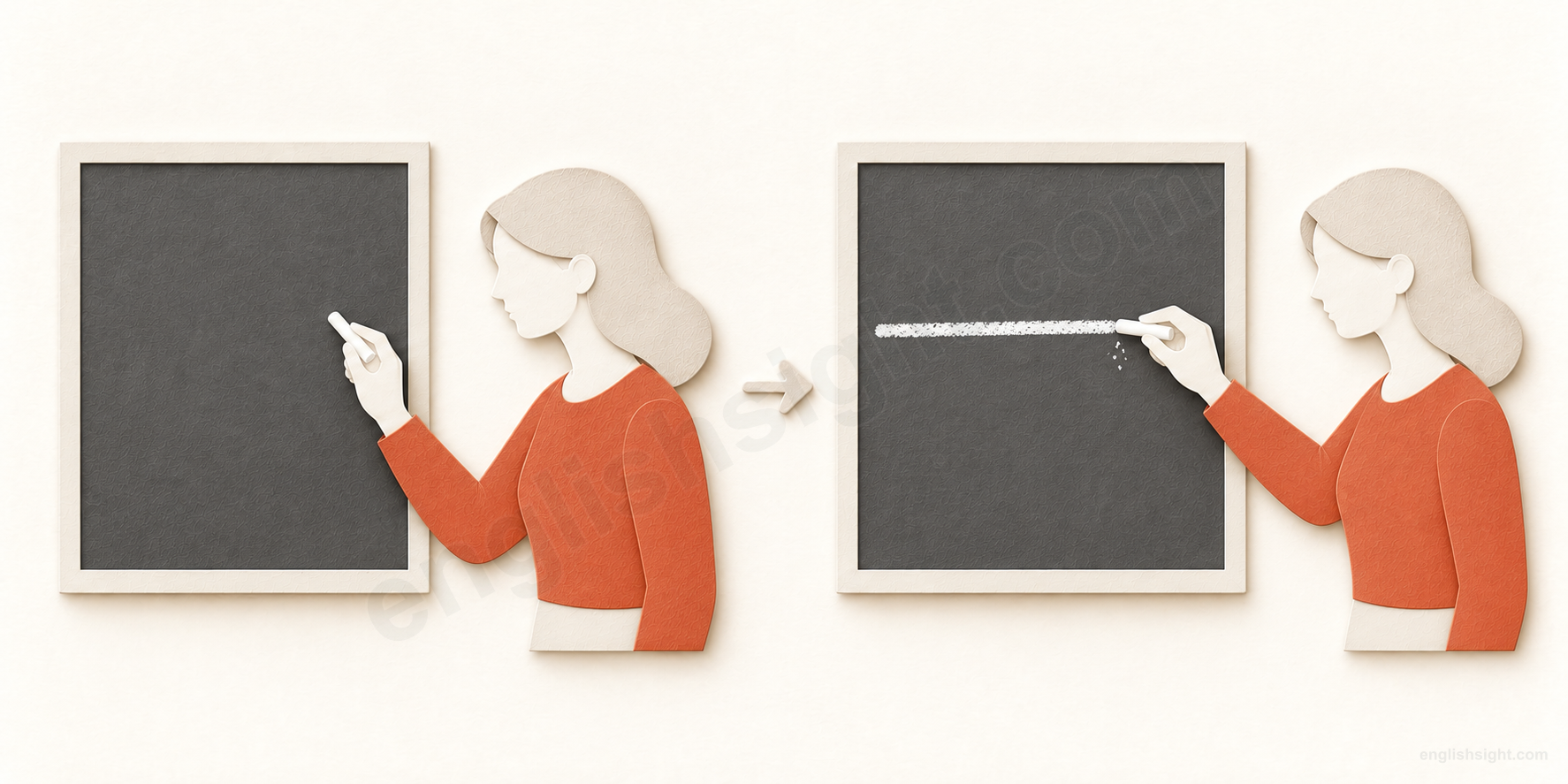
The board is blank; a woman holds a piece of chalk ready to draw.
chalk
A visible white chalk line remains on the board.
She draws the chalk across the board, leaving material behind.
Chalk leaves a visible trace on a surface. This picture shows literal marking, not every chalk expression.
When someone rubs a piece of chalk across a surface, some of the material is left behind as a visible mark.
This model connects the writing material with the literal marking verb. Natural chalk rock is a material sense; the result, attribution, and comparison expressions are established extensions or idioms.
Chalk can name a rock, the material you draw with, or the action of marking with that material. Start with the visible trace left when chalk touches a surface.
The same word also appears in expressions about achievements, causes, and strong comparisons. Those expressions need their own grammar and meaning; one picture cannot predict them all.
01
Rock, writing material, and visible marks
First distinguish the natural rock from the prepared material used in classrooms and drawing. The noun often names material rather than a countable object.
01
chalk; chalk + landscape noun
chalk cliffs
the soft pale rock called chalk
Situation
You are describing the stone forming a cliff.
Meaning or result
You identify its material as chalk.
Here chalk names a natural rock, not classroom equipment.
Chalk is a soft kind of limestone. In landscape descriptions, chalk cliffs and chalk hills identify the rock that forms them.
Treat the rock as uncountable: some chalk or a lump of chalk. The plural in chalk cliffs belongs to cliffs; chalk stays singular as the material modifier.
In a sentence
The path follows a ridge of chalk above the village.
Watch the difference A chalk cliff is made of this rock; it is not a cliff covered with classroom writing.
02
some / any chalk; a piece / stick of chalk; coloured chalks
a piece of chalk
material prepared for writing or drawing
Situation
You need something to draw on a board.
Meaning or result
You ask for chalk, or specify one piece.
Some chalk names material; a piece of chalk counts one portion.
For an everyday request, say Do you have any chalk? To count individual objects, use two pieces of chalk or three sticks of chalk. A stick describes the familiar long shape; a broken fragment is still a piece.
Countable chalks is also possible for individual drawing sticks, especially in a set of coloured chalks. Do not assume that chalk can never be plural. The prepared writing material may resemble the natural rock without being made of that rock.
In a sentence
Could you bring two pieces of chalk for the small board?
Watch the difference A piece of chalk is a clear neutral way to count one; some chalk does not specify how many pieces.
03
write / draw with chalk; a message in chalk; chalk + line / mark / dust
in chalk / with chalk
identify the medium of writing or drawing
Situation
You see a temporary line on the pavement.
Meaning or result
You explain what made the line.
With chalk presents the tool or material; in chalk describes the resulting medium.
You can draw with chalk and leave a drawing in chalk. With highlights what you use; in tells us how the visible words or picture are rendered. On identifies the surface: a message in chalk on the pavement.
A chalk line or chalk mark is a line or mark made with the material. Chalk dust is the fine powder left behind. These noun combinations describe different things; a chalk mark is not another name for a stick.
In a sentence
Someone had drawn a large arrow in chalk outside the gate.
Watch the difference Say written in chalk, not written by chalk, when naming the medium; by normally introduces an agent in a passive.
02
Write, coat, and mark out
The verb names an action done with chalk. Its object can be the writing, the surface receiving chalk, or an area being outlined.
04
chalk + message / mark + on + surface; be chalked (up) on
chalk a message on the board
write or draw something using chalk
Situation
The board has no message.
Meaning or result
Someone uses chalk to leave words on it.
The object names the words or drawing; on names their surface.
Chalk can be a verb: you chalk a number, an arrow, or a message on a surface. Saying chalk a message makes the writing material part of the verb’s meaning; write a message does not specify the material.
The written item can become the subject of a passive: The price was chalked on the board. Literal chalk up can also mean write something up for display: They chalked up the menu on the wall. That context differs from achieving a result.
In a sentence
Maya chalked a welcome message on the board by the entrance.
Watch the difference The message is what is written; chalk on the board without an object does not name the message.
05
chalk + object receiving chalk
chalk a cue
rub chalk onto an object
Situation
A player prepares the tip of a billiard cue.
Meaning or result
The tip receives a coating of chalk.
The object receives the material; it is not a written message.
To chalk a cue is to rub chalk on its tip. Here the direct object is the thing being treated. Compare chalk a number: the number is created as writing, whereas the cue already exists and receives chalk.
This is a material-application use of the same verb. It does not mean drawing a picture of a cue or turning the cue into chalk.
In a sentence
Before her next shot, she chalked the tip of her cue.
Watch the difference Context decides whether the object is something written or something coated; there is no need for up in this use.
06
chalk out + area / shape; chalk + it + out
chalk out an area
mark the outline or limits with chalk
Situation
You need to show where a play area will be.
Meaning or result
Chalk lines make its edges visible.
Out helps present the shape or extent being marked.
Chalk out a rectangle or an area means mark its outline, normally using chalk. The focus is the boundary or shape, rather than a written message.
With a noun, chalk out the area and chalk the area out are possible. Put a pronoun between the verb and particle: chalk it out. The material-to-mark relationship in the diagram is literal here.
In a sentence
We chalked out a rectangle on the playground for the game.
Watch the difference Out does not mean taking chalk outdoors; the object is the area being marked.
07
chalk out + plan / schedule; chalk + plan + out
chalk out a plan
outline the main parts of a plan
Situation
The group has a goal but no agreed steps.
Meaning or result
They set out a rough course of action.
The outline is now an outline of ideas, not necessarily a physical line.
Chalk out can also mean sketch or outline a plan. We chalked out a schedule presents the main arrangement; it does not say that every detail is fixed or that anyone used a board.
Outline a plan is a straightforward alternative when you want to avoid the figurative expression. The physical outline offers a memory link, but this planning meaning is an established use to learn as a whole.
In a sentence
At lunch we chalked out a plan for the school exhibition.
Watch the difference Do not confuse chalk out a plan with chalk up a success: one concerns planning, the other a result.
03
Results, causes, and lessons learned
These established expressions no longer require chalk or a board. Read the object and the words after up to understand the intended meaning.
08
chalk up + result / total; chalk + result / it + up
chalk up a win
achieve or add a result to a record
Situation
A team plays another successful match.
Meaning or result
Its record gains another win.
The object is an achievement or recorded amount, not writing material.
Chalk up is informal when it means gain or record a result: chalk up points, a victory, or years of service. The result can be counted as part of someone’s record; an actual chalkboard is unnecessary.
With an ordinary noun, the particle can follow it: chalk a win up. With a pronoun, use chalk it up, not chalk up it. Up belongs to the established expression; it does not mean the score moved upward in space.
In a sentence
The club chalked up three wins in its first month.
Watch the difference Chalk up a win reports the result; chalk a score on a board can describe the separate act of writing it down.
09
chalk + outcome / it + up to + cause; be chalked up to
chalk it up to luck
attribute an outcome to a cause
Situation
Something unexpected happens.
Meaning or result
You propose an explanation for it.
The object is the outcome; the phrase after to supplies its supposed cause.
Chalk something up to something is informal for treating the second thing as the cause of the first. It works for favourable and unfavourable outcomes: you might chalk a win up to practice or a mistake up to tiredness.
In chalk it up to luck, it refers to the outcome, up belongs with chalk, and to introduces the explanation. This is the speaker’s interpretation, not proof of the cause. A passive is possible: The delay was chalked up to a computer fault.
In a sentence
I chalked my slow start up to a poor night’s sleep.
Watch the difference Chalk up a win means achieve it; chalk a win up to luck means explain why it happened. Keep to before the cause.
10
chalk + setback / it + up to experience
chalk it up to experience
accept a setback as something to learn from
Situation
A decision has cost you money or effort.
Meaning or result
You accept the loss and keep the lesson.
Experience is the lesson gained, not the cause of the mistake.
Chalk it up to experience is a particular idiom used after a disappointment or failure. It encourages someone to regard the setback as useful learning and move on.
This differs from ordinary chalk it up to tiredness, where tiredness explains the event. In the experience idiom, the point is what you can learn. Saying it about a serious loss can sound dismissive if you ignore the other person’s feelings.
In a sentence
The tickets were useless, so we chalked it up to experience and checked the dates more carefully next time.
Watch the difference The idiom does not mean that being experienced caused the loss.
04
British comparisons and emphasis
Learn these expressions as complete idioms. The ordinary properties of chalk alone cannot tell you what the whole expression means.
11
be (like) chalk and cheese; as different as chalk and cheese
chalk and cheese
very different in character or nature
Situation
Two people are being compared.
Meaning or result
You emphasize how unlike each other they are.
This British idiom compares people or things, not just their appearance.
British English uses be chalk and cheese, be like chalk and cheese, and be as different as chalk and cheese for a strong contrast. A quiet person and a very outgoing person might be described this way.
The comparison does not by itself mean that the two people dislike each other. Differences in character can coexist with friendship. Learn the fixed pair of nouns rather than trying to build a new idiom with another food.
In a sentence
The sisters are chalk and cheese: one loves crowds, while the other prefers a quiet room.
Watch the difference This is marked British usage; very different is a clear alternative across varieties of English.
12
negative clause + by a long chalk; superlative + by a long chalk
not by a long chalk
not nearly or not at all
Situation
Someone thinks a job is almost finished.
Meaning or result
You strongly reject that impression.
The phrase intensifies the negative; it does not measure a piece of chalk.
Not by a long chalk is an informal British expression. We’re not finished, not by a long chalk means we are nowhere near finished. Not by a long shot is an alternative also used in North American English.
The positive by a long chalk can emphasize a large difference, especially with a superlative: This is the hardest puzzle by a long chalk. Treat it as emphasis meaning by far, rather than a physical distance.
In a sentence
The repairs aren’t finished yet—not by a long chalk.
Watch the difference Not by a long chalk concerns degree or completeness; it does not mean not for a long time.
Choose the material, action, or whole expression
Count the piece when that is what you mean
Chalk is often uncountable as material. A piece of chalk and two sticks of chalk make the count explicit; coloured chalks is also established for drawing sticks. Do not apply a blanket rule that chalk is always uncountable.
Forms and pronunciation
The l is silent in chalk. The regular verb forms are chalk, chalks, chalked, chalking; chalked ends in /t/. An action in progress can be is chalking a line, and a passive can be a line was chalked on the floor. This verb has no special everyday causative construction.
Material names do not guarantee identical ingredients
Writing chalk can be made from chalklike material. Do not assume every drawing stick has the composition of a natural chalk cliff. The related adjective chalky describes resemblance or texture, but is not interchangeable with every use of chalk.
Scope of this lesson
This selection covers general material and marking uses, familiar record and attribution expressions, and two British idiom families. Technical paint deterioration, treating soil, specialist betting vocabulary, and standalone score or credit uses are not developed here. It is a practical selection, not a frequency ranking.
Read the whole chalk expression
Decide what is being counted, marked, achieved, or explained.
1. You want exactly two ordinary writing sticks. Which request is clearest?
2. A team won, and you believe luck explains the result. Which sentence gives the cause?
3. You booked the wrong date, lost a small fee, and decided to learn from it. What fits?
4. The room still needs hours of cleaning. What does “It isn’t ready—not by a long chalk” mean?
Sources and teaching notes
Definitions and usage were checked against the sources below. Explanations, example sentences, and the diagram were written for this lesson; the visual connection is a teaching interpretation.
The diagram models literal chalk marking; it is a teaching aid, not a mental picture shared by every speaker.