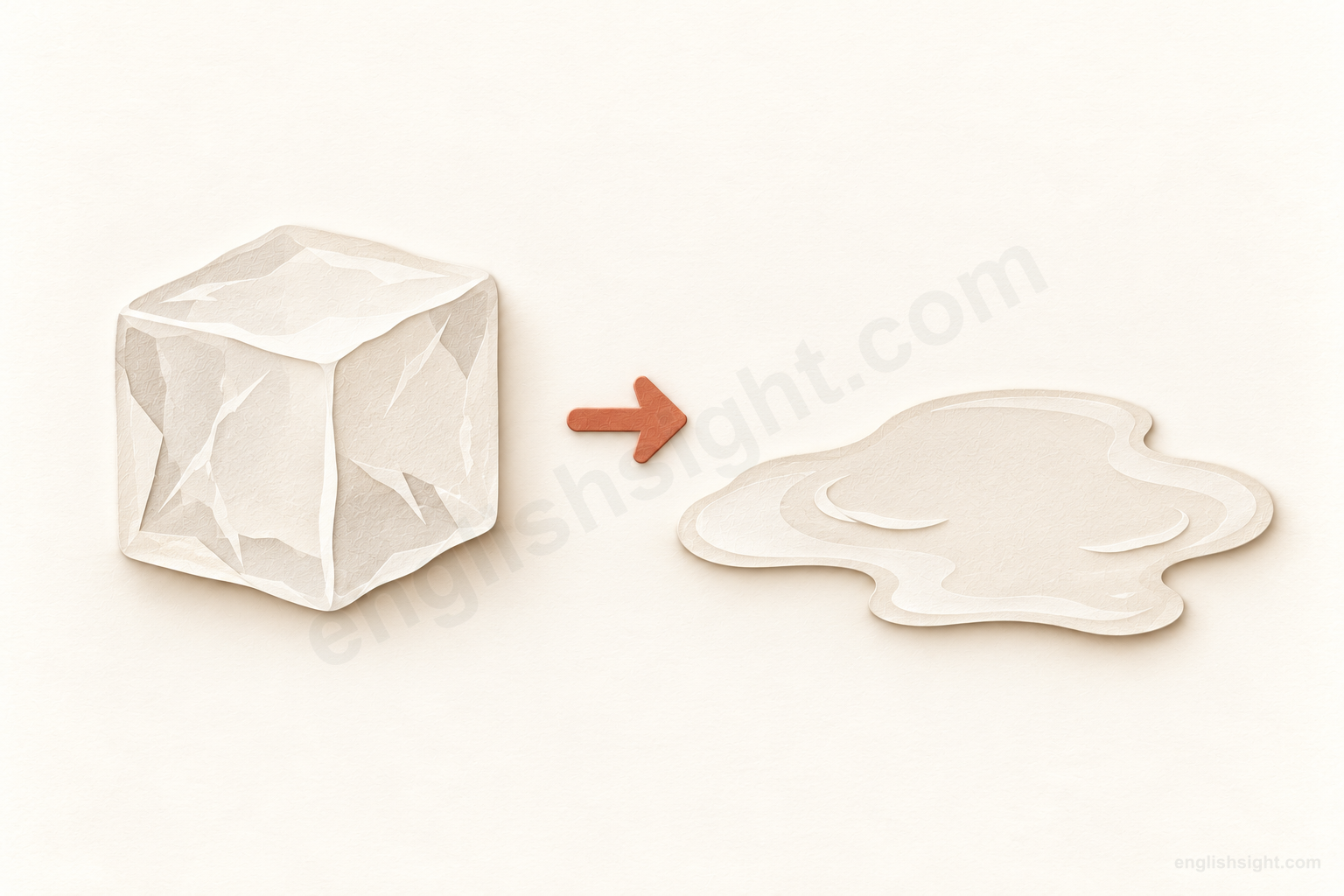
The earlier state gives way to something different.
Follow changes in state, replacements, choices, routines, and money.
Compare before and after
Compare before and after
The water is solid ice with a fixed shape.
change
The water is now liquid and spreads into a shallow puddle.
The ice melts, changing the state of the same water.
Same water, different state: ice melts into liquid. This illustrates one branch of change.
Something becomes different, or another item or arrangement takes its place.
This is a teaching connection, not a claim that every English speaker imagines the same picture. Change can be gradual or sudden, deliberate or unplanned, welcome or unwelcome.
Change can describe something becoming different or someone making it different. It can also describe one item, arrangement, or choice taking the place of another. Ask what is different and whether the original object remains.
The noun names alterations and replacements, but money change has its own established uses. Learn those uses and fixed expressions with their patterns; a single picture cannot predict them all.
01
Becoming different and causing a difference
Start with what changes and whether the sentence names a cause. From, to, into, and back identify earlier and later states.
01
subject + change; be changing; have changed
Things change.
become different without naming a cause
Earlier situation
The situation has one set of features.
Later situation
Some of those features are different.
The subject experiences the change; an outside cause need not be stated.
The weather changed describes a difference over time. Change can also concern a person’s habits, a neighborhood, or a plan. It does not by itself say how large, quick, or welcome the difference is.
Compare The weather is changing, an ongoing process, with The weather has changed, a difference already established. She hasn’t changed can mean her personality or appearance is much as before; context selects the feature.
When a boy’s voice changes during puberty, it becomes deeper. This is an established use of the intransitive verb: the voice is the subject, and change does not take a direct object here.
In a sentence
The neighborhood has changed since I moved away.
Watch the difference Change can happen without anyone choosing it. It does not automatically mean improve.
02
change + object; object + be changed; have + object + changed
change something
cause a person or thing to become different
Earlier situation
The document gives the old delivery date.
Later situation
An editor puts a new delivery date in it.
The subject causes a difference in the object.
I changed the date names the person making the alteration. The news changed our plans gives information the same grammatical role: a cause need not be a person. A new plan need not mean a completely new document.
The date was changed is a passive: the affected item becomes the subject and the editor may be omitted. Have the date changed means arrange for someone to alter it. In Make him change his habits, make supplies the causative pattern. Use make him change or get him to change; change does not itself have the causative pattern change someone to do something.
In a sentence
The organizer changed the date of the workshop.
Watch the difference Distinguish The date changed from The organizer changed the date. For causing happiness, use make her happy, not change her happy.
03
change (something) from A to B; change to + noun / -ing
change from A to B
identify the earlier state or choice and the new one
Earlier situation
The team uses paper forms.
Later situation
The team starts using an online form.
From names the starting point; to names the new state or choice.
Change from paper forms to an online form describes a switch. The same frame works for states: The mood changed from relaxed to tense. The subject may change, or a person may change something from A to B.
Either endpoint can be omitted when understood: We changed to an online form. To is a preposition here, so an activity after it takes an -ing form: change from driving to cycling. A purpose infinitive has a different job: We changed the layout to save space.
In a sentence
We changed from taking notes on paper to typing them on a tablet.
Watch the difference After to in this switching pattern, say to typing, not to type. A purpose clause such as to save time is different.
04
change (something) into + resulting form; be changed into
change into something
take a different form, or cause something to do so
Earlier situation
Water is liquid.
Later situation
In freezing conditions it becomes solid ice.
Into identifies the resulting form, not a destination inside a container.
Water changes into ice concerns transformation. With an object, The machine changes waste into fuel names a cause and a resulting substance. Waste is changed into fuel gives the passive version.
To also occurs in changes of state: Water changes to ice. Into often makes the resulting form especially clear. Do not make a rigid rule that to always means substitution and into always means transformation. Change into a jacket uses a separate clothes convention: the wearer does not become a jacket.
In a sentence
Water changes into ice when it freezes.
Watch the difference For an adjective result, use become quiet or change from noisy to quiet; do not say change quiet.
05
change + color / colour / direction / course
change color / direction / course
begin to have a different value of a property
Earlier situation
A leaf has its earlier color.
Later situation
The leaf develops a different color.
The following noun identifies the property that varies.
Leaves change color does not mean that leaves exchange colored objects. Color names the feature that becomes different. The wind changed direction and The boat changed course follow a comparable pattern.
Color is the usual American spelling; colour is British. Contrast The leaves changed color with I changed the wall’s color: the first describes what the leaves do, while the second names a person altering a feature of an object.
In a sentence
The leaves change color as the days get shorter.
Watch the difference Change course can also mean adopt a different approach. The noun and context decide whether the direction is physical.
06
change back (to something); change something back
change back
return to an earlier state or option
Earlier situation
A setting was switched from dark to light.
Later situation
The user restores the earlier dark setting.
Back adds a return to something that existed before.
The screen changed back to dark mode describes a return. Change it back asks someone to restore the earlier setting. With a pronoun object, put it before back: change it back.
The earlier choice is not necessarily better. Back identifies its place in the sequence. The same return idea appears in change back into your uniform and change unused money back into your home currency; the clothing and money meanings still need their own context.
In a sentence
I tried the new layout, then changed it back.
Watch the difference Say change it back, not change back it. Returning is an added meaning from back, not a promise in change alone.
02
Replacing, exchanging, and redirecting
Sometimes a different item, position, owner, or topic takes the place of the earlier one. The object tells us what kind of substitution is involved.
07
change + item / choice; change A for B; change jobs; need changing / need to be changed
change a battery / password
use a different item or value in place of the old one
Earlier situation
The remote has a flat battery.
Later situation
A fresh battery takes its place.
The role stays available while its occupant or value is replaced.
Change the battery normally means remove the old one and fit another. Change your password means choose a different password; it is not a repair to the old password. What the object is determines the practical action.
Change the battery for a fresh one makes the replacement explicit. Compare replace the battery with a fresh one. Change the broken part and repair the broken part are different: repair may keep the same part. A passive request is This battery needs to be changed; especially in British English, This battery needs changing has a similar passive meaning.
Other everyday substitutions include change your name, adopt a different name, and change jobs, leave one job for another. Change the channel selects a different television channel; it normally keeps the same television. These uses replace a choice or role rather than physically changing the person or device.
Change sides means start supporting a different person, group, or position in a contest or disagreement: During the debate, one member changed sides. This replaces an allegiance or position; it does not necessarily involve moving to another place.
In a sentence
We changed the battery before testing the remote again.
Watch the difference A change is not always a replacement: changing a document may mean editing the same document.
08
change A for B; exchange A for B
change something for another size
return a purchase and receive a different one
Earlier situation
A customer has bought shoes that do not fit.
Later situation
The shop supplies a different size instead.
For introduces the item received in exchange.
In British shopping English, change these shoes for a larger pair asks for an exchange. A customer or a shop assistant can be the subject: The shop changed them for me.
Exchange is a clear alternative across varieties of English. Return the shoes does not by itself guarantee another pair; you might instead ask for a refund. Nor does changing shoes at home mean returning a purchase.
In a sentence
Could I change these shoes for a larger pair?
Watch the difference For names what replaces the purchase. With names a partner in Can I change seats with you?
09
change places / seats (with someone); would not change places with
change places / seats with someone
exchange positions or imagine exchanging situations
Earlier situation
One learner asks questions; the other answers.
Later situation
They exchange those roles.
The participants take each other’s positions or roles.
Change seats with me can refer to a literal exchange of seats. Change places can also exchange roles in an activity: one person tests the other, then they reverse roles. With introduces the other participant.
I wouldn’t change places with her expresses an imagined exchange of life situations, often because the speaker would not want her difficulties. It need not involve movement or an actual offer. Without with, Let’s change tables can simply mean move to another table, not swap with another group.
In a sentence
After five questions, we changed places so I could test Maya.
Watch the difference Changing place in a line is not always an exchange. The plural places and a with-partner make the swapping sense clear.
10
property / business / money + change hands
change hands
pass into different ownership
Earlier situation
The café belongs to one owner.
Later situation
A new owner takes over.
The thing owned is the subject; hands stands for ownership.
A business, house, or valuable object can change hands even if it remains in exactly the same place. A sale is a typical cause, but the expression focuses on the ownership transfer rather than its detailed method.
Money changed hands can describe a payment being made. There is no need to picture literal hands. In this idiom, do not turn the new owner into a direct object after hands; use The café changed hands, not The café changed hands its buyer.
In a sentence
The café changed hands last spring but kept its name.
Watch the difference Moving an object from your left hand to your right hand is a literal action; it does not establish a new owner.
11
change the subject; change the subject to + topic
change the subject
start talking about a different topic
Earlier situation
A conversation concerns the cost.
Later situation
Someone starts talking about the journey instead.
The topic is replaced; the speakers can stay the same.
Change the subject often suggests moving away from an awkward question. It can also be a neutral transition when the current topic is finished. The subject here is the topic of conversation, not necessarily a grammatical subject.
Not to change the subject, but… is a conversational way to introduce a new topic, sometimes humorously, because the speaker is in fact changing it. Learn the whole phrase as a discourse signal rather than treating not as a description of what happens.
In a sentence
When I asked about the missing receipt, he changed the subject.
Watch the difference Use the subject in this established phrase. Change a subject can have other meanings, such as choosing another school subject.
03
Clothes, care, and journeys
Everyday objects give change specific conventional meanings. Changing a bed, a baby, or a train involves different actions.
12
change (your clothes); change into / out of + clothes; get changed; a change of clothes
change into / out of clothes
take off some clothes and put on different ones
Earlier situation
A person is wearing wet clothes.
Later situation
The person puts on dry clothes.
The wearer remains the same; the clothes are replaced.
Change can stand alone when dressing is understood: I’ll shower and change. Change into dry clothes names the new clothes; change out of wet clothes names what is removed. Get changed is another familiar expression, especially in British English.
Change your shirt names the item to replace. A change of clothes is a spare set: Pack a change of clothes in case you get wet. It can therefore name clothing you have not put on yet. Change back into your uniform means put on what you wore earlier.
In a sentence
I changed out of my wet clothes and into dry ones.
Watch the difference The person does not become the clothes in change into a coat. Compare water changing into ice, a transformation.
13
change + baby / diaper / nappy; need changing
change a baby / diaper / nappy
remove a used diaper or nappy and put on a clean one
Earlier situation
A baby is wearing a used diaper.
Later situation
The same baby has a clean diaper.
The care routine replaces what the baby is wearing.
Change the baby is a conventional shortened description of this care task. It does not mean get a different baby. Change her diaper names the item more explicitly; British English normally uses nappy for the same item.
The baby needs changing and The baby needs to be changed both describe a needed care task, with context supplying the diaper meaning. I had his diaper changed says I arranged the task, not necessarily that I performed it myself.
In a sentence
Could you change the baby while I warm the bottle?
Watch the difference Read the whole situation: change a person in a work team may instead mean replace that person.
14
change the bed / sheets; have the sheets changed
change the bed / sheets
remove used bed linen and put on clean linen
Earlier situation
A bed has used sheets.
Later situation
The same bed has clean sheets.
The bedding is replaced, rather than the bed frame.
Change the sheets explicitly names the linen. Change the bed is a familiar shortened expression for the same household task, with the covering understood.
Compare make the bed: that usually means arrange the sheets and covers neatly, and need not involve clean replacements. I had the sheets changed is a natural way to say I arranged for the task to be done.
In a sentence
We changed the sheets before our guests arrived.
Watch the difference Change the bed can mean replace the whole bed in a furniture discussion; the cleaning context selects the linen meaning.
15
change trains / buses / planes; change at + place (for + destination); one change
change trains / change at a station
leave one vehicle and board another to continue a journey
Earlier situation
A passenger travels on the first train.
Later situation
The passenger continues on another train.
The vehicle changes while the journey continues.
Change trains, change buses, and change planes use a plural transport noun without an article. If the route is already clear, change can stand alone: Do we have to change? At names the transfer point; for can name the onward destination.
Change to the airport train names the new service. The noun a change can count a transfer: The journey involves one change. Neither the verb nor the noun means alter the train itself in this travel context.
In a sentence
We change trains at the next station for the airport.
Watch the difference Change the train timetable means alter a schedule. Change trains means transfer between vehicles.
16
change gear; change up / down (from one gear) (into another)
change gear / change up / change down
select a different gear in a vehicle
Earlier situation
A driver is using third gear.
Later situation
The driver selects a higher or lower gear.
The gear ratio changes, not necessarily the vehicle’s speed at that instant.
British English commonly uses change gear; American English commonly uses shift gears. In British driving usage, change up means select a higher gear, while change down means select a lower one.
Into introduces the selected gear: change down into second. Figuratively, change gear or change gears can describe moving to a different level or way of working. Keep this separate from change things up, which means vary the way something is done.
In a sentence
The driver changed down into second before the hill.
Watch the difference Up and down refer to gears here. Change up does not always mean accelerate, and its informal variety sense uses an object.
04
Decisions, attitudes, and approaches
Learn these expressions as complete units. Mind, heart, tune, ways, and tack point to different kinds of change.
17
change one’s mind (about something); change someone’s mind; a change of mind
change your mind
form a different decision or opinion
Earlier situation
Nina plans to leave early.
Later situation
She decides to stay.
The decision changes, not the person’s whole character.
Change your mind can concern a practical choice or a view about something. About introduces the topic: I changed my mind about the route. A change of mind is the corresponding noun expression.
Change someone’s mind says a person or experience causes them to reconsider: The photos changed my mind. Compare make up your mind, which means reach a decision, possibly for the first time. Keep the possessive linked to the thinker: I changed my mind; she changed hers.
In a sentence
Nina changed her mind and decided to stay for dinner.
Watch the difference Change your mind is different from change your brain or change your mood. It concerns an opinion or decision.
18
have a change of heart (about something)
have a change of heart
adopt a different feeling or attitude toward something
Earlier situation
Omar opposes the project.
Later situation
After meeting the volunteers, he supports it.
The expression foregrounds attitude or feeling.
Have a change of heart describes a revised attitude, often one that becomes more sympathetic or willing, though a favorable direction is not compulsory. The new attitude can lead to a different decision.
A change of mind and a change of heart can overlap. Mind readily concerns a choice such as which train to take; heart often gives the reversal a more personal or emotional emphasis. Why the change of heart? asks about that reversal.
In a sentence
Omar had a change of heart about the project after meeting its volunteers.
Watch the difference This idiom does not refer to a medical operation. A physical operation would normally be called a heart transplant.
19
change one’s tune
change your tune
express a different view or attitude, often after circumstances shift
Earlier situation
A colleague dismisses flexible hours.
Later situation
After needing them personally, he praises them.
The speaker points out a noticeable reversal in someone’s position.
Informal change your tune often carries criticism: the speaker thinks someone’s new stance is inconsistent or convenient. It can concern what they say or how they behave.
The tune metaphor concerns the stance being expressed, not music. Compare the more neutral change your mind. Using change your tune directly to someone can sound accusatory, even when the underlying new opinion is reasonable.
In a sentence
He changed his tune about flexible hours when he needed them himself.
Watch the difference Do not use this idiom as a completely neutral synonym in a sensitive report; it often implies disapproval.
20
change one’s ways
change your ways
start behaving or living differently
Earlier situation
A person repeatedly arrives late.
Later situation
They establish more reliable habits.
Ways means habitual conduct, not routes through a place.
Change your ways often suggests giving up behavior the speaker considers bad. It concerns a pattern of conduct, not just a single decision. A person may change their mind without changing their ways.
You need to change your ways can sound like a serious moral judgment. For a specific, less personal request, name the habit: Could you arrive earlier? The general before-and-after model helps, but the evaluative tone belongs to the established expression.
In a sentence
After several warnings, he finally changed his ways and stopped missing deadlines.
Watch the difference This is about behavior. For a travel route, say change route or take a different way.
21
change tack; try a different tack
change tack
try a different method for dealing with a situation
Earlier situation
An explanation using numbers is not helping.
Later situation
The teacher tries a diagram instead.
The approach changes while the goal can stay the same.
Change tack describes choosing a different strategy. The phrase has a sailing background, but everyday use does not require a boat or a physical change of direction.
Compare change the subject, which replaces the topic, with change tack, which may keep the same topic and goal while replacing the approach. You can also say try a different tack.
In a sentence
When the numbers confused the class, the teacher changed tack and drew a diagram.
Watch the difference The established word is tack in this strategy expression. It does not mean change your opinion by itself.
22
chop and change; keep chopping and changing
chop and change
keep changing decisions or activities
Earlier situation
A plan has been chosen.
Later situation
It is replaced again and again.
The repeated switching is the point, often with disapproval.
British informal chop and change describes frequent shifts of mind or action. The changes can make it hard for other people to plan. It is not a literal cutting action.
The expression usually suggests instability rather than one thoughtful revision. If a single new decision was sensible, changed her mind is more neutral than kept chopping and changing.
In a sentence
We cannot book the venue if you keep chopping and changing.
Watch the difference Mark the British informal register; this is not a neutral technical term for any iterative process.
05
Rearranging and switching methods
Around, over, and up form established particle combinations. Read their patterns rather than assigning each small word one universal meaning.
23
change something around / round; change it around
change things around / round
rearrange people or objects into different positions
Earlier situation
The desks stand in rows.
Later situation
The same desks form small groups.
The arrangement changes; the objects need not be replaced.
Change the furniture around means rearrange it, not necessarily buy new furniture. British English also has change the furniture round. The particle gives a conventional rearrangement meaning.
A noun object can appear before or after the particle: change the desks around or change around the desks. A pronoun goes between the verb and particle: change them around. Compare change the desks for larger ones, which replaces them.
In a sentence
We changed the desks around so everyone could see the screen.
Watch the difference Say change them around, not change around them, when them is the object of this particle verb.
24
change over (from A) (to B)
change over to a new system
stop using one system or arrangement and adopt another
Earlier situation
A team uses printed timesheets.
Later situation
It starts recording hours digitally.
Over marks the switch between systems or arrangements.
Change over from paper records to an app emphasizes adopting the new method. The subject is the group or service making the switch. From gives the old system; to gives the new one.
Compare the simpler change to an app, which can describe the same practical switch. Over is not a destination above something. The related noun changeover names the transition itself, but the noun is not a separate sense of change.
In a sentence
Our team changed over from paper timesheets to an app.
Watch the difference To is a preposition here: changed over to recording hours online. Do not read over as a physical path.
25
change something up; change it up
change things up
do something differently to add variety or improve an approach
Earlier situation
A class repeats the same activity each week.
Later situation
The teacher tries a different activity.
Up belongs to an informal expression for varying the way something is done.
Change things up is informal, especially in North American English, and can suggest refreshing a routine or trying another approach. It does not guarantee improvement, and up does not say that something physically moves upward.
The particle is separable: change the routine up or change up the routine; with a pronoun, change it up. Keep this apart from British change up into fourth, which selects a higher gear and has no direct object in that pattern.
In a sentence
Let’s change things up and start with a game today.
Watch the difference For a formal report, vary the routine or use a different approach may fit better. Do not confuse this with a gear change.
06
Changes, alternatives, and notices
The noun can name a process, an individual alteration, a replacement, or a welcome break from routine. Countability and prepositions help distinguish them.
26
a change in something; changes to something; uncountable change
a change / changes / change
name an alteration or the process of becoming different
Earlier situation
A system has its earlier features.
Later situation
It has altered features or is being altered.
Countable change names an alteration; uncountable change can name the general process.
A small change and several changes treat alterations as countable. Rapid change and People resist change discuss the process in general without an article. The plural changes may collect many results of a longer process.
A change in the weather reports a difference in it. Changes to the timetable often presents revisions made to it. In and to overlap in some contexts; do not treat them as a strict natural-versus-deliberate rule. Climate change is an uncountable example of the process use.
In a sentence
There has been a small change in the timetable.
Watch the difference Count a change or two changes; do not add an article to general change in People resist change.
27
make a change / changes (to something); bring about change
make changes / bring about change
carry out alterations or cause a broader difference
Earlier situation
A draft contains unclear instructions.
Later situation
An editor revises several instructions.
The noun names alterations; make supplies the action of carrying them out.
Make a change or make changes to a document describes revisions. Make some changes in your life works with broader personal arrangements. Bring about change emphasizes causing a difference, often at a social or organizational level.
Make changes is a verb-plus-noun collocation, not a particle verb. Compare change the instructions, which uses change itself as the verb. Keep plural make changes separate from American make change for a bill, a money expression.
In a sentence
I made two changes to the instructions before printing them.
Watch the difference Use make changes for alterations, not do changes. In money contexts make change can be correct without an article.
28
a change of + arrangement; a change from A to B
a change of address / plan
name the replacement of an earlier arrangement
Earlier situation
A customer has one registered address.
Later situation
A different address becomes current.
Of identifies what is replaced or newly selected.
A change of address, a change of plan, and a change of government name replacements. The new address can be given separately: Please tell us your new address. A change from paper to digital names both endpoints instead.
The prepositions do not divide all cases neatly: a change of attitude and a change in attitude can both describe someone thinking differently. Learn frequent combinations in context. A change of clothes has a special concrete use for a spare outfit, taught with dressing.
In a sentence
Please notify the office of any change of address.
Watch the difference After change of, address is often singular because it names the kind of change, even when the notice applies to many customers.
29
a change for the better / worse; change for the better / worse
a change for the better / worse
evaluate a change as an improvement or deterioration
Earlier situation
A service has its earlier level of reliability.
Later situation
It becomes more or less reliable.
For the better and for the worse supply the evaluation.
A change for the better is an improvement; a change for the worse is a deterioration. The same phrases follow the verb: Things changed for the better after the repairs.
Change alone is neutral about value. The phrase for the better adds a comparison with the earlier situation, not a destination or an item received in exchange. A change can help one person while making things worse for someone else.
In a sentence
The new opening hours were a change for the better for evening visitors.
Watch the difference Keep the in these expressions: for the better, not for better. Do not infer improvement from change alone.
30
for a change; it makes a change to + verb; a welcome change from + noun
for a change / make a change
do something different from the usual routine
Earlier situation
The friends normally eat indoors.
Later situation
Today they choose a picnic.
The difference is relative to a familiar routine.
For a change often welcomes variety: Let’s eat outside for a change. It makes a change to do something presents it as a refreshing difference. A welcome change from work describes the ordinary activity being contrasted. I need a change can express a wish for a different routine or situation without naming a specific replacement yet.
Tone matters. You could listen for a change can sound critical, suggesting the listener does not usually listen. This use is about contrast with what is normal, not specifically about long-term improvement.
In a sentence
Let’s have a picnic for a change.
Watch the difference For a change is an established adverbial phrase. Do not remove a or confuse it with for the better.
31
a change of scene / scenery / pace
a change of scene / scenery / pace
experience different surroundings or a different rhythm of activity
Earlier situation
A worker has spent the week indoors.
Later situation
A quiet day elsewhere provides a different experience.
The expression names a break from familiar surroundings or activity.
A change of scene or scenery means different surroundings, often a helpful break. A change of pace can mean doing something with a different rhythm or character, not simply moving physically faster or slower.
These expressions often occur with need or be good for someone. They do not specify how long the break lasts, and a change of scene need not involve moving home. Compare a change of address, which normally concerns the address where someone lives or receives mail.
In a sentence
A quiet day in the garden was a welcome change of pace after the conference.
Watch the difference Scenery is uncountable here: a change of scenery, not a change of sceneries.
32
prices / times / arrangements + be subject to change
subject to change
may be altered later
Earlier situation
A website displays planned opening hours.
Later situation
The hours may be revised before the visit.
The notice warns that the current information is not fixed.
Prices, schedules, and arrangements are often described as subject to change. This does not announce that a change has already happened; it warns that one is possible.
Subject to is the larger construction meaning dependent on or open to a condition. Here change is an uncountable noun after the preposition to. Do not confuse this notice with change the subject, which is about conversation.
In a sentence
The departure times are subject to change without notice.
Watch the difference This phrase does not mean the times will definitely change. Subject is not the verb or the topic of conversation here.
07
Currency, coins, and money returned
Money change has several uses: exchanging currencies, breaking a note, having coins, and receiving the excess of a payment back. They are related but not interchangeable.
33
change money; change A into B; change money back into + currency
change money into another currency
exchange money for money used in another country
Earlier situation
A traveler holds euros.
Later situation
The traveler receives yen in exchange.
The currency changes; the numerical amount need not stay the same.
Change euros into yen describes a currency exchange. The exchange rate sets the corresponding amount; an actual service may charge a fee. Change some money can leave the starting and destination currencies unstated when the situation supplies them.
Change unused yen back into euros adds a return to the earlier currency. The same physical banknotes do not have to come back. Compare breaking a note within one currency, where the denomination changes rather than the currency.
In a sentence
We changed some euros into yen before the trip.
Watch the difference Do not assume the same number of units: ten euros is not necessarily ten yen. This is exchange, not an alteration to a banknote.
34
change a note / bill; have change for + amount
change a note / bill
exchange a larger denomination for equivalent smaller ones
Earlier situation
A customer has one twenty-dollar bill.
Later situation
They receive smaller bills or coins totaling twenty dollars.
The denomination changes while the currency and total face value stay the same.
Can you change a twenty-dollar bill? asks whether someone can give smaller denominations of the same currency. British English commonly calls paper money a note; American English commonly calls it a bill.
Do you have change for a twenty? asks if someone has suitable smaller money for that exchange. This does not necessarily involve buying anything. Keep it apart from the change from a twenty after a purchase, which is only the amount left after the price is deducted.
In a sentence
Can you change this twenty-dollar bill into smaller bills?
Watch the difference Change for a bill can include smaller notes or bills as well as coins; it need not mean coins only.
35
some / any change; loose / small / spare change; amount + in change
change / loose change / small change
coins considered collectively
Earlier situation
Someone needs coins for a locker.
Later situation
They look for coins in their pocket.
Change is a mass noun for coins, not a count of individual coins.
Have you got any change? often asks about coins. Loose change is coins someone carries or has left over; small change emphasizes coins of low value. Spare change asks about money someone can spare, often coins.
Two dollars in change means coins whose values add up to two dollars. A coin is countable, but change in this money sense is not: some change, not three changes. Having coins does not imply that they have just been returned after a purchase.
In a sentence
I found enough loose change in my pocket to use the locker.
Watch the difference Three changes can count alterations or travel transfers, but it does not mean three coins.
36
give / get / check one’s change; keep the change; exact change
get your change / keep the change
receive or leave the amount by which a payment exceeds the price
Earlier situation
The price is eight dollars and the customer pays ten.
Later situation
Two dollars are due back.
The returned amount is payment minus price, not necessarily coins.
Your change is the balance returned after paying too much for the price. It can include bills or notes. Give someone their change describes the seller’s side; get your change describes the customer’s side.
Keep the change tells the other person not to return that balance, often leaving it as a tip. Exact change means exactly the amount due, with no balance needing to be returned. These are cash-payment conventions, not a claim that all returned money is small coins.
In a sentence
The snack cost eight dollars, so I got two dollars in change from my ten.
Watch the difference A refund returns money after canceling or reversing a purchase; change is the excess of the payment over the price.
37
make change (for a bill / for someone)
make change
give smaller denominations in exchange for larger money
Earlier situation
A cashier receives a larger bill.
Later situation
The cashier supplies equivalent smaller money.
The complete American expression concerns providing suitable denominations.
In American English, make change for a bill means give smaller denominations for the same value. No purchase is required: a desk may have enough cash to make change.
The expression is also used in the context of working out and giving the money due back after payment. The amounts and situation tell us which cash task is meant. Compare make a change or make changes, which normally describe alterations rather than this money service.
In a sentence
The receptionist could not make change for a fifty-dollar bill.
Watch the difference In this established money expression, use change without an article; make a change normally has a different meaning.
Choose the kind of change
Change does not promise improvement
The difference may be helpful, harmful, or simply noticeable. Use for the better or for the worse to evaluate it. A change can affect one feature while leaving many others the same.
Alteration and replacement are different branches
Changing a paragraph can edit the same text; changing a battery usually replaces it. The object and the situation identify the practical action. The ice-and-water sketch illustrates a change of state only.
Grammar and pronunciation
Forms are change, changes, changed, changing. Both the noun and the base verb are pronounced /tʃeɪndʒ/. Drop the final e before -ing. Use an object when naming what a cause changes; use from…to… or into to specify a result rather than putting a bare adjective after change.
Read countability and the whole expression
Alterations and transport transfers can be counted: two changes. Coins and money returned after paying are uncountable change. Mind, heart, hands, and subject have conventional meanings inside their expressions; they are not freely interchangeable.
Regional and informal choices
Change a purchase and change gear are especially associated with British usage; exchange a purchase and shift gears are clear American alternatives. Chop and change is British informal; change things up is informal, especially in North American English. These labels describe the particular expression, not every use of change.
Identify what becomes different
Use the object, the preposition, and the situation to choose the intended meaning.
1. A schedule is different, but you do not know who altered it. Which sentence leaves the cause unstated?
2. A person puts on a coat before going out. What does She changed into a coat mean here?
3. You paid with a twenty-dollar bill and ask for the balance after buying a twelve-dollar lunch. Which amount is your change?
4. You want your colleague to sit where you sit, and you want their seat. Which request fits?
5. A once-unsympathetic neighbor now feels supportive of a community project. Which phrase emphasizes that attitude reversal?
6. A team stops making paper notes and starts typing. Which switching pattern is correct?
7. A notice says Times are subject to change. What does it tell you?
8. A colleague asks you to rearrange some chairs. Complete the response with a pronoun object.
Sources and teaching notes
Usage was checked against Oxford, Collins, and targeted Merriam-Webster entries. The explanations, examples, and state-change sketch are original teaching material. Sources establish usage; the sketch is a memory aid.
The diagram illustrates a change of state. Other uses need their own patterns and context.