Separate low cost from poor quality, stinginess, and unfair behavior.
A smaller cost for a relevant comparison
A smaller cost for a relevant comparison
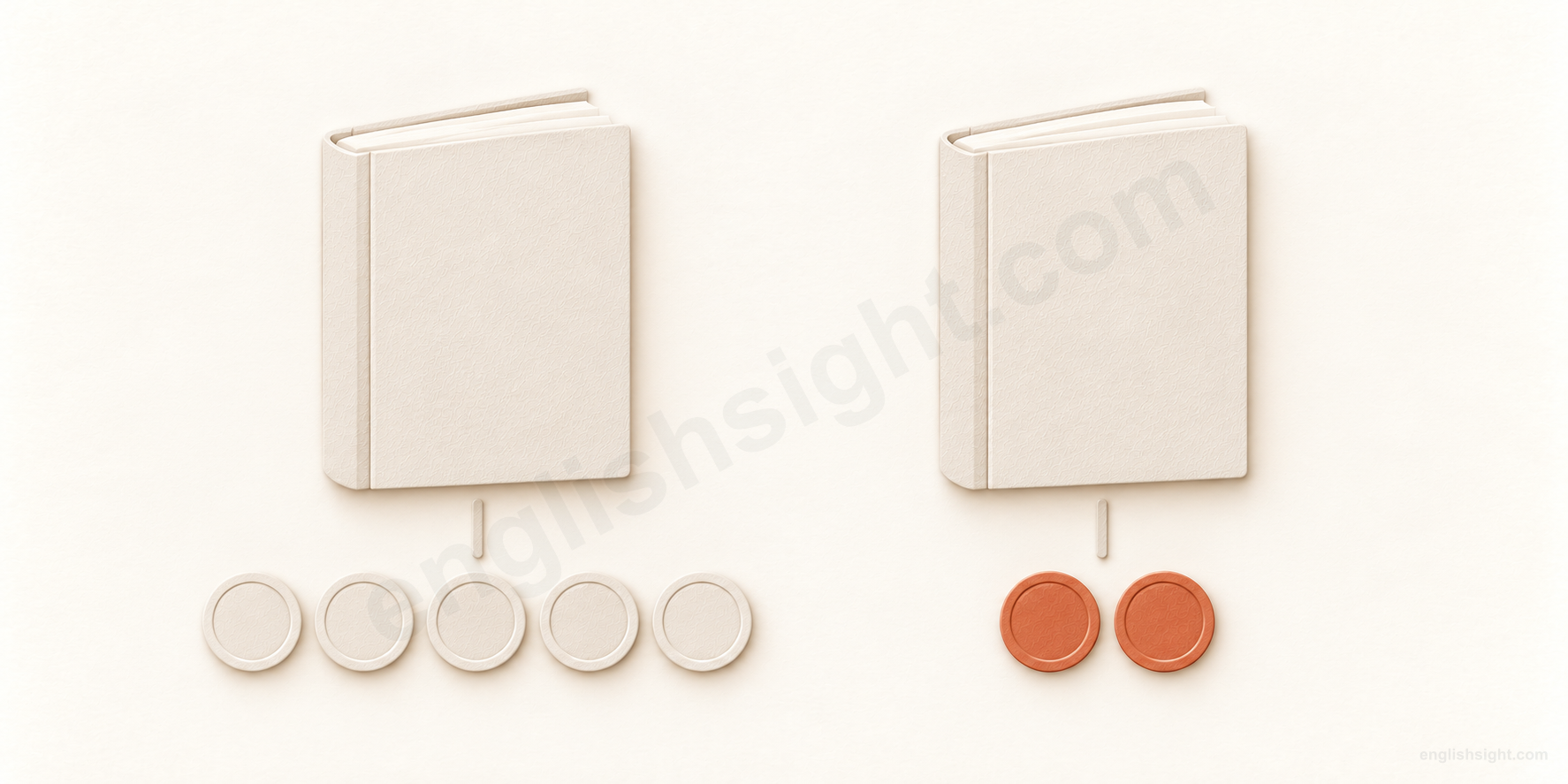
The left book is paired with five coins as a usual or expected cost.
cheap
The right book is paired with only two coins, representing a relatively small cost.
Compare the money needed for the matching books.
Matching books, less money needed: cheap in the price sense. This compares costs, not quality or a change over time.
Compared with similar options or an expected price, little money is needed.
This is a model for the price meaning. The same outline keeps the item in view while the coin groups represent cost; it does not promise equal quality or describe a required price reduction over time.
Cheap often compares a price with what is usual, expected, or offered elsewhere. Start by identifying the thing being priced and the relevant comparison.
Other uses judge quality, effort, generosity, or respect. These links can help you learn, but a price picture cannot predict every established expression.
01
Prices, comparisons, and practical costs
Ask what costs little, which comparison matters, and whether you mean buying something or paying to use it.
01
cheap + noun; subject + be / seem + cheap
cheap tickets / The tickets are cheap.
a small price relative to a relevant standard
Situation / comparison
You compare tickets with the prices you normally pay.
What is being judged?
These tickets require relatively little money.
Cheap compares a cost with a usual, expected, or relevant price.
A cheap ticket describes the ticket before a noun; The ticket is cheap gives the same kind of description after be. The thing being described can be a meal, a flight, a room, or a service.
Ask “cheap compared with what?” A cheap hotel in one city may cost more than a normal hotel elsewhere. The word alone supplies no fixed amount. Cheap does not have to mean poor quality.
In a sentence
We found cheap tickets for the afternoon show.
Watch the difference For a neutral compliment about price, inexpensive avoids the possible suggestion of poor quality. Cheap is not the same as free.
02
cheap + provider noun; provider + be + cheap
a cheap restaurant / shop
a business that charges little
Situation / comparison
You want to eat without spending much.
What is being judged?
You choose a place with low prices.
A cheap business is described through the prices it charges.
The restaurant or hairdresser is the provider, rather than an item you buy. In this use, cheap concerns its charges.
Compare The restaurant is cheap with The meal tastes cheap. The first can recommend the price; the second criticizes the experience. Context can still make a description of the place sound negative.
In a sentence
Is there a cheap restaurant near the station?
Watch the difference Calling a shop cheap does not mean the business itself is being offered for sale.
03
thing + be + cheap to + verb; it + be + cheap to + verb
cheap to run / make / use
a low cost for a specified activity
Situation / comparison
Two printers have similar purchase prices.
What is being judged?
Using one requires less money for ink and electricity.
The infinitive identifies the activity whose cost is low.
The printer is cheap to run means running the printer costs little. The printer is the thing used, not the person doing the running. In It is cheap to print here, it introduces the activity instead.
A machine can be cheap to buy but expensive to run. Keep the purchase cost and continuing cost separate when comparing options.
In a sentence
This little heater is cheap to buy but expensive to run.
Watch the difference Cheap to repair concerns repair costs; it does not say the item rarely breaks.
04
cheaper than + comparison; the cheapest + noun; much / a little cheaper
cheaper than / the cheapest
compare prices or select the lowest one
Situation / comparison
Three available tickets have different prices.
What is being judged?
You identify the least expensive option.
Use cheaper for a comparison and cheapest for the lowest in a set.
The regular forms are cheap, cheaper, cheapest. Than introduces the alternative: The bus is cheaper than the train. Much cheaper describes a large difference; a little cheaper describes a small one.
The cheapest ticket is the lowest-priced ticket in the relevant set. It need not be cheap in an absolute sense: all the tickets might be expensive.
In a sentence
The early train is much cheaper than the evening one.
Watch the difference Use cheaper, not more cheaper. Keep the comparison sensible: ticket with ticket, or mode of travel with mode of travel.
05
cheap enough + for / to; too cheap + to-infinitive
cheap enough / too cheap
judge a price against a purpose or expectation
Situation / comparison
A price seems surprisingly low for the promised product.
What is being judged?
You check the offer before buying.
Enough supplies a sufficient degree; too says the degree exceeds a relevant limit.
Cheap enough for our budget means the price is low enough for what we can spend. In cheap enough for us to buy, for us supplies the buyer and to buy names the intended action.
Too cheap to be genuine expresses suspicion: the price is lower than seems plausible for a real product. It is not a stronger way to praise a bargain. Very cheap can be a neutral description without that warning.
In a sentence
The watch seems too cheap to be genuine.
Watch the difference Put enough after the adjective: cheap enough, not enough cheap. Too cheap is not automatically an error or a bad purchase; the limit comes from context.
06
subject + do / does not come cheap
not come cheap
be expensive to obtain
Situation / comparison
You want a skilled specialist for a difficult job.
What is being judged?
You expect a substantial bill.
The negative expression warns of a high cost.
Good work doesn’t come cheap is a familiar way to say that obtaining it costs a lot. Come belongs to the whole expression; it does not describe someone arriving.
The phrase often explains why something valued is expensive. It does not establish that every expensive service is good, or that a cheaper service must be bad.
In a sentence
Experienced guides don’t come cheap, but we need someone who knows this route.
Watch the difference Keep the negative: comes cheap would not express the same high-price warning.
02
Quality, generosity, and respect
Cheap can criticize an object, a person, or an action. Read the noun and the situation before interpreting the judgment.
A jacket has weak seams and shiny plastic buttons.
What is being judged?
You criticize how it is made or looks.
A low-price association can become a judgment about quality.
In a complaint, cheap material or cheap workmanship criticizes quality. Looks cheap judges appearance; it need not report the actual amount paid.
A coat can be inexpensive without looking cheap. British informal cheap and nasty makes the negative judgment explicit. Cheap and cheerful, covered below, instead accepts a simple, enjoyable result.
In a sentence
The jacket was expensive, but the buttons made it look cheap.
Watch the difference Do not infer the price from looks cheap. The same adjective can evaluate quality without giving a price.
08
cheap + labour / labor; a source of cheap labour
cheap labour / cheap labor
work available to employers at low cost
Situation / comparison
A company compares how much it pays workers.
What is being judged?
It seeks a lower wage bill.
The cost is low from the employer’s viewpoint.
Labour is the usual British spelling; labor is American. Cheap labour concerns what workers are paid or what their work costs. It does not describe their ability.
The phrase can be a practical cost description, but a speaker may use it to criticize exploitation. You need the surrounding facts to know whether unfair pay is being alleged.
In a sentence
The report accuses the company of using students as cheap labour.
Watch the difference Cheap labour is generally uncountable in this meaning. Do not call a person a cheap labour.
09
person + be + cheap; too cheap to + verb
Don’t be cheap.
criticize an unwillingness to spend
Situation / comparison
Someone who can contribute avoids paying their fair share.
What is being judged?
A friend challenges their lack of generosity.
With a person, cheap can criticize spending behavior.
Especially in American English, cheap can mean stingy. It judges willingness to spend, rather than saying the person has little money.
Too cheap to leave a tip means unwilling to spend money on a tip. Compare The meal is too cheap to be good: there the meal’s price, not a person’s generosity, is being judged. Frugal usually presents careful spending more positively.
In a sentence
He is too cheap to contribute even when he can easily afford it.
Watch the difference This is an insulting judgment, not a neutral description of someone on a limited income.
10
make + cheap jokes / remarks / political points
cheap jokes / cheap political points
criticize an unkind or opportunistic remark
Situation / comparison
A speaker mocks someone instead of addressing their argument.
What is being judged?
The audience objects to the tactic.
Cheap can judge the fairness or sincerity of a remark.
A cheap joke may get a reaction by being cruel or obvious. Making cheap political points criticizes gaining an advantage from a situation without a serious or fair argument.
No money needs to be involved. The link with low cost is a teaching comparison: the speaker seeks an easy gain while offering little substance or respect. Learn the evaluative use from its context.
In a sentence
Please answer her question instead of making cheap jokes about her accent.
Watch the difference A cheap joke is not simply a joke that costs nothing to tell.
11
cheap + victory / success noun
a cheap victory
a result achieved with little effort
Situation / comparison
A team wins because its opponent makes repeated avoidable errors.
What is being judged?
The win seems to require little work.
Low cost can refer to effort rather than money.
A cheap victory can be an easy win that costs little effort. The speaker may value it less because it was not strongly contested.
Compare a cheap political point, where the objection may be unfairness or insincerity. Easy success and unethical conduct can overlap, but the adjective alone does not make them identical.
In a sentence
The champions gained a cheap victory after their opponents gave the ball away twice.
Watch the difference Cheap here does not tell you the ticket price or the team’s budget.
12
person + feel + cheap + after / about …
feel cheap
feel ashamed or lowered in your own opinion
Situation / comparison
You realize you treated a friend badly.
What is being judged?
Your judgment of your own behavior falls.
Feel cheap describes shame or a loss of self-respect.
I felt cheap after saying that reports an emotional response to your own conduct. It is different from This fabric feels cheap, which judges a material’s quality.
The evaluation concerns personal worth or behavior, rather than a price. Feeling cheap is possible even when the event involves no spending.
In a sentence
I felt cheap after laughing at a friend’s mistake.
Watch the difference Do not confuse I feel cheap with I’m cheap: the latter can label someone stingy.
03
Established expressions in conversation
Learn the whole expression: its grammar and tone can add more than a simple statement about price.
13
buy / sell / get + object + cheap; for cheap; be going cheap
buy it cheap / for cheap / going cheap
obtain or offer something at a low price
Situation / comparison
Someone offers a used desk for much less than expected.
What is being judged?
You can buy it without spending much.
Cheap can function as an adverb after a buying or selling verb.
I bought it cheap uses cheap to describe the price paid. For cheap is also used, particularly in informal American English. Compare I bought a cheap desk, where cheap describes the noun.
The desk is going cheap means it is on sale at a low price. It does not mean it is physically going somewhere. Cheaply is another adverb: We bought it cheaply. The adjective remains cheap in The desk is cheap.
In a sentence
There’s a used desk going cheap at the office next door.
Watch the difference Do not replace every cheap with cheaply: a cheaply desk and The desk is cheaply are incorrect for these meanings.
14
verb phrase + on the cheap
on the cheap
do or obtain something while spending very little
Situation / comparison
You organize a trip with a small budget.
What is being judged?
You save money on accommodation and meals.
The phrase describes the low-cost way a whole activity is done.
Travel on the cheap describes keeping the cost down. Have repairs done on the cheap can suggest that quality suffered, especially in a complaint.
The phrase is informal. It does not always criticize: a guide to eating well on the cheap can be helpful advice. Compare cheaply made, which often raises a quality concern.
In a sentence
We travelled on the cheap by staying with friends and cooking together.
Watch the difference Keep the whole phrase on the cheap; on cheap is not the expression.
15
cheap and cheerful + noun; be + cheap and cheerful
cheap and cheerful
inexpensive but enjoyable or satisfactory
Situation / comparison
You need a simple meal rather than luxury.
What is being judged?
You enjoy an inexpensive, unpretentious place.
This British expression makes a positive judgment despite modest cost.
Cheap and cheerful accepts simplicity while saying that the food, service, or experience is pleasant. The whole phrase prevents cheap from sounding like an automatic complaint.
Contrast cheap and nasty, which is a negative judgment about poor quality. Cheerful here can describe the overall experience; it does not require the item itself to express an emotion.
In a sentence
We chose a cheap and cheerful café for lunch.
Watch the difference This expression is especially British. It praises a modest option, without promising luxury.
16
be + dirt cheap; be + (as) cheap as chips
dirt cheap / (as) cheap as chips
emphasize a very low price
Situation / comparison
An offer costs far less than you expected.
What is being judged?
You react to the bargain enthusiastically.
Fixed comparisons can strengthen cheap without describing literal dirt or food.
Dirt cheap is informal and strongly emphasizes a low price. Dirt is part of the expression; the goods need not be dirty or used.
Cheap as chips, also as cheap as chips, is British informal wording for something inexpensive or good value. Neither expression guarantees durability or suitability. That still needs checking.
In a sentence
The notebooks were dirt cheap, so I bought a few for the class.
Watch the difference Use dirt cheap, not dirty cheap. Treat chips as part of the fixed comparison.
17
be / would be + cheap at twice the price
cheap at twice the price
praise exceptionally good value
Situation / comparison
A useful chair costs much less than you think it is worth.
What is being judged?
You say even twice that amount would be a bargain.
The imagined higher price strengthens the praise of the actual deal.
It would be cheap at twice the price means you judge the current price extremely good value. You imagine paying twice as much and still being satisfied.
This is an emphatic expression of an opinion, not a request to pay more. The value depends on what the speaker thinks the item offers.
In a sentence
This sturdy chair cost only ten pounds; it would be cheap at twice the price.
Watch the difference Twice describes the imagined comparison. It does not announce that the seller has doubled the price.
18
cheap at half the price
cheap at half the price
humorously complain that something is very expensive
Situation / comparison
A sandwich costs far more than you think reasonable.
What is being judged?
You react with a humorous, critical expression.
The established humorous expression reverses the apparent praise of cheap.
Cambridge records cheap at half the price as humorous wording for something very expensive. The speaker is making a price complaint, rather than praising a bargain.
Compare cheap at twice the price, which can sincerely praise good value. Do not mechanically substitute half for twice and assume the same message. Tone and the whole fixed expression matter.
In a sentence
“Eighty pounds for a sandwich? Cheap at half the price!” she joked.
Watch the difference The word cheap does not make this a sincere claim that the price is low. Read the humorous complaint as a whole.
19
seek / provide + cheap thrills; dismiss + something + as cheap thrills
cheap thrills
excitement judged to have little real value
Situation / comparison
A film relies on sudden shocks instead of developing its story.
What is being judged?
A reviewer criticizes the excitement as shallow.
Cheap can judge the value of the excitement rather than its monetary cost.
In this evaluative use, cheap thrills are moments of excitement or pleasure that the speaker regards as lacking substance. Thrills names the exciting experiences; cheap supplies the dismissive judgment.
A reviewer can criticize an expensive film for providing cheap thrills. The phrase does not establish the ticket price. Learn this collocation alongside the quality and value judgments, rather than treating the coin picture as a literal explanation.
In a sentence
The reviewer dismissed the film’s sudden shocks as cheap thrills.
Watch the difference In this use, cheap thrills is a criticism of the experience’s value, not a neutral synonym for inexpensive entertainment.
20
Talk is cheap.; promises / words + be + cheap
Talk is cheap.
promising is easy; action matters more
Situation / comparison
Someone repeatedly promises help without doing anything.
What is being judged?
You ask them to demonstrate commitment.
The saying contrasts easy words with the effort of following through.
Talk is cheap challenges words that have not been backed by action. It need not mean speaking costs no telephone charges.
Promises are cheap uses the same contrast. The criticism is directed at unsupported promises, rather than at all conversation. The saying can sound impatient, so consider the relationship and tone.
In a sentence
“I’ll help next time.” “Talk is cheap—could you start by carrying this box?”
Watch the difference Do not interpret cheap here as a positive recommendation for a low-cost service.
21
take + a cheap shot + at + person; a cheap shot
take a cheap shot at someone
make an unfair attack or strike a vulnerable opponent
Situation / comparison
A colleague attacks someone’s private troubles during a work disagreement.
What is being judged?
Others object to the unfair personal attack.
The target is vulnerable, and the attack takes advantage of that.
A cheap shot can be a remark that exploits a known weakness instead of making a fair point. Take a cheap shot at someone names the target after at.
In contact sports, a cheap shot can be an intentionally rough hit against an opponent who cannot defend themselves. The physical and verbal uses share unfair advantage, rather than a low ticket price.
In a sentence
Bringing up her family problems was a cheap shot; we were discussing the budget.
Watch the difference Shot is part of a noun phrase here. Take a cheap shot is not a separable phrasal verb.
22
life + be + cheap; life + become + cheap
life is cheap
people’s lives are treated as having little value
Situation / comparison
A story depicts people being killed with little concern from those in power.
What is being judged?
A reviewer condemns the lack of respect for human life.
The phrase criticizes how life is valued, rather than what living costs.
Life is cheap describes a situation in which deaths attract little care. It is a serious, negative evaluation of how people are treated.
Compare Life is cheap here with Living is cheap here. The second can mean daily expenses are low; the first usually makes a grave point about human life.
In a sentence
The novel portrays a brutal society where life is cheap.
Watch the difference Use Living is cheap here if you mean low living costs; Life is cheap may convey something very different.
23
cheap out; cheap out on + noun
cheap out (on something)
save money by spending less than you should
Situation / comparison
A necessary repair needs reliable parts.
What is being judged?
Someone buys unsuitable parts just to avoid the cost.
Cheap out criticizes a saving that goes too far.
This informal verb expression describes choosing inadequate spending. On introduces the thing receiving too little money: cheap out on materials. You can also say Don’t cheap out without naming it.
Forms include cheaped out and cheaping out. Unlike The parts are cheap, the verb expression describes someone’s decision. It normally carries criticism, not praise for efficient shopping.
In a sentence
Don’t cheap out on the parts we need for the repair.
Watch the difference Say cheap out on it, not cheap it out: it is not a separable verb taking that object.
Price, quality, and respect are different judgments
Choose the comparison
Cheap is relative to a setting or expectation. Affordable concerns what someone can manage to pay. Good value weighs what you get against the price. An inexpensive item can still be unaffordable to a particular buyer.
The noun changes the judgment
A cheap meal may be welcome; cheap material may criticize quality; a cheap person may mean someone stingy. Applying cheap to someone’s appearance can also be a derogatory judgment, including a sexualized one. Avoid it as a casual compliment.
Forms and word class
Pronunciation is /tʃiːp/. Use cheaper and cheapest. Cheap is mainly an adjective, but buy cheap uses it as an adverb. Cheaply can describe manner or cost, and cheaply made can criticize construction. Cheapness is a noun. The ordinary adjective has no tense, passive, or causative pattern; the informal verb cheap out is a separate established expression.
Limits of the price picture
The diagram explains one comparison, not a rule that low price always means low worth. Talk is cheap, feel cheap, and cheap shot need their own context. The connections here are teaching aids, not a claim that every speaker sees the same mental picture.
Read what cheap is judging
Identify the subject, the comparison, and any fixed expression.
1. An expensive jacket has weak seams and plastic buttons. You say it looks cheap. What are you judging?
2. A heater is cheap to buy but expensive to run. Which interpretation fits?
3. A friend can easily afford to contribute but refuses. Someone says “Don’t be cheap.” What is the criticism?
4. You want to say food and rent cost little in your town. Which sentence clearly expresses that?
5. You warn someone not to save money by choosing inadequate repair parts. Which pattern works?
6. All the available rooms are expensive, but one costs less than the others. Which claim is guaranteed?
7. Which expression can sincerely praise a bargain even at an imagined higher cost?
Sources and teaching notes
The sources below support the usages. Explanations and examples are original; the diagram is a teaching comparison rather than evidence about every speaker’s mental imagery.
This comparison is a teaching aid, not a picture shared by every English speaker.