Talk about cheese as food, count portions and kinds, and recognize familiar expressions.
Same food, different portions
Portions change; the food remains cheese
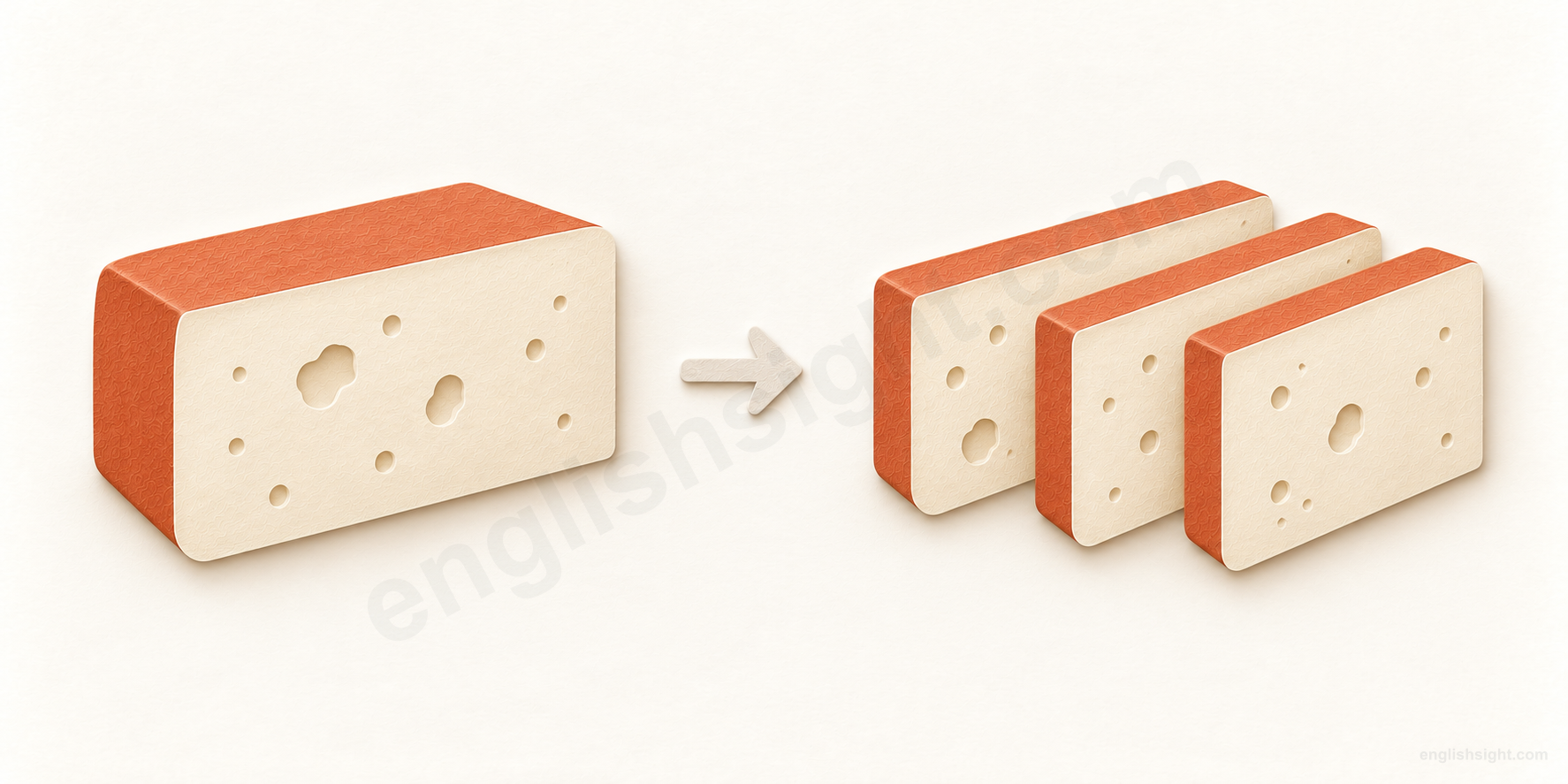
One larger block of cheese.
cheese
Three slices of the same cheese.
Cut the cheese into portions.
The portions change; the food remains cheese. Firm cheese with holes is one example.
Cheese is a milk-based food: cutting it into portions changes the pieces, not what the food is.
The sketch uses one firm cheese as an example. It explains the food-and-portions distinction; it does not claim that all cheese is firm or that fixed expressions develop from cutting it.
Cheese is a food usually made from milk. It can be soft or firm, and it comes in many forms. You can ask for some cheese, count slices of cheese, or compare different cheeses.
The most useful starting point is the distinction between a substance and what you choose to count. Photographic cues and idioms belong to separate conventional uses, not to a hidden rule about dairy food.
01
Food, portions, and kinds
Start with the food itself. Then decide whether you mean an amount, a portion, a variety, or a whole cheese.
01
cheese; some / any / a little + cheese; the cheese + singular verb
some cheese
the food, considered as a substance
Situation / starting point
You are planning a snack.
What you express
You ask whether any cheese is available.
The noun can name food without counting separate objects.
Cheese /tʃiːz/ is ordinarily a noun. For the food in general, use uncountable cheese: I like cheese. To ask for an unspecified amount, use some cheese or a little cheese.
In Is there any cheese left?, any asks about availability. The cheese in the fridge means a particular supply; the does not make an uncountable noun countable. Say The cheese is cold.
The diagram follows the same food from a larger piece to smaller portions. That is a guide to the substance use, not an explanation of the unrelated fixed expressions later in the lesson.
Example
Is there any cheese left in the fridge?
Watch the difference For an ordinary amount, say some cheese, not a cheese. Use How much cheese?, not How many cheese?.
02
a / two + portion noun(s) + of cheese; a weight + of cheese
a slice / piece / block of cheese
count or measure a portion of the food
Situation / starting point
One block is ready to serve.
What you express
You cut the required number of slices.
Count the portions while cheese still names their material.
A piece of cheese is general. A slice is a relatively thin, flat piece; a block is a larger solid shape. A wedge has a narrowing shape, and a chunk is a thick piece. Choose the portion word that fits what you mean.
In two slices of cheese, slices carries the plural ending. For weight, ask for 200 grams of cheese. These forms distinguish an amount of food from two kinds of cheese.
Cutting a block produces portions of the same cheese, as in the sketch. This does not mean that all cheeses come in blocks: soft cheese can be served from a container.
Example
Please put two slices of cheese in my sandwich.
Watch the difference Two cheeses normally suggests varieties or whole cheeses; use two pieces of cheese for two ordinary portions.
03
a + description + cheese; different / several + cheeses; a whole cheese
a cheese / several cheeses
count varieties or whole cheeses
Situation / starting point
A shop offers different products.
What you express
You identify three kinds to taste.
Countable cheese changes what is counted: a kind or a whole unit.
A cheese can mean one variety, and cheeses can mean different varieties. A mild cheese names a kind with a mild flavor; French cheeses identifies varieties from France.
A cheese can also be one complete cheese made as a unit, such as a small round cheese. Three whole cheeses need not be three different varieties. Context tells you whether the count concerns kinds or complete units.
Cheddar cheese, blue cheese, cream cheese, cottage cheese, and goat’s cheese are useful names to recognize when shopping. Learning names of types does not require counting each slice as a cheese.
Example
We tasted three local cheeses at the market.
Watch the difference A cheese is possible, but it does not usually mean one unspecified slice. Ask which kind or size if an order is unclear.
02
Preparing and ordering food
Verbs, preparation words, and neighboring nouns explain what to do with the cheese and how it fits into a meal.
describe how cheese is prepared or its current state
Situation / starting point
You are following a recipe.
What you express
The cheese is ready to add to the dish.
The preparation word supplies the change; cheese names the ingredient.
Grate cheese means reduce it to small shreds using a grater; slice cheese means cut it into thin pieces. Grated cheese and sliced cheese describe the resulting preparation.
Melt the cheese tells someone to heat it until it becomes soft or liquid; the cheese has melted describes a change in the cheese itself. Melted cheese describes its resulting state. Not every type melts in the same way.
Compare Cut the cheese into cubes, a normal cooking instruction, with the slang expression cut the cheese below. The cooking situation and into cubes make the literal action clear.
Example
Sprinkle grated cheese over the hot pasta.
Watch the difference Cheese is the ingredient, not a general cooking verb: say grate the cheese rather than cheese it when you mean use a grater.
05
cheese + food / tool noun; cheese on + food; with / without cheese
a cheese sandwich / cheese on toast
identify a dish, ingredient, or accompaniment
Situation / starting point
You choose something for lunch.
What you express
You specify which food contains the cheese.
The surrounding noun or preposition defines the food relationship.
In a cheese sandwich or cheese sauce, cheese comes before another noun and tells you about its ingredient. The second noun controls ordinary counting: one cheese sandwich, two cheese sandwiches.
Cheese on toast usually means toasted bread covered with melted cheese. Bread and cheese lists two foods together. A burger with cheese includes cheese; without cheese excludes it. These prepositions keep their normal meanings.
A cheese knife is a tool for cheese, so cheese before a noun does not always mean made from cheese. Read the whole noun phrase rather than applying one rule to every combination.
Example
Could I have a cheese sandwich without butter?
Watch the difference Use the singular form in the usual modifier: cheese sandwiches, not cheeses sandwiches.
03
Photographs and fixed expressions
These expressions have conventional functions or separate slang senses. Learn their wording, situation, and tone; the food diagram cannot predict them.
06
Say cheese!; Cheese!; ask someone to say cheese
Say cheese!
ask people to smile for a photograph
Situation / starting point
People face a camera.
What you express
The photographer gives a cue for a smile.
The whole expression is a photographic cue, not a food request.
A photographer may say Say cheese! or simply Cheese! just before taking a picture. The instruction invites a smile; nobody is asking the group to bring or eat cheese.
This is a conventional expression. The food-and-portions model does not predict its communicative function. In a report, say The photographer asked us to say cheese.
Example
Everyone, look at the camera and say cheese!
Watch the difference This is a playful cue for photographs, not a general instruction meaning be happy.
07
a / the big cheese; one of the big cheeses
a big cheese
an important person in an organization
Situation / starting point
Someone with influence arrives at the office.
What you express
A colleague jokingly describes the person’s status.
Big cheese is an informal label for a person, not a size of food.
A big cheese is someone influential or senior, especially within an organization. The expression is informal and humorous, and can sound teasing or dismissive in context.
You can say one of the big cheeses when referring to several influential people. In a formal introduction, use the person’s actual role, such as director. This is an established idiom, not a rule that cheese means boss in ordinary sentences.
Example
One of the big cheeses from head office is visiting tomorrow.
Watch the difference Big describes status in this idiom, not the person’s body size; avoid using it as a respectful job title.
08
be (like) chalk and cheese; be as different as chalk and cheese
like chalk and cheese
very different from each other
Situation / starting point
Two siblings have very different habits.
What you express
You emphasize the contrast between them.
The comparison concerns difference, not liking or disliking cheese.
In British English, two people or things can be like chalk and cheese, or as different as chalk and cheese. The idiom emphasizes how unlike each other they are.
They’re chalk and cheese is another form. The expression does not itself tell you that they hate each other or that one is better. Add details to explain which differences matter.
Example
The twins are like chalk and cheese: one plans everything, and the other decides at the last minute.
Watch the difference Use and inside the fixed expression. Chalk or cheese is not the usual idiom for a comparison.
09
Hard cheese!
Hard cheese!
respond to bad luck, often with ironic sympathy
Situation / starting point
Someone complains about an inconvenience.
What you express
A speaker offers a dismissive response.
The fixed exclamation can sound unsympathetic.
Hard cheese! is a British informal expression responding to someone’s misfortune. It can amount to That’s bad luck, but is often ironic: the speaker may show little real sympathy.
If a friend has a serious problem, I’m sorry to hear that is a clearer sympathetic response. Hard cheese in a recipe or shop can simply describe firm cheese; the conversational context creates the idiomatic reading.
Example
“They won’t let me change my ticket.” “Hard cheese!”
Watch the difference This regional expression is useful to recognize; do not assume it is a kind response to upsetting news.
10
be / get cheesed off; be cheesed off with / by + cause
be cheesed off with…
be annoyed, fed up, or disappointed
Situation / starting point
A problem keeps interrupting your work.
What you express
You express irritation about it.
Cheesed off describes a feeling; with can introduce its cause.
Cheesed off is an informal expression associated especially with British English. Be cheesed off describes the state; get cheesed off describes becoming annoyed or fed up.
You can be cheesed off with a situation or cheesed off by what happened. The -ed form belongs to this established expression; it does not describe cheese becoming old or spoiled.
Annoyed is a neutral alternative. Fed up is another informal expression for being tired of an unpleasant situation. Learn cheesed off as a whole rather than using cheese as a freely interchangeable verb meaning annoy.
Example
I’m cheesed off with these constant delays.
Watch the difference Keep off for this expression. Cheesy is a different adjective, not another form meaning annoyed.
11
cut the cheese (American slang)
cut the cheese
pass gas, in slang
Situation / starting point
People hear or notice someone passing gas.
What you express
A speaker makes a crude joke about it.
The slang reading has nothing to do with cutting a food portion.
In American slang, cut the cheese can mean pass gas from the body. It is a crude, joking expression, useful to recognize in informal dialogue.
At the dinner table, Please cut the cheese into smaller pieces is an ordinary food request. The words alone do not force the slang meaning; the surrounding situation determines it. Pass gas is a more neutral description of the bodily action.
Example
The boys laughed and asked who had cut the cheese.
Watch the difference Avoid the slang expression in formal or polite conversation. It is not the meaning of every sentence containing cut and cheese.
12
cheese (slang mass noun); cheesy + film / song / grin
cinematic cheese
cheap or poor-quality entertainment, in a dismissive description
Situation / starting point
You discuss a film full of weak effects and predictable scenes.
What you express
You dismiss its quality with a slang noun.
A separate evaluative use judges the material rather than naming food.
Cheese can be a slang noun for material regarded as cheap or shabby. In cinematic cheese, the speaker is judging the film’s quality. This secondary use is included for recognition, not as a recommended neutral review term.
The related adjective cheesy is more useful to distinguish: a cheesy film can seem poor, unoriginal, or embarrassingly sentimental; a cheesy grin can look exaggerated or insincere. Cheesy can also literally describe a cheese taste or smell.
These are judgments shaped by context. A viewer may enjoy a cheesy film despite its faults. Neither the noun nor adjective gives an objective quality measurement, and the food diagram does not derive these meanings.
Example
The film is pure cinematic cheese, but we enjoyed it.
Watch the difference Cheese is the noun here; cheesy is an adjective. This evaluative use does not mean that real cheese tastes bad.
Choose the count and read the whole expression
Pronunciation and grammatical role
Cheese /tʃiːz/ ends with a voiced /z/ sound. The plural is cheeses. Most uses here are nouns; cheese in cheese sandwich modifies a noun. Say cheese is an instruction with say as the verb; cheesed off is an established adjective expression.
A useful model with limits
A cut portion remains cheese, but the model does not predict big cheese, say cheese, or other fixed expressions. The sketch is a learning aid, not a claim about an image shared by all native speakers.
Scope of this lesson
Start by using the food patterns and recognizing the expressions. Technical senses based on shape, historical stop-related verb uses, and specialized slang are outside the active beginner vocabulary taught here.
Choose the meaning that fits
Check what is being counted and whether the situation concerns food or a fixed expression.
1. You want two thin portions of the same cheese in a sandwich. Which request is clearest?
2. A menu offers five cheeses from different farms, each a different variety. What is being counted?
3. A photographer says “Cheese!” just before a group photo. What is the intended response?
4. A colleague calls the visiting director “a big cheese.” What does the expression describe?
5. A cook says “Cut the cheese into cubes for the salad.” Which interpretation fits?
6. Your British friend says “I’m cheesed off with all these delays.” How does the friend feel?
Sources and teaching notes
Dictionary entries support the usage descriptions below. The explanations, examples, and food-and-portions sketch were written for this lesson; the sketch is a teaching aid.
The diagram explains one distinction; it does not represent a mental picture shared by every native speaker.