Use chemical to name a substance or connect something with chemistry.
Connect the substance with its chemistry
Connect the substance with its chemistry
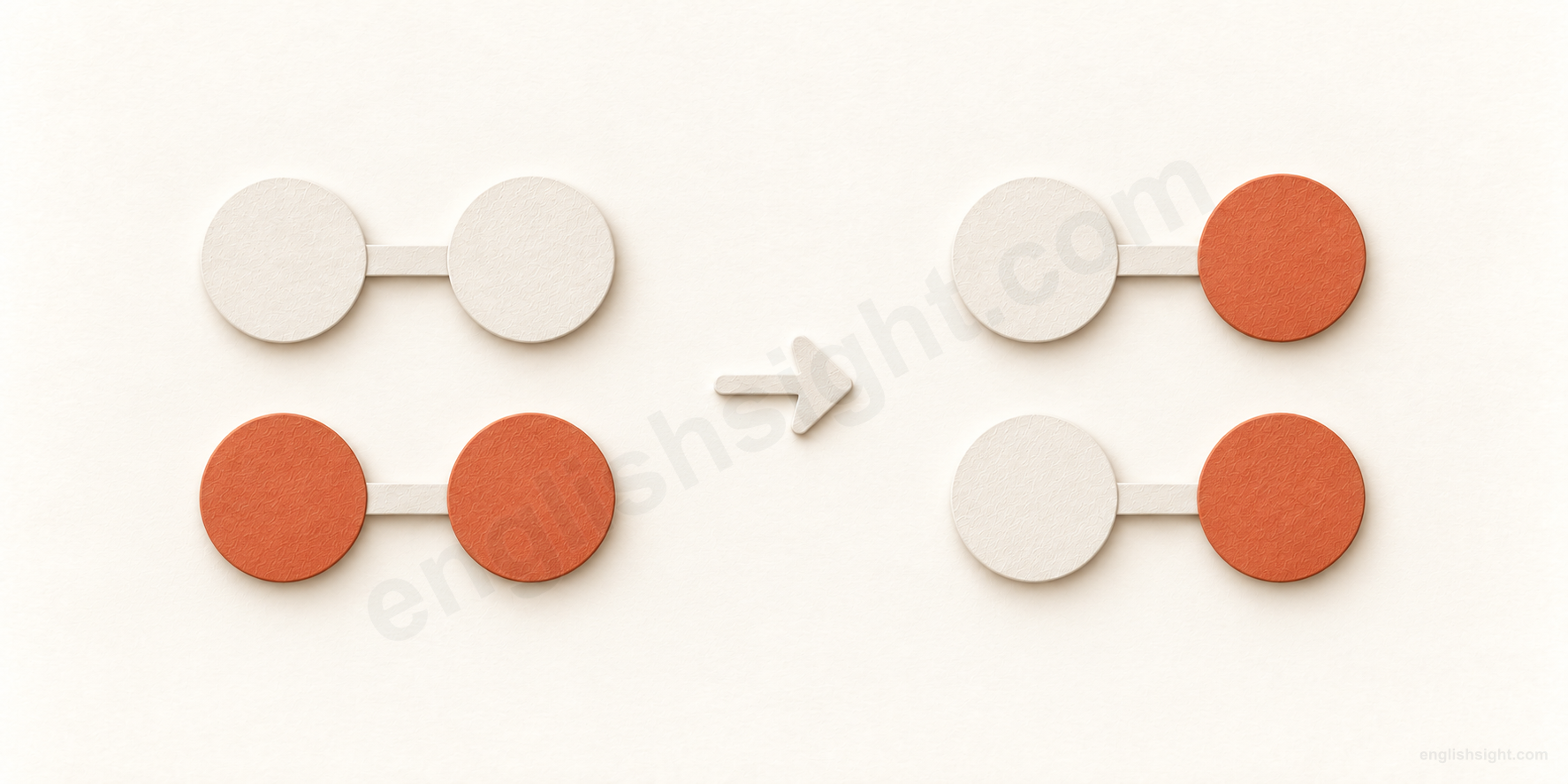
Two ivory atoms are bonded together, and two orange atoms are bonded together.
chemical
Each new pair contains one ivory atom bonded to one orange atom.
A reaction rearranges the bonds while keeping the same atoms.
A reaction can change which atoms are bonded, forming different substances. This simplified model illustrates one aspect of chemical.
Chemical connects substances with their composition, properties, and reactions; as a noun it names a substance, and as an adjective it describes that connection.
The sketch illustrates a chemical reaction through changed bonds. It does not imply that every chemical is reacting, that every substance consists of simple molecules, or that chemical means artificial or poisonous.
A chemical is a substance; chemical before another noun describes a connection with chemistry, substances, or their effects. The rest of the phrase tells you whether you mean a reaction, an industry, or a method.
A useful learning connection is to look beneath a material’s visible shape to its composition and behavior. This is a teaching model, not a claim that every English speaker sees the same mental picture.
01
Naming substances
As a noun, chemical names a substance. Quantity, origin, and danger require additional words or context.
01
a / this + chemical; several / many + chemicals; contain / use / produce + a chemical
a chemical / chemicals
name a substance used in or produced through chemistry
Starting context
A laboratory receives a sample.
What you express
The report identifies a substance in it.
The noun names the substance, not the science or its container.
A chemical is a substance considered in terms of chemistry, especially one made or used in a process. It can be a solid, a liquid, or a gas. The word does not tell you which physical form it has.
This is an ordinary countable noun: a chemical, one chemical, several chemicals. Three chemicals usually means three different substances or kinds, not three drops or three bottles. Use some of this chemical for an unspecified quantity of one substance.
In The cleaner contains two chemicals, the cleaner is the product and the chemicals are substances in it. A product can be a mixture; chemical is not simply another word for bottle or cleaning product.
In a sentence
The test detected a chemical in the water sample.
Watch the difference Say a chemical for one substance and chemicals for more than one; do not use a chemicals.
02
natural / synthetic + chemical(s); chemicals in + body / material
natural / synthetic chemicals; chemicals in the body
describe origin or location without changing the noun’s basic meaning
Starting context
You compare a plant substance with a laboratory-made version.
What you express
You describe where each comes from.
A chemical can occur naturally; it need not come from a factory.
Natural chemicals occur in nature; synthetic chemicals are made through synthesis. These modifiers tell you about origin or production. They are not built into the meaning of chemical itself.
Chemicals in the body refers to substances present or active there. For example, hormones can act as chemical messengers: the substance carries a signal. This use does not mean someone has swallowed an industrial product.
Everyday discussions of farming or cleaning sometimes use chemicals to mean the manufactured substances relevant to that setting. Read the context, but do not turn that narrower conversational use into a scientific definition.
In a sentence
The plant produces a chemical that helps protect its leaves.
Watch the difference Natural and chemical are not opposites. Neither origin word by itself establishes safety.
03
toxic / harmful / hazardous + chemicals; exposure to + a chemical / chemicals; chemical burns
toxic / harmful / hazardous chemicals
specify a harmful property or a danger
Starting context
A report identifies substances at a work site.
What you express
It distinguishes those described as dangerous.
The added adjective supplies the warning; chemical alone does not mean poison.
Toxic chemicals are poisonous substances. Harmful chemicals can cause harm, while hazardous chemicals present a danger. These descriptions overlap, but they are not interchangeable in every technical classification.
Household chemicals and industrial chemicals classify substances by their setting or use. Household does not mean harmless, and industrial does not itself mean poisonous. The words answer different questions.
Exposure to a chemical describes contact with it, for example through air or skin. It does not by itself say that injury occurred. This is a language distinction, not an assessment of any particular substance.
A chemical burn is an injury caused by a chemical substance. Here chemical identifies the cause of the burn. In The liquid caused chemical burns, burns names the injuries; the phrase does not mean that every chemical burns skin.
In a sentence
The report lists the hazardous chemicals stored at the site.
Watch the difference Do not infer toxicity merely from the label chemical, or assume that every exposure causes injury.
02
Describing substances and changes
As an adjective, chemical connects the following noun with chemistry. A reaction, a formula, and a property each describe a different aspect.
04
chemical + noun: analysis / test / process
chemical analysis / a chemical test
relate an activity or description to chemistry
Starting context
You want to identify what a sample contains.
What you express
You describe the kind of analysis used.
Before another noun, chemical usually describes a connection with chemistry.
Chemical analysis examines substances using chemistry. In a chemical test, chemical describes the test; it is not the thing being counted. A chemical is a noun phrase naming a substance, whereas a chemical test names a test.
Compare a physical test of a material’s strength with chemical analysis of its ingredients. Chemical selects the relevant aspect or method. It does not always announce that a new substance is being created.
Chemical is normally a classifying adjective here: chemical tests, not chemicals tests. In ordinary descriptions, more toxic or more reactive is usually clearer than more chemical if you mean greater danger or reactivity.
In a sentence
The laboratory carried out chemical analysis of the powder.
Watch the difference Use chemical analysis for the activity. A chemical analysis can name one particular analysis; a chemical names a substance.
05
a chemical reaction takes place; cause / trigger + a chemical reaction; undergo + chemical change
a chemical reaction / chemical change
describe a change that forms different substances
Starting context
Substances have one arrangement of atoms.
What you express
A reaction produces a different arrangement and different substances.
The diagram’s changing bonds illustrate a reaction, not mere movement or mixing.
A chemical reaction changes substances into other substances through changes at the level of atoms, molecules, or ions. A chemical change emphasizes this change in what substances are present. Rust forming on iron is an everyday example.
A physical change, such as ice melting, can change form or state without producing a different substance. Do not call every change of shape, every bubble, or every act of mixing a chemical reaction merely because it is visible.
We say a reaction happens or takes place; something can cause or trigger a reaction. The verb supplies that action. Chemical describes the kind of reaction and does not function as a verb.
A chemical bond is an attraction holding atoms together. The lines between circles in the sketch represent bonds, not paths along which atoms travel. Two same-kind pairs become two mixed pairs; each kind of atom is conserved. The sketch is a simplified reaction model, not a claim that atoms always come in pairs.
In a sentence
Rust forms when iron undergoes a chemical change.
Watch the difference Chemical reactions do not all involve flames, a laboratory, or a dramatic visible effect.
06
the chemical composition / structure / properties of + substance / material
chemical composition / structure / properties
distinguish what something contains, how it is arranged, and how it behaves
Starting context
Two samples look alike.
What you express
You compare their underlying substances and characteristics.
Appearance alone does not establish chemical identity.
Chemical composition concerns which substances or elements are present and in what proportions. Chemical structure concerns their arrangement and bonding. Chemical properties concern behavior in chemical contexts, such as how a substance reacts.
These are related descriptions, not three freely interchangeable names for appearance. Two materials can look alike yet differ in composition; identifying a color alone does not give their chemical structure.
Chemical makeup is another way to talk about composition. In this phrase makeup means what something consists of, not cosmetics.
In a sentence
The two liquids have different chemical compositions despite their similar color.
Watch the difference Choose composition for what is present, structure for arrangement, and properties for characteristics.
07
a chemical element / compound; the chemical formula for + substance
chemical element / compound / formula
name a type of substance or the notation used to describe it
Starting context
A class discusses oxygen and water.
What you express
It distinguishes an element, a compound, and its written formula.
The following noun tells you whether you mean a substance or a representation.
A chemical element consists of one type of atom. A chemical compound contains atoms of different elements chemically combined in fixed proportions. Oxygen is an element; water is a compound. A compound is not simply any mixture of substances.
A chemical formula uses symbols to represent composition: H2O is the formula for water. It is a written representation, not a sample of water and not necessarily a complete picture of molecular structure.
Chemical remains singular in these adjective combinations: chemical elements and chemical compounds. The head noun takes the plural ending.
In a sentence
H2O is the chemical formula for water.
Watch the difference Do not confuse an element, a compound, and a mixture, or call a formula a physical substance.
08
chemical energy; convert chemical energy into + another form of energy
chemical energy
describe energy associated with chemical substances and reactions
Starting context
A battery contains substances that can react.
What you express
Its reactions make energy available to power a device.
Chemical energy describes energy associated with chemical arrangements, not a separate liquid ingredient.
Chemical energy is energy associated with the chemical makeup of substances and changes in that makeup. We talk about chemical energy in fuels, food, or batteries. The noun energy is normally uncountable in this use.
A battery can convert chemical energy into electrical energy. Convert and into express the transformation; chemical and electrical identify the forms being compared.
The word chemical does not mean that every reaction releases usable energy. Reactions involve energy changes, and some require an energy input.
In a sentence
The battery converts chemical energy into electrical energy.
Watch the difference Say chemical energy, not a chemical energy when referring to energy in general.
03
Products, work, and public information
Read the following noun carefully: chemical can describe an industry, a method, waste, or a weapon. These are established combinations, not phrasal verbs.
09
the chemical industry; a chemical company / factory / plant; chemical engineering
chemical industry / company / plant
talk about businesses and places that make chemicals
Starting context
You discuss where substances are manufactured.
What you express
You identify an industry or a factory.
In chemical plant, plant means a factory rather than a living organism.
The chemical industry is the sector involved in making chemicals. A chemical company is a business in that sector. A chemical plant is an industrial facility that produces chemicals.
Context distinguishes a plant that produces a chemical naturally from a chemical plant that manufactures substances. The first plant can be a living organism; the established combination chemical plant means a factory.
A chemical engineer works with chemical processes and their practical design or operation. Chemical engineering names the field. These combinations name occupations and activities, not a special new sense meaning a person.
You may also see a chemicals company. In that wording chemicals is a plural noun used before company, naming the products the business deals in. It is not a plural form of the adjective chemical. Both chemical company and chemicals company are established expressions.
In a sentence
A new chemical plant opened outside the town.
Watch the difference Do not read chemical plant as a particular kind of tree or flower.
10
chemical treatment of + material; treat + material + with + a chemical; chemical fertilizer / pesticide
chemical treatment / chemical fertilizer
describe a method or product that uses chemicals
Starting context
A process uses substances to achieve a practical effect.
What you express
You describe that method or product as chemical.
Chemical can identify the means used, rather than the material being treated.
Chemical treatment is treatment using chemicals. The treatment of water, for example, describes the water as the thing treated. Chemical describes the method, not a claim that the water was previously free of substances.
Chemical fertilizer and chemical pesticides are familiar farming combinations. In these contexts chemical often highlights manufactured products, in contrast with other methods or naturally sourced materials. This contrast is contextual, not a rule that natural materials have no chemistry.
Fertiliser is the British spelling of fertilizer. In chemical treatment, treatment names the process; a treatment can mean one particular application or method.
In a sentence
The report compares chemical treatment with filtering the water.
Watch the difference The phrase describes how treatment works; it does not by itself say whether the method is suitable or safe.
11
a chemical spill; chemical waste / pollution; chemical residue
chemical spill / waste / pollution
describe an accidental release, unwanted material, or environmental contamination
Starting context
A substance escapes from an industrial container.
What you express
People describe the release and its possible consequences.
Spill, waste, and pollution describe different stages or aspects of a situation.
A chemical spill is an accidental release of chemicals, especially liquid chemicals. Chemical waste is unwanted material from processes involving chemicals. Chemical pollution describes contamination involving such substances.
Spill is countable: a spill, two spills. Waste and pollution are normally uncountable in general discussion: chemical waste, not a chemical waste for an unspecified amount. Specialist classifications may use wastes for different types.
Chemical residue is material left behind after a process or use. Residue does not necessarily mean an accidental spill; the following noun carries that distinction.
In a sentence
The chemical spill polluted a nearby stream.
Watch the difference Not every piece of chemical waste comes from a spill, and residue does not automatically mean pollution.
12
a chemical weapon / attack; chemical weapons; chemical warfare
chemical weapons / chemical attack
recognize a specific harmful use in news and history
Starting context
A news report discusses a kind of weapon.
What you express
Chemical specifies the means used to injure people.
This established combination involves toxic substances used as weapons.
Chemical weapons use poisonous chemicals to injure or kill. Chemical warfare describes warfare using such weapons; a chemical attack is an attack using them. These combinations occur in news and historical discussion.
The harmful purpose comes from the whole expression and context. A chemical weapon is not every object made of chemicals, and an ordinary chemical reaction is not automatically an attack.
Compare a chemical accident, which describes an unintended event. The words attack and accident cannot be substituted merely because chemicals are involved.
In a sentence
The documentary discusses the use of chemical weapons.
Watch the difference Do not transfer this specialized harmful meaning to every use of the adjective chemical.
04
Choose the right word form
The substance, the field of study, and the way something is done require different forms.
13
study chemistry; a chemical process; chemically + treated / produced
chemical / chemistry / chemically
choose a substance, a field, an adjective, or an adverb
Starting context
You decide whether to name a subject or describe a process.
What you express
You select the form that fits the sentence.
Chemical, chemistry, and chemically do different grammatical jobs.
Chemistry names the science: She studies chemistry. Chemical can name a substance, as in a chemical, or describe another noun, as in a chemical process. Do not say She studies chemical when you mean the school subject.
Chemically is the adverb: chemically treated wood is wood treated using a chemical method. Compare chemical treatment, where an adjective describes a noun, with chemically treated, where an adverb describes how something was treated.
The ch in chemical and chemistry has a /k/ sound, and the stress is on the first syllable. The noun plural is chemicals; the adjective has no plural ending. There is no ordinary verb chemical and no productive phrasal-verb family to learn for it.
In a sentence
The panels are made from chemically treated wood.
Watch the difference Use chemical treatment but chemically treated; the ending depends on what the word modifies.
Keep the word and its context separate
A substance is not a safety verdict
Chemical does not itself tell you whether a substance is natural, manufactured, helpful, harmful, or safe in a particular situation. Additional words and context supply that information.
The image has a boundary
Changing pairs illustrate a reaction. Chemical composition can describe a substance that is not changing, and the chemical industry names an economic activity. Do not force a before-and-after reaction into every phrase.
Everyday contrasts can be narrower than science
In product or farming discussions, chemicals may refer to a selected group of manufactured substances. Ask which substances the speaker means; this does not establish a scientific division between natural matter and chemicals.
Scope and grammar
This lesson covers the modern noun, adjective, common combinations, and the related adverb. Passive or causative forms belong to verbs such as treat and produce, not to chemical. Specialist drug slang, detailed engineering terminology, and medical classifications are outside this beginner lesson.
Choose the meaning and form
Read the whole phrase and decide what is being named or described.
1. A sample contains two different substances. Which wording counts the substances?
2. A plant makes a substance naturally. Can that substance be called a chemical?
3. Iron forms rust. Which phrase highlights the formation of a different substance?
4. A report says a chemical plant will open outside town. What is planned?
5. Which form naturally describes wood that has undergone treatment using chemicals?
Sources and teaching notes
Definitions and usage were checked against the sources below. Explanations, example sentences, and the diagram were written for this lesson; the visual connection is a teaching interpretation.
The sketch illustrates a teaching connection, not a mental picture shared by every native speaker.