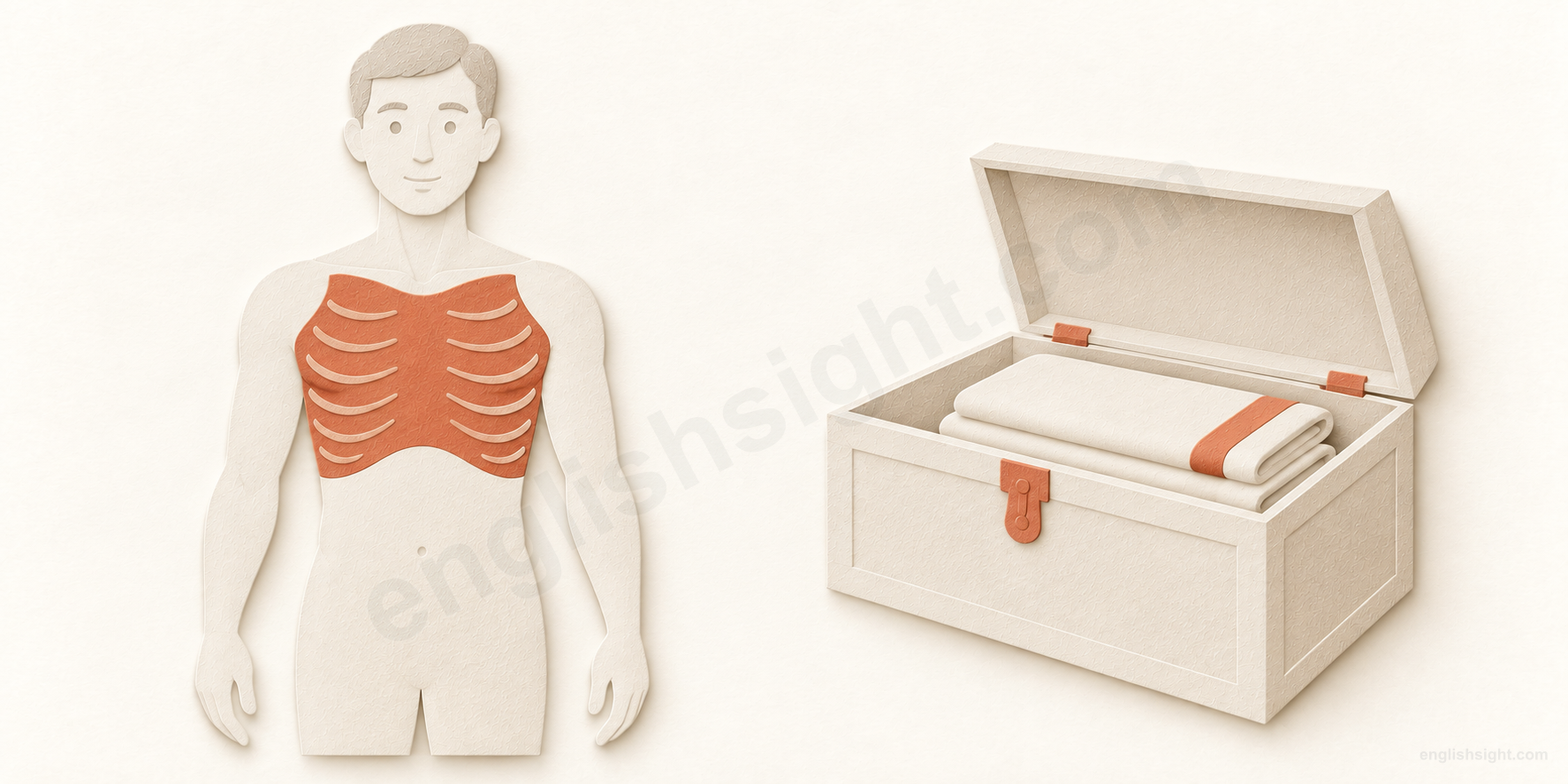
Separate the body and storage senses, then learn what the whole expression adds.
Body and storage: keep both branches
Two branches, with different kinds of contents
The chest is below the neck and above the abdomen.
chest
A storage chest holds belongings inside.
Compare two established senses, without a change from one to the other.
The body region surrounds the heart and lungs; the storage box holds belongings.
Chest names the upper body region around the heart and lungs, or a substantial box or cabinet used for storage.
Treat these as two established senses. The sketch compares them side by side; it does not show one becoming the other. Fixed expressions must still be learned in context.
Your chest moves as you breathe. A wooden chest can hold blankets. English uses the same word for a body region and a storage object, and the surrounding words usually make the intended sense clear.
An enclosure is a useful memory link: ribs surround the heart and lungs, while a storage chest holds belongings. This comparison helps organize the two branches; it does not turn the body into a literal box or predict every idiom.
01
The upper body: place, feeling, and description
Locate the chest first. Surrounding words then tell us about contact, a feeling, appearance, or posture.
01
on / in / across / against + possessive + chest; hit someone in the chest
on / in / against your chest
the upper part of the body, especially its front
Situation
You describe where someone holds a folder.
What the expression communicates
The folder touches the front of the upper body.
Chest identifies a region; the preposition supplies the relation.
Your chest is below your neck and above your abdomen. In everyday descriptions it often means the front of that region; in descriptions of the body’s interior it includes the space around the heart and lungs.
Hold a folder against your chest describes contact. A hand on your chest is on its surface; a feeling in your chest is experienced within that region. Across your chest describes something extending from one side to the other.
Use a possessor when it matters: my chest, her chest. In a pattern such as The ball hit him in the chest, him identifies the person and the chest identifies the body part. Chest can describe anyone’s upper body.
A chest pocket is a pocket on a shirt or jacket at chest level. In He put the ticket in his chest pocket, chest locates the pocket; it does not name a separate storage chest.
In a sentence
Maya held the folder against her chest while she searched for her keys.
Watch the difference The chest is above the stomach area. The word does not mean the whole torso, including the abdomen.
02
my chest hurts; pain / tightness in the chest; chest + noun; someone’s chest rises and falls
chest pain / a chest infection
feelings, breathing, or illness associated with the chest
Situation
You describe a physical sensation or someone’s breathing.
What the expression communicates
The listener knows the relevant body region.
In a compound such as chest pain, chest tells us where the pain is felt.
My chest hurts and I have pain in my chest locate discomfort. Chest pain uses the same noun before another noun; chest stays singular in this compound. Pain and pains are both possible in different descriptions.
A chest infection names an infection affecting the chest’s breathing organs. A chest cold is an everyday expression for a cold mainly affecting this area, rather than a statement that the skin feels cold. These labels alone do not specify an exact cause.
Her chest rose and fell describes the movement of breathing. Her chest was heaving describes stronger, noticeable movement, for example after exertion. The verbs supply the movement; chest still names the body region.
In a sentence
After the final sprint, his chest was heaving as he caught his breath.
Watch the difference Chest pain describes a symptom, while a chest infection names an illness. They are not interchangeable expressions.
03
adjective + chest; adjective-chested; a + number-unit + chest
a broad chest / broad-chested
describe the shape, covering, or measurement of the chest
Situation
You describe a person or choose the size of a jacket.
What the expression communicates
The description concerns the chest rather than the waist.
An adjective describes the chest; -chested builds an adjective describing its owner.
A broad chest and a muscular chest describe the body part. A broad-chested person has a broad chest. Bare-chested means wearing no clothing over the chest; it does not describe the width of the chest.
Other established descriptions include flat-chested and hairy-chested. The ending -chested here is part of a descriptive adjective, not evidence that someone performed the football action chest.
In clothing sizes, chest can stand for the measurement around this part of the body: a 100-centimetre chest. The measurement is around the body, not simply a straight line across its front.
In a sentence
The broad-chested actor needed a larger jacket.
Watch the difference Say He has a broad chest or He is broad-chested. Keep the hyphen in broad-chested.
04
puff out + possessive + chest; someone’s chest swells / swelled with pride
puff out your chest / swell with pride
describe a posture or feeling associated with pride
Situation
A parent watches their child receive a prize.
What the expression communicates
The parent feels visibly proud.
The body region becomes part of an expression of emotion.
Puff out your chest describes pushing the chest forward, often to look proud, important, or confident. Puff out contributes the change in posture; chest names the part moved.
My chest swelled with pride can express a strong feeling of pride without reporting a literal change in body size. With pride tells us which emotion is involved.
These expressions may describe pleasure in another person’s achievement. They do not automatically imply the arrogant public boasting suggested by chest-thumping.
In a sentence
Her chest swelled with pride when her daughter collected the prize.
Watch the difference Do not treat swelled with pride as a clothing measurement or a medical description.
02
Boxes, furniture, and things kept inside
The other main sense is a storage container. Learn the established names too: not every chest is a wooden box with a lid.
05
a + material / purpose + chest; put something in / take something out of a chest
a wooden chest / a tool chest
a sturdy container used for keeping things
Situation
Blankets need a place to be stored.
What the expression communicates
They are kept inside a large box.
This branch names an object that holds belongings.
A chest is typically a substantial storage box, often with a lid. A wooden chest describes its material; a tool chest names what it holds. A toy chest similarly stores toys.
Put something in a chest and take something out of a chest use ordinary location expressions. Nothing is happening to a person’s body: the blankets, lid, and storage setting select the container sense.
Box is the broader word. A small cardboard package is usually called a box, whereas chest suggests a more substantial storage object. Modern tool chests can have drawers, so a hinged lid is a typical feature, not a universal rule.
In a sentence
We keep the spare blankets in a wooden chest at the foot of the bed.
Watch the difference Chest is countable: a chest, the chest, two chests. Do not use it for every kind of small box.
06
a treasure chest; a treasure chest of + plural / uncountable noun
a treasure chest / a treasure chest of ideas
a box of valuables, or figuratively a rich source of valuable things
Situation
You find a collection with many useful ideas.
What the expression communicates
You describe the collection as something rich and worth exploring.
Valuable contents can be literal objects or useful discoveries.
In a story, a treasure chest may contain coins or jewels. Treasure tells us why the contents matter; chest supplies the container.
A treasure chest of ideas treats useful ideas as valuable things collected in one place. The expression can describe a book, archive, or other rich source; no physical chest is required.
Learn the whole figurative phrase. Calling an ordinary reference book a chest, without treasure or a suitable context, would not normally communicate this praise.
In a sentence
The old craft book is a treasure chest of ideas for rainy afternoons.
Watch the difference Treasure chest can be figurative, but chest alone does not generally mean a useful collection.
07
a chest of drawers; two chests of drawers
a chest of drawers
a piece of furniture containing drawers, often for clothes
Situation
You need somewhere to put socks and shirts.
What the expression communicates
They go into pull-out drawers in a piece of furniture.
The established name identifies furniture, not a box full of loose drawers.
A chest of drawers has drawers that slide out from the front. It is part of the storage branch, but its usual opening arrangement differs from a chest with a lid.
One piece is a chest of drawers. For more than one piece, say chests of drawers: the main noun chest changes, while drawers remains plural. A drawer is one of the sliding compartments.
In North American English, dresser and bureau can also name this kind of bedroom furniture. Learn these as alternatives in the relevant context, not as replacements for every use of chest. In American furniture descriptions, chest alone can also refer to a chest of drawers; the shopping context supplies the intended type.
In a sentence
The socks are in the top drawer of the chest of drawers.
Watch the difference For one complete item, say a chest of drawers, not a chest of drawer or a chests of drawers.
08
a medicine chest; in the medicine chest
a medicine chest
a cabinet or container for medicines and small supplies
Situation
You look for a packet of bandages in the bathroom.
What the expression communicates
You find it in the cabinet used for medical supplies.
The contents give a storage object its established name.
A medicine chest can be a small cabinet, often on a bathroom wall, for medicine and related items. It need not resemble the large wooden chest in the diagram.
Medicine is the first part of a compound noun: it tells us the purpose of the chest. Here chest is the storage sense. Compare a chest infection, where chest identifies a body region.
The exact object depends on the setting: chest is also used for containers of medical supplies. Do not infer the cabinet’s exact size or material from the name alone.
In a sentence
There is a packet of bandages in the medicine chest beside the mirror.
Watch the difference A medicine chest is a storage object; medicine for a chest infection treats a problem in the body.
09
an ice chest; a chest freezer
an ice chest / a chest freezer
two different objects for keeping food cold
Situation
You plan a picnic or put away frozen food.
What the expression communicates
The full compound tells you which cold-storage object is meant.
Ice chest and chest freezer share a container shape, but work differently.
An ice chest is an insulated box, especially in North American usage, that holds ice to keep food and drinks cold. British English also uses cool box. It can be taken on a picnic.
A chest freezer is a freezer with a lid on top rather than an upright door. In this compound, freezer is the main noun and chest identifies its box-like design.
Compare We packed the drinks in an ice chest with We stored the frozen vegetables in a chest freezer. The first describes an insulated container using ice; the second names a freezing appliance.
In a sentence
We filled the ice chest with ice and drinks before leaving for the beach.
Watch the difference An ice chest is not another name for a chest freezer. Read the order of the words and the whole compound.
03
Reserves, private thoughts, and public displays
These expressions draw on storage, the body, or a familiar action. Their established meanings belong to the whole expression.
10
build up / have / spend + a war chest; a war chest for + purpose
build up a war chest
accumulate money available for a particular campaign or project
Situation
An organization prepares for a major campaign.
What the expression communicates
It has a reserve of money ready to spend.
Stored resources become a fund, without requiring a physical box.
A war chest is money held ready for a planned effort. You may meet it in reports about political campaigns or business competition; literal warfare is not required.
Build up contributes the gradual accumulation of funds. Spend, use, or have a war chest describes other relations to the same reserve.
The storage image can help you remember money kept available. The full expression supplies the campaign or strategic purpose; chest alone is not the ordinary everyday word for any bank balance.
In a sentence
The party built up a war chest for the next election campaign.
Watch the difference The phrase can refer to money in accounts. It does not imply that cash is kept in an actual chest.
11
get + something / it + off + possessive + chest
get something off your chest
talk about something that has been troubling you
Situation
You have kept a worry or complaint to yourself.
What the expression communicates
You tell someone about it, seeking relief.
The familiar expression treats an unspoken concern as a burden.
Get something off your chest means say what has been worrying or upsetting you. It may introduce a complaint, an admission, or a difficult feeling.
In I need to get it off my chest, it refers to the matter you want to express. The possessive normally matches the person who has been troubled: she got it off her chest.
The burden image is a teaching aid. The established idiom concerns speaking, not removing an object from the skin. Talking may bring relief; the phrase does not say the underlying problem has been solved.
In a sentence
Can we talk? I need to get something off my chest about yesterday’s meeting.
Watch the difference Keep off in the idiom. Get something out of a chest describes removing it from a storage box.
12
hold / keep / play + possessive + cards close to + possessive + chest
keep your cards close to your chest
avoid revealing your plans or intentions
Situation
Other people want to know your next move.
What the expression communicates
You keep that information private.
A card-playing image explains secrecy about a plan.
Someone who keeps their cards close to their chest does not reveal what they intend to do. The expression can apply to a job decision, a negotiation, or a competition without any actual cards.
Hold your cards close to your chest and play your cards close to your chest are also established forms. Change the possessives together: he keeps his cards close to his chest.
The body sense helps the literal image: cards held near the chest are harder for others to see. The idea of hiding intentions comes from the whole expression, not from chest by itself.
In a sentence
Nina is keeping her cards close to her chest about her next job.
Watch the difference This idiom concerns withholding information. Get something off your chest instead concerns expressing a troubling thought.
13
chest-thumping; adjective + chest-thumping
chest-thumping
a loud or arrogant display of one’s own strength or importance
Situation
A speaker publicly insists that their group is superior.
What the expression communicates
A listener criticizes the display as boastful.
A physical display becomes a description of self-important behavior.
Chest-thumping can name boastful, forceful self-assertion, especially in criticism of public behavior. No one has to hit their body.
The literal action is thumping or beating your chest. A report about a gorilla may describe an actual movement; political chest-thumping may describe only words and attitudes.
Chest still contributes the body image, while the compound has a conventional evaluative meaning. It is stronger and more critical than simply saying someone feels proud.
In a sentence
The debate turned into political chest-thumping instead of a discussion of practical plans.
Watch the difference Do not use chest-thumping as a neutral synonym for confidence or every kind of pride.
14
something will / would put hairs on your chest
That will put hairs on your chest!
a joking comment about a very strong alcoholic drink
Situation
Someone tastes a powerful alcoholic drink.
What the expression communicates
Another person jokes about how strong it is.
Recognize a conventional joke rather than a physical prediction.
You may hear This will put hairs on your chest! as a joke about a strong alcoholic drink. It does not literally predict new body hair.
The expression draws on an association between chest hair and toughness. That association explains the joke; it is not a claim that body hair measures someone’s strength.
This is a recognition item rather than a neutral way to describe every drink. In an ordinary description, This drink is very strong is more direct.
In a sentence
“That will put hairs on your chest!” he joked after tasting the strong drink.
Watch the difference Do not interpret this as advice about hair growth or as a literal effect of a drink.
04
A verb in football
In football commentary, the body-part noun also becomes a verb naming a way of controlling the ball.
15
chest + the ball / it + down; chest something + direction / destination
chest the ball down
control a football using the chest
Situation
A high pass reaches a football player.
What the expression communicates
The player brings the ball under control with their chest.
The noun names the body part; the verb names an action using it.
In football (soccer), chest can be a transitive verb: the player chests the ball. The ball is its object, and the body part supplies the means of control.
In chest the ball down, down adds a downward result or direction. With a pronoun, say chest it down. This is a sports action with a directional word, not the idiom get something off your chest.
The verb forms are chest, chests, chested, chested, chesting. A report can also use a passive, such as The ball was chested down. This specialized verb does not make chest an everyday general verb for putting things in boxes.
In a sentence
The striker chested the ball down before passing it to a teammate.
Watch the difference Chested the ball describes a sporting action. Broad-chested describes someone’s body shape.
Choose the branch and keep the full expression
A countable noun and a consonant cluster
The noun is chest /tʃest/, plural chests /tʃests/. Keep the final t when learning the word and its plural. Say a chest, my chest, or the chest as the context requires; chest stays singular before another noun in chest pain and chest infections.
No single picture predicts everything
The body and storage senses are both established. The enclosure comparison is a teaching aid, not proof that every modern sense is generated by one rule. In particular, a medicine chest can be a cabinet, and idioms about worries or cards require the whole expression.
Read the endings and word order
Broad-chested is a descriptive adjective, while chested the ball is a past-tense verb. Chest pain locates pain in the body; a medicine chest stores supplies; a chest freezer names an appliance. Similar words can play different grammatical roles.
Scope of this lesson
Start with the body, storage, and the two information idioms. War chest, chest-thumping, the drink joke, and the football verb extend recognition into particular contexts. Historical public-fund senses, engineering containers, and specialist musical uses are not developed here.
Choose the meaning that fits
Use the whole expression and the situation, not just the word chest.
1. “The spare blankets are in the chest.” What does chest most naturally mean here?
2. You bought two separate pieces of furniture with drawers. Which form fits?
3. A worry has been bothering you, and you want to talk about it. Which expression fits?
4. “He is keeping his cards close to his chest about the negotiations.” What does this suggest?
5. You carry an insulated box with ice and drinks to a picnic. Which expression fits?
6. “The defender chested the ball down.” What did the defender use?
Sources and teaching notes
The dictionary pages below support the senses and expressions. Explanations and examples are original; the comparison between a body enclosure and a storage container is a teaching aid.
The diagram compares two senses; it does not claim that all native speakers share one mental picture.