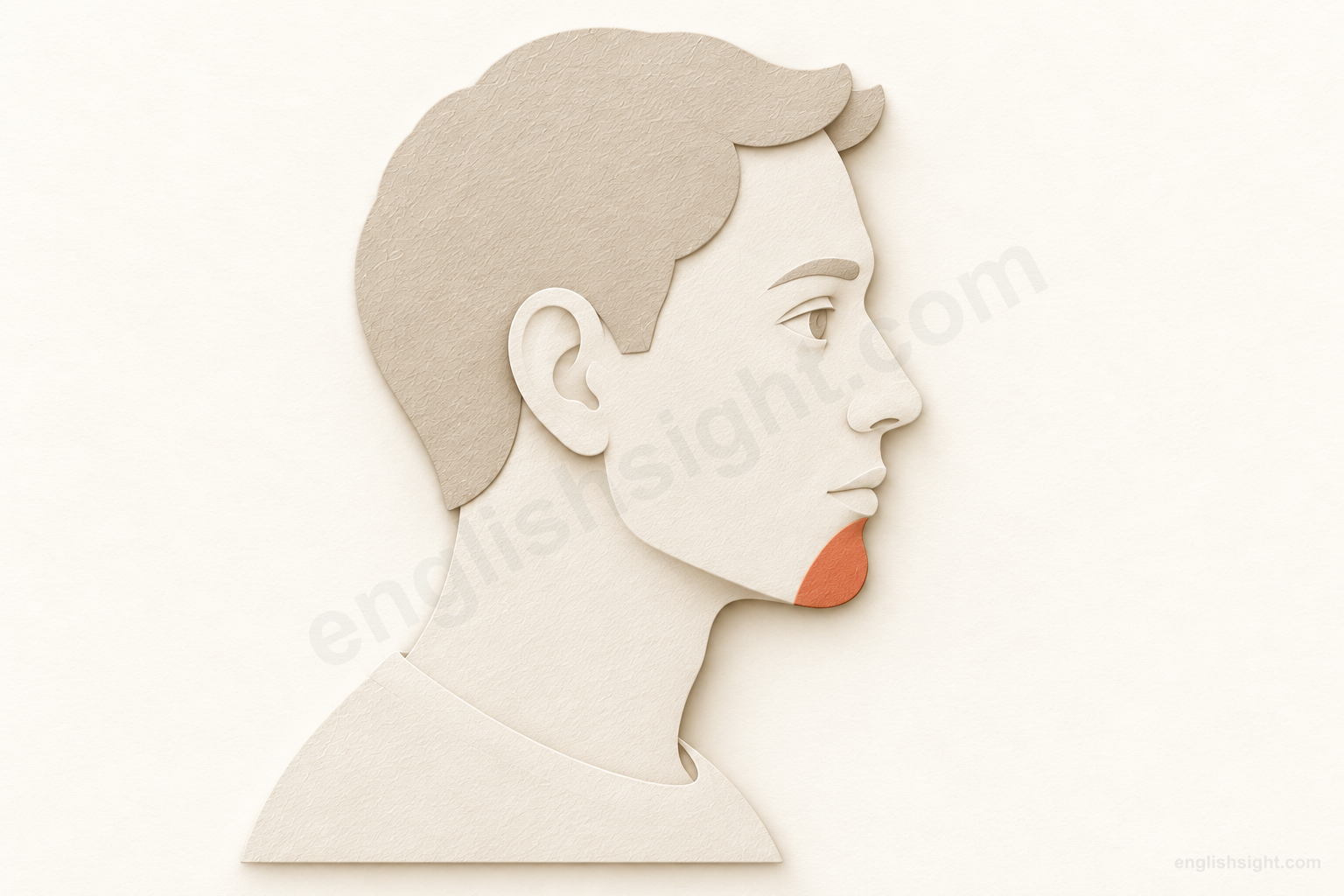
Name the chin, describe its position, and recognize the expressions built around it.
Find the chin between the mouth and neck
Locate the projecting part below the lower lip
The mouth is above the highlighted area.
chin
The neck lies below and behind the chin.
The terracotta patch marks the projecting front of the lower face.
The highlighted chin is below the lower lip and above the neck.
The chin is the projecting front of the lower face, below the mouth and above the neck.
The diagram locates a body part; it shows no change over time. Head position offers a memory link for some expressions, but the idioms require their own meanings.
Chin usually names a body part: the projecting front of the lower face. With ordinary movement verbs and prepositions, the same body part can be raised, touched, supported, or used as a reference for height.
A few familiar expressions use chin figuratively. Learn their complete wording and context: the body-part meaning alone cannot tell you whether a sentence offers encouragement, describes acceptance, or reports a loss.
01
Identify and describe the body part
Start with the front of the lower face. Chin names a particular part, while surrounding words describe its shape or appearance.
01
my / your / his / her + chin; a chin; plural chins
your chin
the projecting front of the lower face
Situation
You want to name a specific part of your face.
What is described
You identify the part below the mouth, above the neck.
Chin picks out the front, rather than the whole lower jaw.
Chin is a countable noun: one chin, two chins. Use a determiner when referring to an individual body part: my chin, her chin, or a chin. The plural normally refers to the chins of different people.
Point to the front of the face directly below the lower lip. That is the chin. Jaw has a wider reference to the bony structures around the mouth; chin is not a general replacement for jaw.
In a sentence
There is a little paint on your chin.
Watch the difference In an ordinary description, say My chin hurts, not Chin hurts.
02
have + a + adjective + chin
a strong chin
a chin with a noticeable or well-defined shape
Situation
You describe how a face looks.
What is described
You specify the shape of its chin.
The adjective describes appearance, not a proven personality trait.
A strong chin is prominent or clearly defined. A weak chin is less prominent. Pointed, square, and rounded describe different outlines; they do not name different body parts.
Use have to attach the description to a person: She has a pointed chin. In a description, strong does not mean that this part can lift heavy things, and it does not establish that the person is brave.
In a sentence
The two sisters have the same pointed chin.
Watch the difference Do not infer character from strong chin or weak chin; these can simply describe facial shape.
03
have + a double chin
a double chin
a fold beneath the chin that looks like an extra chin
Situation
You notice a fold below the usual chin.
What is described
You describe the appearance as a double chin.
Double refers to the appearance of a second contour.
A double chin names a fold of flesh or fat under the chin. It does not mean someone literally has two separate chin bones. The usual construction is have a double chin.
The plural double chins is possible when describing more than one person. As with other comments on someone’s body, context and tone matter; the expression itself is a physical description.
In a sentence
The portrait shows a man with a double chin.
Watch the difference Use a double chin for one person’s feature; two chins is not the usual name for that fold.
02
Touch, support, and head position
On, under, and movement verbs describe different physical relationships involving the same body part. They do not give chin a new meaning each time.
04
rest + possessive + chin + on + support; hit + someone + on the chin
rest your chin on your hand
support the chin on something
Situation
Your hand is below your face.
What is described
Your chin rests on the hand.
Rest gives the support relationship; chin names the supported body part.
Rest your chin on your hand describes placing it there for support. Rub or stroke your chin describes touching it with a moving hand. These are ordinary verb-and-noun combinations, not separate meanings of chin.
On also marks a location on its surface: food on your chin. In hit someone on the chin, someone names the person affected and the chin identifies the place of impact. The article the is natural in this body-part construction.
In a sentence
Maya rested her chin on one hand while she listened.
Watch the difference Rest your chin on your hand describes support. Rub or stroke your chin describes moving a hand against it; these verbs are not interchangeable.
05
under / beneath + possessive + chin; at chin level
under your chin
below the chin rather than on its front surface
Situation
A helmet strap passes beneath the face.
What is described
It lies below the chin.
Under supplies the spatial relationship.
Under your chin places something beneath that part of your face. Compare a mark on your chin with a strap under your chin: the first is on the surface; the second passes below it.
Beneath is another possible preposition here. Chin can also act as a reference point for height: at chin level means at roughly the same height as the chin. Neither expression describes a different body part.
In a sentence
The helmet strap sits comfortably under her chin.
Watch the difference Under and on describe different locations; choose the relationship you mean.
06
lift / raise / lower + possessive + chin; jut + possessive + chin + out
lift your chin
raise the front of your lower face by changing head position
Situation
Your face is tilted down.
What is described
Your head tilts so that the chin is higher.
The movement verb supplies the change; chin remains the body part.
Lift or raise your chin is a literal instruction about head position. Lower your chin describes the reverse. Jut your chin out means push it forward; in a story this may accompany defiance, but the words alone do not prove an emotion.
A photographer’s Chin up a little can be a physical instruction. After disappointing news, Chin up! can instead be encouragement. Decide from the situation rather than treating every mention of an upward chin as an idiom.
In a sentence
For the next photo, lift your chin a little.
Watch the difference A physical instruction to lift the chin does not necessarily mean become cheerful.
03
Encouragement and difficult experiences
Learn these informal expressions as whole units. A lifted head or an imagined blow can help you remember them, but the conventional meaning comes from the expression.
07
keep + possessive + chin + up; Chin up!
keep your chin up
try to stay cheerful or hopeful during difficulty
Situation
A friend feels discouraged after a setback.
What is described
You encourage the friend to keep going.
The whole expression offers emotional support.
Keep your chin up is informal encouragement. The possessive changes with the person: I’m trying to keep my chin up; she kept her chin up. Chin up! is a shorter form addressed to someone.
A lifted head is a useful memory link, but you need not physically raise your chin when using this idiom. It encourages someone’s attitude; it does not promise that the problem has ended.
In a sentence
Keep your chin up—we can try another route tomorrow.
Watch the difference Keep your chin up is encouragement, not a claim that the listener is already happy.
08
take + criticism / defeat / it + on the chin
take criticism on the chin
accept an unpleasant experience without making a fuss
Situation
You receive criticism that is difficult to hear.
What is described
You accept it calmly and continue.
The idiom describes the response to the setback.
Take something on the chin can mean accept criticism, defeat, or another unpleasant experience without complaining or making excuses. Something may be a noun such as criticism, or it may refer back to a setback already mentioned.
The imagined blow can help memory, but no physical hit is required. Keep your chin up urges hope; take it on the chin describes accepting an unwelcome experience. These are different communicative jobs.
In a sentence
Leo took the criticism on the chin and revised his plan.
Watch the difference The idiom uses the chin: took it on the chin, not took it on his chin in this fixed expression.
09
person / organization + take it on the chin
take it on the chin
suffer a serious setback or damaging effect
Situation
A business faces an unexpected problem.
What is described
It experiences a substantial loss.
This reading reports harm, not necessarily a brave reaction.
Especially in North American English, take it on the chin can report being badly affected. A company or a group can be the subject even though it has no literal chin.
Context distinguishes this from calm acceptance. A sentence about shops losing sales may simply report damage; it need not tell us whether the owners complained. It refers to the setback or its impact, not an object being picked up.
In a sentence
Small shops took it on the chin when the bridge closed for a month.
Watch the difference Do not always add without complaining to this reading; the sentence may say only that someone suffered.
04
Recognize the exercise name
A chin-up is a countable exercise movement. Its spelling and grammar distinguish it from the spoken encouragement Chin up!
10
do + a / number + chin-up(s)
do a chin-up
pull the body upward while hanging from a bar
Situation
You hang from a bar by your hands.
What is described
You pull upward to bring the chin to bar height or above.
The chin provides a height reference in the exercise name.
A chin-up is a countable noun: do one chin-up, do three chin-ups. The movement involves pulling the body up while holding a bar, bringing the chin to the bar’s height or above. In the usual specific exercise sense, the palms face you.
The hyphenated noun a chin-up names a movement. Chin up! is an encouragement or, in a suitable context, a head-position instruction. Collins also records the exercise verb chin or chin oneself; for everyday instructions, do chin-ups is a straightforward way to name the exercise.
In a sentence
I managed two chin-ups before my arms got tired.
Watch the difference Say do two chin-ups for the exercise; Keep your chin up does not mean perform a workout.
Keep the body part and the whole expression distinct
Chin, jaw, and the words around them
Chin names the projecting front below the lower lip. Jaw has a wider anatomical reference. On, under, lift, and rest contribute their own spatial or action meanings; they are not extra dictionary senses of chin.
Forms and scope
The ordinary noun has plural chins. Collins also records verb forms chin, chins, chinned, and chinning for exercise and certain informal uses, including hitting someone on the chin and US slang for chatting. This lesson focuses on the body-part noun, familiar idioms, and the exercise name; it does not teach those verbs as a productive phrasal-verb family.
The diagram has a limited job
The highlighted profile identifies the body part. It does not establish anyone’s mood or character, explain every idiom, or represent a mental picture shared by every English speaker.
Read the situation and the whole expression
Choose the sentence or interpretation that matches the context.
1. A helmet strap passes beneath the front of your lower face. Which description fits?
2. A friend feels discouraged after a failed attempt. Which expression offers encouragement?
3. The report says shops took it on the chin after a long road closure. What can this mean?
4. You want to count two completed pulls upward on a gym bar. Which sentence fits?
5. A photographer says, “Lift your chin a little.” What is the immediate request?
Sources and teaching notes
The dictionary pages below were consulted for the noun, collocations, idioms, exercise term, and scope boundaries. Explanations and examples are original; the diagram is a teaching aid.
The diagram locates the chin; it does not explain every fixed expression.