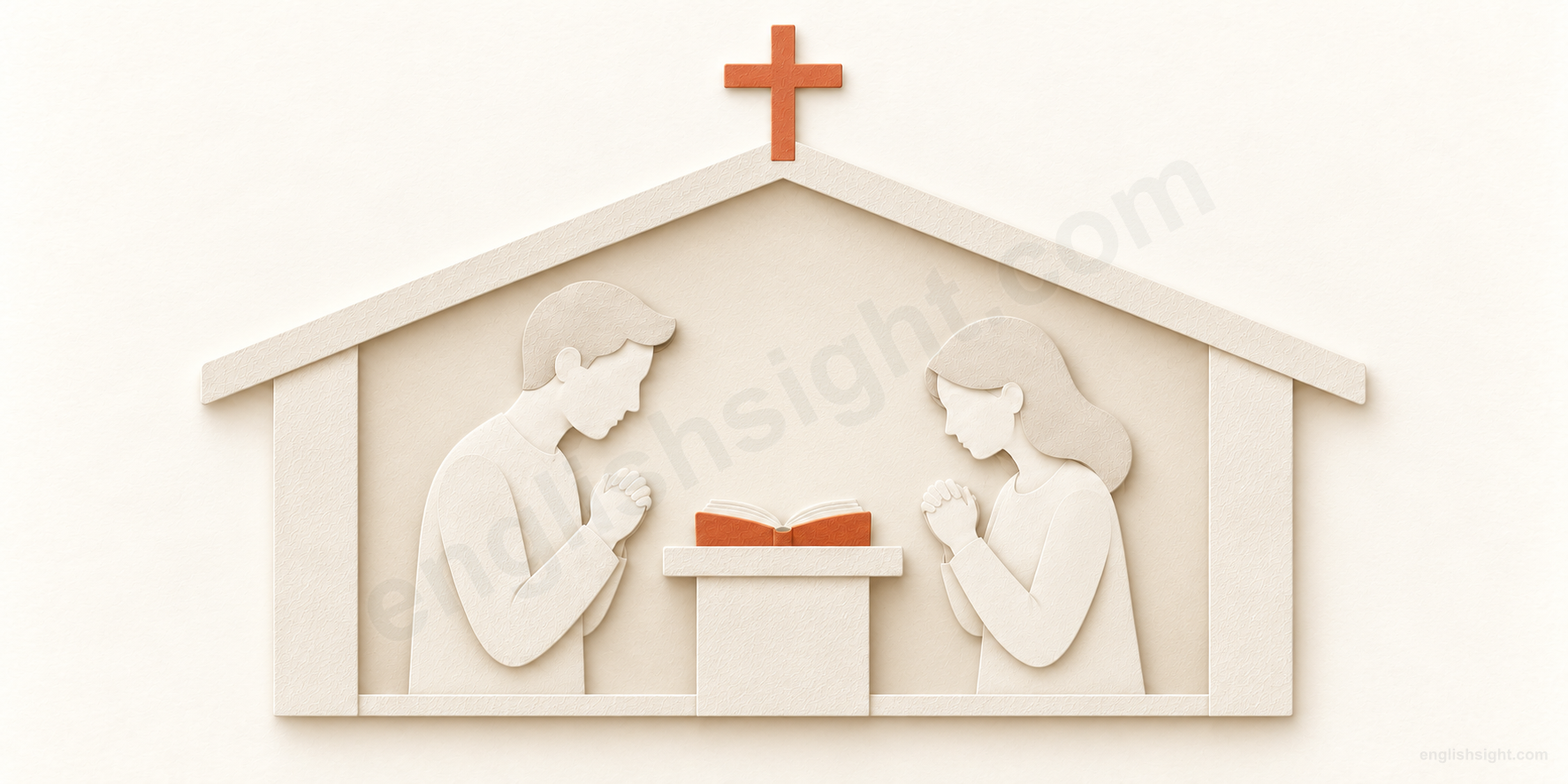
Read church as a building, worship, or an organized body of Christians.
Place, worship, and community
People gathered for Christian worship
The worship place.
church
The worshipping community.
People gather for Christian worship.
Church can name the place, the worship, or the community; context selects the meaning.
Church can name a Christian worship building, worship itself, or the community and institution connected with it.
The picture links the central noun uses; it does not explain every institutional expression or the idiom a broad church by itself.
Picture people gathered for Christian worship in a church. English can focus on the place, the worship taking place, or the community that gathers. The surrounding words tell you which is intended.
This connection is a teaching model, not a claim that every English speaker sees the same mental picture. Institutional expressions and a broad church also need their own context.
01
A worship building
Identify a place and choose an article.
01
a / the + church; plural churches; a named church
a church / the church
a building used for Christian worship
Situation
You describe a village landmark.
What you communicate
Your listener identifies a particular building.
A countable church is a place; the article identifies which one.
A church names one building; churches names more than one. Use the church when your listener can identify it: the church opposite the station. The building may also host a concert or a community event.
Compare We walked past a church with We walked past the church. The first introduces an unspecified building; the second treats it as identifiable. A name such as St Mark’s Church identifies it directly.
The cross and roof in the sketch suggest a Christian worship place. A tower, steeple, or cross is not a required feature of every real church.
In a sentence
The church beside the bridge has a red door.
Watch the difference Do not use church as the general name for every religion’s worship building.
02
Worship, location, and time
Use church without an article when the activity is in focus.
02
go to church; attend church
go to church / attend church
take part in Christian worship
Situation
Someone asks about your Sunday routine.
What you communicate
You describe attending worship.
Without an article, church can name the religious activity.
Go to church and attend church focus on worship, not simply reaching a building. Compare I go to church on Sundays with I went to the church to repair its door. The repair sentence identifies a destination.
Go adds the idea of going; attend emphasizes being present. Church does not take an article in these activity expressions. This is an established use of the noun, not a phrasal verb.
In a sentence
Maya goes to church with her grandmother.
Watch the difference Go to the church can be natural when a particular place is intended; the article changes the focus.
03
be at / in church; be at / in the church; get married in church
at church / in church
be attending worship, or describe a church setting
Situation
You cannot reach a friend during a service.
What you communicate
You explain where she is and what she is doing.
The preposition gives location; the article helps distinguish activity from a particular building.
She is at church commonly presents her as attending worship. In church is especially usual in North American English for this meaning; it also occurs in British English. The varieties overlap.
In the church emphasizes being inside an identifiable building. At the church locates someone at that place without necessarily saying they are inside or worshipping.
Get married in church is an established expression for a church wedding. They got married in the church near the river instead identifies the venue. Neither phrase tells you all the details of the ceremony.
In a sentence
Please call her later; she’s at church.
Watch the difference At church does not necessarily mean permanent membership; in the church does not by itself mean attending a service.
04
before / after church; church starts / ends at + time
before church / after church
use a worship service as a point in time
Situation
You arrange a meal around a service.
What you communicate
The meeting time is relative to worship.
Church can stand for the service itself, which has a time and duration.
After church means after the service or period of worship. Before church works in the same way. The reference is an event, not the age or position of the building.
Church starts at ten gives the service’s starting time. For an explicitly countable event, use a service or a church service: There are two services today.
In a sentence
We’ll have lunch together after church.
Watch the difference Say two church services when counting worship events; two churches normally counts buildings or communities.
03
People and institutions
Move from a local congregation to a wider religious body.
05
join / belong to / be a member of + a church
join a church / belong to a church
become or be a member of a Christian community
Situation
A family wants a local religious community.
What you communicate
They become members of a congregation.
Here church means people organized around shared worship, not the walls around them.
Join a church means become a member of a community; belong to a church describes that membership. A church can meet in a rented hall, so the community and its building need not be the same thing.
Our church collects food for local families gives the community an action. The people organize the collection; the building does not. Leaving a church can mean ending membership, while leaving the church after a concert can mean walking out. Context decides.
In a sentence
Our church is collecting blankets for the shelter.
Watch the difference Going to church does not automatically mean joining that church.
06
the + name + Church; the Church of + place
the Catholic Church / the Church of England
a particular organized Christian tradition
Situation
A text compares Christian organizations.
What you communicate
You identify the organization rather than a local building.
A Church can be a wider religious body with many local communities.
A denomination is an organized Christian group with its own traditions and teachings. Names include the Catholic Church and the Church of England. Several churches in a city may belong to the same wider Church.
Capitalize Church as part of an official name. In ordinary references such as a village church, use lowercase. A capital C can also signal an institution in context; it is not a reliable test for whether a building is meant.
In a sentence
The article compares the Catholic Church with several Protestant churches.
Watch the difference Keep the article and capitalization required by the name; do not treat every occurrence as a building.
07
the Church; church and state; church leaders
the Church / church and state
Christianity as an organized institution, its authorities, or its wider body of believers
Situation
A history discussion concerns religious and political power.
What you communicate
You discuss institutions and their relationship.
The reference can widen from a local community to religious organization as a whole.
The Church may refer to Christian institutions or their leaders, to a particular Church already understood, or to Christians collectively. Read the surrounding text to find the intended scope.
Church and state contrasts organized religion with civil government. Separation of church and state concerns their institutional relationship. It does not describe moving a church building away from a government office.
Capitalization varies with context and style. The early Church points to the historical Christian community; church leaders points to people with authority, not architectural features.
In a sentence
The class discussed the separation of church and state.
Watch the difference The Church does not always mean the Roman Catholic Church; establish the reference from context.
04
Useful combinations and an idiom
Read the whole expression for careers, church life, and metaphorical groups.
08
go into / enter + the Church
go into the Church / enter the Church
become a Christian minister as a vocation
Situation
Someone is choosing a religious career.
What you communicate
They begin a life of ministry.
The institution supplies a career meaning in this established expression.
Go into the Church and enter the Church can mean become a Christian minister. They are especially useful when reading biographies. Here into describes entry into a vocation, rather than movement through a doorway.
Compare He went into the church to look at the windows: the purpose clause makes a physical visit clear. Enter can also refer to joining a religious body in some contexts, so use become a minister when you need to remove doubt.
In a sentence
After university, Daniel went into the Church and trained as a minister.
Watch the difference Do not assume every enter the church sentence refers to a career; look for the surrounding action and purpose.
09
church + noun: service, choir, hall, bells, tower, member
church service / church choir / church hall
identify something connected with church life
Situation
You describe an event or part of a community’s activities.
What you communicate
The following noun tells your listener exactly what you mean.
Church modifies another noun; the head noun controls the phrase.
A church service is an occasion of worship; a church choir is a group that sings; a church hall is a building or room used for church and community activities. Church bells and a church tower identify features associated with the building.
Learn the full combination. A church wedding describes a kind of wedding, while a church member describes a person’s connection to a community. The shared modifier does not make these separate meanings of a verb.
Pluralize the head noun when appropriate: two church halls, three church services. In a church choir, the article belongs to the whole phrase; it does not break the no-article pattern in go to church.
In a sentence
The church choir is rehearsing in the church hall.
Watch the difference A church hall is not necessarily the main worship room; the second noun matters.
10
a group / movement / field + be + a broad church
a broad church
a group or field that accommodates varied views or approaches
Situation
A club includes people with different opinions.
What you communicate
You emphasize that they can belong to the same group.
The established metaphor extends a community to a range of accepted views.
In this mainly British expression, broad describes the range of opinions or approaches within a group. A party, movement, or field of activity can be a broad church without being religious.
This is an idiom to learn as a whole. It connects with the community sense, but you cannot predict it by imagining a physically wide building. The separate historical label Broad Church refers to an Anglican tradition.
In a sentence
Our reading club is a broad church, welcoming fans of both poetry and crime novels.
Watch the difference The idiom describes variety within a group, not a large church building.
Let the whole phrase guide you
Form and pronunciation
Church is usually a noun in everyday use. The plural is churches. British /tʃɜːtʃ/ and American /tʃɜːrtʃ/ differ in the r sound; both begin and end with /tʃ/, the first sound in chair.
Membership, attendance, and buildings differ
A person can attend worship without joining the community, and a community can meet without owning a church building. Church in front of a noun signals a connection; the following noun specifies it.
Scope and respect
This lesson explains English usage without assuming that the learner belongs to a religion. Church usually concerns Christianity; use the appropriate name for other religious buildings and communities. Rare historical or regional verb uses are outside the lesson.
Choose the intended reference
Use the scene and the whole expression, including articles.
1. You describe regularly taking part in worship. Which sentence puts the activity in focus?
2. A repair worker is inside a particular building fixing its windows. Which sentence makes that location clear?
3. In Our church is collecting blankets, what is doing the collecting?
4. Daniel went into the Church and trained as a minister. What does went into the Church express here?
5. A political movement calls itself a broad church. What does it want to emphasize?
Sources and teaching notes
The sources support the usage distinctions below. The explanations, examples, and visual model were created for this lesson.
The diagram connects a worship place with worshippers; it is a teaching aid.