From shapes and movement to social groups and returning patterns.
A round outline around a centre
Around a centre, with no corners
The centre dot sets one reference point.
circle
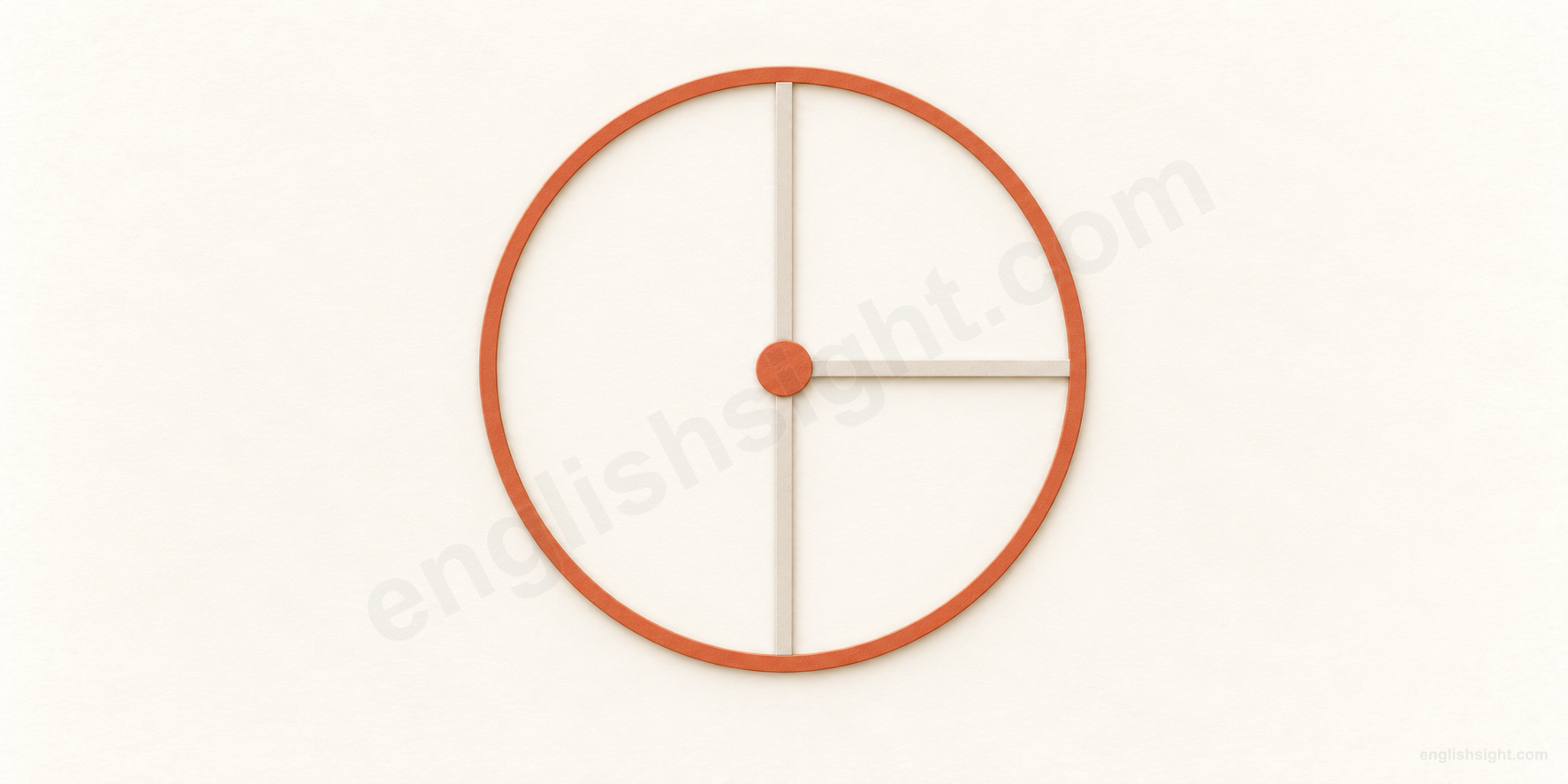
A closed round outline surrounds the centre.
Three equal radii connect it to the outline.
One centre, equal radii, one closed round outline.
A geometrical circle is a closed round outline whose points are all equally far from its centre. Everyday uses extend to round areas, surrounding arrangements, and routes.
The sketch shows a centre, three equal radii, and the closed outline they reach. It is a construction relationship, not a before-and-after event. Social circles and idioms are explained separately.
Circle can name a flat round shape, a group arranged around a middle, or a connected social group. As a verb, it can describe making a rounded mark, moving around something, or forming a surrounding route.
The core picture is a closed round outline around a centre. It helps connect several uses, but fixed expressions carry their own meanings. This is a teaching model, not a claim about a picture shared by all English speakers.
01
Shapes, pieces, and arrangements
Start with the outline, then notice whether circle names a flat piece, a pattern, or an arrangement around a centre.
01
draw / trace a circle; the radius / diameter / circumference / area of a circle
draw a circle
make a completely round, closed outline
Starting situation
You choose a centre and a distance from it.
Relation or outcome
The outline closes with every point equally far from the centre.
A circle has no corners and is flat, rather than a solid ball.
Use a circle for one round figure and circles for more than one. In geometry, the boundary stays the same distance from its centre. Ordinary drawings can be approximate: a rough circle is still a useful everyday description.
The radius runs from the centre to the edge; the diameter goes through the centre from one edge to the other. The circumference measures the distance around, and the area measures the space inside. Concentric circles share a centre; overlapping circles share some space.
Circle is a noun here. Draw names the action. To describe a shape with an adjective, use circular: a circular table. A ball is a three-dimensional object, rather than a flat circle.
In a sentence
Draw a circle with a radius of three centimetres.
Watch the difference Use a circle for a countable shape. Say a circular window, rather than using circle as the general adjective.
02
a circle of + material / light; cut out + a circle
a circle of paper / light
a round flat piece or visible area
Starting situation
You have a sheet to cut or a light shining onto a surface.
Relation or outcome
A round piece or patch has a visible edge.
Of names the material or what occupies the round area.
A circle of paper is a round piece, not necessarily an outline drawn on paper. Cut out a circle asks for that piece. A circle on the paper could instead be a mark drawn on the sheet.
A circle of light describes a round illuminated patch, such as one made by a torch. Circle can name the whole flat area in everyday usage; it does not always mean only its edge.
In a sentence
Cut two circles of paper for the eyes.
Watch the difference Distinguish a circle of paper, which is a piece, from a circle on paper, which may be a drawing.
03
arrange + objects + in a circle; form a circle; a circle of + people / things
stand / sit in a circle
be arranged around a central space
Starting situation
The chairs are in rows.
Relation or outcome
The chairs form a round arrangement around an open middle.
In a circle can describe the arrangement itself, not a position inside a drawn line.
Arrange the chairs in a circle or form a circle tells people how to organize a group spatially. A circle of chairs names the resulting formation; the chairs do not become one solid round object.
Sit in a circle usually means sit around the edge of an imagined circle. Sit inside the circle specifically puts someone within a marked boundary. A circle of people is physical here, unlike a circle of friends, which describes relationships.
In a sentence
We arranged the chairs in a circle so everyone could see one another.
Watch the difference Do not assume in a circle always means inside a line drawn on the ground.
04
have + dark circles + under / around + possessive + eyes
dark circles under the eyes
darker areas of skin below or around the eyes
Starting situation
You notice darker patches beneath someone’s eyes.
Relation or outcome
You describe their appearance using a familiar plural expression.
Circles here need not be complete, perfectly round rings.
Dark circles under your eyes and dark circles around your eyes are familiar descriptions of appearance. The word circles gives a rough visual comparison, not a geometrical measurement.
Use the plural when referring to both eyes: He has dark circles under his eyes. The phrase describes what you see; it does not by itself establish a medical cause.
In a sentence
After the overnight journey, I had dark circles under my eyes.
Watch the difference Keep the whole phrase. Dark circles alone could also mean dark shapes in a design.
02
Mark, move around, or surround
As a verb, circle can describe drawing a boundary, following a rounded route, or forming a surrounding line. The subject and context distinguish them.
05
circle + item; circle it; be circled in + colour
circle the answer
draw a line around an item to mark it
Starting situation
Several printed options are unmarked.
Relation or outcome
A rounded line surrounds the selected option.
The object is what you mark, rather than the line you draw.
On a form or worksheet, Circle the answer asks you to draw around it. Circle a date on a calendar similarly makes it stand out. The object tells you what to enclose.
You can say Circle it, with a pronoun directly after the verb, and The date is circled in red, with a passive. In red tells you the colour of the mark. This differs from underline it, which puts a line underneath.
In a sentence
Please circle the date that suits you best.
Watch the difference Circle the answer does not mean write the word circle, and it does not ask you to underline the answer.
06
circle; circle + object; circle around / round + object; circle over / above + place
circle / circle around something
move along a rounded route around a place or object
Starting situation
A helicopter stays near the same area.
Relation or outcome
It keeps moving around that area rather than landing.
The subject moves; the object or following phrase locates the centre of that movement.
A bird can circle overhead without a direct object. A helicopter can circle the harbour or circle around the harbour. Around and round make the surrounding route explicit; they are prepositions before the place, not separable particles.
The movement may repeat, and it need not trace a perfect geometrical circle. Circle is not restricted to flight: two players or boxers may circle each other. Is circling describes movement in progress.
Compare walk in a circle, which describes a rounded route, with spin, which can mean turn on the spot. To circle a tree, you move around it; you need not rotate your own body on one spot.
In a sentence
The helicopter circled the harbour before landing.
Watch the difference Circle the harbour and circle around it are both possible. Do not move it between circle and around as though this were a separable phrasal verb.
07
a road / route + circles + place
a road circles the town
form a surrounding route or boundary
Starting situation
A town lies within the route of a road.
Relation or outcome
You describe the road’s course around the town.
A fixed thing can circle a place without physically moving.
When a road circles a town, the road extends around it. The subject is a fixed route, unlike a car that circles the town. The meaning comes from the subject together with the surrounding shape.
Encircle or surround may be useful alternatives when enclosure matters. Context decides whether something is moving around a place or is already arranged around it; circle alone does not mean attack.
In a sentence
A narrow road circles the village.
Watch the difference The road itself is not travelling. Compare A bus circles the village, where the bus moves.
03
Friends, professional groups, and influence
A social circle groups connected people. It does not require anyone to sit in a round formation.
08
have + a circle of friends; a social / family circle; widen + your circle
a circle of friends
a group of socially connected people
Starting situation
You know several people through shared activities.
Relation or outcome
They belong to your social network.
The boundary represents connection, not a physical seating arrangement.
A circle of friends names a group in someone’s social life. Your family circle refers to the family group. Neither expression requires the people to be together in one place.
A wide circle of friends means you know many people; a small circle is limited in size. Widen your circle of friends means make more social connections. Unlike an organized club, a circle need not have formal membership or fees.
In a sentence
Joining the choir helped me widen my circle of friends.
Watch the difference Compare friends standing in a circle, which describes where people stand rather than how they know one another.
09
in + adjective / field noun + circles; move in + social circles
in scientific / business circles
among people connected with a field
Starting situation
People in a profession discuss a proposal.
Relation or outcome
The proposal becomes known within that community.
Plural circles can refer to social or professional communities.
In scientific circles means among people involved in science. You may similarly read in political circles or in business circles. In certain circles leaves the particular community unnamed.
Move in different circles means belong to different social networks, not travel around different round shapes. Here in marks membership or the community in which an idea circulates.
In a sentence
The proposal has attracted attention in scientific circles.
Watch the difference Do not translate in literally as a position inside a round room.
10
someone’s inner circle; be in / part of + the inner circle
the inner circle
a small group close to the centre of power
Starting situation
Many employees work in an organization.
Relation or outcome
A few influential people have access to its leader and major decisions.
Inner adds closeness to power or privileged access.
The director’s inner circle is the small group near the director with special influence or access. It is narrower than the whole staff or the director’s full circle of acquaintances.
Be in or be part of the inner circle describes membership. Inner is doing important work here: an ordinary social circle does not automatically imply control, privilege, or secrecy.
In a sentence
Only members of the director’s inner circle knew about the plan.
Watch the difference The phrase concerns relationships and influence, not desks in the middle of an office.
04
Seats, roads, and a named boundary
Some established names use the shape connection but need to be learned as whole expressions.
11
in the circle; dress circle; upper circle
seats in the circle
seats on an upper level of a theatre
Starting situation
You compare ticket areas on a seating plan.
Relation or outcome
You choose an upper tier of seats.
Circle is an established theatre term, not a promise that the whole building is round.
In theatre seating, especially in British usage, the circle is an upper seating level. You may see dress circle and upper circle on a seating plan. Check the plan for the actual tier and view.
We sat in the circle concerns the ticket area. It differs from We sat in a circle, which describes people arranged around a centre.
In a sentence
Our seats are in the dress circle, above the stalls.
Watch the difference The article matters: in the circle names a theatre area; in a circle normally describes an arrangement.
12
at + the traffic circle; a traffic circle / roundabout
a traffic circle
a road junction with traffic moving around a central area
Starting situation
Several roads meet at a circular junction.
Relation or outcome
Vehicles follow the junction around to the relevant exit.
Traffic circle names a road layout rather than a repeated journey.
Traffic circle is a North American term for a circular road junction; roundabout is also used, including in British English. This is useful vocabulary when following directions.
At the traffic circle, take the second exit names the junction and the route through it. It does not mean drive round repeatedly. Specific local road rules are a separate matter from the word’s meaning.
In a sentence
Take the second exit at the traffic circle.
Watch the difference A road that circles a city is a route around the city, not necessarily a traffic circle at one junction.
13
the Arctic Circle; north of + the Arctic Circle
the Arctic Circle
a named line of latitude in the far north
Starting situation
You locate a northern place on a map.
Relation or outcome
You describe it in relation to a named geographical line.
This circle is a geographical boundary around the Earth, not a visible line on the ground.
The Arctic Circle is the name of a particular line of latitude around the northern part of the Earth. It appears in travel, weather, and geography contexts.
Use the with the name, and capitalize Arctic Circle. North of the Arctic Circle locates a place relative to the line. Detailed polar geography and calculations are outside this vocabulary lesson.
In a sentence
The village lies north of the Arctic Circle.
Watch the difference Keep the capital letters in this proper name; an ordinary drawn circle uses a lowercase c.
05
Returning, repeating, and responding together
These expressions use different ideas: return, lack of progress, reinforcing effects, incompatible demands, or group defence. Do not treat them as interchangeable.
14
circle back; circle back to + place / topic
circle back to a topic
return to a place or to an earlier discussion
Starting situation
A discussion moves on before one point is resolved.
Relation or outcome
You return to that point later.
Back contributes return; to introduces the place or topic returned to.
Circle back can describe returning to a location: We circled back to the entrance. The route may curve around rather than simply retrace every step.
In workplace talk, circle back to the question means discuss it again after moving on. This use is business jargon; return to the question or discuss it again is a plain alternative. Naming a time makes the promise more specific.
It does not by itself mean the problem has been solved. Keep the topic after to: circle back to it, rather than circle it back when you mean return to that topic.
In a sentence
Let’s circle back to the budget after we have the new figures.
Watch the difference Circle back proposes a return; go round in circles criticizes repeated effort without progress.
15
go round / around in circles; go in circles
go round / around in circles
repeat an effort or discussion without getting anywhere
Starting situation
A group keeps repeating the same points.
Relation or outcome
The discussion remains unresolved despite more talking.
The idiom focuses on lack of progress, rather than a literal route.
We’re going round in circles can mean that discussion or problem-solving keeps returning to the same point. Go around in circles is also used. Round or around goes with go; in circles completes the familiar expression.
We drove in circles looking for the hotel can describe actual repeated routes, often with an implication of being lost. In a meeting, no literal circular movement is needed. Context distinguishes the physical route from the idiom.
In a sentence
We’re going around in circles; let’s decide what information we still need.
Watch the difference A productive discussion may return to a point. This idiom specifically suggests that the repeated activity is failing to advance.
16
run round / around in circles
run round / around in circles
be very busy without achieving much
Starting situation
Many urgent tasks compete for your attention.
Relation or outcome
You rush between them but complete little.
Run emphasizes busy activity, not necessarily physical running.
Run round in circles, also run around in circles, describes frantic or ineffective activity. A person may be answering calls and changing tasks rather than literally running.
Compared with going round in circles in a discussion, this version often emphasizes wasted busyness. It can sound critical or express the speaker’s own frustration.
In a sentence
I spent the morning running around in circles because nobody could tell me who approved the order.
Watch the difference Do not use it as a neutral description of a busy but successful morning.
17
come / turn + full circle
come full circle
return to an earlier situation after intervening changes
Starting situation
You begin with one approach and try several alternatives.
Relation or outcome
You return to the approach you started with.
Full signals a completed return, rather than necessarily wasted effort.
Come full circle describes a sequence that ends at something like its starting point. It may concern a career, an opinion, a style, or a plan. Turn full circle is another established version.
After trying several designs, we’ve come full circle and chosen the first one emphasizes the return after exploration. It need not be a failure: the intervening experience may have been valuable.
Learn the expression without an article: come full circle. Compare draw a full circle, which literally describes drawing a complete round outline.
In a sentence
After years of working abroad, she came full circle and returned to teach at her old school.
Watch the difference Come full circle is not the same as going round in circles: returning once can be meaningful and productive.
18
a vicious circle of + linked problems; break / be trapped in + a vicious circle
a vicious circle
a harmful process in which problems reinforce one another
Starting situation
An unclear instruction causes mistakes.
Relation or outcome
Extra checking takes time away from improving the instruction, so the mistakes continue.
The key relation is feedback: an effect helps keep its cause going.
A vicious circle is more than a list of bad events. One problem produces another, and that second problem strengthens or sustains the first. Vicious cycle is an alternative expression.
For example, unclear instructions cause errors; checking those errors leaves no time to rewrite the instructions, so more errors follow. Break the vicious circle means interrupt this reinforcing process.
In a sentence
Unclear instructions caused errors, and checking the errors left no time to improve the instructions: a vicious circle.
Watch the difference An ordinary sequence of unrelated problems is not enough to illustrate the feedback relation.
19
a virtuous circle of + linked improvements; create + a virtuous circle
a virtuous circle
a beneficial process in which improvements reinforce one another
Starting situation
You practise speaking and become more confident.
Relation or outcome
That confidence encourages further practice and improvement.
The reinforcing effects are helpful rather than harmful.
A virtuous circle describes improvements that support further improvements. The formal expression is useful in discussions of learning, organizations, or the economy.
Practice builds confidence; confidence encourages more practice. The connection is a positive feedback process. Virtuous here evaluates the helpful results; it does not say the people involved are morally perfect.
In a sentence
Daily practice built confidence, and confidence encouraged more practice, creating a virtuous circle.
Watch the difference Use virtuous for mutually reinforcing benefits and vicious for mutually reinforcing problems.
20
try to + square the circle; square the circle of + competing demands
square the circle
solve something apparently impossible, especially reconcile conflicting demands
Starting situation
Two requirements seem impossible to satisfy together.
Relation or outcome
You attempt to find a solution that meets both.
This is a fixed expression about an apparently impossible task, not ordinary drawing.
Square the circle can describe attempting the apparently impossible. In practical discussion, it often means reconcile demands thought incompatible, such as improving a service while sharply reducing its resources.
The phrase can describe a successful solution too: They have squared the circle suggests they managed the unlikely reconciliation. Do not infer guaranteed failure simply from the expression. This lesson uses the figurative expression rather than teaching the historical geometry problem.
In a sentence
The team is trying to square the circle: provide longer opening hours with fewer staff.
Watch the difference Square the circle does not simply mean change an object’s shape from round to square.
21
circle the wagons; circle the wagons around + person / group
circle the wagons
unite defensively against an outside threat or criticism
Starting situation
An organization faces strong external criticism.
Relation or outcome
Its members close ranks and protect one another.
The whole expression names a defensive group response.
Circle the wagons is a North American, informal expression. In figurative use, a group rallies together to defend itself, often becoming less open to outsiders or criticism.
It is not a general synonym for cooperate: the defensive response matters. Context may present the response as necessary solidarity or criticize it as shutting out legitimate questions. No actual wagons need be present.
In a sentence
When reporters questioned the deal, the board circled the wagons around its chair.
Watch the difference The members are not literally travelling in a circle. Learn the defensive meaning with the whole phrase.
Keep the shape, grammar, and idiom apart
Noun and verb forms
The noun is countable: a circle, two circles. Verb forms are circle, circles, circled, circled, circling. Drop the final e before -ing. The ordinary noun and verb share the same pronunciation: /ˈsɜːkl/ in British English and /ˈsɜːrkl/ in American English.
Choose the relevant construction
Draw a circle creates the shape; circle an answer marks something already on the page. A plane is circling describes movement in progress. An answer can be circled in red, a passive marking construction. No special causative complement is required: ask someone to circle the answer is a separate verb construction.
A shape is not every kind of round thing
Circular is the usual adjective for the shape. A circle is flat; a ball is solid and three-dimensional. A ring emphasizes a loop or band, often with an open middle. These words overlap in some contexts but are not freely interchangeable.
Boundaries of the model
A social circle does not need a physical centre or a perfect boundary. Full circle, vicious circle, and circle the wagons have established meanings that must be learned with their full wording. The lesson selects modern practical uses rather than every technical, historical, or regional sense.
Choose the meaning from the situation
Look at what the subject is doing and which words occur with circle.
1. A form says “Circle your preferred time.” What should you do?
2. Nora has a wide circle of friends. What does wide describe?
3. “A road circles the town.” What is moving?
4. After exploring other designs, the team chooses the original one. Which expression highlights this return?
5. Practice increases confidence, and confidence encourages more practice. Which expression fits these helpful effects?
6. Your British theatre ticket says “Dress Circle”. Which description fits?
Sources and teaching notes
The sources below support the meanings, patterns, and usage notes. Explanations and example sentences are original; the visual connection is a teaching model.
The diagram is a teaching aid, not a picture that every native speaker shares.