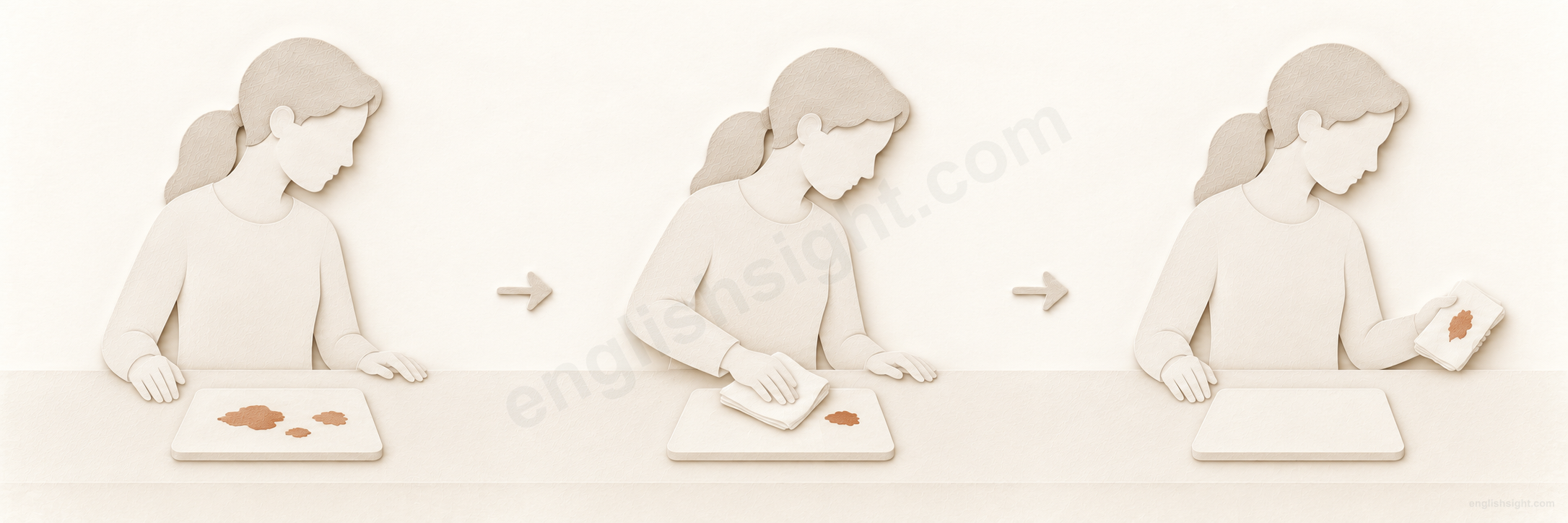
Clean can name a state, an action, a fresh start, or a complete result.
The object remains; the marks go
The object remains; the unwanted material is gone
The tile bears unwanted dirt marks.
clean
The same tile remains, free of those marks.
A cloth removes the dirt from the tile.
The tile stays; the dirt goes. Wiping is one way to clean.
In its physical uses, clean describes an object without the relevant dirt or unwanted material; to clean it is to remove that material.
Clean need not mean washed, sterile, empty, or morally good. The noun, construction, and situation determine the relevant standard. Completeness expressions such as clean through and financial clean up are separate established branches.
A clean plate has no unwanted food or dirt on it. Cleaning the plate removes that material while leaving the plate ready to use. That state-and-removal relationship is a useful starting point for this lesson.
Other uses concern pollution, errors, fairness, design, or completeness. Some are understandable extensions; others are fixed expressions that need their own context. The lesson offers a teaching model, not a claim that every English speaker pictures the same scene.
01
What kind of clean?
The noun and situation identify what is absent: visible dirt, pollution, errors, rule-breaking, or unwanted detail. Some uses are evaluative rather than measurable.
Clean describes the state; it does not itself report how that state was achieved.
A clean towel is ready to use; a dirty towel needs attention. Clean can stand before a noun or after be, look, seem, stay, or get. Cleaner and cleanest compare degrees: this cloth is cleaner than that one.
Keep the counter clean means maintain that state. A clean person or animal can also mean one with habits of cleanliness. Clean is different from tidy: a washed desk may still have papers scattered over it. Spotlessly clean and as clean as a whistle intensify physical cleanliness. Squeaky clean is an informal way to say very clean: The washed glasses were squeaky clean.
Original example
Please keep the kitchen counter clean.
Choose carefully A clean-looking surface is not necessarily sterile; clean and disinfected make different claims.
02
clean + water / air / energy; cleaner + noun
clean water / clean energy
have little or none of the relevant pollution
Situation / starting point
A community worries about polluted water and smoky power generation.
State / interpretation
It asks for safe water and less polluting energy.
The unwanted substance depends on whether clean describes water, air, or an energy source.
With air or drinking water, clean concerns contamination. With energy or a manufacturing process, it concerns the pollution produced. These are related uses, but clean energy is not energy that someone has washed.
Cleaner expresses a comparison with another option. In environmental discussion, the label alone does not specify which emissions, which stage of production, or an exact standard.
Original example
The town wants cleaner buses and better access to clean water.
Choose carefully Clear water describes appearance; clean drinking water concerns suitability and contamination.
03
a clean sheet of paper; a clean copy of + noun
a clean sheet / clean copy
be blank, or have no unwanted corrections or errors
Situation / starting point
A writer has a marked-up draft.
State / interpretation
The writer prepares an unmarked final version.
A clean page and clean copy are related but different: blank versus free of unwanted changes or mistakes.
A clean sheet of paper has nothing written on it. Clean copy can contain a complete text: it is a version without the unwanted corrections, marks, or errors being discussed.
Read the noun and context before deciding whether clean means empty. A clean page is not a page deleted from a document, and a clean copy is not necessarily a blank copy.
Original example
Send me a clean copy after you remove the editing notes.
Choose carefully Do not treat clean as meaning blank in every document context.
04
a clean + record / driving licence / reputation
a clean record
have no recorded wrongdoing of the relevant kind
Situation / starting point
An employer checks a candidate’s driving history.
State / interpretation
The history shows no driving offences.
Clean evaluates a record against relevant rules, rather than describing a washed document.
A clean driving record or clean driving licence means no recorded driving offences in the relevant sense. A clean police record concerns criminal history. The noun narrows the claim.
A clean reputation or image similarly suggests freedom from scandal or wrongdoing. These are judgments about conduct or public perception, not a guarantee that every aspect of a person’s life is perfect. A squeaky-clean image suggests a reputation without faults or wrongdoing. Depending on tone, it may praise someone or cast doubt on an overly perfect public image.
Original example
The delivery company requires a clean driving record.
Choose carefully A clean driving record does not make a claim about every kind of criminal record.
05
a clean + game / fight / match; play clean / cleanly
a clean game / fight
follow the rules without cheating or fouls
Situation / starting point
Two teams compete intensely.
State / interpretation
They play within the rules.
Clean can describe fair conduct even when the competition is physically tough.
A clean game need not be gentle or easy. Clean singles out the absence of cheating, fouls, or other prohibited conduct. Play fair is a useful alternative when discussing behavior directly. Clean also works as an adverb in expressions such as play clean, meaning play fairly; play cleanly is another possible form.
Clean here does not concern the players’ clothes. A match on a muddy field can still be a clean match in this sense.
Original example
It was a hard but clean match.
Choose carefully Winning is not part of the meaning: either side can play clean and lose.
06
clean + joke / fun; keep it clean; clean living
clean jokes / keep it clean
avoid obscene or sexually explicit material
Situation / starting point
A comedian is planning a family show.
State / interpretation
The material avoids offensive sexual language.
Clean is an evaluation of content and suitability for an audience.
Clean jokes and good clean fun suggest entertainment without obscenity or sexual material considered unsuitable. Keep it clean can be a request to avoid such content when speaking.
This use depends partly on audience and context. Clean living describes a lifestyle viewed as wholesome; it is not simply a report that somebody bathes often.
Original example
The host asked the guests to keep their jokes clean.
Choose carefully Clean is not a universal age rating and does not automatically mean suitable for every child.
07
be / stay clean; have been clean for + period
be clean
not use drugs, or not carry illegal items
Situation / starting point
A speaker describes recovery, or a police search.
State / interpretation
The context supplies the relevant absence.
Two informal uses need different contexts: substance use and illegal possession.
In recovery contexts, someone who has been clean for a year has not used the relevant drugs during that time. The phrase can also refer to alcohol in an appropriate context; the substance is understood, not named by clean itself.
In a search context, They searched him, but he was clean means no illegal drugs, weapons, or other contraband were found on him. It does not mean the search proved his innocence of every offence. These are established informal uses. Prefer a person’s own wording when discussing recovery.
Original example
In the interview, she said she had been clean for two years.
Choose carefully The everyday adjective dirty should not be used as a label for a person who uses drugs.
08
clean + lines / design / edge / cut
clean lines / a clean cut
have a simple shape or a smooth, definite edge
Situation / starting point
A designer removes fussy detail; a sharp blade cuts material.
State / interpretation
The shape or edge is clear and regular.
Clean may describe form rather than hygiene.
Furniture with clean lines has a simple, definite outline rather than elaborate ornament. A clean cut in a sheet of card has a neat edge without ragged tearing.
The shared teaching connection is the absence of unwanted irregularity. It does not imply that a design has just been physically cleaned. A clean design can still use color or decoration.
Original example
The chair’s clean lines suit the simple room.
Choose carefully Clean and plain overlap, but clean can praise precision rather than lack of decoration.
Clean evaluates execution; cleanly usually describes how the action is performed.
A clean landing or clean catch highlights skillful execution without a fumble or other error. A clean getaway emphasizes escape without trouble or being caught, not the moral goodness of the escape.
Use cleanly to describe manner in neutral prose: She caught the ball cleanly. This is different from the informal intensifier clean in clean forgot, which means completely.
Original example
The gymnast finished with a clean landing.
Choose carefully Clean does not mean fair in every action noun: a clean getaway can describe a thief.
10
a clean + smell / taste
a clean smell / taste
seem fresh, light, and pleasant
Situation / starting point
A window opens onto sea air.
State / interpretation
A speaker notices a fresh smell.
This is a sensory description, not a laboratory finding.
A clean smell or clean taste is perceived as fresh and without an unpleasant heaviness or taint. This is an evaluative description of the experience.
It can accompany literal cleanliness, but smelling pleasant and being uncontaminated are different matters. The adjective does not establish that food or water is safe.
Original example
The room had a clean, fresh smell after we opened the windows.
Choose carefully Do not infer safety simply from a clean smell.
02
Cleaning, results, and services
Distinguish the object being cleaned, the material removed, and the resulting state. Cleaning need not involve water.
11
clean + object (+ with + tool); clean; be cleaned; clean something down
clean the floor / clean with a cloth
remove dirt from an object or place
Situation / starting point
Dust covers a shelf.
State / interpretation
Someone removes the dust; the shelf remains.
The direct object can name the thing that becomes cleaner.
Clean is a general verb: you can clean by wiping, brushing, vacuuming, or washing. With names the tool or material: clean the screen with a soft cloth. Wash specifically involves water; rinse often removes soap using water.
I’m cleaning the kitchen describes an activity in progress. I clean on Saturdays leaves the object understood. The floor was cleaned is passive: the floor received the action. The forms are clean, cleans, cleaned, cleaning.
Clean down the equipment emphasizes thorough cleaning of its surfaces. It is separable: clean the equipment down; clean it down. Down does not require a downward movement.
Original example
I cleaned the shelf with a dry cloth.
Choose carefully Clean does not require water: I washed the screen suggests a more specific method.
In wipe it clean, clean is the resulting state of it.
Wipe the table clean combines an action, an object, and a result adjective. The same grammar appears in scrub the pan clean. Keep it clean instead asks you to maintain the state; the action need not be wiping.
This surface cleans easily says it is easy to clean. The surface is not doing housework itself. Compare It is being cleaned, a passive construction describing an actual ongoing action.
Original example
The smooth surface cleans easily with a damp cloth.
Choose carefully Clean in wipe it clean describes it; cleanly in cut it cleanly describes the manner of cutting.
13
have / get + object + cleaned; object + needs cleaning
have a coat cleaned
arrange for someone to clean something
Situation / starting point
Your coat needs specialist attention.
State / interpretation
A cleaner does the work for you.
Have or get plus an object and cleaned presents a service or arranged action.
I had my coat cleaned normally means I arranged the work, often professionally. It does not normally mean I personally cleaned the coat. The same service pattern works with carpets, windows, and other objects.
With clothing, clean can refer to dry-cleaning. Dry-clean makes the method explicit: it uses a process other than ordinary washing in water. Your coat needs cleaning means it needs to be cleaned; cleaning here does not make the coat the person doing the work.
Original example
I’ll have this jacket cleaned before the wedding.
Choose carefully I had cleaned my jacket is past perfect: it places my cleaning before another past reference point. It does not use the have + object + cleaned pattern for arranging a service.
14
clean + fish / poultry
clean a fish
prepare it by removing unwanted internal parts
Situation / starting point
A whole fish has not been prepared for cooking.
State / interpretation
Its internal parts have been removed as required.
With fish or poultry, clean has a conventional food-preparation meaning.
A recipe that asks you to clean a fish normally means preparing it by removing its internal organs and other unwanted parts, not merely rinsing the outside. The exact preparation needed depends on the recipe and the animal.
This fits a broad removal connection, but it has a specific conventional object meaning. It should not be generalized to every food: clean an apple does not mean remove the apple’s internal organs.
Original example
The fishmonger cleaned the fish for us.
Choose carefully Cleaning a fish is not the same operation as filleting it; follow the actual preparation requested.
15
give + object + a (good) clean; do the cleaning
give it a good clean / do the cleaning
name a cleaning session or household work
Situation / starting point
A bicycle is covered in road dirt.
State / interpretation
Someone plans a thorough cleaning session.
A clean names an occasion of cleaning; cleaning can name the activity generally.
Give the bike a good clean uses clean as a singular noun after a. It packages the work as one session. The construction is especially familiar in British English; clean the bike well is a broadly useful alternative.
Do the cleaning refers to the household task in general. Here cleaning is normally uncountable. Compare I clean the kitchen, where clean is a verb, and The kitchen is clean, where it is an adjective.
Original example
The bike needs a good clean after that muddy ride.
Choose carefully Do not use a cleaning to mean household work generally: say I do the cleaning.
03
Off, up, and out
Particles help specify removal, a cleaned-up situation, or an emptied interior. Several whole expressions also have established figurative meanings.
16
clean + material + off / from + surface; clean + object + off
clean the mud off / clean it off
remove unwanted material from a surface
Situation / starting point
Mud is stuck to a boot.
State / interpretation
The mud is removed from the boot.
The object can be the material removed; off or from introduces its original surface.
Clean the mud off the boots names mud as the removed material. Clean the boots names the object made clean. From can replace off in a removal construction, as in clean dust from the filter. Clean the dust away similarly presents removal without naming the surface.
When the surface is understood, clean the mud off and clean it off are possible. A pronoun object goes before the particle: clean it off. Clean off the mud also works with a noun. Clean the counter off can instead put the affected surface in object position; context tells you what is removed.
Original example
Clean the wet paint off the handle before it dries.
Choose carefully In clean it off, check whether it refers to the dirt or the surface; do not assume both are the same object.
17
clean up; clean + object + up; clean up after + person / event
clean up / clean up after someone
deal with dirt, clutter, or a mess
Situation / starting point
A party leaves crumbs and cups everywhere.
State / interpretation
The mess is removed and the room is usable again.
Up presents dealing with the messy situation, without requiring upward motion.
Clean up the kitchen and clean the kitchen up are separable patterns. With a pronoun, use clean it up. You can also say We cleaned up with no object when the context makes the mess clear.
Clean up after someone means deal with the mess that person leaves. Clean up after dinner locates the task after an event. Cleaning up can include putting things away; it is broader than washing a single object. Cleaning up a polluted beach uses the same pattern with environmental contamination.
In informal American usage, clean up can also mean finish outstanding work: We need to clean up these last few tasks before Friday. Here the tasks are completed, rather than physically washed; this is an established completion use.
Original example
Everyone helped clean up after the party.
Choose carefully Say clean it up, not clean up it. After does not always mean following someone physically.
18
clean (yourself) up; get cleaned up
clean yourself up / get cleaned up
wash and make yourself presentable
Situation / starting point
Someone comes in from working in the garden.
State / interpretation
They wash and change as needed.
The person receiving the cleaning is also the person attending to their appearance.
I need to clean up can mean I need to wash and make myself presentable. Adding myself removes the ambiguity with cleaning a room. Get cleaned up is also an ordinary informal way to express this change.
A context such as before dinner helps identify personal washing. The expression does not mean that somebody is morally bad or needs to change their behavior; that is the separate idiom clean up your act.
Original example
Give me ten minutes to clean myself up before we leave.
Choose carefully Keep the reflexive before up: clean yourself up, not clean up yourself in this ordinary pattern.
19
clean + organization / activity + up; clean up one’s act; clean house
clean up a business / clean up your act
remove wrongdoing or improve irresponsible behavior
Situation / starting point
A company has corrupt practices; a worker repeatedly behaves irresponsibly.
State / interpretation
Practices are reformed or behavior improves.
The unwanted element is misconduct rather than physical dirt.
Clean up an industry or a city can mean tackle corruption or crime. A newspaper report about cleaning up a city may therefore concern police work, rubbish removal, or both; the surrounding details matter.
Clean up your act is an informal idiom telling someone to behave more responsibly. Act here means behavior, not necessarily a stage performance. North American clean house can mean remove unwanted staff or practices; literally, clean house can also mean do housework.
Original example
The league promised to clean up the sport after the bribery scandal.
Choose carefully A clean image concerns appearance or reputation; cleaning up actual practices requires changes in conduct.
20
subject + clean up (+ at / on + source)
clean up at the box office
make or win a large amount of money
Situation / starting point
A film attracts unusually large audiences.
State / interpretation
It earns a great deal of money.
This informal financial use belongs to the whole expression clean up.
A company, performer, or gambler can clean up by making a lot of money. A film that cleans up at the box office is financially successful; nobody needs to be cleaning a cinema.
This use is intransitive: The investors cleaned up. The amount or source may be supplied in context. It is not the same as clean up the accounts, which may concern correcting or reforming them.
Original example
The studio hopes its new comedy will clean up at the box office.
Choose carefully Do not interpret clean up as a profit claim whenever an object follows it: clean up the mess is literal.
21
clean out + container / room; clean + object + out
clean out a cupboard
empty and thoroughly clean an interior
Situation / starting point
A cupboard contains old packages and dust.
State / interpretation
Unwanted contents and dirt are removed.
Out focuses attention on what is inside the object.
Clean out a cupboard often involves taking things out, disposing of what is unwanted, and cleaning inside. Clean the cupboard can be less specific about its interior. The useful things may be put back afterward.
The pattern is separable: clean out the cupboard, clean the cupboard out, clean it out. It does not necessarily mean permanently leave the cupboard empty.
Original example
We cleaned out the fridge before buying more food.
Choose carefully Do not translate out as leaving the building: the object’s interior is the focus.
22
cost / loss + clean + person + out; clean out + savings / account
clean someone out
leave someone with no money
Situation / starting point
A person pays a very large bill.
State / interpretation
They have no spare money left.
The person is depleted of money; they have not been washed.
An expensive repair can clean you out. This informal expression often exaggerates the speaker’s remaining spending money rather than asserting a precise bank balance.
Gambling losses can have the same effect. With the person as a pronoun, keep it between the verb and particle: The bill cleaned me out. Compare cleaned up, which can mean made a lot of money: the financial directions are opposite.
The object can also be a fund: They cleaned out their savings to pay for the move means they used all that money. This describes depletion, not necessarily theft or gambling.
Original example
Replacing the engine has cleaned me out this month.
Choose carefully Clean me out can describe an expense without implying that anyone stole from me.
23
clean + person / place + out; clean out + place / stock
clean out a house / shop
take all the valuables, or exhaust a supply
Situation / starting point
Burglars enter a house; eager shoppers visit a sale.
State / interpretation
Valuables or available stock are gone.
The complete-removal meaning must be interpreted from the agent and context.
If burglars cleaned out a house, they stole its valuables. The house did not receive a helpful cleaning service. A person can also be the object: They cleaned us out means they took what we had.
In sales talk, customers cleaned out the shop can mean they bought all its available goods. That use emphasizes exhausted stock, not theft. These informal readings depend on the subject and situation.
Original example
The burglars cleaned out the shop overnight.
Choose carefully Check who did it: cleaners, burglars, and customers suggest different readings of clean out the shop.
04
Fresh starts, honesty, and complete results
Learn these expressions as units. Their meanings cannot always be predicted from a picture of wiping a surface.
24
come clean with + person + about + matter; make a clean breast of + matter
come clean about something
admit something previously hidden
Situation / starting point
A worker has hidden a mistake.
State / interpretation
The worker tells the relevant person what happened.
Come clean is a conventional honesty expression, not a washing instruction.
Come clean about a mistake means reveal the truth that you have been concealing. With identifies the person told; about identifies the topic. Coming clean may be voluntary or follow pressure.
Make a clean breast of something is another established, less everyday way to describe a full confession. The wording is fixed; changing breast to chest does not preserve this idiom.
Original example
I came clean with my manager about the missing receipt.
Choose carefully Do not say come clean of a mistake for this pattern; use about.
25
start with a clean slate; wipe the slate clean; make a clean start
start with a clean slate / wipe the slate clean
begin without holding past mistakes against someone
Situation / starting point
Two friends have a history of arguments.
State / interpretation
They agree to start again without counting the old disputes.
The slate is a metaphorical record of the past.
Start with a clean slate means begin without previous faults or failures counting against you. Wipe the slate clean means agree to put those things aside. Neither phrase normally asks anyone to clean a real writing board.
A clean start emphasizes beginning afresh. This family connects the blank-page idea with social forgiveness or a new opportunity. It does not itself cancel a legal debt or delete an official record.
Original example
We agreed to wipe the slate clean and work together again.
Choose carefully A clean slate offers a fresh start; it does not claim the past never happened.
26
team / goalkeeper + keep a clean sheet
keep a clean sheet
finish a match without conceding a goal
Situation / starting point
A team plays a football match.
State / interpretation
Its opponents score no goals.
Here a clean sheet refers to the goals conceded, not the whole match result.
In football reporting, especially British usage, a team or goalkeeper keeps a clean sheet when no opposing goals are allowed. A nil-nil draw gives both teams a clean sheet.
The expression draws on a record with no goals entered against the team. It is distinct from the literal clean sheet of paper and from a clean game played without fouls.
Original example
Our goalkeeper kept a clean sheet in the goalless draw.
Choose carefully Keeping a clean sheet does not guarantee winning.
27
give + person / thing + a clean bill of health
a clean bill of health
a favorable report after an examination
Situation / starting point
A person, building, or system is checked.
State / interpretation
The report identifies no relevant problem.
A bill of health is a report, not a request to pay a fee.
Give someone a clean bill of health means report that the examination finds them healthy. The expression also extends to inspected buildings, machines, or organizations judged to be in good condition.
The claim is tied to the examination and its scope. It is not a promise that no problem could ever develop, and clean does not mean the patient or building was physically washed.
Original example
The inspection gave the old bridge a clean bill of health.
Choose carefully Read the whole idiom: bill here does not mean an invoice for cleaning.
28
make a clean break with / from + person / past / organization
make a clean break with the past
end a connection completely
Situation / starting point
Someone is still tied to a former way of life.
State / interpretation
They end the ties and begin a different life.
Clean emphasizes complete separation, not cleanliness or approval.
Make a clean break with or from something means end the connection decisively. It may concern a relationship, organization, or former lifestyle. A break from work can simply be a rest; clean break makes the separation stronger.
A clean break in a bone is a separate physical use: a break in one place, rather than a complicated pattern of breaks. It should not be read as a claim about absence of infection.
Original example
She moved away to make a clean break with her old life.
Choose carefully A complete break is not necessarily painless or wise; clean does not guarantee a good decision.
29
make a clean sweep of + awards / organization
make a clean sweep
win everything, or replace everything considered unwanted
Situation / starting point
A team enters three events; a new manager reviews a failing department.
State / interpretation
The team wins all three; the manager removes all the old arrangements.
Two established meanings emphasize completeness, with different goals.
Make a clean sweep of the awards means win all the relevant awards. It is stronger than simply doing well. The scope must be supplied: all three medals in an event, for example, not every medal in the sport’s history.
A manager can instead make a clean sweep of an organization by removing the people or arrangements considered in need of change. This is not a claim about winning prizes or literally using a broom.
Original example
The club made a clean sweep of the three regional titles.
Choose carefully Specify the set involved; a clean sweep is complete within that set.
30
keep + possessive + nose clean
keep your nose clean
stay out of trouble or illegal activity
Situation / starting point
Someone wants to avoid further trouble.
State / interpretation
They avoid wrongdoing.
The body-part expression is figurative advice about conduct.
Keep your nose clean is an informal instruction or description meaning avoid trouble, especially wrongdoing or illegal behavior. It often appears when somebody is being warned or discussing a previous history of trouble.
It is not the same as come clean: come clean means reveal a hidden truth, whereas keep your nose clean means avoid misconduct. Neither involves physical washing in the idiomatic reading.
Original example
He promised to keep his nose clean after the warning.
Choose carefully Use the appropriate possessive: keep my nose clean, keep her nose clean, keep your nose clean.
31
clean + through / away; clean forgot
clean through / clean forgot
completely or all the way
Situation / starting point
A hole passes through the full thickness of a board.
State / interpretation
Nothing remains across the path of the hole.
Clean is an informal intensifier, not a description of how hygienically something happens.
Clean through means all the way through. Clean away can mean completely away, as with a successful escape. I clean forgot means I completely forgot; it is informal and less neutral than completely forgot.
This adverb use is limited to established combinations. Do not attach clean to any verb just to mean completely. Cleanly usually expresses neat or accurate manner, so it is not a substitute in I clean forgot.
Original example
The nail went clean through the thin board.
Choose carefully For neutral writing, all the way through and completely forgot are widely useful choices.
Read the object and the full expression
Clean, tidy, wash, and clear
Clean concerns unwanted dirt or another contextually relevant defect. Tidy concerns arrangement. Wash specifies cleaning with water. Clear can mean remove objects or an obstruction. A tidy room may still be dusty; a clean room may still be untidy.
State, action, and manner
The cloth is clean describes a state. I clean it describes an action. I wiped it clean gives a result. I cut it cleanly gives a manner. Clean in clean through means completely. These are different grammatical jobs.
Limits and respectful wording
Clean is often an ordinary practical description, but some social uses carry judgments. Do not infer someone’s worth from their hygiene, health, recovery status, or record. This lesson explains established usage rather than endorsing every evaluation.
Scope
This is a selection of modern common uses, not a frequency ranking or an exhaustive list. Specialist religious classifications, nuclear and aviation terminology, weightlifting clean, and the regional idiom clean someone’s clock are outside the main lesson. Derived compounds such as clean-shaven and clean-cut have their own lexical behavior.
Choose the meaning from the situation
Identify the object, the grammar, and any fixed expression.
1. You rubbed the dirt away. Which sentence presents clean as the resulting state of the table?
2. The kitchen is a mess. Replace the kitchen with it in clean up the kitchen.
3. A costly car repair used all your available money. Which informal sentence fits?
4. The football match ended 0–0. Which statement is accurate?
5. You decide to reveal a mistake you previously hid. Which expression fits?
6. You arranged for a professional to clean your jacket. Which sentence directly conveys that?
Sources and teaching notes
The linked dictionaries support the usage inventory. Explanations, examples, and the visual teaching model were written for this lesson. Dictionary groupings differ; the lesson groups uses by practical meaning and construction.
The diagram is a teaching aid for physical cleaning; other uses are explained in the text.