From a changing display to deadlines, work records, and measured results.
Passing time becomes readable
Passing time becomes a readable measure
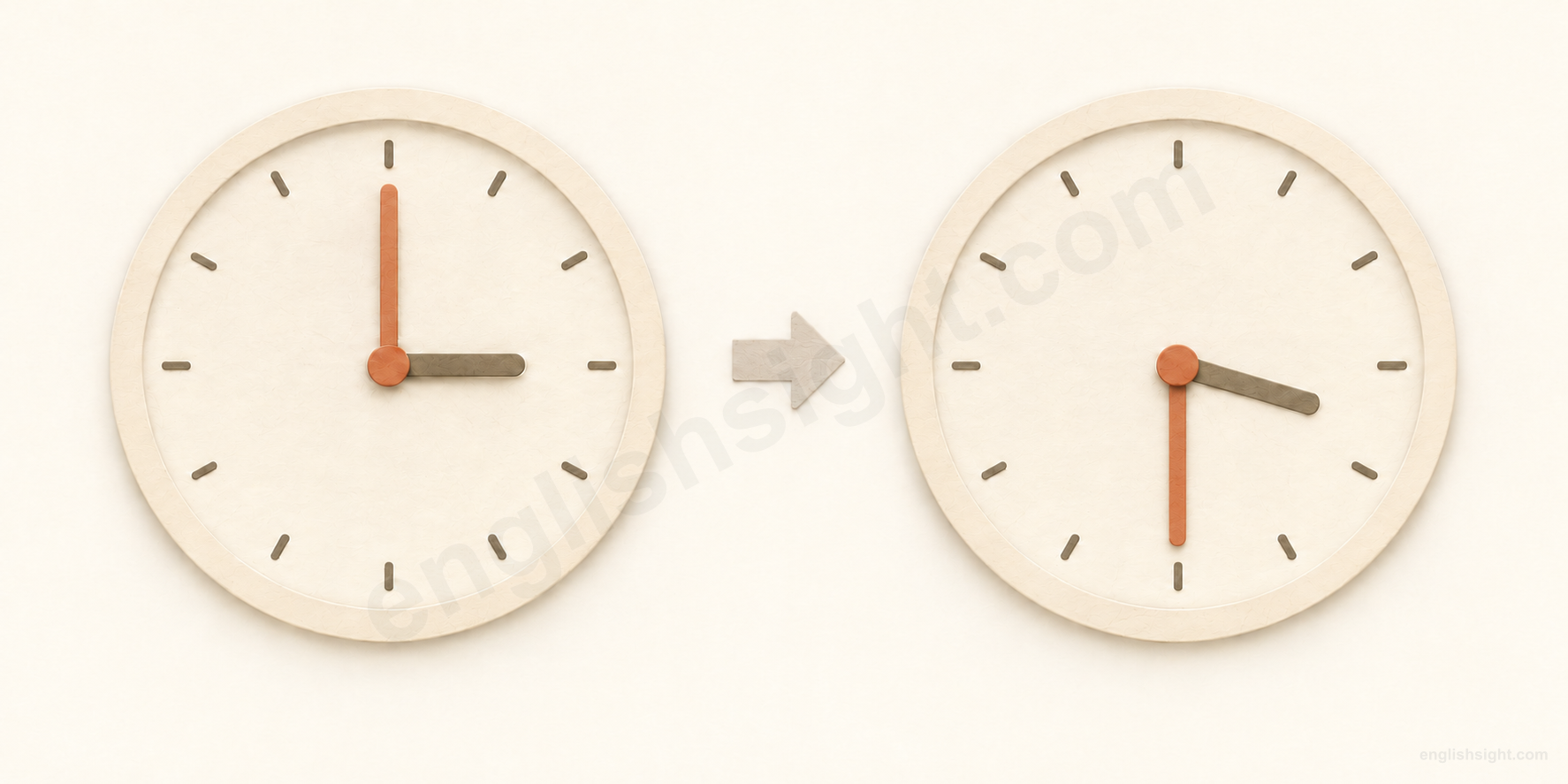
Earlier: 3:00.
clock
Later: 3:30.
Half an hour passes; both hands advance.
One clock, two moments: changing hands make half an hour visible.
A clock tracks time through a changing display, letting us read an hour or measure how much time has passed.
The same clock appears at two moments. This models timing and recording; it does not explain every informal meaning of clock.
A clock makes passing time readable through moving hands or changing numbers. That concrete device helps us understand many expressions about time limits and records.
Some uses are established idioms or separate informal meanings. The diagram is a teaching model, not a claim that all English speakers share one mental picture.
01
Reading and setting the time
Start with the device, its display, and the systems used to express time.
01
a / the + clock; clock + noun
a wall clock / an alarm clock
a device that shows the time
Situation / starting point
You need to know when to leave.
Reading / result
You look at a time display.
Clock names the device; time names what it measures.
A clock can have hands on a face or numbers on a digital display. A wall clock hangs on a wall; an alarm clock can make a sound at a chosen time. A watch is normally worn or carried, especially on the wrist.
Clock is countable: a clock, two clocks. In clock face, clock hands, and clock tower, the first noun identifies the kind of part or structure. The hands point to the time; they are not body parts here.
In a sentence
There is a digital clock above the station entrance.
Watch the difference Ask What time is it?, not What clock is it?, when you want the current time.
02
the clock says / reads + time; by + clock
the clock says / reads…
report the time displayed
Situation / starting point
You check the kitchen clock.
Reading / result
Its display gives a time.
The clock supplies a reading, not a spoken statement.
The clock says eight and The clock reads eight both report its display. By the kitchen clock identifies the device you are using as your reference.
A clock ticks when it makes repeated small sounds. A striking clock can strike eight, sounding the hour. Digital clocks need not tick or strike.
In a sentence
It is ten past eight by the kitchen clock.
Watch the difference The displayed reading may be wrong; says does not guarantee accuracy.
03
clock + be + amount + fast / slow
the clock is five minutes fast / slow
describe a reading ahead of or behind the correct time
Situation / starting point
The correct time is nine.
Reading / result
Your clock shows five past nine.
Fast and slow compare the displayed time with the correct time.
A clock that is five minutes fast shows a time five minutes later than the correct time. Five minutes slow means its reading is five minutes earlier.
A clock that keeps good time stays accurate. A clock that has stopped no longer advances. These descriptions concern the device, not whether you personally are early or late.
In a sentence
This clock is five minutes fast, so we still have time.
Watch the difference Fast can describe an incorrect reading even if the hands are now moving at the normal rate.
04
set a clock to + time; set an alarm clock for + time; wind + clock
set / reset / wind a clock
adjust the reading or keep a mechanism running
Situation / starting point
The display is wrong or the mechanism needs attention.
Reading / result
You adjust or power the clock.
Setting the reading and winding a mechanism are different actions.
Set a clock to the correct time; reset it after an interruption or change. To set an alarm clock for seven is to choose when its alarm should sound, not necessarily change the current-time display.
Wind a clock means turn its key or winding control to power a mechanical movement. A battery-powered digital clock does not normally need winding.
In a sentence
I reset the clock to the correct time after replacing the battery.
Watch the difference Wind in this use rhymes with find; it is not pronounced like the noun for moving air.
05
put the clocks forward / back; set the clocks ahead / back
put the clocks forward / back
adjust clock readings for an official time change
Situation / starting point
An official seasonal change is due.
Reading / result
People change the displayed hour.
Forward advances the reading; back makes it earlier.
British English uses put the clocks forward/back; American English also uses set or move the clocks ahead/back. The clocks go forward/back describes the official change more generally.
The plural clocks often refers collectively to clocks in a place. The expression itself does not tell you whether a particular country changes its time or when it does so.
In a sentence
Remember to put the clocks back before you go to bed.
Watch the difference A clock adjustment does not reverse events; distinguish this from figurative turn the clock back.
06
number 1–12 + o’clock; at + time
at seven o’clock
name an exact hour
Situation / starting point
You arrange a meeting time.
Reading / result
You specify the hour without minutes.
O’clock follows the hour number as one fixed form.
Say seven o’clock for 7:00. With minutes, say seven ten or ten past seven, without adding o’clock. At introduces the meeting time: at seven o’clock.
The apostrophe belongs inside o’clock. Clock on its own names a device, while o’clock is a fixed time-telling word.
In a sentence
The lesson begins at seven o’clock this evening.
Watch the difference Do not say seven clock or seven thirty o’clock.
07
use the 12-hour / 24-hour clock
the 12-hour / 24-hour clock
two systems for writing hours of the day
Situation / starting point
A timetable shows 18:00.
Reading / result
You understand that it means six in the evening.
Here clock names a time notation system, not a separate machine.
The 24-hour clock numbers hours across the day; 18:00 corresponds to 6 p.m. The 12-hour system repeats the hours and can use a.m. and p.m. to distinguish the two halves of the day.
A digital display can use either system. Digital describes how the reading is displayed; 24-hour describes how the hours are numbered.
In a sentence
The timetable uses the 24-hour clock, so the train leaves at 18:00.
Watch the difference A 24-hour clock is not the same expression as working around the clock.
02
Deadlines, waiting, and continuous activity
A clock can stand for the time available. Learn what each full expression adds.
08
work against the clock; a race against the clock
work / race against the clock
act under a deadline or compete by elapsed time
Situation / starting point
A repair must be finished before opening time.
Reading / result
The team works quickly under pressure.
The clock represents the time limit.
Work against the clock means hurry because time is limited. A race against the clock can describe an urgent task, without a literal race or a visible clock.
In some sports, competing against the clock means performance is judged by the recorded time. Against the clock describes the pressure or competition; it does not say the attempt succeeded.
In a sentence
We worked against the clock to repair the doors before the shop opened.
Watch the difference Use beat the clock when you want to say you actually finished within the limit.
09
beat the clock; try to beat the clock
beat the clock
finish within the time allowed
Situation / starting point
Only a minute remains in a challenge.
Reading / result
You complete the task in time.
Beat presents a successful outcome, not only an attempt.
The clock is treated as an opponent in this established expression. The task is completed before the allowed period ends.
Compare We tried to beat the clock, which reports an attempt and leaves success open. The article the is part of this familiar idiom.
In a sentence
We beat the clock and submitted the final answer with ten seconds left.
Watch the difference This does not mean hitting a timepiece.
10
the clock is ticking (down)
the clock is ticking
warn that the available time is running out
Situation / starting point
A decision has a deadline.
Reading / result
Less time remains to decide.
A running clock can stand for a shrinking opportunity.
The clock is ticking can be literal, but in a warning it means there is limited time left. The decision or deadline comes from the surrounding context.
You may read the clock is ticking down to an event. Down emphasizes progress toward the endpoint rather than a clock physically moving downward.
In a sentence
We need a decision today; the clock is ticking.
Watch the difference The idiom does not necessarily refer to a ticking sound.
11
work around / round the clock; round-the-clock + noun
around / round the clock
throughout day and night
Situation / starting point
A service needs to stay available at every hour.
Reading / result
People take shifts to keep it running.
The full cycle of hours represents continuous coverage.
Work around the clock or work round the clock means continue through day and night. It does not require one individual to work without a break; a team may take turns.
Before a noun, use hyphens: round-the-clock care or around-the-clock support. The phrase describes continuous coverage, not merely a long working day.
In a sentence
The support team works around the clock in three shifts.
Watch the difference Around ten o’clock means approximately 10:00; around the clock means continuously.
12
turn / put the clock back; turn back the clock
turn / put the clock back
return to or imagine an earlier state
Situation / starting point
You regret a past decision or discuss a lost custom.
Reading / result
You imagine restoring what existed before.
The earlier clock reading is a metaphor for an earlier situation.
You cannot turn the clock back can express that the past cannot be undone. A speaker may wish for another chance, or invite listeners to imagine an earlier period.
In criticism, turn the clock back can mean restore outdated ideas or practices. This figurative meaning differs from the literal seasonal adjustment of clocks.
In a sentence
We cannot turn the clock back, but we can make a better decision now.
Watch the difference The idiom concerns the situation as a whole, not just changing a clock display.
13
watch the clock; keep watching the clock
watch the clock
keep checking the time while waiting for an activity to end
Situation / starting point
A class feels very long.
Reading / result
You keep looking to see how much longer it will last.
Repeated attention to time can reveal impatience.
As an idiom, watch the clock often suggests boredom or eagerness to leave. In workplace criticism, it can suggest caring more about finishing time than the work.
Looking at a clock once to find the time is simply checking the time. Context can also make watch the clock a literal instruction to monitor a display.
In a sentence
During the dull presentation, I found myself watching the clock.
Watch the difference Do not assume every glance at a clock implies laziness.
14
stop the clock; run out / run down / kill the clock
stop / run out the clock
pause official timing or let remaining game time expire
Situation / starting point
There is little playing time left.
Reading / result
Timing pauses, or the leading side uses up the remaining time.
Stopping the clock and running it out have opposite effects on time remaining.
Stop the clock means pause the measurement of time in a timed activity. The players may still be moving while official timing is paused.
Run out the clock or run down the clock describes using up the remaining game time, often by keeping possession while protecting a lead. Kill the clock is another established expression for this strategy; it does not mean breaking the timing device.
In a sentence
With a narrow lead, our team kept the ball to run out the clock.
Watch the difference Different sports have different timing rules; the expression alone does not specify them.
03
Work, measured results, and accumulated totals
The verb and its particles distinguish registration, measurement, achievement, and duration.
15
clock in / on; clock in at + starting time
clock in / on
record the start of working time
Situation / starting point
You arrive for a shift.
Reading / result
Your starting time is registered.
In and on mark entry into recorded work time.
A time clock is a device for registering working hours. Clock in and, especially in British usage, clock on describe registering when work begins. A card, terminal, or electronic system can do the recording. Simply walking through the door does not necessarily register your time.
These are intransitive phrasal verbs in this pattern: I clocked in at eight. Punch in is a familiar American alternative. At eight states the starting time; it is not an object.
In a sentence
I clock in on the terminal beside the staff entrance.
Watch the difference Compare The film clocks in at ninety minutes: that reports duration, not arrival at work.
16
clock out / off; clock out at + finishing time
clock out / off
record the end of working time
Situation / starting point
Your shift is over.
Reading / result
Your finishing time is registered.
Out and off mark departure from recorded work time.
Clock out and, particularly in British English, clock off mean register the end of work. Punch out is a familiar American alternative.
Clock off can also be used conversationally about finishing work and going home. These verbs do not take the workplace as a direct object: clock out at the factory, not clock out the factory.
In a sentence
Please clock out before leaving at the end of your shift.
Watch the difference Clock out is about working time, not checking out of a hotel.
17
be on / off the clock; amount of time + on the clock
on / off the clock
within or outside recorded or paid working time
Situation / starting point
A coworker asks whether you are working.
Reading / result
You clarify your duty status.
The clock can represent the period for which work is recorded.
I’m on the clock says I am currently on duty or being paid for my working time. I’m off the clock says that period is over or has not begun. These are informal prepositional expressions, not commands to operate a clock.
Working off the clock can describe doing work outside recorded or paid hours. That differs from relaxing after a shift. In sport, two minutes on the clock instead means two minutes shown as remaining.
In a sentence
I can help with that order; I’m still on the clock.
Watch the difference Use the context to distinguish duty status from a sports display.
18
clock + time / speed
clock a time / speed
achieve a recorded performance
Situation / starting point
A runner completes a race.
Reading / result
A finishing time is recorded.
The performer is the subject; the result follows clock.
In sports reports, an athlete can clock a time, meaning achieve that recorded result. The number is a performance, not the current hour of the day. A boat can also clock a speed of twenty knots: the figure reports the speed it reaches.
Clock is a regular verb: clocks, clocked, clocking. Clocked ends in the sound /t/. Compare a time of eleven seconds with at eleven o’clock: duration and time of day answer different questions.
In a sentence
Maya clocked eleven seconds in the school sprint final.
Watch the difference A faster race time is usually a smaller duration, not a later clock reading.
19
clock someone at + speed; be clocked at + figure; clock someone doing + speed
clock someone at… / be clocked at…
measure someone’s time or speed
Situation / starting point
A device measures a passing vehicle.
Reading / result
Its speed is recorded.
The measurer can be the subject, or the measured participant can become the passive subject.
Clock someone at a speed means measure that speed. The passive is common: The car was clocked at eighty miles an hour. At introduces the measured figure. A duration is also possible: The runner was clocked at twelve seconds reports a measured finishing time.
Clock someone doing a speed is another pattern: The camera clocked the car doing eighty. Doing gives the measured activity; it is not a request for the driver to do something.
In a sentence
The camera clocked the van at seventy miles an hour.
Watch the difference In this pattern clock does not mean strike or notice; the speed figure supplies a clear clue.
20
clock up + amount; clock + miles / hours
clock up miles / hours / wins
reach an accumulated total
Situation / starting point
Journeys or achievements add up over time.
Reading / result
You report the total reached.
Up emphasizes the accumulated amount.
Clock up is especially associated with British usage. It can describe distance, time spent, or achievements such as wins, rather than a literal clock face.
We clocked up three hundred miles reports accumulated travel. Bare clock also occurs with distances or hours: She clocked long hours in the lab. The noun or figure names the total, not a time of arrival.
In a sentence
The cycling club clocked up three hundred miles over the weekend.
Watch the difference Do not confuse clock up hours, accumulating them, with clock in, registering a starting time.
21
something + clock in at + measured amount
clock in at ninety minutes
have a measured duration or total
Situation / starting point
You check how long a film lasts.
Reading / result
You report its running time.
In at introduces a measured amount, not necessarily a starting time.
A film clocks in at ninety minutes means it lasts ninety minutes. The film is the subject, and no worker is registering an arrival.
This informal pattern can also report other measurements, such as a total cost. Compare I clocked in at nine: a person and a time of day usually point to the workplace sense.
In a sentence
The documentary clocks in at ninety minutes, including the credits.
Watch the difference Do not interpret ninety minutes as the time when a film begins.
04
Other meanings and context clues
Mileage and bodily rhythms extend the recording or timing idea. Informal notice and hit are separate branches.
22
vehicle + with + distance + on the clock
miles on the clock
distance shown by a vehicle’s odometer
Situation / starting point
You examine a used car.
Reading / result
You learn its recorded total mileage.
In this informal vehicle use, clock refers to the distance register.
In this mainly British informal use, a car with forty thousand miles on the clock has that mileage displayed on its odometer, called a milometer in British English. Clock here does not mean an ordinary dashboard time display.
The figure is a displayed record. It is different from saying the car is travelling at forty miles an hour, which is its current speed.
In a sentence
The van has forty thousand miles on the clock.
Watch the difference A mileage figure is not a duration or a speed.
23
clock + vehicle; a clocked car
a clocked car
a car whose displayed mileage has been dishonestly reduced
Situation / starting point
A buyer sees a suspiciously low mileage.
Reading / result
An inspection reveals the reading was altered.
This British informal verb concerns the mileage register.
To clock a car can mean alter its odometer so it appears to have travelled less. A clocked car uses a past participle to describe the affected vehicle.
This is a separate established vehicle use. Compare The car was clocked at seventy: the at-phrase points to speed measurement, not mileage tampering.
In a sentence
The inspection suggested that the used car had been clocked.
Watch the difference Clocked alone needs context; it can also describe a measured speed.
24
clock + person / thing; clock that + clause; clock where + clause
clock someone / clock that…
notice or recognize
Situation / starting point
You see a small change.
Reading / result
You become aware of it.
This informal British branch is about awareness, not measuring time.
In informal British English, clock can mean notice something or recognize someone. You can clock a person, clock that something has changed, or clock where something is.
Learn this branch independently. The time-display diagram does not predict it, and notice is usually the clearer choice in neutral international English.
In a sentence
I clocked that the entrance had moved to the other side.
Watch the difference Clock someone may also mean hit them; the situation must distinguish the meanings.
25
clock + person + on / in + body part; clean someone’s clock
clock someone on the jaw
hit someone hard
Situation / starting point
A report describes a fight.
Reading / result
Someone receives a blow.
This informal sense concerns an impact, not a time reading.
Clock someone can mean hit them hard, especially on the head or face. On the jaw identifies the place hit. The tone is informal and often belongs to accounts of fights.
The longer North American informal idiom clean someone’s clock can mean defeat them decisively, or beat them in a fight. The meaning of that whole idiom is not obtained by treating clean literally.
In a sentence
A witness said that the attacker clocked him on the jaw.
Watch the difference Do not use clock as a neutral synonym for every kind of touch or accidental contact.
26
someone’s body clock; biological clock; biological clock is ticking
body clock / biological clock
an internal system regulating bodily timing
Situation / starting point
You cross several time zones.
Reading / result
Your sleeping rhythm takes time to adjust.
Clock is a model of natural timing, not a device inside the body.
Your body clock helps regulate when you feel ready to sleep, eat, or wake. Biological clock is a broader expression for natural timing systems in living things, also used in scientific contexts.
In talk about having children, someone’s biological clock is ticking is a figurative expression of concern about time and reproductive age. It may sound personal or pressuring; it does not describe everyone’s wishes or a precise deadline.
In a sentence
After the long flight, my body clock still wakes me before sunrise.
Watch the difference This is a vocabulary explanation, not a way to diagnose health or predict fertility.
Read the whole expression
Device, hour, and duration
Clock is a countable device noun. Time can name the hour or a duration. Say at seven o’clock for an hour, for seven minutes for a duration, and a clock for a device.
Regular verb; several constructions
The verb forms are clock, clocks, clocked, and clocking. Measurement allows a passive, as in was clocked at a speed. Work registration uses intransitive clock in/out. Clock up takes an accumulated total. There is no general clock someone to do causative pattern.
Scope and diagram
This lesson selects modern everyday and useful recognition meanings, without a frequency ranking. Specialist electronic clock signals, clock speed, old textile ornament senses, and detailed clock mechanisms are not expanded. The timing model helps connect uses, but it cannot predict every fixed expression.
Choose by the situation
Use the subject, the measurement, and the full expression as clues.
1. The correct time is 9:00. Your clock shows 9:05. Which description fits?
2. You hurried to submit a form, but you missed the deadline. Which sentence can still be true?
3. A review says The film clocks in at ninety minutes. What is being reported?
4. Your shift has ended and you need to register your finishing time. What do you do?
5. The police clocked the car at eighty miles an hour. What happened?
6. A help desk offers round-the-clock support. What can a customer expect?
Sources and teaching notes
The linked publisher pages support the usage and coverage notes. Explanations and examples are original; the diagram is a teaching model.
The diagram explains a timing relationship; it is not a universal mental image.