Use cloth for textile material, a cloth for a useful piece, and full expressions for the figurative meanings.
Material and a piece put to use
From textile material to a useful piece
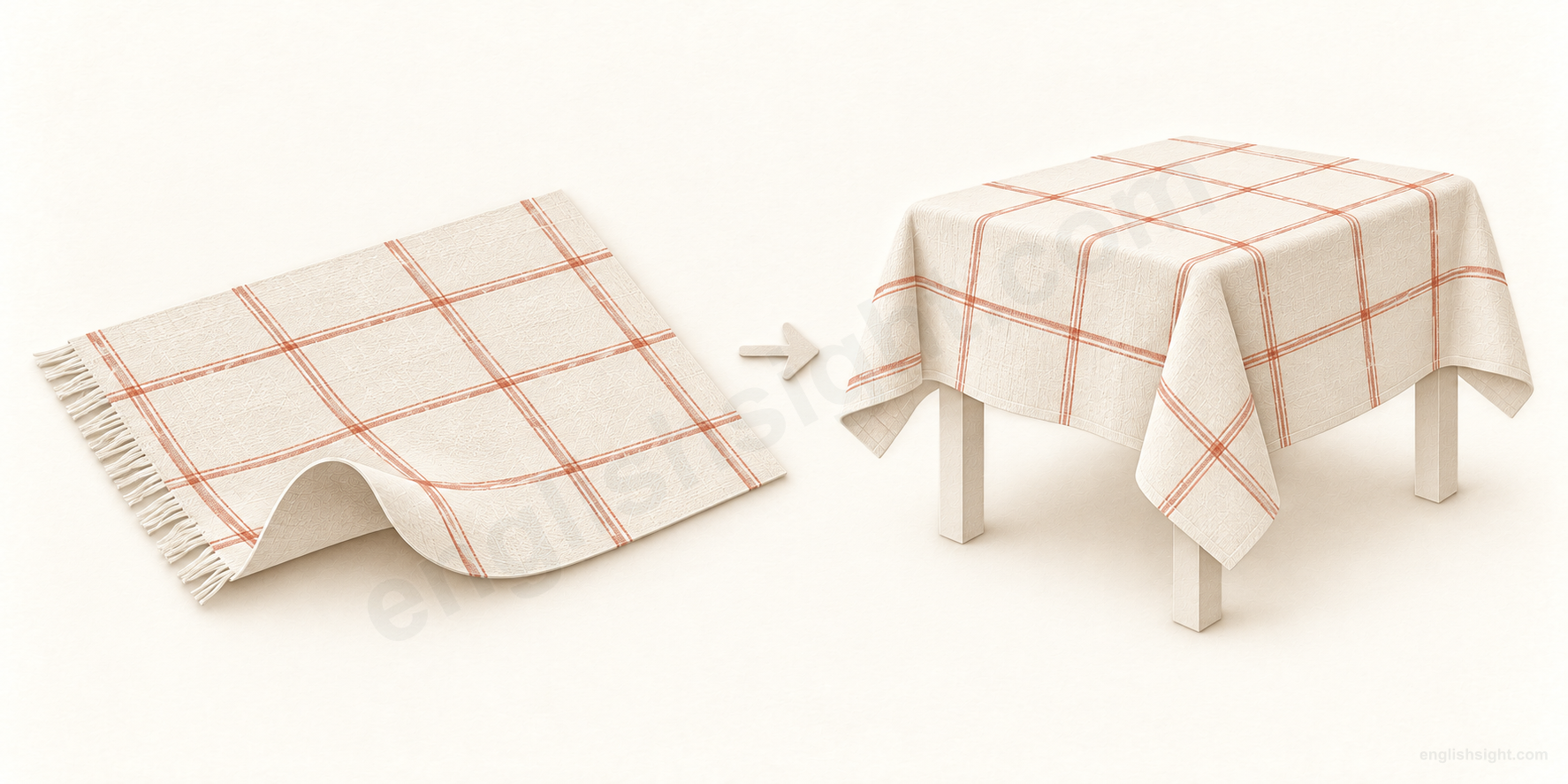
A flexible sheet of cloth lies nearly flat.
cloth
A cloth covers the tabletop and hangs down its sides.
The material bends over the table’s edges.
Cloth names the material; a cloth can be one piece used as a covering.
Cloth is flexible textile material; a cloth is a piece put to a particular use.
The sketch shows a sheet of textile material and a piece draped over a surface. It illustrates flexibility and use, not a definition of every textile or a prediction of every idiom.
A roll of material and a small wiping piece can both involve cloth. The grammar tells you whether you mean the substance or an individual item. Clothes, despite the similar spelling, names what people wear.
Start with the material and its uses, then learn the fixed expressions as whole phrases. This lesson offers a teaching connection, not a single mental picture shared by all English speakers.
01
Buying and describing material
Talk about the textile substance, measure an amount, or say what an object is made from.
01
some / cotton / woollen / soft / coarse + cloth
cotton cloth
textile material considered as a substance
Situation
You are choosing what to sew with.
What you mean
You select material, not a finished garment.
Cloth names the material rather than what someone wears.
Think of a flexible textile sheet that can be cut, folded, or sewn. Cotton cloth and woollen cloth identify the fibre; soft or coarse cloth describes how the material feels. It need not already be a useful household object.
Use cloth without a/an when the amount is unspecified: We need some cloth. A supplier can weave, produce, or sell cloth; those verbs describe different work done with the material.
Fabric is a useful close alternative when shopping for sewing supplies. Material is broader: wood and metal are materials too, but they are not cloth. Cloth can contain synthetic fibres; it does not mean cotton only.
Example
We chose blue cotton cloth for the curtains.
Watch the difference Do not use clothes for the material on a roll; clothes are items to wear.
02
a piece / strip / scrap of cloth; a length of cloth; two metres of cloth
a piece of cloth
a specified portion of the material
Situation
You need a small amount rather than a whole roll.
What you mean
A piece or measurement tells the listener how much.
The countable word piece measures the uncountable material.
A piece of cloth can be any suitable portion. A strip is narrow and long; a scrap is a small leftover piece. You can also buy two metres of cloth. The number belongs to pieces, strips, or metres, not automatically to cloth.
Compare We have enough cloth with We have three pieces of cloth. The first treats it as a supply; the second counts separate portions. Ask How much cloth do we need? when you mean the total amount.
Example
I cut a narrow strip of cloth to tie around the parcel.
Watch the difference For an amount to sew with, say two metres of cloth, not two cloths.
03
cloth + noun; be made of cloth
a cloth bag
an object made from cloth
Situation
You compare bags made from different materials.
What you mean
Cloth identifies what the bag is made of.
Cloth before another noun describes its material.
A cloth bag contrasts with a paper or plastic bag. A cloth napkin contrasts with a paper napkin. You can restate the material relation with made of cloth.
Cloth is often used before a noun. Oxford and Merriam-Webster treat this within the noun entry; some Collins dictionaries also list an adjective use. The practical pattern is the same: cloth stays unchanged while the main noun takes its plural, as in cloth bags.
Example
Please bring a cloth bag for the vegetables.
Watch the difference Cloth bags describes the bags’ material; clothes bags would suggest bags for clothing.
02
Pieces for everyday jobs
Count a wiping or covering piece, and choose a household name that matches its job.
04
wipe / clean + object + with a clean / dry / damp cloth
a damp cloth
one piece used for wiping or cleaning
Situation
There is dust on a shelf.
What you mean
A cloth serves as the tool for wiping it.
A cloth is countable when you mean one usable piece.
In a cleaning instruction, get a cloth means get one suitable wiping piece. Clean, dry, soft, and damp tell you which condition is needed; damp means slightly wet.
With a cloth names the tool: wipe the shelf with a cloth. Cloth itself does not mean clean, wet, or wipe. The action comes from the verb and the condition comes from the adjective.
Example
Use a soft cloth to wipe the dust from the shelf.
Watch the difference Use a cloth for one wiping piece and two cloths for two; cloths is not spelled clothes.
05
cover + object + with a cloth; put a cloth over + object
cover it with a cloth
put a fabric piece over something
Situation
A bowl needs a light covering.
What you mean
A cloth lies over the bowl.
The same flexible material can serve as a covering.
A cloth can cover something as well as wipe it. Cover the bowl with a cloth and put a cloth over the bowl describe the placement; neither says the cloth is a garment.
At a dining table, the cloth can mean the tablecloth when that object is clear from the situation. This is the ordinary countable meaning with the, not necessarily the special religious expression the cloth.
Example
She put a clean cloth over the bowl of dough.
Watch the difference A cloth may be only a loose piece; the word does not guarantee a fitted cover or a waterproof barrier.
06
a dishcloth / washcloth / tablecloth; plural -cloths
dishcloth / washcloth / tablecloth
names that specify what a cloth is for
Situation
You need a cloth for a particular household task.
What you mean
The compound identifies the appropriate object.
The first part of the compound helps identify its purpose.
A dishcloth is used to wash dishes. A washcloth is used to wash the face or body. A tablecloth covers a dining table. These are established names, not three unrelated meanings of cloth.
Match the name to the task: washcloths belong with washing the body, while dishcloths belong with washing dishes. In each compound, add s at the end for the plural: dishcloths, washcloths, tablecloths.
Example
The guest bathroom has fresh towels and two washcloths.
Watch the difference Do not assume every noun ending in cloth is for cleaning; a tablecloth normally covers the table.
03
Cloth is not clothes
Keep the material, usable pieces, and things you wear distinct in speech and writing.
07
cloth is…; a cloth is…; cloths are…; clothes are…
cloth / cloths / clothes
material, separate cloth pieces, and garments
Situation
You sort sewing supplies, wiping pieces, and shirts.
What you mean
You choose a different word for each category.
Clothes is a separate plural noun, not the plural of cloth.
Some cloth is material; two cloths are two pieces for a purpose; some clothes are things you wear. Compare The cloth is blue, The cloths are blue, and Her clothes are blue.
For one wearable item, name it, such as a shirt, or say an item of clothing. Do not say a clothes. Cloth is one syllable, with a vowel like the one in clock in standard British English. Clothes has the vowel of close, as in Close the door. Both /θs/ and /ðz/ occur at the end of cloths; keep the vowel distinction from clothes.
Example
The cloths are in the kitchen, but my clean clothes are upstairs.
Watch the difference Adding s to cloth gives cloths; inserting e changes the word to clothes.
04
Fixed expressions to recognize
These phrases add established comparisons and associations. Learn their whole form and notice their tone and setting.
08
be cut from the same cloth (as + person)
cut from the same cloth
very alike in character or approach
Situation
Two people handle problems in a similar way.
What you mean
You describe them as the same kind of person.
Shared cloth provides an image for shared character.
People cut from the same cloth have similar attitudes, habits, or character. The comparison can praise them, criticize them, or simply note a resemblance; the surrounding description supplies the judgment.
Use be cut from the same cloth, optionally followed by as and the person being compared. The material image helps you remember the comparison, but it does not claim that the people are related or dress alike.
Example
Mara and her aunt are cut from the same cloth: neither gives up easily.
Watch the difference This describes what people are like, not matching outfits or proof of shared ancestry.
09
cut one’s coat according to one’s cloth
cut your coat according to your cloth
make your plans fit the resources available
Situation
You want an expensive celebration but have a small budget.
What you mean
You reduce the plan to what you can afford.
The saying compares limited money with limited fabric.
A tailor cannot make a coat larger than the available fabric allows. The saying applies that image to plans and spending: work within what you have. It is especially associated with British English.
Your changes with the person: We must cut our coat according to our cloth. The whole saying conveys advice about limits; according to means in line with here. It does not mean you must buy a coat.
Example
We will hold a smaller party; we have to cut our coat according to our cloth.
Watch the difference This is a proverb about resources, not a general instruction to be ungenerous.
10
invent / make up + story + out of whole cloth; be made of whole cloth
invented out of whole cloth
completely invented rather than based on facts
Situation
A story has no real events or evidence behind it.
What you mean
Someone calls the account entirely made up.
Whole cloth has an established figurative meaning in this phrase.
Invented or made up out of whole cloth describes complete fabrication. Made of whole cloth is another established form. This idiom is especially associated with American English and often appears in commentary about claims or stories.
The expression concerns the absence of a factual basis; it does not mean that a real piece of fabric is involved. Learn the full wording rather than guessing its meaning from whole and cloth separately.
Example
The supposed interview was invented out of whole cloth; no meeting ever took place.
Watch the difference Whole cloth is not the same as the whole truth; the idiom can accuse someone of making things up.
11
have cloth ears
have cloth ears
fail to listen or understand properly
Situation
An instruction is repeated but still missed.
What you mean
The speaker criticizes the listener’s lack of attention.
The idiom concerns listening, not literal ears made of fabric.
Have cloth ears is a British expression for not taking in or understanding what someone says. It is informal criticism and can sound rude when directed at another person.
A self-directed remark such as I must have cloth ears can soften the admission that you missed something. Do not treat it as a neutral medical description of hearing loss; ask politely for repetition when you need it.
Example
I must have cloth ears today—you said Tuesday, and I wrote Thursday.
Watch the difference Use Could you say that again? as a neutral request; Have you got cloth ears? can insult the listener.
12
a man of the cloth; the cloth
a man of the cloth
a Christian priest or minister
Situation
A text describes someone’s religious role.
What you mean
Cloth stands for the clergy rather than a piece of material.
Distinctive religious dress can stand for the people who wear it.
A man of the cloth means a Christian priest or minister. The cloth can also refer to Christian clergy collectively. Oxford labels this use literary; priest or minister is usually clearer in everyday conversation.
This is an established association with religious dress. It is separate from The cloth is on the table, where cloth means a particular covering. The article the alone does not make an ordinary cloth religious.
Example
In the novel, the traveller turns out to be a man of the cloth.
Watch the difference Do not apply this expression to every religious worker or to anyone wearing a robe.
Keep the choices clear
Material or item?
For sewing supplies, use some cloth or an amount of cloth. For a wiping or covering piece, a cloth and several cloths are natural. Specialist talk can count types of cloth, but that is not the default way to ask for a length of material.
Cloth, fabric, clothing
Fabric is a close alternative for textile material. Clothing names things to wear as a category; clothes is plural. A piece of cloth is material, while an item of clothing is a wearable item.
Which part contributes the meaning?
In wipe with a cloth, wipe supplies the action and with introduces the tool. In a cloth bag, cloth supplies the material. The fixed expressions need their own meanings; none is a phrasal verb formed from a verb cloth.
Coverage boundary
This lesson covers the ordinary noun, material modifier, household compounds, and selected established expressions. Historical cloth meaning clothing, regional garment senses, stage scenery, and technical sail-panel uses are outside the practice focus.
Choose the word or expression
Use the purpose and the sentence grammar to decide.
1. You need material to sew a curtain. Which request fits?
2. You want two separate wiping pieces. Which wording fits?
3. What does cloth tell you in a cloth bag?
4. Two colleagues are cut from the same cloth. What does this suggest?
5. A report was invented out of whole cloth. What is the speaker claiming?
Sources and teaching notes
Dictionary entries support the uses and forms below. Explanations and examples are original; the material-to-use sketch is a teaching aid.
The diagram supports learning; it does not represent a picture shared by every speaker.