Use coal for the material, coals for pieces, and full expressions for figurative meanings.
Solid fuel can burn and give off heat
Solid fuel can burn and give off heat
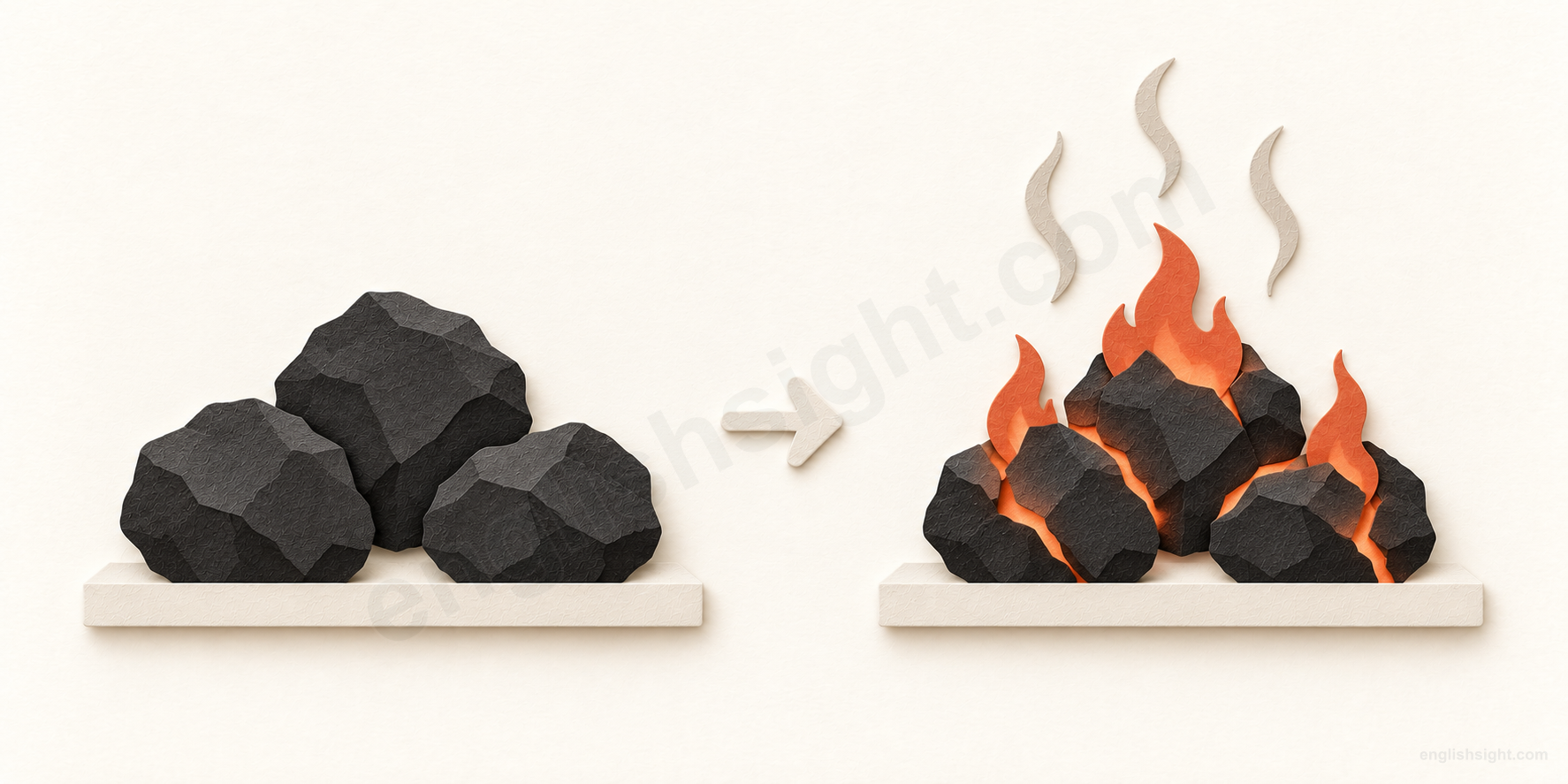
Dark solid fuel before burning.
coal
Burning coal with flames and glowing seams.
Burning releases heat.
Coal can burn and release heat; it need not already be hot. This diagram shows the fuel and burning process, not the meanings of fixed idioms.
Coal is a dark solid fuel taken from the ground; burning it releases heat. In the countable use, a coal is a piece, especially a burning one.
The picture follows the material into combustion. It does not show how coal formed, and it cannot predict the meanings of fixed idioms. Glowing coals may also come from wood or charcoal.
Coal /kəʊl/ in British English and /koʊl/ in American English is usually the name of a solid fuel taken from the ground. Context tells you whether you are talking about a supply, a piece, or an industry.
A useful starting connection is dark solid fuel that can burn and give off heat. Some expressions draw on its colour or hot pieces; others have established meanings that need their own explanation.
01
Fuel, amounts, and glowing pieces
Start with the material. Then distinguish measuring a supply, burning it, and referring to individual hot pieces.
01
coal / some coal / the coal + singular verb
coal
the solid fuel as a material
Situation / starting point
A museum displays dark rock taken from a mine.
Meaning in context
You identify the fuel without counting separate pieces.
Coal names the material; it does not mean that it is already burning.
For the mined fuel, coal is normally a mass noun: some coal, more coal, or coal as a general category. The same material can be stored, transported, or burned.
Coal is a fossil fuel. Charcoal is a different material made by heating wood or other organic matter with little or no air. Use charcoal when naming that barbecue fuel; the two names are not freely interchangeable.
In a sentence such as Coal is expensive to transport, coal takes a singular verb. No article is needed for a general statement; the coal identifies a particular supply.
In a sentence
The museum explains how coal was brought out of the ground.
Watch the difference For an unspecified amount, say some coal, not a coal. A coal can instead mean an individual piece in the countable use.
02
a lump / piece / bag / tonne of coal; how much coal
a lump of coal / a tonne of coal
count pieces or measure a supply
Situation / starting point
A delivery contains many pieces of fuel.
Meaning in context
You specify either a piece or a measured quantity.
The unit word carries the count; coal continues to name the substance.
A lump of coal is one solid piece; the phrase two lumps of coal counts two pieces. A piece of coal is a more general alternative. A bag of coal describes a containerful rather than one lump.
For a delivery, use a weight such as a tonne of coal. In these phrases, make the unit plural when needed: three bags of coal. Keep coal unchanged.
Ask How much coal is left? about the amount, but How many lumps are left? about the pieces. Ordinary fuel quantities do not require the plural coals.
In a sentence
We ordered three bags of coal for the winter.
Watch the difference Three coals counts individual pieces in a suitable context; it does not mean three bags or three tonnes.
03
burn coal; coal burns; coal is burned; a coal fire
burn coal / a coal fire
use the fuel to produce heat
Situation / starting point
Fuel is available for heating.
Meaning in context
It burns and gives off heat.
Burn names the process; coal names the fuel undergoing it.
People burn coal; coal burns. The first pattern names someone using the fuel, while the second makes the fuel the subject. The passive sentence Coal is burned describes the process without naming the user.
A coal fire is a fire fuelled by coal. In put coal on the fire, on identifies where the fuel goes; put supplies the action. This is an ordinary verb-and-preposition combination, not a phrasal verb headed by coal.
In a sentence
The old house was heated by a coal fire.
Watch the difference A coal fire names the fuel, whereas a hot fire describes temperature. Coal alone does not mean fire.
04
a hot coal; hot / glowing / live coals + plural verb
a hot coal / glowing coals
individual pieces of hot or burning fuel
Situation / starting point
A fire has burned down.
Meaning in context
Separate pieces still glow and give off heat.
The countable use focuses on pieces, often ones still burning.
A hot coal is one piece, and hot coals or glowing coals are several. The phrase live coals means pieces that are still burning, not living things. This countable use makes a coal possible even though a supply of the mined material is normally uncountable.
Coals can also refer to glowing pieces left by a wood fire or to burning charcoal. The surrounding context identifies the fuel. Over the coals describes a position above those hot pieces; it does not by itself mean the criticism idiom.
Contrast The coal is dry, which describes a supply, with The coals are glowing, which describes separate hot pieces.
In a sentence
The flames had gone, but the coals were still glowing.
Watch the difference Glowing coals are not the same as cold ash. The noun does not require visible flames.
02
Mining, energy, and colour
In compounds, coal helps identify a material, an industry, a source of energy, or a colour comparison. Read the other word too.
name the place, activity, or business connected with the fuel
Situation / starting point
People extract the fuel and sell it.
Meaning in context
Different nouns identify the workplace, work, and business.
The head noun tells you what kind of thing is being named.
A coal mine is a site where coal is extracted. A coal miner is a person doing that work; coal mining names the activity. These are related expressions, not three different substances.
The coal industry includes the business surrounding the fuel. Coal dust is fine material from coal, and a coal seam is a layer of it in the ground. In each combination, coal specifies what the following noun concerns.
Pluralize the head noun when appropriate: two coal mines or several coal miners. Coal normally stays singular as a noun modifier.
In a sentence
Her grandfather worked in a coal mine near the town.
Watch the difference A coal miner is a worker; a coal mine is a place. Do not drop the final -r when you mean the person.
06
coal-fired + power station / power plant / boiler
a coal-fired power station
describe equipment that burns coal as its fuel
Situation / starting point
A power station needs a fuel source.
Meaning in context
Coal supplies energy through combustion.
Coal-fired says what is burned to run the equipment.
A coal-fired power station or coal-fired power plant uses coal as fuel. Fired here concerns heating or operating by burning fuel; it does not mean dismissing an employee.
Coal-fired is a compound adjective. Keep the hyphen in the spelling shown here. Compare a gas-fired plant: changing the first element changes the fuel. The phrase does not say the plant itself is made of coal.
In a sentence
The report compares a coal-fired plant with a gas-fired one.
Watch the difference Coal-fired describes the energy source, not the material used to build the plant.
07
coal-black + noun
coal-black
describe a very dark black colour
Situation / starting point
You notice an object’s deep black colour.
Meaning in context
You compare its appearance to coal.
The comparison selects coal’s colour rather than its use as fuel.
Coal-black is an adjective for a very dark colour. Coal-black hair describes appearance; it does not imply that the hair contains coal or has been burned.
This is a colour compound, separate from the material noun. Plain black is usually enough for a neutral description; coal-black adds a more vivid comparison.
In a sentence
The horse had a coal-black mane.
Watch the difference Use the hyphenated adjective coal-black, not coal as an ordinary colour adjective: a coal-black mane.
03
Established figurative expressions
These expressions are learned as wholes. Their meanings are not new definitions of coal by itself.
08
haul / rake / drag + someone + over the coals + for + noun / -ing
haul / rake someone over the coals
criticize someone very severely for a mistake
Situation / starting point
A worker sends an incorrect bill.
Meaning in context
The manager sharply rebukes the worker.
The whole idiom expresses strong criticism, without a literal fire.
Haul someone over the coals is especially British; rake someone over the coals is the North American variant highlighted by Oxford. Drag someone over the coals is another established variant.
Put the person after haul, rake, or drag, and keep over the coals together. Add for plus a noun or -ing form to give the reason. The passive is natural: She was hauled over the coals for the error.
The image of hot coals can help you remember the severity, but coal alone does not mean criticism. This is a fixed idiom rather than a freely predictable meaning of over.
In a sentence
The manager hauled me over the coals for sending the wrong bill.
Watch the difference Keep the plural and article: over the coals. A person cooking over coals may be describing a literal cooking position instead.
09
carry / take coals to Newcastle; be like carrying coals to Newcastle
carry / take coals to Newcastle
supply something where it is already plentiful
Situation / starting point
Your host already owns a large collection of cookbooks.
Meaning in context
Another cookbook adds something they hardly need.
The idiom focuses on unnecessary supply, not physical fuel delivery.
Carry coals to Newcastle or take coals to Newcastle describes supplying something to someone who already has plenty of it. Oxford labels the expression British English; it is useful to recognize in conversation and writing.
The actual item need not be coal, and the destination need not be Newcastle. Keep Newcastle as part of the established expression rather than substituting any town and expecting the same idiom.
Be like carrying coals to Newcastle compares an action with this unnecessary supply. It does not mean that every repeated gift is unwelcome; the point is the existing abundance.
In a sentence
Buying her another cookbook would be like carrying coals to Newcastle; she already owns hundreds.
Watch the difference Use the full expression. Coals to Newcastle does not mean any long or difficult journey.
10
be a canary in a / the coal mine
a canary in a / the coal mine
an early sign of a larger danger
Situation / starting point
One small part of a system begins to fail.
Meaning in context
That failure alerts you to a wider problem.
The expression names a warning sign, not the whole dangerous situation.
Call something a canary in a coal mine when it gives an early warning of danger. In a discussion about a particular system, a canary in the coal mine is also an established form.
The expression can describe an event, a species, or another indicator. In the example, repeated small computer failures warn of a broader system problem. No actual bird or mine is involved.
Learn canary in a/the coal mine as one figurative expression. Coal mine alone continues to name a mining site; it does not mean warning.
In a sentence
Those small system failures were a canary in the coal mine, warning us of a bigger problem.
Watch the difference The warning is early evidence of danger, not a guarantee that a particular disaster will happen.
11
at the coalface; people working at the coalface
at the coalface
where people do the practical work
Situation / starting point
A plan is discussed in an office.
Meaning in context
People doing the daily work experience its effects.
The figurative phrase shifts attention to direct practical experience.
Literally, a coalface is the surface inside a mine where coal is cut out. The British expression at the coalface also refers to the place or level where people do the actual work.
Nurses, teachers, and other workers can be described as being at the coalface when attention is on their direct involvement. They need not be miners. This recognition item extends the compound coalface, not the independent noun coal.
The phrase often contrasts practical work with planning or discussion. It does not by itself say that the work is underground or that it is unsuccessful.
In a sentence
The new school policy should reflect the experience of teachers at the coalface.
Watch the difference In this expression, write coalface as one word and keep at the.
Keep material, pieces, and idioms distinct
Coal, charcoal, and coals
Coal usually identifies the mined fossil fuel. Charcoal names a manufactured carbon-rich material. Coals can describe burning or glowing pieces of either, or of wood. Do not identify a fuel solely from the plural word coals.
Grammar is part of the meaning
Some coal is a quantity of material; a coal is one piece. Use a singular verb for the material (Coal is dry), and a plural verb for pieces (The coals are glowing). In coal mines, the head noun mines carries the plural ending.
A small verb entry is not a daily verb family
General dictionaries also record coal as a verb for supplying or taking on coal, or turning material into coal or charcoal. These specialized uses are not expanded here. Ordinary conversation usually uses burn coal, supply coal, or load coal. The lesson does not invent particle verbs or a general causative pattern for coal.
Use the full figurative expression
Criticism, unnecessary supply, early warning, and practical work belong to the idioms explained here. They are not interchangeable meanings of the isolated word coal. The visual model is a learning aid, not a claim about every English speaker’s mental image.
Choose the meaning that fits
Check whether the sentence concerns a material, individual pieces, or a full idiom.
1. You want to ask about the quantity of fuel remaining in a store. Which question fits?
2. A wood fire has no flames, but its pieces still glow. Can you call them coals?
3. A boss hauled a worker over the coals for an error. What happened?
4. A small failure is described as a canary in the coal mine. What is its role?
Sources and teaching notes
Publisher dictionary entries were read to check meanings, grammar, compounds, and idioms. The explanations, examples, and visual teaching model were written for this lesson.
The diagram is a teaching aid; English speakers do not all share one mental picture.