Connect clothing, animal hair, and surface layers, then learn the expressions that need their own explanation.
A layer over something underneath
A layer over something underneath
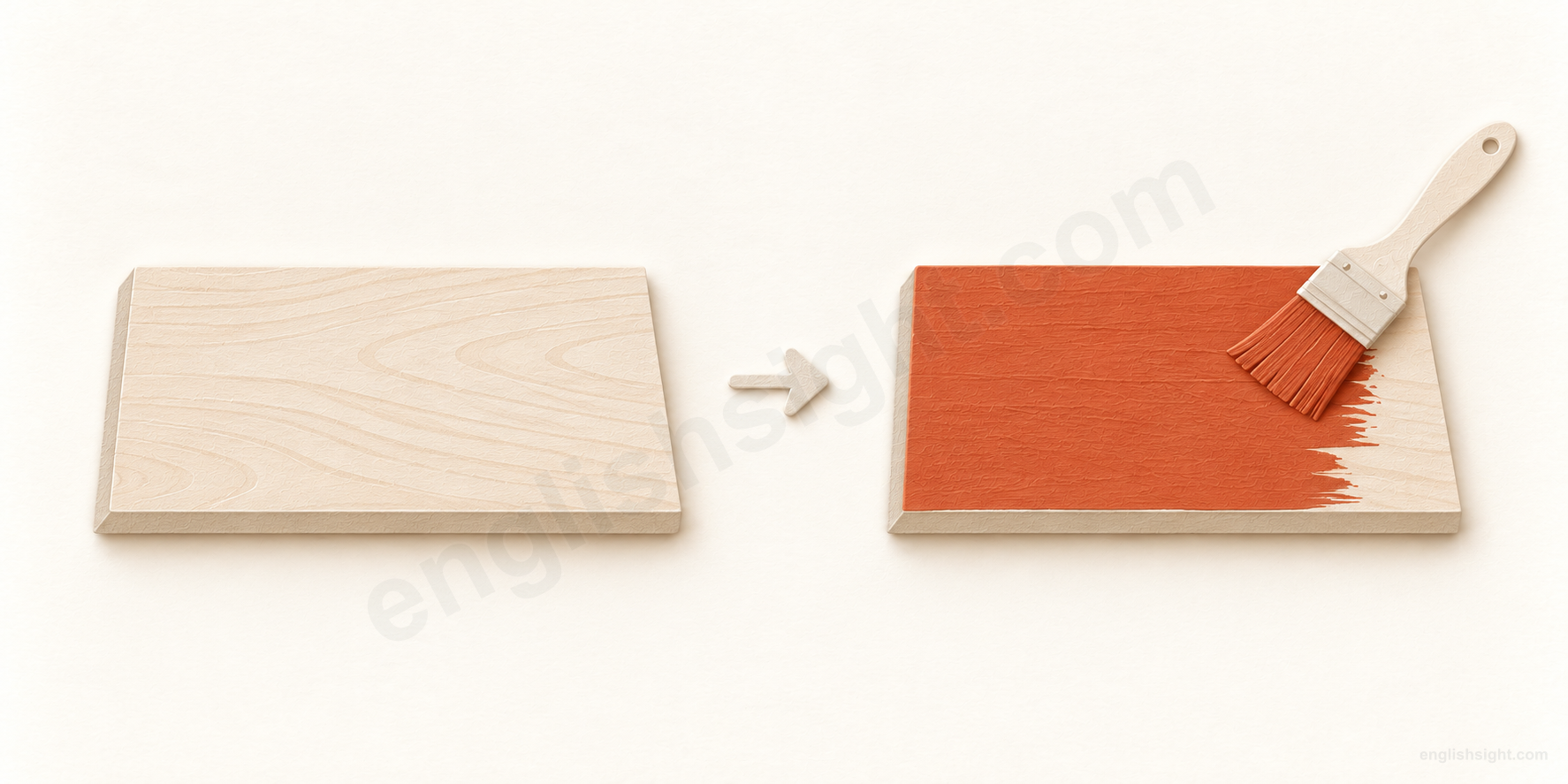
Bare wood is visible.
coat
Paint covers most of the same panel.
A brush spreads paint over the surface.
The wood stays underneath as paint forms a coat on its surface.
A coat is an outer covering; to coat something is to cover its surface with a layer of material.
The picture demonstrates the surface-layer sense. Clothes can be put on and removed; an animal’s natural coat grows. Neither works exactly like applying paint, and the fixed expressions below need separate learning.
You reach for a coat before going outside, brush a dog’s coat, or give a door another coat of paint. The surrounding situation tells you whether coat names clothing, natural hair, or a layer of material.
As a verb, coat describes covering a surface with a substance. The outer-covering connection is a useful teaching model; it does not turn every compound or saying into a predictable literal meaning.
01
Clothing and everyday routines
Name the garment, distinguish putting it on from wearing it, and recognize the nouns used when storing it.
01
a / the / my + (adjective or material) + coat; in a coat
a warm coat
an outer garment with sleeves
Situation / starting point
You need clothes for a cold journey.
Meaning / result
You choose an extra garment to wear over your clothes.
Coat names a garment; the adjective or material describes which kind.
A coat covers the upper body and has sleeves. A winter coat, wool coat, and raincoat suggest different needs or materials; coat does not name one fixed length or fabric.
You can identify someone as the woman in the red coat. Here in describes what she is wearing, not her position inside a room. A coat pocket or coat sleeve is part of the garment; coat modifies the following noun.
A lab coat is worn over clothes for work rather than outdoor warmth. Learn such garment names in context rather than treating every coat as heavy winter clothing.
Example in context
The woman in the yellow coat is waiting for the bus.
Watch the difference Use a determiner with a singular garment: I bought a coat, not I bought coat.
02
put on / take off + a coat; put / take + it + on / off; wear a coat
put on / take off / wear a coat
distinguish dressing actions from the state of being dressed
Situation / starting point
The coat is on a chair before you leave.
Meaning / result
You put it on, wear it outside, and take it off indoors.
The action comes from put on or take off; coat remains the garment.
Put on your coat describes getting the garment onto your body. Wear your coat describes having it on. Take off your coat describes removing it. You can wear the same coat all afternoon after putting it on once.
The particle verbs allow Put your coat on and Take your coat off. With a pronoun, use Put it on and Take it off. When a host says Let me take your coat, take means receive it to hold or hang up, not necessarily remove it from your body.
Example in context
I put on my coat at the door and wore it all the way home.
Watch the difference Do not use wear for the moment of dressing when you mean put on.
03
a suit coat; a suit jacket
a suit coat
the jacket that forms the upper part of a suit
Situation / starting point
You choose formal clothes for an interview.
Meaning / result
You wear the jacket with the matching trousers.
In this clothing context, coat can mean a suit jacket.
Suit coat is established North American usage. Suit jacket is a useful alternative, especially in British English, where this sense of coat alone can sound old-fashioned.
Unlike an overcoat worn over a suit outdoors, the suit coat is part of the suit itself. Do not assume that every coat mentioned at a formal event is an extra winter layer.
Example in context
He removed his overcoat but kept his suit coat on during the interview.
Watch the difference Use the context to distinguish the suit jacket from the overcoat worn over it.
04
a coat hanger; hang a coat on a hanger
a coat hanger
a shaped support for hanging clothes
Situation / starting point
You want to store the coat without leaving it on the floor.
Meaning / result
You place it on a hanger.
The final noun names the object; coat indicates its clothing use.
A coat hanger has a shape that supports clothing and a hook for hanging it. It can hold other clothes too: the name does not restrict it to coats.
Put the coat on a hanger or hang it up. A coat hook supports the garment directly; it is not the same object as a hanger. These are noun combinations, not new actions performed by the verb coat.
Example in context
Please put your wet coat on a hanger.
Watch the difference A hanger is the support; hanging is the action.
05
leave / collect a coat at the coat check
the coat check
a place where visitors leave coats temporarily
Situation / starting point
You arrive at a theatre with a bulky coat.
Meaning / result
You leave it at a staffed storage area.
Coat check is a place or service, not a command to inspect clothing.
In North American English, a coat check, coatroom, or checkroom is a place for leaving coats and sometimes bags while visiting a building. Cloakroom is a common British term for this function.
At the coat check, an attendant may keep your coat and give you a ticket so you can collect it later. The exact arrangements vary; the noun itself does not guarantee that storage is free.
Example in context
We left our coats at the coat check before the concert.
Watch the difference Check your coat can be a request to leave it for storage; the coat check names the place.
02
Natural coverings and added layers
Read what is underneath and what forms the covering. The noun counts garments or layers; the verb describes covering a surface.
06
an animal’s coat; have / shed a thick coat
a dog’s coat
the natural hair or fur covering an animal
Situation / starting point
You brush your dog after a walk.
Meaning / result
Its hair looks clean and smooth.
The animal’s coat is its natural covering, not usually a separate garment.
A dog’s coat, a horse’s coat, and a cat’s coat refer to the hair or fur over the body. The noun treats that covering as a whole; you can describe a thick, shiny, or shaggy coat.
An animal may grow a thicker winter coat and shed it in warmer weather. This connects with the outer-covering model, but no one has applied the hair like paint. A dog wearing a waterproof coat is different: that is an actual garment.
Example in context
Our dog sheds much of her thick coat in spring.
Watch the difference Do not infer clothing from winter coat when the context is an animal’s natural hair.
07
a coat of + material; apply / give something + a second coat; two coats of paint
a coat of paint
one layer of material over a surface
Situation / starting point
The door has been sanded ready for painting.
Meaning / result
A new layer covers its face.
Coat counts the layer; of names the material.
A coat of paint or varnish is a layer spread over a surface. Give the door a fresh coat of paint and apply a coat of varnish describe adding such a layer.
Two coats of paint means two applications or layers, not two kinds of paint. Let the first coat dry before applying the second. When the material is already clear, you can simply say It needs another coat.
The covering can also be unwanted, as in a coat of dust. The noun does not by itself say that the layer protects, improves, or deliberately decorates the surface.
Example in context
Let the first coat dry before you give the door a second coat of paint.
Watch the difference Say a coat of paint, not a paint of coat; pluralize coat when counting layers.
08
coat + object + with / in + substance
coat something with / in something
cover an object’s surface with a substance
Situation / starting point
Potato pieces have no oil on their surfaces.
Meaning / result
You spread oil over them before cooking.
The object is what receives the covering; with or in introduces the material.
Coat the potatoes with oil puts potatoes after the verb because they are the things being covered. The oil is the covering substance. Coat the pieces in flour uses the same basic relation with in.
Both with and in occur with materials such as flour, sauce, and chocolate. Context and customary wording guide the choice; in need not mean the food is still submerged in a container.
Coat focuses on material across a surface. Cover is broader: you can cover a bowl with a lid, but you would not normally describe placing a separate lid on a bowl as coating the bowl.
In recipe directions such as Add the oil and stir to coat, the food and covering material can be understood from the previous instruction. This shortened direction does not mean the food turns itself into a coat.
Example in context
Coat the potato pieces with a little oil before baking them.
Watch the difference Keep the roles straight: coat the potatoes with oil, not coat the oil with potatoes.
09
substance + coats + surface; surface + be coated with / in + substance
dust coats the shelf / be coated with dust
describe a substance covering a surface, or the resulting condition
Situation / starting point
Dust settles while a room is unused.
Meaning / result
The shelf has a layer of dust on it.
Coating can happen without anyone deliberately applying a substance.
Dust coats the shelf makes the covering material the subject and the shelf the object. It reports a physical covering, not a person putting a garment on the shelf. In cooking, The sauce coats the back of a spoon similarly describes sauce forming a layer on a surface; it can be used to judge its consistency.
The shelf is coated with dust focuses instead on the affected surface. This often describes its present condition. The shelf was coated with varnish yesterday can report a completed action; surrounding information tells you whether the sentence emphasizes a state or an event.
Adverbs specify degree: lightly coated, thickly coated, or completely coated. Coat itself does not promise a perfectly even layer or a particular thickness.
Example in context
By Monday, a fine powder coated the shelf beside the machine.
Watch the difference The preposition with names the covering material, not necessarily the person who applied it.
10
material-coated + noun; noun + coated with + material
chocolate-coated / coated paper
describe something that has an added surface layer
Situation / starting point
Chocolate is spread over a biscuit.
Meaning / result
You can describe the finished biscuit by its covering.
Coated can describe a product; a preceding material identifies the layer.
Chocolate-coated biscuits have a chocolate layer. A chocolate-coated biscuit and a biscuit coated with chocolate express the same basic covering relation in different grammatical positions.
Coated paper has a treated surface; you may need more context to know the material or purpose. In a chocolate-coated biscuit, the words before the noun form one compound description. The noun is still biscuit, not coat.
Do not confuse a sugar-coated food with figurative sugar-coat the news. One concerns an actual layer; the other is an established way of talking about presentation.
Example in context
The shop sells chocolate-coated biscuits in small boxes.
Watch the difference A coated biscuit has a layer on its surface; it need not be filled with that substance.
03
Fixed expressions and related words
These are useful recognition items in descriptions, advice, and commentary. Learn each whole expression; they are not extra literal meanings you can freely give to coat.
11
a coat of arms; the city’s coat of arms; coats of arms
a coat of arms
a symbolic design representing a family, city, or organization
Situation / starting point
You notice a shield-shaped design above a town hall door.
Meaning / result
You identify it as the city’s official emblem.
This is a fixed noun expression, not a coat worn on someone’s arms.
A coat of arms is a symbolic design associated with a family, city, or organization, often shown on a shield. You may encounter it on buildings, signs, or documents.
Learn the expression as a whole. Arms here belongs to the established name; it does not mean the sleeves or a person’s limbs. The plural is coats of arms: coat takes the plural ending.
Example in context
The city’s coat of arms appears above the entrance.
Watch the difference The plural is coats of arms, not coat of armses.
12
cut + possessive + coat according to + possessive + cloth
cut your coat according to your cloth
match your plans or spending to the money you have
Situation / starting point
A group wants an expensive celebration but has limited funds.
Meaning / result
It chooses a smaller event that fits its budget.
The whole saying gives advice about living within financial limits.
The saying imagines making a garment from the cloth available. In use, it advises doing only as much as you can afford. It does not normally give instructions about actual sewing.
This traditional expression is useful to recognize in advice and commentary. In direct everyday wording, you could say We have to stay within our budget. Your, our, or another possessive changes with the people being discussed.
Example in context
We cannot afford a large reception, so we must cut our coat according to our cloth.
Watch the difference The fixed saying supplies the financial meaning; coat alone does not mean budget.
13
on + possessive + coat-tails; ride on someone’s coat-tails
on someone’s coat-tails
benefit from another person’s success or influence
Situation / starting point
A successful musician attracts a large audience.
Meaning / result
Another performer gains opportunities through that connection.
This related idiom describes borrowed advantage, not an ordinary covering.
On someone’s coat-tails means using that person’s success or influence to become successful yourself. It can suggest dependence on someone else rather than success earned independently.
You may also hear ride on someone’s coat-tails. The connection is to following along behind someone, but the established social meaning must be learned as a whole. This is an expression built on the related noun coat-tails, not a particle use of the verb coat.
Example in context
Critics say the new singer rose to fame on her sister’s coat-tails.
Watch the difference Do not use the expression as a neutral synonym for every kind of help; it can sound dismissive.
14
sugar-coat + news / facts / a situation; not sugar-coat it
sugar-coat the news
make something unpleasant seem less unpleasant
Situation / starting point
You have unwelcome information to explain.
Meaning / result
You can soften its presentation, or choose to state it directly.
The compound adds an established figurative meaning that bare coat does not carry.
Sugar-coat an unpleasant fact means present it in a way that makes it seem less unpleasant. I won’t sugar-coat it announces a direct account of bad news, rather than a reassuring version.
The image of a pleasant outer layer makes the expression memorable, but it remains a separate compound verb. Do not shorten sugar-coat the problem to coat the problem and expect the same meaning. Literally sugar-coated food has an actual sugar layer.
Example in context
I won’t sugar-coat it: the repairs will cost more than we expected.
Watch the difference Softening a description does not make the underlying situation better.
Keep the covering and the construction clear
Coat and jacket overlap
A jacket is often shorter and lighter than an outdoor coat, but length alone is not a dependable rule: coats may be short, and suit coat is established North American usage. Choose the usual name for the garment and context.
Count the coat, not the material
A coat and two coats can name garments or applications of a surface layer. In two coats of paint, coats is countable and paint names the material. A dog’s coat means its covering of hair, not a garment unless the context explicitly describes clothing for dogs.
Forms and limits
The verb forms are coat, coats, coated, and coating. Coated has two syllables; coating keeps one t. Coat is normally transitive, with the surface as object. With and in introduce the covering substance; they are prepositions, not separable particles. Put on and take off are verbs used with the noun coat. Technical anatomy, detailed seed structures, historical clothing senses, and specialized garment names are outside this lesson.
A covering need not be helpful
A protective coat can keep a surface safe, but a coat of dust or oil can be unwanted. Do not build protection or deliberate human action into every use. The sketch is a teaching aid, not a claim that all native speakers share one mental picture.
Choose the covering or the construction
Use the context to identify the meaning and choose a natural expression.
1. Your coat is already on your body throughout a cold walk. Which sentence describes that continuing state?
2. A vet says, “Her coat looks healthy.” The vet is examining a cat’s body. What does coat mean?
3. The first application of paint has dried. You apply paint over the door once more. Which phrase counts the new layer?
4. A recipe asks you to cover small pieces of potato with oil. Which instruction fits?
5. A local business has little money for a celebration. Someone says, “We must cut our coat according to our cloth.” What is the advice?
Sources and teaching notes
The dictionary pages below support the usage distinctions. Explanations, examples, and the covering model were written for this lesson; the model is a teaching interpretation.
The diagram illustrates an outer layer. It is not a mental picture shared by every native speaker.