From cold water and feeling chilly to a cold reply, a cold, and familiar idioms.
Low warmth, with limits to the link
A low level of warmth
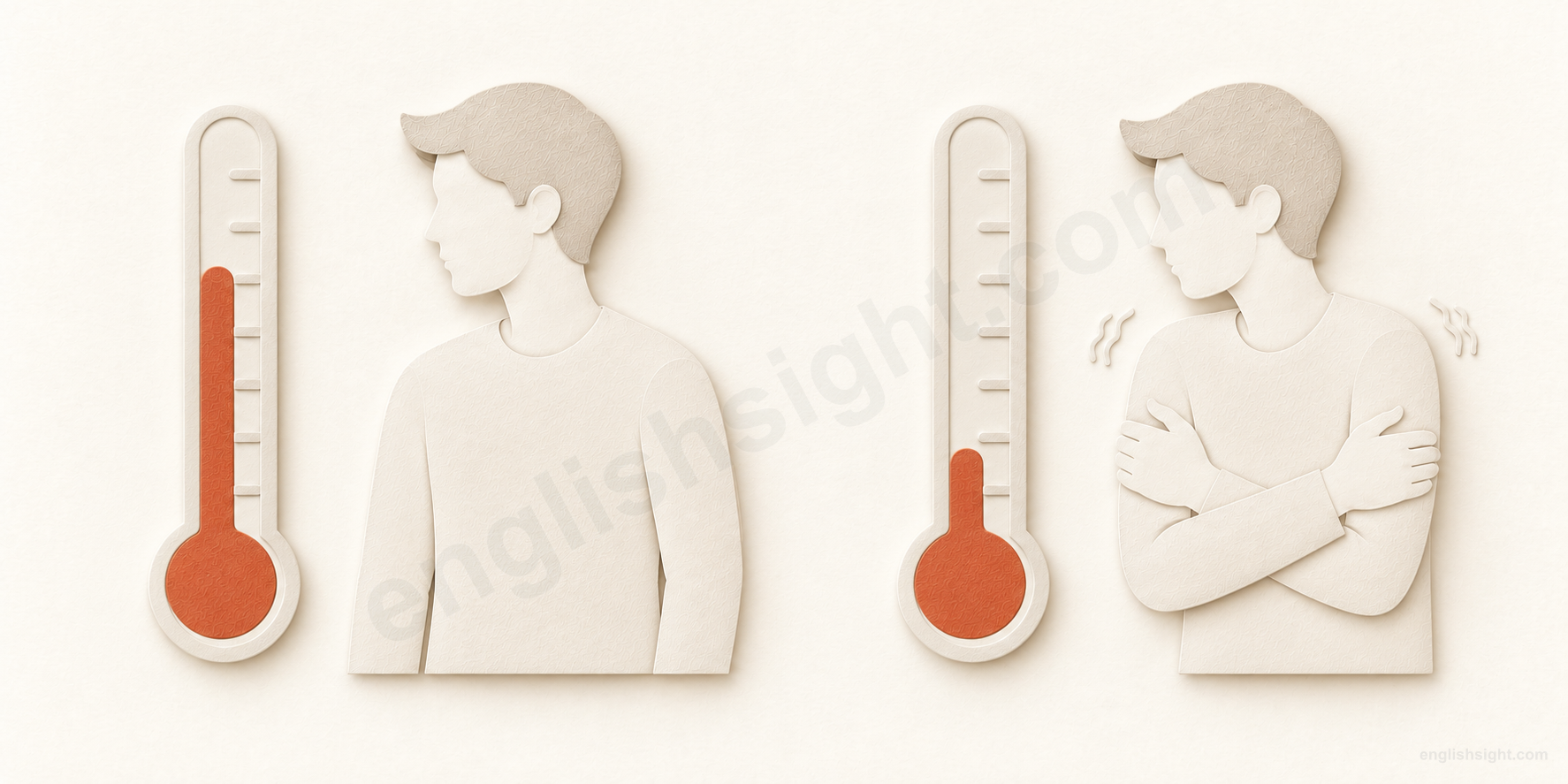
A warmer reference: the man stands relaxed.
cold
At the lower temperature, he hugs his arms and shivers.
Compare the temperature and the need for warmth.
The lower column and self-hug show a lack of bodily warmth.
Cold describes a temperature low for its context. Figuratively, a lack of warmth can describe feelings or responses; illness and fixed idioms need separate learning.
The comparison shows a state, not a required cooling event. A cold drink may be welcome. No single temperature or visual metaphor explains every use.
Cold first gives us a temperature contrast: something has less warmth than is usual, expected, or comfortable in the situation. The same water may feel cold in one setting and welcome in another.
Emotional warmth helps connect a cold welcome with a lack of friendliness, but this is a teaching link, not a rule that predicts every phrase. A cold is also the name of an illness. Fixed expressions such as cold feet and have it down cold need their own meanings.
01
Temperature, bodies, food, and surroundings
Begin with low temperature relative to a situation. Grammar tells you whether cold describes a state, a change, a maintained condition, or the cold itself.
01
cold + noun; it + be + cold; colder than; the coldest
cold weather / It’s cold
a low temperature in the air or surroundings
Situation
You check the weather before going outside.
Meaning in context
You describe the air as colder than is comfortable or expected.
The setting supplies the standard for a low temperature.
Cold can come before a noun: a cold morning, cold air, a cold room. In It’s cold outside, it is the usual weather subject; it does not stand for a particular object.
Cold is relative to the situation, not a fixed number of degrees. Use colder for a comparison and coldest for the lowest temperature in a set. Bitterly cold and freezing cold emphasize how cold it feels; ordinary freezing does not always report an exact measured temperature.
Example in context
It’s colder by the river than it is in the town centre.
Watch the difference Use It’s cold for the weather; I’m cold describes your own feeling.
02
person + be / feel + cold; body part + be + cold; feel cold to the touch
be / feel cold
feel a lack of bodily warmth
Situation
You sit beside an open window.
Meaning in context
You want a warmer place or an extra layer.
A person can feel cold even when someone else feels comfortable.
I’m cold and I feel cold describe your bodily experience. My hands are cold describes the temperature of a body part. The metal feels cold describes the sensation it gives when touched; cold is still an adjective after feels.
Compare I have a cold: the article a turns cold into the countable name of an illness. Being cold and having a cold make different claims. Are you cold? asks about warmth, not whether you are ill.
Example in context
I’m cold; could we close the window?
Watch the difference Say I’m cold, not I have cold, when you mean that you need warmth.
03
get / grow / turn / go + cold; keep / make + object + cold
get cold / keep something cold
become cold or maintain a low temperature
Situation
A drink warms up if it is left in the sun.
Meaning in context
Ice can maintain its low temperature.
The verbs add change, cause, or continuation to the temperature adjective.
Get cold describes becoming cold; grow or turn cold can also describe a change. Coffee has gone cold is especially familiar in British English when a formerly hot drink is now too cool. Cold itself is not a verb meaning make cold.
Keep the drink cold means maintain its temperature. Make the room cold means cause the cold condition. Here the noun after keep or make is the thing affected, and cold describes its state. A cold engine has not yet warmed up; this need not mean freezing weather.
Example in context
Put some ice in the jug to keep the water cold.
Watch the difference Get cold describes a change in temperature; get a cold describes becoming ill.
Cooked chicken has cooled and is ready for a salad.
Meaning in context
You serve it without reheating it.
Cold describes serving temperature, not whether something was cooked.
Cold chicken may already be fully cooked. Cold drinks may be chilled, while cold food can simply be food served without heating. Cold does not automatically mean raw, frozen, old, or unsafe.
Serve cold and eat it cold put the adjective after the verb or object to describe the food’s condition. A dinner that has gone cold was often intended to be hot; cold meat on a lunch menu may be exactly what was intended. Ice-cold emphasizes a very low temperature; stone cold can emphasize that food or drink is completely cold when it was expected to be warm or hot.
Example in context
We served the cooked chicken cold with a fresh salad.
Watch the difference Cold is a temperature description; raw describes food that has not been cooked.
05
cold + light / colour / tone
cold light / cold colours
light or colour that suggests a lack of warmth
Situation
A lamp gives the room a blue-grey appearance.
Meaning in context
The room looks visually cool and unwelcoming.
The comparison is about appearance, not a thermometer reading.
A cold light or a cold blue tone can suggest an atmosphere without visual warmth. Such descriptions often contrast with warm yellow or orange light. They do not mean that the lamp or paint is physically cold.
Cool colours is also an established way of talking about colour. Cold can add a stronger impression of an unwelcoming or bleak appearance; the sentence and the speaker’s attitude matter.
Example in context
The cold grey light made the empty kitchen look bleak.
Watch the difference A cold-looking room can still have its heating on.
06
in / out of / against + the cold; with + cold
the cold / with cold
cold weather or the experience of low temperature
Situation
You have been waiting outdoors in winter.
Meaning in context
You go inside to escape the low temperature.
Cold can be an uncountable noun naming the condition itself.
In the cold, out of the cold, and protect against the cold treat low temperature as a condition around you. With cold can give a cause: shaking with cold means shaking because you feel very cold.
No plural is needed for this temperature meaning. Colds normally names separate episodes of the illness. Compare I don’t feel the cold, meaning low temperatures do not bother me much, with I don’t have a cold, meaning I do not have that illness.
Example in context
We went into the café to get out of the cold.
Watch the difference In the cold can be literal; left out in the cold can also mean excluded from a group.
02
A cold: the illness
Keep the countable illness separate from feeling chilly. Have describes the condition; catch, get, and come down with describe its beginning.
07
have / have got + a cold; a bad / slight cold; colds
have a cold
be ill with a common nose-and-throat infection
Situation
Your nose is running and you are sneezing.
Meaning in context
You explain why you sound different today.
A cold is a countable illness noun, not a temperature adjective.
Have a cold and have got a cold describe having the illness now. You can have a bad cold, a slight cold, or several colds over a period. The name the common cold refers to the illness as a type rather than one person’s current episode.
The verb have reports the condition; it does not say when the illness began. I’m cold instead reports a lack of bodily warmth. A cold is a viral illness: the expression is not simply another way of saying that someone feels chilly.
Example in context
I’ve got a cold, so my voice sounds strange today.
Watch the difference For one ordinary episode, say a cold: I have a cold, not I am a cold.
08
catch / get + a cold; come down with + a cold; catch cold
catch / get / come down with a cold
become ill with a cold
Situation
You felt well earlier in the week.
Meaning in context
A cold begins and you start feeling ill.
These verbs describe onset rather than just the existing illness.
Catch a cold and get a cold describe becoming ill. Come down with a cold also focuses on the illness starting. Here come down with is a multiword verb expression; a cold is its complement.
Catch cold without a is also established, especially in British English. That fixed variation does not license I have cold as the ordinary way to report an illness. Compare I’m getting cold: without a, this normally means that you are beginning to feel chilly.
Example in context
I think I’m coming down with a cold; I started sneezing this morning.
Watch the difference Keep the article in get a cold; get cold has a different meaning.
03
Warmth in feelings and relationships
A lack of warmth can suggest distance or a lack of enthusiasm. Several familiar idioms instead name particular forms of fear, exclusion, or changing attitude.
09
cold + person / voice / look / welcome; be cold towards / to + person
a cold reply / cold towards someone
show little friendliness or affection
Situation
You expect a friendly response.
Meaning in context
The reply is distant and offers no warmth.
Emotional warmth provides a useful figurative link.
Cold can describe a person, voice, look, welcome, or manner. A cold reply may be controlled and unfriendly even when it is perfectly polite in wording. Cold towards someone, or cold to someone, names the person receiving that treatment.
The adjective need not mean shy, quiet, or unable to feel emotion. It describes the lack of warmth shown in this context. Calling someone a cold fish is an informal, disapproving label for someone who seems emotionally distant; it can sound insulting.
Example in context
She was polite but cold towards the new manager.
Watch the difference I feel cold usually concerns temperature; She was cold towards me concerns her attitude.
10
thing / experience + leave + person + cold
leave someone cold
fail to interest, excite, or move someone
Situation
Other people are excited by a performance.
Meaning in context
You feel no enthusiasm for it.
The object is the person whose response remains unchanged.
The show leaves me cold means it does not produce the interest or feeling that it might produce in others. This can express a personal taste, without claiming that the show is objectively bad.
The whole leave + person + cold expression gives the figurative meaning. Leave my food cold could instead describe a literal temperature. In the figurative pattern, cold describes the person’s lack of response; it is not an adverb describing how somebody departs.
Example in context
Everyone praised the film, but it left me cold.
Watch the difference This means a lack of emotional response, not physical cold or deliberate exclusion.
11
give + person + the cold shoulder; get the cold shoulder
give someone the cold shoulder
deliberately treat someone in an unfriendly way
Situation
You greet someone you know.
Meaning in context
They turn away or avoid speaking warmly to you.
An ordinary greeting receives deliberate social distance.
Give someone the cold shoulder describes unfriendly treatment, often by ignoring or avoiding them. It is stronger than simply being busy or failing to notice a greeting. The person after give is the recipient of the treatment.
The shoulder is part of a fixed idiom; no actual shoulder movement is required. You can also receive or get the cold shoulder. Keep the when using the noun phrase in this idiom.
Example in context
After our argument, Ben gave me the cold shoulder at lunch.
Watch the difference The fixed idiom uses the: give someone the cold shoulder.
12
get / have cold feet (about + noun / -ing)
get / have cold feet
become or be nervous about a planned action
Situation
You have agreed to speak at a public event.
Meaning in context
As the event approaches, you hesitate and consider backing out.
Get marks the onset; have describes the nervous state.
Get cold feet means lose your nerve about doing something you intended to do. Have cold feet describes that nervous hesitation already being present. The planned action can follow about or be supplied by context.
The expression does not imply that you definitely cancel the plan. It is an informal idiom, distinct from having physically cold feet. A fear of failure, commitment, or risk can cause the hesitation.
Example in context
I agreed to give the talk, but now I’m getting cold feet about it.
Watch the difference Cold feet expresses reluctance about a plan; it is not a general synonym for every kind of fear.
13
make + possessive + blood + run cold; possessive + blood + run cold; go hot and cold
make someone’s blood run cold
fill someone with fear or horror
Situation
You hear an unexplained noise in a supposedly empty house.
Meaning in context
You feel sudden, intense fear.
Cold represents a frightening bodily sensation in a fixed expression.
The noise made my blood run cold means it frightened me intensely. The thing causing the fear is the subject; the frightened person appears as my, your, her, and so on before blood. My blood ran cold at the news presents the experience directly.
Go hot and cold is another established expression for a sudden feeling of fear or worry. Neither phrase is a literal report about measured blood temperature. In cold blood has a different meaning: deliberate cruelty.
Example in context
The sudden scream made my blood run cold.
Watch the difference My blood ran cold describes fear; in cold blood describes how a cruel act is done.
14
be in + a cold sweat; break out in / into + a cold sweat
break out in a cold sweat
begin sweating while feeling cold, often from fear or anxiety
Situation
You wake from an alarming dream.
Meaning in context
You notice sweat and a cold, anxious feeling.
The familiar phrase combines sweating with feeling cold.
A cold sweat names sweat accompanied by a cold feeling, often in fear or anxiety. Be in a cold sweat describes the state; break out in, or break out into, a cold sweat describes its onset.
This is a noun phrase, not a verb made from cold. Break out contributes the sudden beginning. In an ordinary story, the phrase may emphasize how frightened the person was; it does not mean ordinary sweating from being too hot.
Example in context
I woke from the dream in a cold sweat.
Watch the difference Keep a in this familiar phrase: in a cold sweat.
15
leave + person + out in the cold; be left out in the cold; come in from the cold
leave someone out in the cold
exclude someone from participation or support
Situation
A group makes plans without consulting one member.
Meaning in context
That member is not included.
Being outside the warmth is a social metaphor here.
Leave someone out in the cold means fail to include them in a group, activity, or benefit. The passive is common: I felt left out in the cold. The context tells you whether the exclusion concerns decisions, friendship, opportunities, or support.
Come in from the cold describes becoming accepted after a period of exclusion. These expressions can be figurative even indoors. In We waited out in the cold, the same words can instead describe literal weather.
Example in context
The team planned the trip without me, and I felt left out in the cold.
Watch the difference Leave me cold means fail to interest me; leave me out in the cold means exclude me.
16
blow hot and cold (about + topic)
blow hot and cold
repeatedly change between approval and disapproval
Situation
Someone praises a plan one day.
Meaning in context
The next day they oppose it, then support it again.
The changing temperature metaphor concerns attitude.
Blow hot and cold about something means keep changing your opinion or enthusiasm. The person’s position is unreliable or inconsistent, rather than simply becoming less excited once.
About names the topic; some uses leave it understood. Compare go hot and cold, which describes sudden fear or worry. Blow is part of this established idiom and does not describe breathing on an object.
Example in context
Alex keeps blowing hot and cold about moving abroad.
Watch the difference Blow hot and cold concerns shifting attitudes; go hot and cold can concern fear.
04
Facts, judgment, and discouragement
Read the whole expression: emotional detachment, clearer judgment, insufficient consolation, discouragement, and deliberate cruelty are different meanings.
17
the cold facts / truth; cold logic; cold, hard facts
cold facts / cold logic
facts or reasoning presented without emotional softening
Situation
A discussion has focused on hopes and feelings.
Meaning in context
You turn to figures and the practical situation.
The contrast is between emotional warmth and detached assessment.
The cold facts and the cold truth emphasize reality without comforting additions. Cold logic suggests reasoning detached from sympathy or personal feeling. The information may be unpleasant, but cold does not itself mean false or incorrect.
This differs from a cold voice, which describes interpersonal manner. A person may explain hard facts kindly. Cold, hard facts is a familiar emphatic combination; the facts themselves have no physical temperature.
Example in context
We like the idea, but the cold facts show that we cannot afford it.
Watch the difference Cold facts are presented without emotional softening; calling them cold does not prove they are accurate.
18
in the cold light of day, + reassessment
in the cold light of day
after excitement fades and calm consideration becomes possible
Situation
A late-night idea felt wonderful.
Meaning in context
Later, you consider its practical weaknesses.
The idiom contrasts excitement with a clearer later view.
In the cold light of day means looking at something calmly and realistically, often the next morning. Light suggests that the situation is easier to see clearly; cold suggests that excitement is no longer warming the judgment.
The expression does not require cold weather or literal sunlight. It is an established phrase for reassessment, not a general instruction to do something during daylight hours.
Example in context
In the cold light of day, our exciting plan looked far too expensive.
Watch the difference The cold light of day is a fixed idiom; a cold light alone can simply describe lighting.
19
be + cold comfort + to / for + person; that is cold comfort
cold comfort
a small consolation that does little to improve a bad situation
Situation
You have missed an important opportunity.
Meaning in context
Someone points out a minor benefit, but it scarcely helps.
The apparent comfort lacks enough warmth to console.
Something is cold comfort to or for someone when it offers little consolation compared with their loss or difficulty. There may be a genuinely positive detail, but it is not enough to make the person feel much better.
Comfort is uncountable in this phrase. That’s cold comfort can respond to an unhelpful attempt at reassurance. It does not mean a physically cold blanket or a person who enjoys low temperatures.
Example in context
Getting my travel costs back was cold comfort after missing the wedding.
Watch the difference Do not treat cold comfort as strong reassurance; it emphasizes how little the consolation helps.
20
pour / throw + cold water + on + idea / plan
pour / throw cold water on something
discourage an idea by criticizing it or giving objections
Situation
Someone proposes a project enthusiastically.
Meaning in context
You point out problems and reduce the enthusiasm.
The cooling is a metaphor for discouragement.
Pour cold water on an idea means respond with criticism or reasons against it. Throw cold water on is an alternative. The object after on is usually a plan, suggestion, hope, or proposal.
The expression can show that the speaker finds the criticism discouraging; it does not prove the objections are wrong. This is a whole idiomatic phrase, not a special phrasal verb pour cold.
Example in context
I suggested a class picnic, but the weather forecast poured cold water on the idea.
Watch the difference Keep on before the idea; literal pouring cold water over something describes a different action.
21
kill / murder + person + in cold blood
in cold blood
deliberately and cruelly, especially in an act of killing
Situation
A crime is being described.
Meaning in context
The speaker stresses deliberate cruelty rather than a sudden loss of control.
This fixed phrase describes the manner of the act.
In cold blood is used especially with kill or murder to emphasize deliberate cruelty. It is a strong, condemning expression. It does not mean merely doing any ordinary task calmly.
Cold can suggest emotional detachment here, but the established phrase supplies the specific meaning. Contrast My blood ran cold, where the person experiences fear rather than committing a cruel act.
Example in context
The witness said that the prisoner had been killed in cold blood.
Watch the difference Avoid using in cold blood for a neutral decision simply because it was carefully planned.
05
Clues, preparation, and established expressions
Freshness, preparation, finality, and mastery depend on the construction. Learn the compounds and idioms as units rather than predicting them from temperature alone.
22
cold + trail / scent; trail + go + cold
a cold trail / the trail goes cold
clues become old or stop leading to useful information
Situation
Investigators follow a series of recent clues.
Meaning in context
The next clue provides no useful way forward.
Cold contrasts with a fresh, active lead.
A cold trail or cold scent is difficult to follow because it is no longer fresh. The trail went cold describes the loss of a useful connection in a search or investigation.
The temperature is figurative when the trail consists of information. Go cold focuses on a change; a cold trail describes its condition. This does not necessarily mean that the whole investigation is permanently closed.
Example in context
The trail went cold when the last known email address stopped working.
Watch the difference The trail goes cold when useful clues fade; it need not refer to snow or cold ground.
23
you + be + cold / warm / hot; getting colder / warmer
You’re cold!
you are far from finding the answer in a guessing game
Situation
A player looks far from a hidden object.
Meaning in context
You give feedback that they should look elsewhere.
Temperature is a conventional scale of closeness in the game.
In a familiar hiding or guessing game, cold means far from the object or answer. Warm or warmer means closer, and hot can mean very close. The words guide a search without giving the answer directly.
This use depends on the game convention. You’re cold in an ordinary conversation is more likely to mean that the person seems physically cold unless the context supplies this guessing activity.
Example in context
“Is the key in the kitchen?” “No, you’re cold—try upstairs.”
Watch the difference The game feedback concerns closeness to an answer, not the player’s body temperature.
24
read / perform + object + cold; go / walk in + cold; from cold
read / perform something cold
do something without preparation or rehearsal
Situation
An actor receives a script for the first time.
Meaning in context
They are asked to read it immediately.
Cold suggests beginning without a warm-up or prior familiarity.
Read a passage cold or perform a song cold means do it without preparing it first. Cold functions as an adverb in these uses: it tells you the circumstances of the performance, not the performer’s temperature.
Go in cold or walk in cold can mean enter a situation without preparation, prior information, or introduction. From cold is also recorded in British English for beginning without advance notice or preparatory information. Do not change cold to coldly: coldly usually describes an unemotional or unfriendly manner.
stop + person + cold; stop cold; turn + person + down + cold
stop someone cold / turn someone down cold
stop abruptly or reject completely
Situation
Someone is speaking confidently.
Meaning in context
An unexpected question makes them stop at once.
Cold adds abruptness or finality in informal North American English.
Stop someone cold means halt them suddenly and completely, physically or figuratively. A difficult question can stop a speaker cold without anyone moving. Turn someone down cold emphasizes a firm, complete refusal.
Cold is an adverb here. It does not mean that the person becomes physically cold, and it is not interchangeable with coldly. Turned me down cold stresses the refusal’s finality; turned me down coldly stresses an unemotional or unfriendly manner.
Example in context
Her question stopped me cold; I had no answer.
Watch the difference This emphatic cold is especially North American and informal.
26
know + material + cold; have + material + down cold
know something cold / have it down cold
know something thoroughly and be able to reproduce it confidently
Situation
An actor has rehearsed the opening lines many times.
Meaning in context
They can now deliver them without hesitation.
This established American expression means mastery, not lack of preparation.
In informal American English, know something cold or have it down cold means know it extremely well. The thing known can be lines, facts, or a routine. Cold follows the object in these expressions.
This use cannot be predicted by treating cold as always meaning unprepared. Read the speech cold means no preparation; know the speech cold means thorough knowledge. Learn the whole construction and check what verb is being used.
Example in context
She has the opening speech down cold and never needs her notes.
Watch the difference Have it down cold and do it cold point to different relationships with preparation.
27
be + out cold; knock + person + out cold
out cold / knock someone out cold
unconscious or, in a sleep context, sleeping very deeply
Situation
In a story, a character receives a blow and loses consciousness.
Meaning in context
The character is described as out cold.
This is an informal condition expression, not a temperature measurement.
Be out cold means be unconscious. Knock someone out cold describes causing that condition, for example with a blow. The expression is used after the verb rather than as an ordinary modifier before a noun.
Cold here does not mean dead. In a sleep context, out cold can also mean sleeping very deeply: After the long journey, the children were out cold by eight. The context distinguishes sleep from loss of consciousness; the phrase alone does not explain the cause or duration.
Example in context
In the film, the guard was knocked out cold.
Watch the difference Out cold does not mean standing outside in cold weather.
28
quit / stop + habit / substance use + cold turkey
quit / stop cold turkey
stop using an addictive substance abruptly rather than gradually
Situation
A character has been smoking regularly.
Meaning in context
The story says they stopped all at once.
Cold turkey is a fixed expression for abrupt withdrawal.
Quit smoking cold turkey describes stopping suddenly rather than reducing gradually. The expression is associated with giving up an addictive substance and the difficult experience that can follow; it is not about the temperature of food.
Cold turkey acts as a unit describing how someone stops. As a noun, it can name abrupt withdrawal or the unpleasant state following it. Its meaning belongs to the whole expression, not to cold or turkey separately.
Example in context
In the novel, the main character quits smoking cold turkey.
Watch the difference Cold turkey is a whole fixed expression; cold alone does not mean quitting a habit.
29
make / receive + a cold call; cold calling; cold-call + potential customer
a cold call / cold calling
an unsolicited approach to a potential customer
Situation
A salesperson has not spoken to the recipient before.
Meaning in context
They phone to try to sell a service.
There is no established contact to warm up the approach.
A cold call is a sales call to someone the caller does not know, without a previously established relationship or request. Cold describes the initial contact, not the speaker’s emotional tone or the temperature of the phone.
Cold calling names this sales activity; cold-call can be used as a verb. These are compound forms, not a particle verb call cold. A friendly-sounding call can still be a cold call.
Example in context
We received a cold call from a company selling office equipment.
Watch the difference An unfamiliar caller is not automatically making a cold call; the sales or solicitation context matters.
30
a cold war between + countries; the Cold War
a cold war / the Cold War
hostility between countries without direct fighting between them
Situation
Two countries are hostile and compete for influence.
Meaning in context
The conflict does not take the form of direct fighting between them.
The compound contrasts hostility with an openly fought hot war.
A cold war is a hostile relationship between countries that are not directly fighting each other. The expression names a kind of conflict, not a war fought in winter.
The Cold War, with capitals, usually refers to the historical conflict involving the United States and the Soviet Union after the Second World War. The label does not imply a world without violence: the key contrast is with direct war between the principal opponents.
Example in context
The history class is studying the Cold War this term.
Watch the difference Cold in this compound does not describe the climate of the countries involved.
Keep the meaning tied to the construction
Cold, cool, chilly, and freezing
Cold is the broad temperature word. Cool often suggests a lower temperature that is pleasant; chilly often suggests discomfort. Freezing can mean extremely cold in everyday speech. None of these everyday descriptions by itself guarantees a measured temperature.
Adjective, noun, or adverb?
A cold room uses an adjective; the cold uses an uncountable temperature noun; a cold uses a countable illness noun. Perform it cold uses an adverb. Colder and coldest compare adjective meanings; colds is the illness plural. Coldly usually describes an unemotional manner, and coldness names the quality. Cold is not an ordinary verb meaning to cool something.
Construction changes the interpretation
Get cold changes temperature; get a cold begins an illness; get cold feet begins nervous hesitation. Leave someone cold describes an unmoved response; leave someone out in the cold describes exclusion. These differences belong to the whole patterns.
Compounds and scope
This lesson explains selected everyday compounds, not every term containing cold. Specialized technical terms, historical senses, and separate products or conditions need their own entries. No ordinary passive or causative verb family belongs to cold itself; make something cold supplies causation through make, and be given the cold shoulder is a passive of give.
Choose by situation and construction
Check the article, the verb, and the surrounding situation.
1. You feel chilly beside an open window and want it closed. Which sentence fits?
2. Your friend was well yesterday but now thinks an illness is beginning. Which sentence reports that onset?
3. The chicken has been cooked and cooled. You will serve it without reheating it. Which description fits?
4. Your team makes all its plans without involving you. Which expression describes being excluded?
5. You agreed to sing in public but are now nervous and may back out. Which expression fits?
6. You receive a script you have never seen, then read it immediately. Which description matches?
7. Your trip was ruined. A very small refund hardly makes you feel better. How can you describe it?
8. An unfamiliar salesperson phones your office without any previous contact. Which expression fits?
Sources and teaching notes
Dictionary headwords and linked expressions support the usage inventory below. Explanations and examples are original; the warmth comparison is a teaching model, not evidence for every idiom.
The diagram is a teaching comparison, not a claim about a picture shared by every native speaker.