From shirt collars and pet collars to catching someone, work labels, and an emotion idiom.
A fitted part or band around the neck
Something fitted around the neck
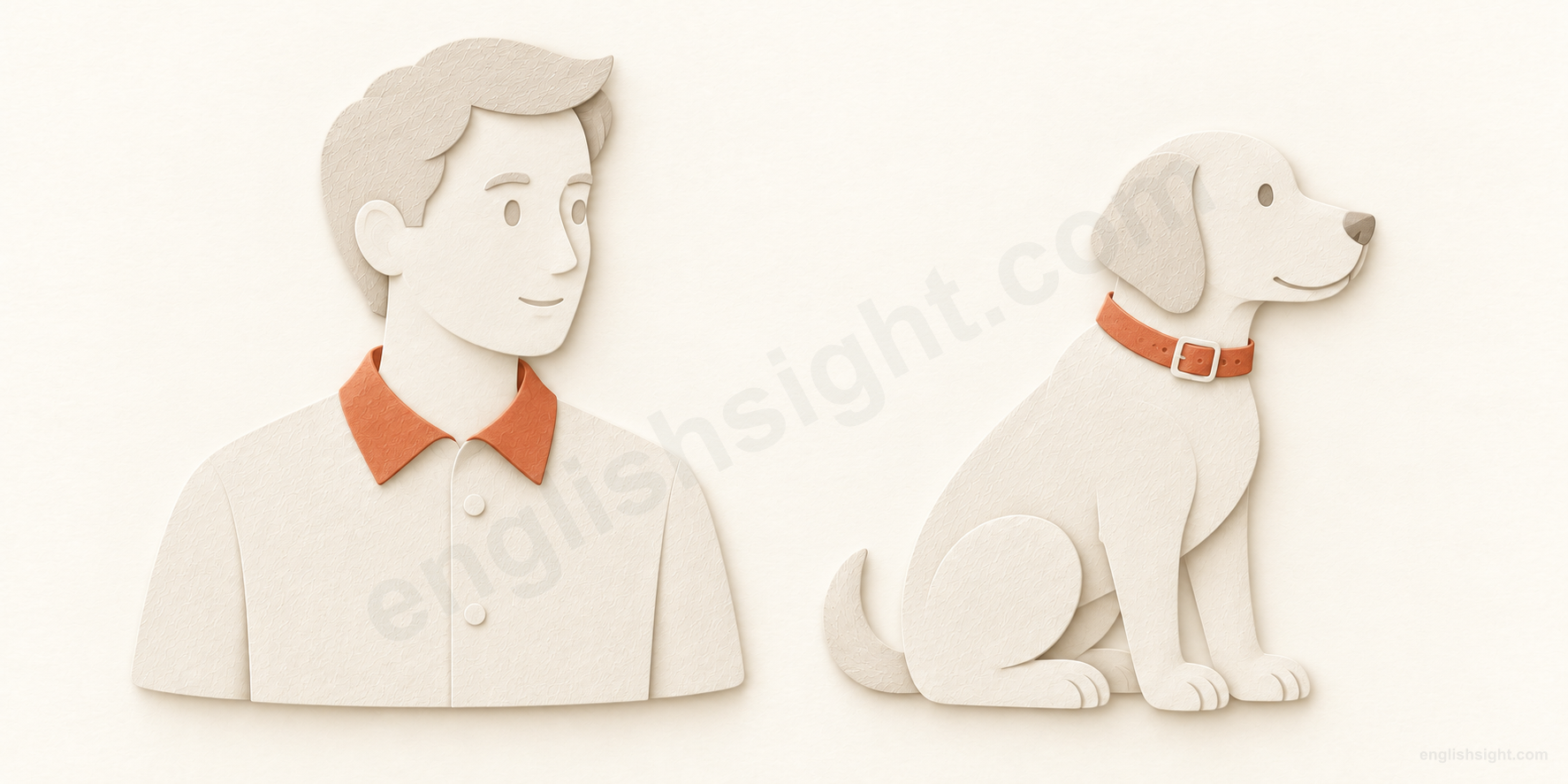
On the left, a person wears a shirt with a folded collar.
collar
On the right, a dog wears a separate strap collar.
Both highlighted parts fit around the neck.
A clothing part and a separate band share the same position around the neck. These are two examples, not successive states.
A collar is a part or band fitted around the neck; some related objects are named for their similar surrounding shape or function.
The diagram compares a shirt collar and a dog collar. It shows a spatial relationship, not an action sequence. Capture, conversation, job labels, and the emotion idiom are taught separately rather than forced into the drawing.
Start with where a collar fits: around the neck. It may be part of clothing or a separate band. Related ring-like objects share the surrounding shape, while the verbs and fixed expressions need their own contexts.
This lesson connects verified uses through a teaching model. It does not claim that every English speaker has the same mental picture, or that the picture predicts every expression.
01
At the neckline
Name the part of a garment, describe how it is worn, and distinguish a clothing part from the neck itself.
01
a / the / possessive + collar; the collar of + garment; a collared / collarless + garment
a shirt collar
the garment part that fits around the neck
Situation / starting point
You examine the top of a shirt.
Meaning in this use
You identify its collar, rather than the sleeve or neckline alone.
The collar belongs to the garment; the neck belongs to the wearer.
A collar is countable: a collar, the collar of my coat, two collars. It may stand up or fold down. It is not necessarily a separate ring, and not every top has one.
A shirt with a collar is a collared shirt; a collarless jacket has no collar. A high collar describes its height, while a stiff collar describes how firmly it holds its shape. Collar size is useful when choosing a shirt.
The neckline is the edge or shape of the opening around the neck. A collar is a particular garment part at that opening. A round neckline does not automatically mean a round collar.
In a sentence
This shirt has a stiff collar, but the jacket has no collar.
Watch the difference Say the collar of the shirt, not the collar of my body. Use neck for the body part.
02
turn up + collar; turn + collar / it + up; an open / undone collar
turn up your collar
raise a garment’s collar instead of leaving it folded down
Situation / starting point
The coat collar lies down.
Meaning in this use
You raise it beside the neck, often against cold or wind.
Up describes the changed position; collar names the part being moved.
Turn up your collar and turn your collar up both describe raising it. With a pronoun, say turn it up. Turn it down describes lowering it again.
An open or undone collar is a different detail: the fastening at the neck is open. Loosen your collar means make it less tight. These describe what you do to clothing, not new meanings of collar.
In a sentence
I turned my coat collar up when the wind grew stronger.
Watch the difference A raised collar is not necessarily unfastened. Up and open describe different things.
03
wear + a collar and tie; a collar and tie + be required
a collar and tie
a shirt with a collar worn with a tie, suggesting formal dress
Situation / starting point
You ask what to wear to an event.
Meaning in this use
The answer calls for a collared shirt and a tie.
The phrase names a way of dressing, not two loose accessories.
Wear a collar and tie is a conventional way to refer to this fairly formal style. The collar normally belongs to the shirt being worn.
In an instruction such as A collar and tie are required, the full phrase supplies the dress expectation. Collar by itself does not mean formal, expensive, or professional.
In a sentence
Do we need to wear a collar and tie to the dinner?
Watch the difference Do not assume every collar-and-tie event also requires a suit; the actual dress instructions decide.
04
grab / seize + someone + by the collar
grab someone by the collar
take hold of the garment at someone’s neck
Situation / starting point
Someone reaches for another person’s clothing.
Meaning in this use
Their hand grips the collar.
By identifies the part used as the point of contact.
In grab him by the collar, him is the person affected and the collar identifies what the hand holds. The ordinary body/clothing construction uses the: by the arm, by the sleeve, by the collar.
This is a literal physical grip. It can suggest force or aggression. Compare collar him as a verb: in some contexts that means catch or stop him without actually gripping any clothing.
In a sentence
In the film, the guard grabs the intruder by the collar.
Watch the difference Here collar is still a noun. By the collar is a prepositional phrase, not a phrasal verb.
02
Bands around necks and other objects
Animals, neck supports, and some machine parts also have collars. The surrounding shape connects these uses; their functions differ.
05
a collar for + animal; put a collar on + animal; animal + wear a collar
a dog collar
a band worn around an animal’s neck
Situation / starting point
A dog needs a band to carry its identification tag.
Meaning in this use
The tag hangs from a collar around its neck.
A collar surrounds the neck; a lead or leash extends away from it.
A dog collar or a cat collar is a separate band, unlike a collar sewn onto a shirt. A tag can be attached to it; a lead (British English) or leash (especially American English) may connect to it.
Put a collar on the dog names the fitting action. The dog is wearing a collar describes the resulting state. Neither sentence says that someone is currently holding the lead.
You may also meet flea collar or tracking collar: the first word tells you the collar’s purpose. These are kinds of collar, not meanings of the verb.
In a sentence
The cat’s name is on a tag attached to her collar.
Watch the difference A collar is not a leash: the collar stays around the neck, while the leash is the longer connecting line.
06
animal + slip + possessive + collar
slip its collar
get out of a collar that was around the animal’s neck
Situation / starting point
The dog has a collar on.
Meaning in this use
The dog pulls free, leaving the collar behind.
The animal escapes from the collar; the collar is the object of slip.
The dog slipped its collar is a compact way to describe the dog getting free of it. It does not mean that the dog fell over or that someone deliberately removed the collar.
Compare The collar slipped off: here the collar is the subject, and the sentence describes its coming off. In slipped its collar, collar remains a noun; the escape meaning comes from slip in this construction.
In a sentence
Our dog slipped his collar and ran back to the gate.
Watch the difference Do not interpret slip here as simply losing your footing.
07
wear + a neck collar
a neck collar
a device worn around the neck for support or protection
Situation / starting point
A person has a support fitted around the neck.
Meaning in this use
The device is described as a neck collar.
The surrounding form is shared with other collars; the purpose here is support.
In a medical setting, collar can name a neck support. Neck collar makes the location clear. The word describes an item, not a diagnosis.
Compare a shirt collar: it is part of clothing. A neck support has a different purpose, even though both items fit around the neck.
In a sentence
The patient was wearing a neck collar in the photograph.
Watch the difference Do not infer that an ordinary clothing collar provides medical support.
08
wear + a clerical collar; a dog collar (informal, clergy context)
a clerical collar
a distinctive white collar worn by some clergy
Situation / starting point
You describe what a minister is wearing.
Meaning in this use
You identify the white collar associated with that religious role.
The collar is a real item of dress, with a particular social association.
A clerical collar is worn by some Christian clergy. Clerical here relates to religious ministry, rather than office paperwork.
Dog collar can also name this item informally, especially in British usage. In The priest wore a dog collar, the person and context select that meaning; no dog is involved.
In a sentence
The minister wore a dark shirt and a clerical collar.
Watch the difference A clerical collar is not the same expression as a white-collar job. The latter describes work, not religious clothing.
09
a collar around / on + shaft / rod / pipe
a metal collar around a shaft
a ring or band fitted around a machine part
Situation / starting point
A diagram shows a rod with a ring around it.
Meaning in this use
The ring helps locate, hold, strengthen, or connect parts, depending on the design.
The extension is based on surrounding shape and function, not a literal animal neck.
In technical descriptions, a collar may surround a shaft, rod, or pipe. The particular design determines whether it holds a part in position, strengthens it, or helps connect it.
This is a useful recognition meaning rather than an engineering lesson. Saying a part has a collar does not specify every detail of its function.
In a sentence
A metal collar holds the wheel in place on the shaft.
Watch the difference The part is called a collar by resemblance; the shaft does not have a human neck.
03
Putting on, catching, and stopping
As a verb, collar takes an object. Context separates fitting a collar from capturing someone or stopping them for a conversation.
10
collar + animal; collar + animal + with + device; be collared
collar an animal
put a collar on an animal
Situation / starting point
Researchers prepare a tracking collar for a fox.
Meaning in this use
The fox has been fitted with the collar.
The verb can mean providing the object named by the noun.
Collar a dog or collar a fox can mean fit it with a collar. With a device specified, collar an animal with a transmitter makes the fitting meaning clearer.
In everyday pet care, put a collar on the dog is often an easier, more explicit expression. Be collared can describe an animal that has been fitted with a collar; it need not mean that it was arrested.
In a sentence
The research team collared the fox with a tracking device.
Watch the difference With a human object, collar usually suggests catching or stopping the person. Read the subject, object, and context together.
11
collar + someone; someone + be collared + place / by + agent
collar a suspect
catch or seize someone so they cannot get away
Situation / starting point
A suspect is trying to leave.
Meaning in this use
Officers catch and detain the suspect.
The person is brought under someone’s control; a literal collar need not be touched.
This transitive verb is informal. Police collared someone can describe capture or arrest. For a neutral official account, arrested is more explicit when an arrest actually occurred.
The passive is natural: The suspect was collared near the station. The person caught becomes the subject. The verb does not require a particle such as up or down.
The connection with taking hold at the neck is a memory aid, not a rule that the person must be wearing a shirt with a collar.
In a sentence
The officers collared the suspect near the station.
Watch the difference Do not automatically translate every collar someone as arrest: stopping someone to talk is another established use.
12
collar + someone + for a chat / to ask…; be collared by + person
collar someone for a chat
stop someone and take their attention for a conversation
Situation / starting point
You see a colleague on the way out.
Meaning in this use
You stop them to ask about something.
The person is kept in conversation, rather than necessarily held by the clothing.
I collared Sam after the meeting suggests catching Sam’s attention and stopping him to talk. It may imply that the listener was busy, wanted to leave, or did not choose the conversation.
I was collared by a salesperson gives the stopped person’s viewpoint. For a chat states the conversational purpose; it is not a particle that turns collar into a separable phrasal verb.
If you simply arranged a friendly meeting, met or talked to may fit better. Collar highlights the act of intercepting someone.
In a sentence
I collared Nina after the meeting to ask about the new schedule.
Watch the difference No physical grabbing is required, and Nina has not necessarily done anything wrong.
04
Work labels and an emotion idiom
Learn these established combinations as whole expressions. Clothing provides a useful association, but literal collar shape does not determine their meanings.
A report compares factory employment and office employment.
Meaning in this use
It uses blue-collar and white-collar as broad work categories.
The whole compound describes work; it does not report the actual color of a person’s shirt.
Blue-collar describes physical work in industry and people who do it: blue-collar jobs or blue-collar workers. White-collar usually describes office work and those doing it: a white-collar job.
These are established compound adjectives, normally written with a hyphen before a noun. They are broad categories, not measures of skill, intelligence, or someone’s value.
White-collar crime is another familiar combination: it concerns crimes such as fraud associated with business or professional activity. It does not mean a crime involving a white shirt.
In a sentence
The report compares blue-collar jobs in factories with white-collar jobs in offices.
Watch the difference A blue collar describes the color of a garment part; blue-collar work describes a kind of employment.
14
be / get + hot under the collar + (about + issue)
hot under the collar
angry, annoyed, or sometimes embarrassed
Situation / starting point
A comment provokes a strong emotional reaction.
Meaning in this use
The person is described as hot under the collar.
The complete idiom describes emotion; it does not require a collar or literal heat.
Be hot under the collar describes the state; get hot under the collar describes becoming upset. About can name the issue: hot under the collar about a decision.
Anger or annoyance is a central use. Embarrassment is also possible: Maya got hot under the collar when everyone noticed her mistake. Context tells you which feeling is meant.
The image of heat near the neck can help you remember the idiom. It cannot establish a person’s actual body temperature, and it does not mean every phrase with under the collar has this meaning.
In a sentence
Ben got hot under the collar about the extra delivery charge.
Watch the difference Keep the whole expression, including hot and the: under a collar alone does not mean angry. This idiom is informal.
Keep the object, action, and expression apart
Forms and pronunciation
Collar has two syllables, with stress on the first: British /ˈkɒlə(r)/ and American /ˈkɑːlər/. The noun plural is collars. The regular verb forms are collar, collars, collared, collaring; collaring keeps one r.
What the grammar contributes
The main noun is countable. The verb takes an object and permits ordinary passives and progressive forms: They are collaring the animals for the study. The catching and conversation uses are informal. There is no everyday particle-verb family to memorize here; by the collar, for a chat, and with a device are different grammatical additions.
Scope of the model
A collar need not restrain anyone: a clothing collar can decorate or finish a neckline. Horse harness collars, collar-shaped animal markings, decorative neck ornaments, and specialized trade senses are outside the main practice. Their existence does not make every ring or necklace an ordinary collar.
Choose the meaning that fits
Use the surrounding words and the situation, not just a single translation.
1. Which item fits around a dog’s neck, rather than extending from it to a person’s hand?
2. “I collared Jo after the meeting to ask about tomorrow.” What does this normally mean?
3. A coat collar lies flat, and you want it to stand up against the wind. Which instruction fits?
4. A report mentions white-collar jobs. What does the expression describe?
5. “Lee got hot under the collar about the unfair charge.” Which meaning fits?
Sources and teaching notes
Dictionary meanings, forms, and expressions were checked against the sources below. The lesson wording, examples, and relationship diagram are original teaching material; the visual connection is a teaching interpretation.
The diagram explains a relationship; it does not represent an identical picture in every native speaker’s mind.