Meet the hair tool, the grooming action, and the careful-search uses of comb.
Work through, strand by strand
Work through, strand by strand
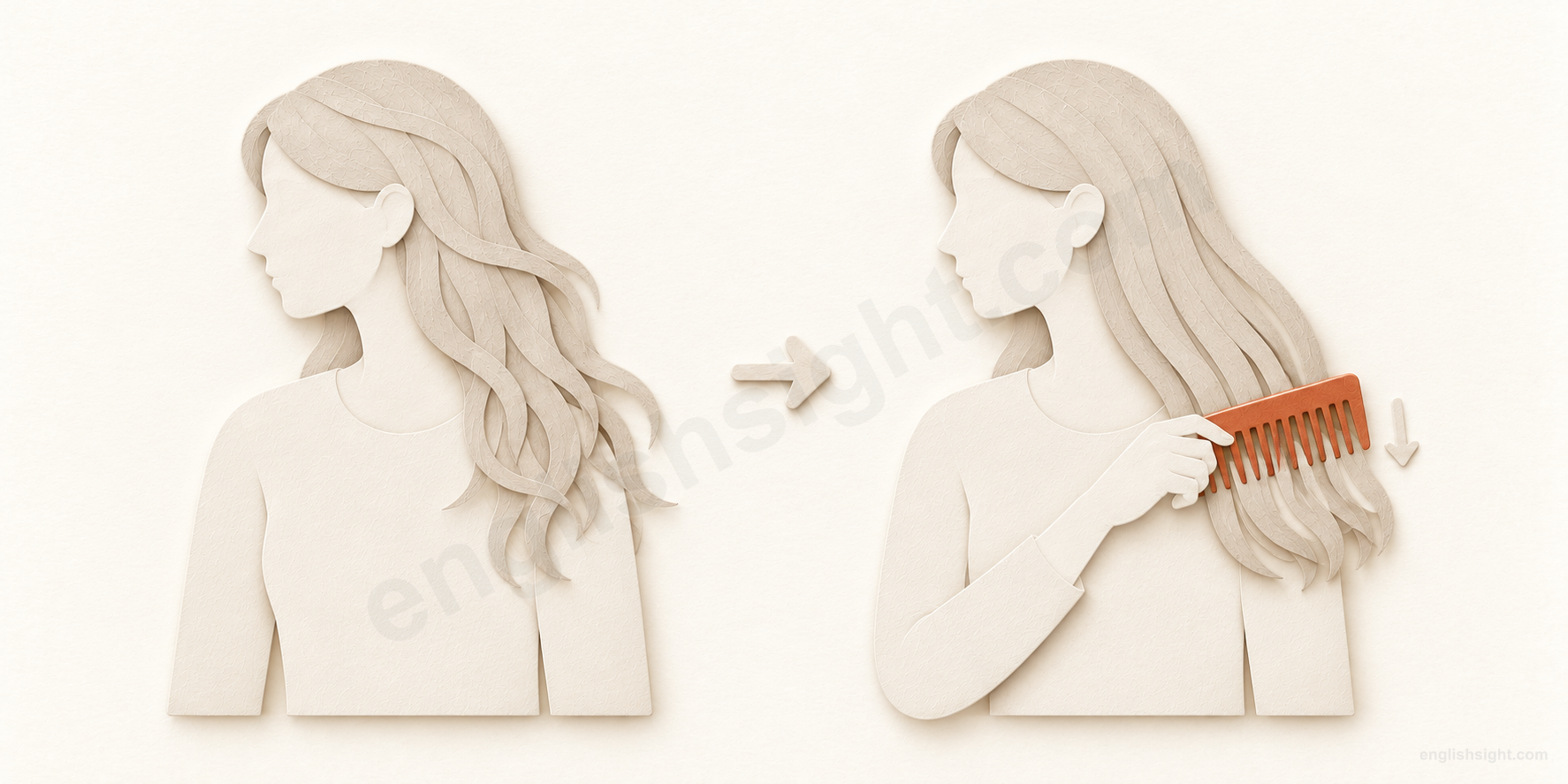
Loose hair strands cross and bend.
comb
The strands above the comb lie more evenly arranged.
She draws the comb downward through her hair.
The comb's teeth work between strands to separate and arrange the hair.
A comb’s teeth pass between strands to separate and arrange them. In searching, comb means checking a place or body of information thoroughly.
The search extension concerns careful coverage, not physical straightening, and does not guarantee a find. Bird and honeycomb senses are separate recognition branches.
A comb separates and arranges strands with its teeth. As a verb, comb can also describe a thorough search of a place or a close examination of information.
The teeth-and-strands picture is a teaching connection for these uses. A bird’s comb and bees’ comb are established noun senses to recognize separately.
01
The tool and the action
Start with teeth passing between strands. Notice whether comb names an object, an act, or a verb.
01
a / the / possessive + comb; run a comb through + hair
a comb
a tool with teeth for arranging hair
Situation before
You need to tidy your hair.
Action or result
You choose a toothed tool.
The noun names the tool, not the action.
A comb has a row of teeth; a brush has bristles. Both can arrange hair, but the objects have different structures. Say a comb or two combs.
Run a comb through your hair describes using the tool. A decorative comb can instead stay in the hair to hold it in place.
A fine-tooth or fine-toothed comb has closely spaced teeth; a wide-toothed comb has wider gaps. These descriptions name the spacing, not the size of the whole tool.
In a sentence
I keep a comb in my bag.
Watch the difference Use comb for the toothed tool and brush for the bristled one. They are not interchangeable object names.
02
give + hair + a comb; hair + need + a comb
give your hair a comb
comb used as the name of an act
Situation before
Your hair looks untidy.
Action or result
You spend a moment arranging it.
A comb can mean one act of combing rather than a second tool.
Give your hair a comb means comb it. Your hair needs a comb can similarly refer to the action; context distinguishes that from needing to buy a tool.
This action noun is especially familiar in British English. Comb your hair is a straightforward alternative across varieties.
In a sentence
I gave my hair a quick comb before the call.
Watch the difference In this sentence, give does not mean hand a tool to your hair.
03
comb + hair; comb + hair / it + back
comb your hair / comb it back
arrange hair with a comb
Situation before
Hair is out of place.
Action or result
It is arranged, perhaps away from the face.
The hair is the object; back adds the direction.
Comb your hair tells someone to use a comb on it. English normally uses a possessive here: my hair, your hair, or the child’s hair.
Comb it back means arrange it toward the back of the head. Back contributes direction; this is not a separate mysterious meaning of comb.
Her hair was neatly combed describes the resulting appearance or a passive action. He is combing his hair describes an action in progress.
In a sentence
Maya combed her hair back before putting on her hat.
Watch the difference Say comb my hair, not comb myself, when you mean this ordinary grooming action.
04
comb + tangles + out (of + hair); comb out + tangles; comb + hair / it + out
comb out tangles / comb your hair out
remove knots or make hair free of them
Situation before
Several strands are caught together.
Action or result
Combing loosens the tangles.
Out highlights removing tangles or working them out of the hair.
Comb the tangles out and comb out the tangles focus on what you remove. You can add the source: comb the tangles out of your hair.
Comb your hair out instead makes hair the object: work through it until it is smooth and free of knots. The object changes, so do not assume hair is being removed.
With a pronoun, put it before out: comb them out for tangles, or comb it out for hair. Comb out them is not the normal order.
In a sentence
She carefully combed the tangles out of the child’s hair.
Watch the difference Combing tangles out removes knots, not necessarily hairs. Hair as the object has a different role.
05
comb + fingers + through + hair
comb your fingers through your hair
use fingers in a comb-like action
Situation before
Your hair needs a quick adjustment.
Action or result
You draw spread fingers through it.
Here fingers act like the teeth of a comb.
Comb your fingers through your hair describes the movement of the fingers. Through introduces the hair they pass between.
This is a physical use of the combing action, not the careful-search meaning. Compare comb your hair with your fingers, where hair is the object and with identifies the means.
In a sentence
He combed his fingers through his hair while he thought.
Watch the difference In comb his fingers through his hair, he is not tidying the fingers.
02
Searching and examining carefully
Careful coverage links these uses to combing. The object tells you where the search takes place; for names the target.
06
comb + place + (for + person / thing)
comb an area for something
search a place thoroughly
Situation before
A dog is missing near the river.
Action or result
People carefully search the surrounding area.
The place is what you search; for introduces who or what you hope to find.
Comb the park for a missing dog means search the park carefully. The verb suggests more thorough coverage than simply looking around.
For names the target, not the place. You can omit it when the purpose is understood: Volunteers are combing the park.
Combing describes the search, not its success. We combed the beach for the ring, but found nothing is consistent.
In a sentence
Volunteers combed the riverbank for the missing dog.
Watch the difference Do not reverse the roles: comb the dog would ordinarily mean groom the dog.
07
comb through + material + (for + target); comb + material + for + target
comb through records
examine information carefully to find something
Situation before
An old receipt may show the payment date.
Action or result
You check the records closely.
Through presents material you work through; for can add the target.
Comb through emails, files, or evidence means examine them carefully. No physical comb is involved. Comb the files for a receipt is also possible without through.
In comb through them, them follows through because it is the material being examined. Do not apply the pronoun order of comb it out to this different construction.
Through is also possible with physical material or places. The distinction is not a strict rule that places take no through and documents always require it.
In a sentence
I combed through last month’s emails for the booking number.
Watch the difference Comb through means examine closely; skim means read quickly for an overview or selected points.
08
go over / through + something + with a fine-tooth / fine-toothed comb
go over something with a fine-tooth comb
examine every small detail with great care
Situation before
A contract may contain an unnoticed condition.
Action or result
You check it in detail before signing.
Closely spaced teeth provide a useful image of detailed checking.
Go over or go through something with a fine-tooth comb is an established idiom emphasizing a very thorough examination. It can concern documents, a place, or other material.
Fine-toothed comb is also an accepted form. With a fine-tooth comb describes the manner of examining; it usually does not name a tool actually used on a contract.
The idiom emphasizes care, not guaranteed perfection. Checking thoroughly does not logically prove that no mistake remains.
In a sentence
We went over the contract with a fine-tooth comb before signing.
Watch the difference Learn the whole expression. Fine here concerns the teeth, not a statement that the comb is excellent.
03
Other things called comb
These are useful recognition senses, not extra meanings of tidying hair. Context identifies the object.
09
a bird’s / rooster’s + comb
a rooster’s comb
the fleshy crest on a chicken’s head
Situation before
You identify parts of a rooster.
Action or result
You name the crest on top of its head.
This comb is part of the bird, not a grooming tool.
A rooster’s comb is the fleshy growth on top of its head. This is a separate established noun sense; it does not describe the bird combing its feathers.
The noun is countable. The possessive tells you which bird has the comb.
In a sentence
The rooster had a bright red comb.
Watch the difference The bird possesses this body part; it is not holding or using a hair tool.
10
honey + in the comb; a piece of + comb
honey in the comb
the wax cells made by bees
Situation before
Honey is still inside its wax cells.
Action or result
You describe it without treating it as liquid in a jar.
Comb here means honeycomb, not a row of teeth.
In a beekeeping or food context, comb can mean the wax structure of cells that bees make. Honeycomb is the clearer full word for a beginner.
Honey in the comb refers to honey still in those cells. A piece of comb names a portion; this sense allows both countable and uncountable uses.
In a sentence
The beekeeper showed us a piece of comb full of honey.
Watch the difference This meaning needs bee or honey context. A comb on a bathroom shelf will normally be a hair tool.
11
comb + wool / cotton; combed + cotton
comb wool / combed cotton
prepare textile fibres by separating and aligning them
Situation before
Fibres need preparation for making cloth.
Action or result
A special comb or machine works through them.
The tool-and-strands relationship also applies to textile fibres.
In textile work, combing cleans and aligns fibres such as wool or cotton using special equipment. This is a specialist extension of the physical action.
Combed cotton on a clothing label names cotton that has undergone this process. It does not mean someone brushed a finished shirt.
In a sentence
The label says the shirt is made from combed cotton.
Watch the difference Recognize this on product labels; it is not a claim that every textile is prepared by combing.
Choose the object and read the whole pattern
The b is silent
Comb is pronounced /kəʊm/ in British English and /koʊm/ in American English. The b stays silent in combs, combed, and combing. Forms are comb, combs, combed, combed, combing.
Search is not success
Comb an area for a key describes a careful search. It does not say the key was found. Find supplies that result; comb does not.
Grammar follows the meaning
Hair was combed and records were combed through are possible passives. I had my hair combed uses the general have + object + past participle pattern to describe arranging for someone to do it; it is not a new sense of comb.
What this lesson leaves out
Specialized comb-shaped machine parts, roof or helmet ridges, gunstock terminology, wave-breaking uses, abbreviations, and uncommon figurative comb out meanings are not developed here. They cannot all be predicted from the grooming picture.
Choose the intended meaning
Look at the object, the following words, and the situation.
1. The key is missing in the garden. Which sentence says you searched the place carefully?
2. Tangles are the object represented by them. Which order is natural?
3. A colleague went through the report with a fine-tooth comb. What happened?
4. We combed the beach for the ring. What can you safely conclude?
5. A rooster has a red comb on its head. What is comb here?
Sources and teaching notes
Usage was checked against the dictionary pages below. Explanations and examples are original; the visual connection is a teaching interpretation.
The diagram is a teaching aid, not a picture shared by every native speaker.