Use a viewpoint to connect arrival, appearance, and familiar expressions.
A chosen viewpoint
Choose the reference point
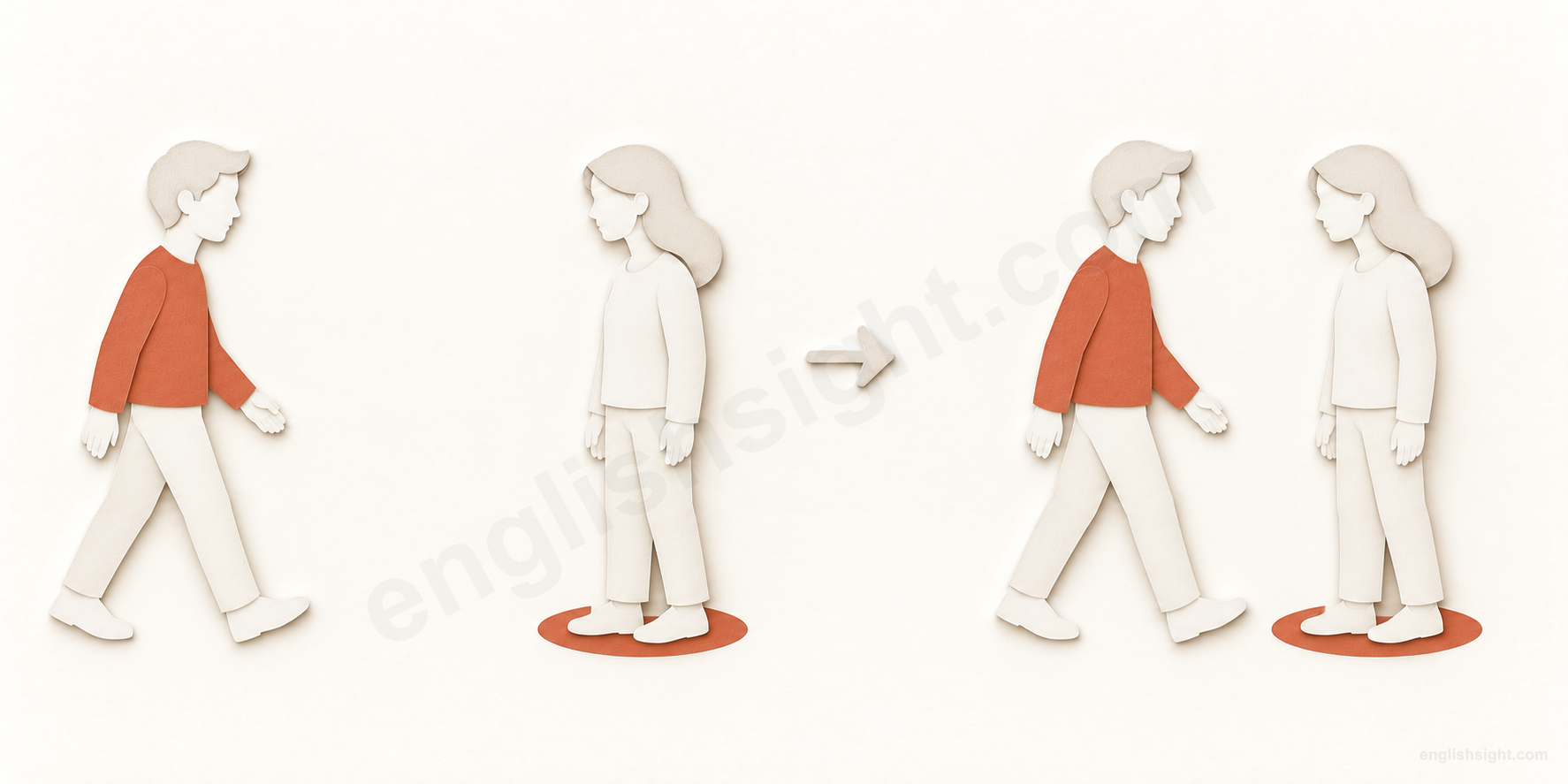
The walker is farther from the stationary person at the marked reference point.
come
The same two people are now closer together.
The walker moves towards that person; the reference point stays fixed.
Come presents movement towards the conversation’s adopted reference point. Here, one person approaches another; that person can represent the listener’s location. In other contexts the speaker, a shared destination, or a narrative viewpoint supplies the reference point. The shrinking gap illustrates approach, not a rule that every use reaches an endpoint. State changes and fixed expressions still require their own explanations.
A moving figure approaches a marked point. First ask whose “here” the conversation adopts. Then read the rest of the sentence.
The diagram explains viewpoint in movement and offers a limited memory link to arrival or appearance. It does not define every use of come.
With come, the useful starting picture is movement towards a reference point. That point may belong to the speaker, the listener, a future shared event, or the story’s viewpoint.
This picture is a teaching model, not a claim that every native speaker sees the same drawing. State changes, product specifications, and established expressions need their own constructions; a physical arrow does not predict all of them.
01
Movement has a viewpoint
Start by choosing the reference point: the speaker, the listener, a shared destination, or a place adopted in the story. Come presents movement towards that point; it does not always mean towards the speaker’s present body.
01
come + here / home / to + place
come here / I’m coming
move towards the chosen viewpoint
Before
Someone is elsewhere.
After
They approach the reference point.
Choose whose “here” matters.
Come normally presents movement towards the speaker, listener, or another adopted viewpoint. Replying I’m coming to someone calling you is natural even though you are moving away from your own present position.
Use come home and come here without to: Please come home early. Here and home function as destination adverbs in these patterns.
In a sentence
Wait there. I’m coming to help you.
Watch the difference Go describes movement to another place without this towards-here perspective.
02
come with + person; come to + event
come with us
join someone on a journey or at an event
Before
The group is setting off.
After
You join the group.
A shared viewpoint includes the group.
Come with us invites someone into the speaker’s group. Are you coming to the party? can adopt the future event as a shared destination. The speaker need not already be standing there.
Come forward adds volunteering or offering information: Two witnesses came forward with information. A person actively offers help or evidence, rather than merely walking forwards. With names what is offered; an actual movement is not required.
In a sentence
We’re visiting the museum. Would you like to come with us?
Watch the difference With names company; to names a destination.
03
come to + verb; come and + verb; come + -ing
come to see / come and see
travel somewhere for a purpose
Before
You are in another place.
After
You arrive to do something.
The following verb gives the purpose.
Come to see me and come and see me are familiar invitations. Informal American English also allows come see me. In a past-tense account use came to see or came and saw, not came see.
Compare come for + item: I’ve come for my coat means arriving to collect it. With a person, context can instead suggest collecting them, arresting them, or attacking them: The police came for him. For does not supply a single universal meaning; read the situation.
In She came running towards us, running describes how she moved; came is still past tense. Come skating with us invites someone to join an activity. These -ing patterns differ from the purpose infinitive in come to help.
In a sentence
My brother came to help with the move.
Watch the difference Come to understand usually describes developing understanding, not a visit.
04
come from + place / source / cause
come from
have a place, material, or cause as a source
Before
A person or thing has an origin.
After
The origin is identified.
From traces a source.
I come from Seoul identifies origin and need not describe a journey happening now. Cheese comes from milk traces material; problems can come from poor planning. The noun after from determines what sort of source is meant.
In I see where you’re coming from, coming from is an informal way to discuss the experiences or reasoning behind an opinion. It means understanding the person’s perspective, not asking for a geographical origin.
In a sentence
This cheese comes from a small farm near the coast.
Watch the difference Where are you coming from? may ask about a current journey instead.
02
Read what follows come
A destination, source, rank, adjective, infinitive, amount, or product specification changes the construction. Some patterns describe arrival; others have conventional meanings without any actual journey.
05
time / event + come; come as + reaction
the time has come
an event or moment arrives
Before
An event is still ahead.
After
The event becomes present.
Time is treated as approaching.
The time has come to act means the appropriate moment is now. Winter is coming similarly presents a future season as approaching. Come as a surprise describes the reaction an event produces, not its physical route.
Come under criticism means become the target of criticism: The plan came under criticism. Come under new management means become controlled by new management. What category does this come under? instead asks for classification. Under links different established relationships, not necessarily a physical position.
After a noun, to come means future: We’ll need this in the years to come. Come and go can describe repeated arrivals and departures, or something appearing and disappearing: The pain comes and goes means it is intermittent, not constant.
In a sentence
Her invitation came as a lovely surprise.
Watch the difference The invitation is the subject; the surprised person need not be the subject.
06
come + first / second / next / last
come first / come next
occupy a rank, order, or priority
Before
Things need ordering.
After
A position is specified.
The complement names an ordered place.
In a race, come first means finish in first place. In My family comes first, first expresses priority. Come next describes sequence. These are established position uses, not commands to walk towards the speaker.
In a sentence
Safety comes first when we plan a trip.
Watch the difference A habitual priority normally uses the simple present, not is coming first.
07
come in + colour / size; come with + included item
come in blue / come with a charger
be offered in a form or include something
Before
You are checking a product.
After
Its options or included items are specified.
No journey is taking place.
This bag comes in blue describes an available colour; it does not announce a blue bag arriving. Comes with a charger says a charger is included. Use these patterns when comparing products, sizes, colours, and packages.
In a sentence
Does this lamp come with a bulb?
Watch the difference These specification uses normally take simple tenses.
08
come + selected adjective: loose / undone / true
come loose / come true
reach certain established result states
Before
Something is fixed or only imagined.
After
It becomes loose or real.
The adjective supplies the result.
A screw comes loose when it stops being securely fixed. A wish comes true when it becomes reality. Come does not freely replace become before every adjective: we normally say get hungry, not come hungry to mean become hungry.
In a sentence
One of the screws has come loose.
Watch the difference Come hungry can mean arrive while hungry, a different construction.
09
come to + an end / a decision / an agreement; come into effect / force
come to an end / an agreement
reach a named stage or outcome
Before
A process or discussion continues.
After
It reaches an endpoint or agreement.
To introduces a result noun.
A meeting comes to an end; people come to an agreement. The subjects differ because the process ends but the people reach agreement. Come into effect and come into force describe a rule beginning to operate: The new rule comes into force in June. These combinations require their established nouns and prepositions.
Come to terms with a difficult situation means gradually accepting and learning to live with it: I’m coming to terms with the change. Compare come to terms with someone, which can mean reach an agreement. Acceptance of a reality and negotiation with a person are different uses of the complete idiom.
In a sentence
After an hour, we came to an agreement.
Watch the difference Say reach an agreement or come to an agreement, not come an agreement.
10
come to + understand / realize / believe; how did ... come to + verb?
come to understand
gradually reach a belief or understanding
Before
Your understanding is incomplete.
After
A new understanding develops.
The infinitive describes a developed state.
Over time, I came to understand her decision means understanding developed through experience. How did you come to work here? asks what circumstances led to the situation. Neither requires travelling towards the speaker.
In a sentence
I came to understand why the rule mattered.
Watch the difference Distinguish purpose: I came to explain means I visited in order to explain.
11
amount / bill + come to + total
come to £30
add up to a total
Before
Several charges are separate.
After
They make a total.
To introduces an amount.
At a checkout, The bill comes to £30 gives the total cost. The bill is the subject and the amount follows to. The visual connection is arriving at a number; no person or payment actually travels in this grammar.
In a sentence
The tickets and booking fee came to £30.
Watch the difference Cost £30 has no to; come to £30 requires to.
12
come / comes; came; has come; is coming
come → came → come
use the irregular verb forms
Before
You choose a time construction.
After
The correct verb form fits.
Past tense and participle differ.
Yesterday she came uses the simple past. She has come uses the past participle, which matches the base form. Coming drops the final e. Come is usually intransitive in its ordinary movement senses, so She was come by him is not an ordinary movement passive.
In a sentence
They came yesterday and have come again today.
Watch the difference Say has come, not has came. This is a form note, not another meaning.
03
Directions, appearance, and arrival
In, out, back, up, down, on, over, and along can help organize meaning. They also enter established expressions. A particle is not a universal code that generates every meaning.
13
come in; come into + room / building
come in
enter, or arrive into a receiving place
Before
Someone or something is outside.
After
They enter the relevant space.
In adds an inward direction.
Come in! welcomes someone at a door. News is coming in means reports are being received; money coming in means income. These abstract uses retain a receiving viewpoint, but the subject tells you what is arriving.
Come into money means inherit it: She came into some money after her aunt died. In Luck doesn’t come into it, come into means be relevant to the matter. Inheritance and relevance are established meanings, distinct from physically coming into a room.
In a sentence
You can come in now; the meeting has finished.
Watch the difference Come in can stand alone; name a room with come into the room.
14
come out; come out of + place / material
come out
move outwards, become visible, be removed, or have a finished result
Before
Something is inside or hidden.
After
It is outside or visible.
Out adds emergence.
Come out of the room describes leaving it towards the adopted viewpoint. The sun came out means it appeared from behind cloud. A stain that comes out is removed by washing. Out alone does not tell you which situation applies.
Come out can also describe a finished result: The photos came out blurry describes their quality, not their publication. My explanation came out wrong means I expressed it badly. In both, the following adjective describes the outcome.
In a sentence
The rain stopped and the children came out of the house.
Watch the difference Go out often views departure from inside; come out adopts another viewpoint.
15
come back; come back to + place; memory + come back
come back
return to a place or previous presence
Before
Someone or something is away.
After
They return.
Back restores an earlier position.
Come back home asks for a return towards home as the reference point. A memory can come back, meaning it is remembered again. Compare go back, which can describe returning away from the current viewpoint.
Come back to a topic means discuss it again: We’ll come back to the cost later. Here to introduces the topic, not a travel destination. This differs from a memory coming back to a person, where an idea becomes remembered again.
In a sentence
When I heard the song, the memory came back.
Watch the difference Come back is intransitive; bring it back describes returning an object.
16
come over (to + place); feeling + come over + person
come over
visit, cross to a place, or be affected
Before
You and someone else are apart.
After
They visit or a feeling affects them.
Context decides between travel and feeling.
Come over for dinner is a casual invitation to visit. A strange feeling came over me makes the feeling the subject and the affected person the object. In British informal usage I came over dizzy describes suddenly feeling dizzy.
In a sentence
Would you like to come over for dinner on Sunday?
Watch the difference What came over you? asks about unusual behaviour, not a travel route.
17
come along; come along with + people; how is ... coming along?
come along
join, appear, or make progress
Before
There is a journey or developing situation.
After
Someone joins or something develops.
Along can frame shared movement or progress.
Can I come along? asks to join others. How is the work coming along? asks about progress. An opportunity comes along when it appears. The progressive work question is an established expression, not a question about its physical direction.
Come can also measure distance: We’ve come twenty miles today. You’ve come a long way with your English instead praises substantial progress. The distance phrase has no to; the figurative use does not require a journey.
In a sentence
How is your new project coming along?
Watch the difference The subject distinguishes a person joining from a project progressing.
18
device + come on; illness / symptom + be coming on
come on: lights and symptoms
start operating or begin to develop
Before
A device is off or a symptom is absent.
After
Operation or a symptom starts.
On marks a starting state.
The lights come on when they start shining. A headache is coming on means it is beginning to develop. In each construction the light or symptom itself is the subject; no person is named as causing it.
A programme can start too: What time does the news come on? asks when the broadcast begins.
In a sentence
The outside lights come on automatically at dusk.
Watch the difference Turn the lights on is transitive; the lights come on is intransitive.
19
come up; be coming up; come up to + person
come up
arise, be mentioned, or approach in time
Before
Something is not yet the focus.
After
It enters attention or the near future.
Up often marks emergence, but meanings are conventional.
Something urgent has come up means an unexpected matter requires attention. A topic comes up when it is mentioned. A birthday is coming up when it is near. Physical uses include the sun rising and a person coming up to you.
Come up against + obstacle means encounter opposition or difficulty: We came up against a problem with the permit. The people facing the problem are the subject. Compare A problem came up, where the problem itself is the subject and arises unexpectedly.
In a sentence
The question of cost came up during lunch.
Watch the difference Come up a question is incorrect for “mention”; a question comes up.
20
come down; come down + stairs; price / temperature + come down
come down
descend or decrease
Before
Something is high.
After
It becomes lower.
Down supplies a lower direction or value.
Come down the stairs describes physical movement. Prices coming down describes a lower amount. Rain coming down describes falling rain. These examples share a useful downward comparison, but their nouns determine movement, value, or weather.
In a sentence
We’ll book when the price comes down.
Watch the difference Bring the price down names an outside cause; the price comes down does not.
04
Ideas and impressions reaching people
Compare accidentally finding something, giving an impression, getting an idea, and becoming publicly available. The whole construction, its subject, and its object decide the meaning.
21
book / album / truth + come out; person + come out
come out: publication and disclosure
be released or become publicly known
Before
A work or fact is not public.
After
People can access or know it.
Public availability replaces physical emergence.
A new album comes out when it is released. The truth comes out when it becomes known. A person can come out about their sexual orientation or gender identity; this is an established disclosure expression, not an invitation to leave a room.
Come to light also describes information becoming known: New facts came to light. Come clean about something instead means a person admits a previously hidden truth: She came clean about the mistake. Information becoming known and a person making an admission have different subjects and implications.
In a sentence
Her new album comes out on Friday.
Watch the difference Identify the subject and context; public release and personal disclosure are distinct meanings.
22
come across + person / thing
come across something
find or meet by chance
Before
You are not specifically finding this item.
After
You unexpectedly encounter it.
The encounter is accidental.
You come across an old photo while looking through a drawer. This meaning belongs to the whole expression. Across does not necessarily describe crossing a road, and the object stays after across, including a pronoun.
Come by something means obtain it: Good jobs are hard to come by. In North American usage, Come by my house can instead invite a short visit. Unlike accidental come across, obtaining something through come by does not itself say whether finding it was accidental.
In a sentence
I came across your old letter while clearing the desk.
Watch the difference Say came across it, not came it across.
23
come across as + adjective / noun; message + come across
come across as
give an impression or communicate successfully
Before
Someone speaks or behaves.
After
An impression reaches an audience.
As introduces the perceived quality or role.
She comes across as confident means that is the impression she gives, whether or not she feels confident. The message came across means it was understood. Compare came across a message, which describes finding one.
In a sentence
He comes across as friendly in interviews.
Watch the difference As changes the pattern; finding a person and seeming friendly are different uses.
24
come up with + idea / answer / plan / money
come up with
produce an idea, answer, or needed resource
Before
An answer or resource is needed.
After
Someone produces it.
The whole expression names finding or producing.
Come up with a solution means think of or produce one. Come up with the money means obtain the needed sum. The noun after with is the idea or resource; it is not another traveller accompanying you.
Compare An idea came to me while I was cooking: the idea is the subject, and to names the person who suddenly thinks of it. Writing comes naturally to her means writing is easy or natural for her; the skill is the subject, not a travelling object.
In a sentence
Can you come up with a name for the club?
Watch the difference Say come up with it, keeping the pronoun after with.
05
Established outcomes and difficulties
Some uses can be remembered as arrival after a process. Others need their own explanation. Learn the entire expression and distinguish who changes, what arrives, and whether anyone causes the event.
25
come down with + cold / flu / illness
come down with
begin to have an illness
Before
You feel generally well.
After
An illness starts affecting you.
This is an established illness expression.
I’m coming down with a cold suggests symptoms are beginning. With introduces the illness; down does not explain a literal downward movement. The phrase is commonly used for ordinary illnesses, rather than as a universal way to describe every diagnosis.
In a sentence
I think I’m coming down with a cold.
Watch the difference This describes onset, not recovery; get over a cold describes recovery.
26
come down to + noun / choice / -ing
come down to
depend ultimately on one main factor
Before
Several considerations are discussed.
After
One decisive issue remains.
The expression reduces a question to its essentials.
It comes down to cost means cost is the deciding factor. This meaning is conventional; a downward arrow alone cannot explain it. The complement can also be a choice or an -ing activity.
In a sentence
In the end, the decision comes down to cost.
Watch the difference Keep down to together: come to a decision describes reaching a decision instead.
27
come around / round; come to; come around to + idea
come around / come round / come to
visit, recover consciousness, or change an opinion
Before
Someone is absent, unconscious, or opposed.
After
They visit, wake into awareness, or reconsider.
Separate the established senses.
Come around on Saturday invites a visit. Come around after an operation means regain consciousness; come to can mean the same. Come around to an idea means eventually accept it. British English also uses come round.
In a sentence
She was doubtful, but she came around to our plan.
Watch the difference Coming around to a plan does not mean physically walking around it.
28
part + come off; object + come apart
come off / come apart
become detached or separate into pieces
Before
Parts are attached.
After
A part detaches or the object separates.
Off and apart describe different results.
A handle comes off when it detaches from the object. A toy comes apart when it separates into pieces, perhaps by design. A stain comes off when it is removed. These intransitive patterns do not say who caused the separation.
In a sentence
The handle came off when I lifted the bag.
Watch the difference Take the handle off names a person removing it; the handle comes off does not.
29
plan + come off; come off well / badly
come off: plans
happen successfully as planned
Before
A plan is uncertain.
After
It succeeds, or fails to happen as intended.
An established result meaning replaces detachment.
The plan came off means it worked or happened successfully. It is an informal use, distinct from a button coming off. Come off well or badly can describe someone’s result in a contest or debate.
In a sentence
We hoped to arrange a surprise, but the plan didn’t come off.
Watch the difference This is not the same as calling an event off, which means cancelling it.
30
event / change + come about
come about
happen or develop
Before
The cause or process is unknown.
After
An event occurs.
About belongs to an established event expression.
How did the change come about? asks about the circumstances that caused it. The event or change is the subject. Unlike bring about a change, come about does not give an agent a direct object.
Come of asks about a result: What came of your application? means what happened as a result of applying. Nothing came of our discussion means it produced no result. This established use differs from asking how the discussion came about, which asks about its cause.
In a sentence
How did this change in the timetable come about?
Watch the difference The change came about; the manager brought the change about.
31
come through; come through + ordeal; come through with + promised resource
come through
arrive, survive, or deliver what was promised
Before
A process or difficulty stands in the way.
After
The message arrives or a person succeeds.
The subject selects an established meaning.
The email came through means it arrived through a system. Come through an operation means survive it. Come through with the money means provide money as promised. The obstacle image is a memory aid; it cannot select the meaning without the subject and complement.
In a sentence
Our sponsor came through with the money at the last minute.
Watch the difference Come through with the money describes delivering it; come up with the money describes obtaining it.
06
Useful expressions in conversation
Everyday formulas can organize topics, offer encouragement, ask for clarification, or describe usefulness. Their social effect depends on tone and context as well as grammar.
32
Come on!; Oh, come on!
Come on!
encourage, hurry, or challenge a claim
Before
Someone hesitates or says something doubtful.
After
You urge them or object.
Tone and conversation carry the function.
Come on! You can do it encourages. Come on! We’re late urges speed. Oh, come on! after an implausible claim expresses disbelief. These conversational uses are learned with their tone; on is not a physical surface here.
In a sentence
Come on, you’re nearly at the finish line!
Watch the difference A sharp tone can sound impatient or confrontational.
33
come in handy; come in handy for + noun / -ing
come in handy
be useful when needed
Before
An item might seem unnecessary.
After
It proves useful in a situation.
Learn the complete idiom.
A spare bag will come in handy means it will be useful, perhaps for carrying shopping. Handy is an adjective, but in is fixed in this idiom. No hand needs to appear in a literal picture.
In a sentence
Keep the box; it might come in handy for storing cables.
Watch the difference Say come in handy, not come handy.
34
when it comes to + noun / -ing
when it comes to
introduce a topic or area of ability
Before
Several topics are possible.
After
One topic becomes the focus.
To is a preposition in this expression.
When it comes to cooking, Sam is the expert introduces cooking as the relevant field. After to use a noun or -ing form. It is not the purpose infinitive in come to cook.
In a sentence
When it comes to fixing bikes, Maya knows what to do.
Watch the difference Say when it comes to fixing, not when it comes to fix.
35
How come + statement?; Come again?
How come? / Come again?
ask for a reason or repetition
Before
Something needs explanation or was not heard.
After
You ask for clarification.
These are different conversational formulas.
How come you’re early? informally asks why and normally keeps statement word order after how come. Come again? asks someone to repeat what they said; it does not ask why. Both may sound abrupt, so use a friendly tone or a fuller polite question.
Come to think of it introduces a newly remembered or realized detail: Come to think of it, I left my keys upstairs. It is a fixed conversational aside, not a command to travel somewhere and think. Unlike How come?, it does not ask for a reason.
In a sentence
How come the café is closed today?
Watch the difference Normally say How come it is closed?, not How come is it closed?
A viewpoint helps; the construction decides
Come is not always towards the speaker’s current position
Listeners, shared destinations, and narrative viewpoints can supply the reference point. I’m coming! is a natural answer to someone calling you.
Do not turn every use into a physical journey
Come in blue, come first, and come in handy have established constructions. State what each means instead of forcing a literal picture.
Common modern usage, with an explicit boundary
This selection covers the main everyday families, major productive patterns, and common expressions. It is not a frequency ranking, every dictionary entry, or an official Ogden-only course.
Which construction fits the situation?
Choose a phrase, then use the explanation to check the viewpoint and grammar.
1. Your friend calls from the doorway. You reply that you are moving towards them. Which is natural?
2. You unexpectedly find an old photo while tidying. Which sentence fits?
3. Choose the correct perfect construction.
4. You introduce bicycle repair as someone’s area of expertise. Which opening fits?
Sources and teaching notes
Definitions and usage were checked against the sources below. Explanations, example sentences, and the diagram were written for this lesson; the visual connection is a teaching interpretation.
This diagram helps explain a connection; it is not a picture shared by every native speaker.