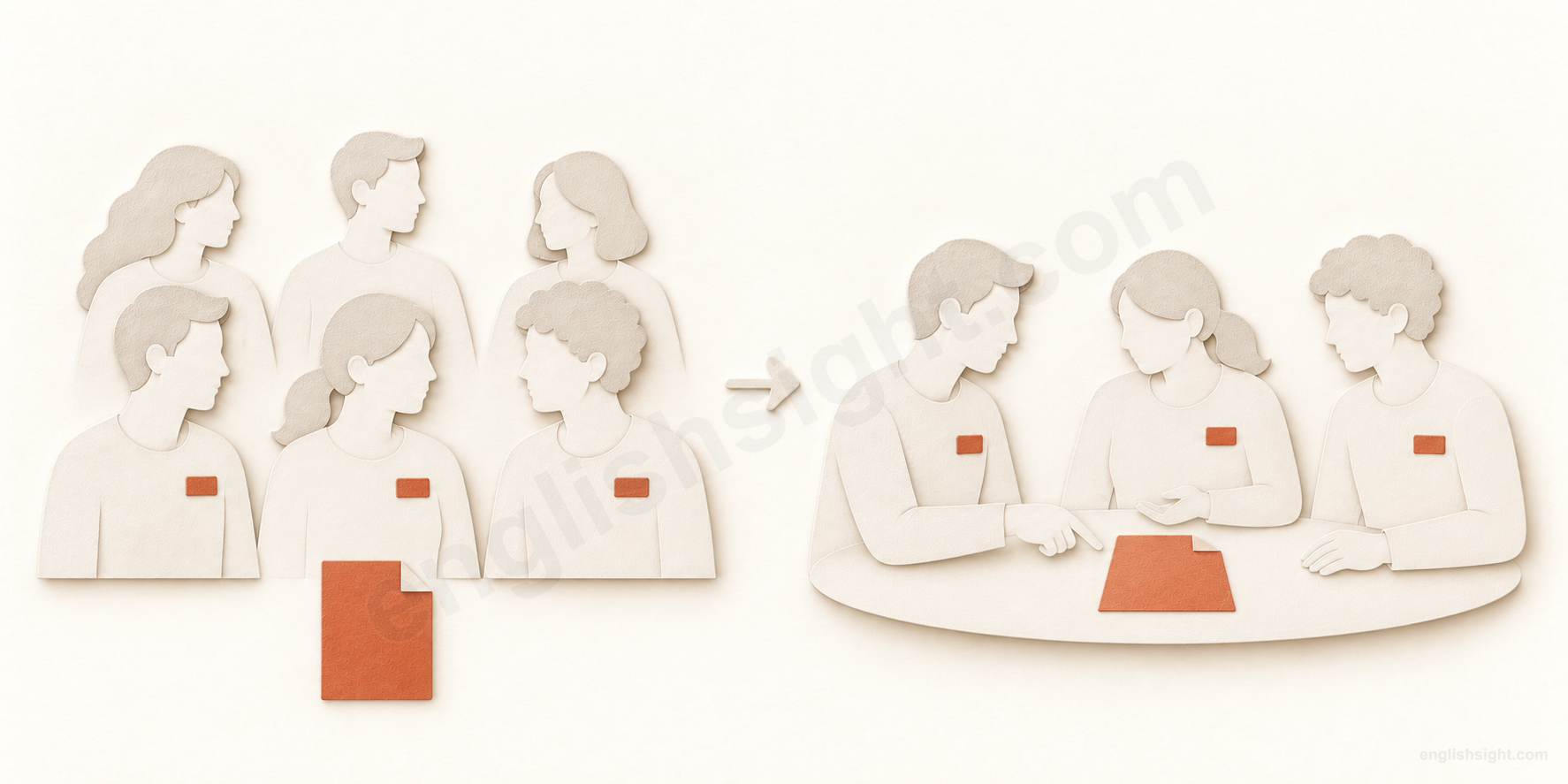
Use committee for a body that considers, plans, advises, or acts on a defined matter.
A body with a defined task
Designated people, a shared responsibility
A larger group has a matter to handle.
committee
The three members consider one shared matter as a committee.
Three designated members take responsibility together.
A committee is a group responsible for a particular matter; considering it does not itself mean agreement or a final decision.
A committee is a body of people designated or organized to consider or handle a particular matter.
Being chosen by a larger body is typical, not compulsory: a group can also organize itself around a cause. The picture shows the representative case, not a required seating arrangement, voting rule, or successful outcome.
A club needs its accounts checked; a school needs an event organized; a legislature needs evidence examined. A committee gives particular people responsibility for that work. It is more specific than simply a group.
The central picture is a useful teaching model: designated people share a task. It does not claim that every English speaker imagines the same scene, or that every committee has the same powers.
01
A group with a particular responsibility
Identify the body, establish it, join it, and describe the work it has been given.
01
a / the + committee; plural committees
a committee
a body of people responsible for a particular matter
Situation / need
A club needs someone to handle its spending.
Role / outcome
A designated group takes responsibility for that work.
The noun names the people acting as a body, rather than their meeting or the room.
A committee has a defined job: it may investigate, advise, organize, or decide. A random crowd or friends having lunch are not automatically a committee. The teaching picture highlights responsibility shared by designated members.
A committee is often chosen by a larger organization, but that is not an absolute requirement. People can also organize themselves into a committee to support a cause, such as protecting a local park. The shared purpose remains; there need not be a parent organization.
Committee is countable: a committee, the committee, two committees. It usually names the whole body. For one person, say a committee member. A committee can continue to exist between meetings.
In a sentence
The club has a committee that checks how membership fees are spent.
Watch the difference A committee meeting is an occasion when the body meets; it is not the body itself.
02
form / set up / establish / appoint / elect + a committee; committee + to-infinitive
form / set up / appoint a committee
establish the body or choose its members
Situation / need
No group has yet been given the job.
Role / outcome
A committee is established to handle it.
The verb describes how the body comes into existence or how its membership is chosen.
Form, set up, and establish a committee all describe creating one. Establish is useful in formal writing. Appoint a committee emphasizes an authority choosing the people; elect a committee emphasizes choosing them by a vote.
A to-infinitive can give its task: set up a committee to review the rules. The committee will review them; it is not the object of review. In A committee was appointed, the passive comes from appoint, not from a verbal meaning of committee.
In a sentence
The residents set up a committee to organize repairs to the shared garden.
Watch the difference Appoint and elect describe different ways of choosing people; a committee is not necessarily elected.
03
be / sit / serve + on + a committee; join + a committee; a member of + a committee
be / sit / serve on a committee
belong to the body as a member
Situation / need
The group has places for members.
Role / outcome
You hold one of those places.
On marks membership, not physical position.
I am on the committee states membership. I sit on the committee means the same kind of involvement, even when meetings happen online. Serve on emphasizes doing the work of membership.
You can join a committee, be appointed to it, or be elected to it. Join takes no preposition; to marks the position you enter with appointed or elected. Compare a member of the committee, where of connects the member to the body.
In a sentence
I serve on the school’s library committee.
Watch the difference For ordinary membership, on the committee is the standard learner pattern. In committee has a different established use.
04
chair / head + a committee; committee chair; chair of + the committee
chair / head a committee
lead the body or its proceedings
Situation / need
Members need someone to lead their discussion.
Role / outcome
One member takes the chairing role.
Chair can name a person or the action of leading proceedings.
To chair a committee is to lead it, particularly its meetings. A committee chair, chairperson, or chairman is the person in that role; chair is a useful gender-neutral title. Head a committee emphasizes leadership more generally.
The chair of the committee and the committee chair identify the same role. Compare chair a meeting: you may lead one meeting without being the committee’s permanent head. Chairing does not by itself give one person power to decide everything.
In a sentence
Rosa chairs the committee, but each member has a vote.
Watch the difference Chair is the verb in Rosa chairs the committee. Committee remains a noun.
05
committee on + subject; committee for + purpose; committee of + members; function + committee
a committee on / for / of…
specify its subject, purpose, or membership
Situation / need
You know that a group exists.
Role / outcome
Extra words identify what it handles or who belongs to it.
The preposition determines the relationship of the following words to committee.
A committee on road safety handles that subject. A committee for a new festival has that purpose or responsibility. A committee of five residents tells you its membership. In the established phrase a committee of inquiry, of introduces its function instead.
A modifier can name the job too: a finance committee deals with financial matters; an organizing committee arranges an event. An advisory committee gives advice; an executive committee has executive responsibilities. The modifier and the organization’s rules determine the exact powers.
These are noun phrases, not phrasal verbs. A committee to investigate a complaint states a task; it does not guarantee that the committee has reached a conclusion.
In a sentence
A committee of five residents will advise the council on road safety.
Watch the difference Do not assume that every committee makes binding decisions: advising and deciding are different jobs.
02
Meetings, decisions, and prepositions
The surrounding words show whether someone belongs to the group, addresses it, or sends it a matter to consider.
06
committee + meeting / member / report; a meeting of + the committee
a committee meeting / report
name an event or document connected with the body
Situation / need
The body needs to discuss its work and record findings.
Role / outcome
It holds a meeting and may issue a report.
Committee modifies the following noun; that noun names the event, person, or thing.
A committee meeting is a meeting of the committee. A committee report records findings or recommendations from its work. A committee member belongs to it. In these compounds committee stays singular even though the body has several people.
A meeting of the committee and the committee’s report are alternative structures. A report may lead to action later, but a document recording recommendations is not automatically an approval of them.
In a sentence
The committee report will be discussed at Friday’s meeting.
Watch the difference Use committee members for several people on one body; committees means several bodies.
07
the committee + singular verb; British English also plural verb; committees + plural verb
the committee decides / recommends / approves
attribute an action to the body
Situation / need
Members consider a proposal.
Role / outcome
The body gives advice, reaches a decision, or grants approval.
The verb tells you what authority was exercised.
The committee recommends a change gives advice; approves a change gives approval; decides to make a change reports a decision. These actions should not be treated as interchangeable.
For agreement, The committee has decided treats it as one body. British English also allows The committee have decided when thinking of the members. American English normally uses a singular verb with committee; The committee members have decided is a clear plural alternative.
Plural committees takes plural agreement: The two committees meet separately. A plural verb after singular committee in British usage does not mean several committees exist.
In a sentence
The committee has recommended a trial, but the director has not approved it yet.
Watch the difference A recommendation is not necessarily a final decision. Keep verb and pronoun agreement coherent in the variety you use.
08
refer / submit + something + to + a committee; appear / give evidence + before + a committee
refer to / appear before a committee
send it a matter or address it as a witness
Situation / need
A matter needs examination, or members need information.
Role / outcome
The matter reaches the body; a witness may address its members.
To marks the recipient; before marks the body hearing someone’s evidence.
Refer a matter to a committee means send it there for consideration. Submit a proposal to the committee for approval identifies both the recipient and the requested action. Neither expression says approval has already been given.
Appear before a committee or give evidence before it means address the members in their official capacity. Before here is not a time word meaning earlier than. A witness who appears before the committee need not be on it.
In a sentence
The complaint was referred to the committee, which invited the manager to give evidence before it.
Watch the difference On describes a member; before can describe a witness; to can introduce the group receiving a matter.
09
a bill / proposal + be + in committee; discuss something in committee; die in committee
in committee
under consideration by the body
Situation / need
A proposal has entered the committee stage.
Role / outcome
Members are considering it; a later outcome may still be pending.
The expression describes a stage of consideration, not a person’s membership.
The bill is in committee means a committee is considering the proposed law. Still in committee emphasizes that it has not progressed beyond that stage. The phrase has no article in this use.
A proposal that dies in committee fails to advance from that stage. Die is figurative: the proposal stops progressing, not a person’s life. More generally, discussed in committee means discussed in the committee’s proceedings.
In a sentence
The bill is still in committee, so there has been no final vote by the full assembly.
Watch the difference She is on the committee describes her role. The bill is in committee describes its procedural stage.
10
decide / design / work + by committee; be approved + by the committee
decide / design by committee
work through collective discussion rather than one person’s direction
Situation / need
Several people contribute to a decision or design.
Role / outcome
Their combined input shapes the outcome.
By introduces the method of collective work.
We decide by committee emphasizes a collective process. Contrast The plan was approved by the committee, where by the committee names the particular body that performed the action.
Designed by committee can be critical: a speaker may feel that too many competing suggestions have weakened a design. That judgment comes from the context; committee alone does not mean slow, confused, or ineffective.
In a sentence
We choose the festival programme by committee rather than leaving it to one organizer.
Watch the difference By committee describes a process; it does not guarantee unanimous agreement or a poor result.
03
Names that tell you what kind
Some modifiers name a function; others name an established type of committee. Learn the distinctions without treating them as new meanings of every word.
11
a standing committee on + subject; a temporary / ad hoc committee
a standing committee
an ongoing body for a continuing subject area
Situation / need
An organization repeatedly needs work on the same subject.
Role / outcome
An established committee continues to handle that area.
Standing describes continuing status, not people standing on their feet.
A standing committee is kept in place to deal with its subject over time. Its members can change while the body continues. Contrast a temporary or ad hoc committee set up for one specific task.
The contrast concerns duration and remit, not whether members sit or stand during meetings. Exact terms of office and procedures depend on the organization.
In a sentence
A standing committee reviews safety issues throughout the year.
Watch the difference Standing does not mean that the same people must remain members permanently.
12
a steering committee for + project; the project steering committee
a steering committee
a body that directs an activity’s overall course
Situation / need
A project needs decisions about its direction.
Role / outcome
A designated group guides how the activity proceeds.
Steering is a metaphor for guiding an activity, not driving a vehicle.
A steering committee guides an activity and decides how it should proceed. In a project, this can involve choices about priorities and direction; the exact responsibilities are assigned by the organization.
The name does not mean the members carry out every task themselves. Compare an organizing committee, whose name emphasizes arranging the practical work of an event.
In a sentence
The steering committee agreed on the project’s main priorities.
Watch the difference Do not use steering committee as a general synonym for any group attending a meeting.
13
a selection committee; a search committee; the committee selects + candidates
a selection committee
a body that chooses people for a role or place
Situation / need
Several candidates or players are being considered.
Role / outcome
A designated group makes the selection.
Selection tells you the committee’s job: choosing.
A selection committee considers candidates and makes a selection, for example for places on a sports team. It is the selecting body, not the group of candidates waiting to be chosen.
A search committee looks for suitable candidates for a job. It may produce a shortlist or recommend a candidate, while someone else makes the final appointment. Search and selection procedures vary by organization.
In a sentence
The selection committee will choose the players for the regional team.
Watch the difference Selection committee names a choosing function; select committee is a different established expression.
14
a parliamentary select committee; select committee on + subject
a select committee
a committee appointed to examine a subject
Situation / need
A public issue calls for detailed examination.
Role / outcome
A chosen body investigates the issue.
In British political reporting, select committee is an institutional term.
A UK select committee examines a particular issue or area, using a chosen group of politicians or experts. It is useful to recognize the term in reports about parliamentary investigations.
Do not infer that its job is selecting job candidates. That is the selection committee pattern. Rules and powers differ between institutions and countries; the name alone does not describe a universal procedure.
In a sentence
A parliamentary select committee examined the evidence on river pollution.
Watch the difference Select and selection are not interchangeable in these established committee names.
15
a subcommittee on + subject; form a subcommittee; the full committee
a subcommittee
a smaller body formed from a main committee
Situation / need
A main committee has a topic needing closer attention.
Role / outcome
A smaller committee takes on that detailed work.
Sub- marks a committee within the work of a larger committee.
A subcommittee is a smaller committee formed from the main one to study part of its work more closely. It may report its findings back to that main body.
A subcommittee is itself a group; it is not a single junior member. Compare the full committee, meaning the main body rather than one of its smaller groups.
In a sentence
The committee formed a subcommittee to examine the repair costs in detail.
Watch the difference Not every small committee is a subcommittee: the connection to a main committee matters.
16
a committee of + players; use a committee at + position
a committee of players
several players sharing a role in US sports usage
Situation / need
A team might normally rely on one player for a role.
Role / outcome
Several players share that role instead.
The informal extension highlights shared responsibility, without an administrative meeting.
In informal American sports reporting, a committee can mean players collectively filling a role that might otherwise belong mainly to one player. A committee of running backs can share the running workload.
This is an extension of the group-responsibility idea. It does not mean the players have been appointed to a governing body, and it is not a general term for any sports team.
In a sentence
The coach is using a committee of running backs instead of one regular starter.
Watch the difference The selection committee chooses players; a committee of players in this sports sense shares a playing role.
Keep the body, its members, and its work distinct
Say it and spell it
Committee is pronounced /kəˈmɪti/, with stress on the second syllable: kuh-MIT-ee. Keep the doubled m, t, and e in committee; the plural is committees. The modern noun names a body, not the act of committing something.
Committee, team, board, and meeting
Team is a broader word for people working or playing together. Committee emphasizes a defined body handling a matter. Board often names a governing body; committees may do particular work for it. Official names can overlap, so follow the organization’s own name. A meeting is an event, not a permanent group.
Powers are assigned, not implied
A committee may recommend, investigate, organize, or approve. Do not assume that every committee can make final decisions, that every member must agree, or that all committees are temporary.
Scope of this lesson
This lesson covers the modern count noun, its common constructions, useful committee names, and a marked US sports extension. The historical legal noun for an individual entrusted with another person’s care or property is outside the lesson. Specialist parliamentary and campaign-finance procedures are not explained here. Committee is not taught as a verb, so verb tenses, causatives, and particle-verb families do not apply.
Choose the relationship
Read who belongs to the body, what it does, and which preposition fits.
1. You are one of the people chosen to handle the school’s library affairs. Which sentence states your membership?
2. A proposed law is still being examined by a committee. Which sentence describes its stage?
3. The body has advised trying the plan, but the director must still grant permission. Which statement fits?
4. A group’s job is to choose players for a team. Which label directly names that function?
5. Three people belong to one committee. Which phrase counts those people accurately?
Sources and teaching notes
Dictionary entries support the uses and distinctions below. Explanations, examples, and the visual model were written for this lesson. Coverage notes distinguish dictionary evidence from teaching synthesis.
This picture is a teaching model, not a shared mental image of every native speaker.